
Researched & checked — 31 Oct 2026
Mysore: The Palace, the Zoo and Chamundi Hills, With the Real Costs Shown
NEW Published 31 October 2026
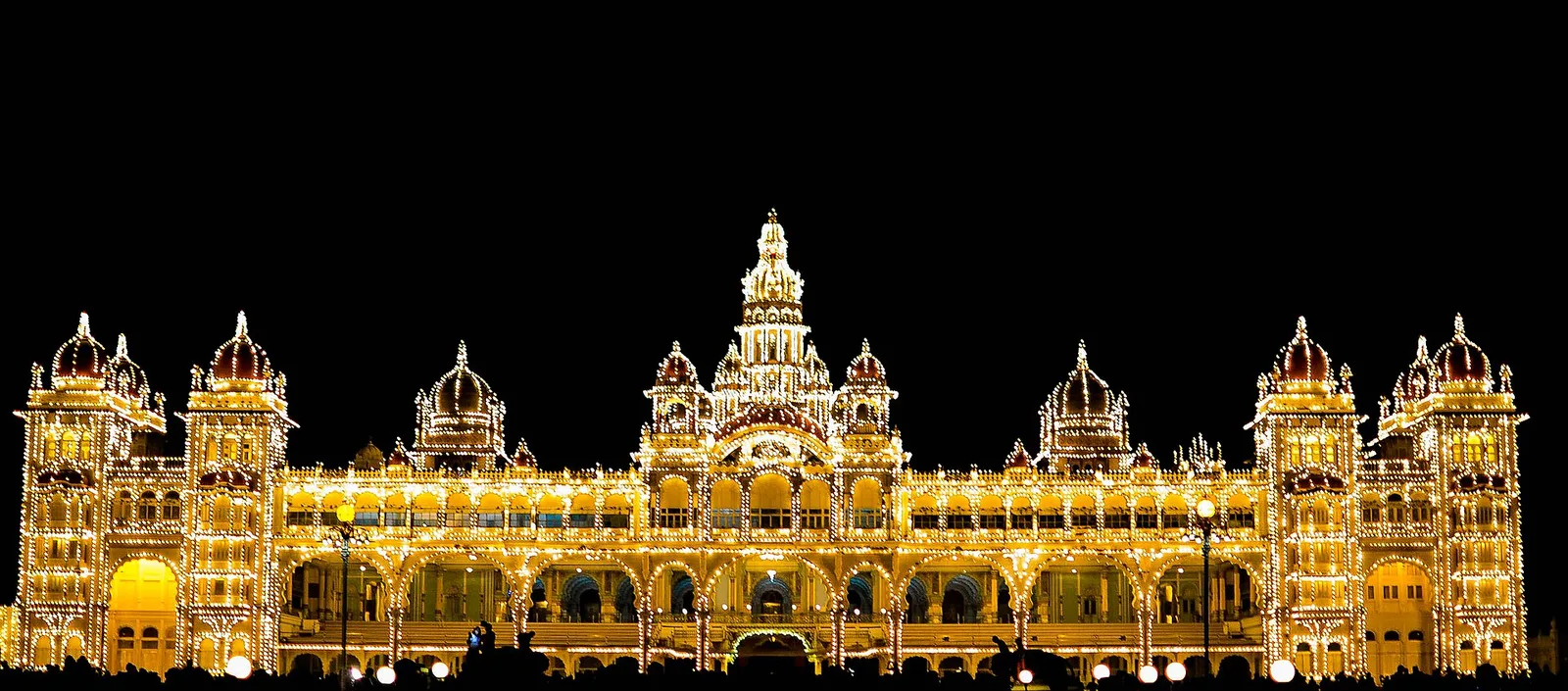
Mysuru turns on a small set of official facts: what the palace charges Indians, foreigners and children, the one evening a week it blazes with light, the day the zoo shuts, and what darshan on Chamundi Hills costs — nothing. Every figure here comes from the Palace Board, the zoo's own tariff or official temple listings.
Mysore Palace is open every day, 10:00 AM–5:30 PM; entry is ₹150 for Indian adults, ₹1,000 for foreign adults and ₹70 for children above 10 and below 18, through the Varaha and Amba Vilas gates on the south side. The palace is illuminated on Sundays and public holidays, 7:00–8:00 PM; on other evenings the sound-and-light show runs instead (₹100/₹40 in Kannada, ₹120/₹50 in English). Mysuru Zoo is open 8:30 AM–5:30 PM but closed every Tuesday; entry ₹120 adult, ₹60 child (5–12), under-5s free, with a zoo-and-Karanji-Lake combo at ₹150/₹80. On Chamundi Hills, general darshan at the Chamundeshwari Temple is free, in three daily sessions, with optional paid entry tickets currently listed at ₹30 and ₹100.
SECTION 01The Palace by Day: Tickets, Gates and Hours
The Amba Vilas Palace — Mysore Palace — is the reason the city is on the map, and the Palace Board's official timings page runs it like a timetable. The palace is open to visitors every day from 10:00 AM to 5:30 PM, with entrance tickets issued across the same hours; there is no weekly closure to plan around, which makes the palace the flexible piece in a Mysuru itinerary. Public entry is through the Varaha and Amba Vilas gates on the south side of the complex.
The Board's published ticket table has three lines, and they are worth knowing before you reach the counter. Indian adults pay ₹150. Foreign adults pay ₹1,000. Children above 10 years and below 18 years pay ₹70. The Board's table publishes no rate for children under 10, and this guide prints the table as it stands rather than assuming the missing line — if you are travelling with younger children, the counter works from the same published table. Inside, the route takes you through the durbar halls, carved doors, stained glass and painted ceilings at a self-guided pace; allow a clear two hours. Go early if you can: by midday the south gates carry the full weight of Karnataka's day-trip traffic, and the halls are better seen at ten than at noon.
One more thing the day ticket settles: the palace sells its evenings separately. Daytime entry ends at 5:30 PM; the illumination and the sound-and-light show in the next section are evening events with their own arrangements and, for the show, their own tickets. The classic Mysuru pattern is the palace by day, then a return to the grounds after dark on the right evening of the week.
SECTION 02After Dark: The Illumination and the Sound-and-Light Show
Two different evening spectacles share the palace grounds, and the Board's published schedule keeps them on different nights. The illumination — the palace outlined in thousands of bulbs — happens on Sundays and public holidays, from 7:00 PM to 8:00 PM. It is the image of Mysuru the world knows, and it costs you nothing but the effort of being there: the Board lists it as the evening's viewing on those nights, a one-hour window in which the façade is switched on. Arrive before seven; the grounds fill with families treating it as the week's outing, because for the city, it is.
On the evenings that are not Sundays or public holidays, the palace runs its sound-and-light show instead — a 45-minute telling of the palace's and the Wadiyar dynasty's story, staged against the façade. The Board publishes it in two languages on a fixed weekly pattern, with separate prices: in Kannada, Monday to Wednesday at 7:00–8:00 PM and on Saturday at 8:15–9:15 PM, at ₹100 for adults and ₹40 for children; in English, Thursday to Saturday at 7:00–8:00 PM, at ₹120 for adults and ₹50 for children. Show tickets are sold only at the Varaha Gate counter, from 6:30 PM on the day — there is no advance channel the Board lists, so the evening's plan starts at that counter. Two of the Board's fine-print points are worth carrying: a short illumination of about fifteen minutes follows the show, so a show night still ends with the palace lit; and if a show is stopped midway — the Board names power failure and rain — the entry fee is not refundable.
The planning consequence is simple and worth underlining. A Sunday in Mysuru gives you the illumination but no sound-and-light show; a weekday gives you the show but no full illumination. If your trip spans both, you can have each. If you have one evening only, choose by taste: the illumination is the spectacle, the show is the story.
SECTION 03Mysuru Zoo: A Full Morning, Priced Plainly
Sri Chamarajendra Zoological Gardens — Mysuru Zoo — is one of India's oldest and best-kept zoos, and it publishes the most complete tariff in this guide. First, the trap: the zoo is closed every Tuesday. On every other day it opens 8:30 AM to 5:30 PM, and the morning is the visit to make — the animals are active, the avenues are shaded, and the crowds are still arriving as you finish.
The zoo's official tariff, as published on its own visitor page: entry is ₹120 for adults and ₹60 for children aged 5 to 12, and children below 5 enter free. The zoo also runs Karanji Lake, the bird-filled lake next door, and sells the pair together: a combined zoo and Karanji Lake ticket costs ₹150 for adults and ₹80 for children, against ₹60 and ₹30 for the lake alone — so the combo is the right buy if the lake's aviary and butterfly park are on your list, as they should be with children. Cameras are charged separately and plainly: ₹100 for a still camera, ₹200 for a video camera, and luggage can be left for ₹15.
The zoo is big enough that its battery-operated vehicles are a real consideration, especially with older travellers or small children. The published rates are ₹240 for adults, ₹180 for children aged 5 to 12 and ₹180 for senior citizens, with a whole seven-seater bookable online at ₹2,400. Parking: ₹40 for a two-wheeler, ₹70 for a car, jeep or auto, ₹175 for a bus, GST included. School groups get concessions on the zoo's stated conditions — a letter on school letterhead, uniform and ID — from free for the youngest classes up to ₹40–₹50 per student, though the zoo itself flags that student concessions stop during Dasara. What the current official tariff does not list is any separate safari product — older write-ups describe one, but the zoo's own price list today is the table above.
SECTION 04Chamundi Hills: The City's Own Temple
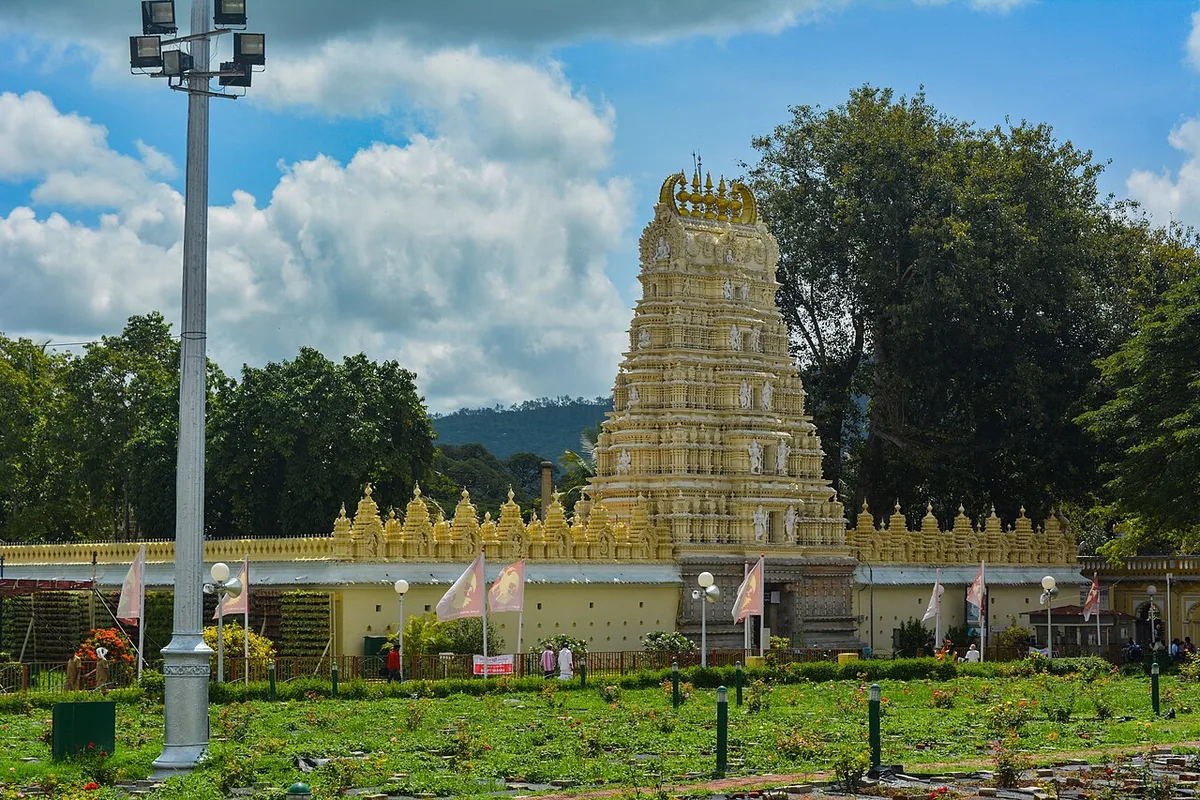
Every Mysuru itinerary should climb the hill. The district's official page puts Chamundi Hills at 3,489 feet, about 13 km from the city, and its temple — dedicated to Chamundeshwari, the presiding deity of Mysuru and the titular goddess of the royal family — is less a tourist sight than the city's own shrine, busy with local devotees from dawn. The road winds up to a hilltop of flower stalls and coconut sellers, the great Mahishasura statue at the square and the temple's golden gopuram at its heart; the traditional approach, for the fit and the devout, is the long flight of steps up the hillside.
Darshan runs in sessions, and this is the one place in this guide where the figures carry a caution. The temple's published pattern, as carried in the Karnataka temple listings, is three sessions a day: 7:30 AM to 2:00 PM, 3:30 PM to 6:00 PM, and 7:30 PM to 9:00 PM — the temple closes between sessions, so a mid-afternoon arrival can mean a wait on the hill. General darshan is free. The temple also offers paid ways to shorten the queue: a special entry ticket currently listed at ₹30 and a VIP entry at ₹100. Those two prices are printed with a flag rather than as settled fact: they are the figures the temple's booking listings currently carry, the temple authority's own website could not be read directly when this guide was checked, and the hilltop counter is the final word. The temple's free dasoha — its meal service for devotees — is likewise listed in three windows across the day (morning, midday and evening), a genuinely useful thing to know if you time the climb for lunch, and another detail to confirm on the day. None of this undermines the essential fact, which is not in doubt: you can have darshan of Chamundeshwari without paying anything at all.
SECTION 05Brindavan Gardens: The Evening Excursion
The standard Mysuru evening out of town is Brindavan Gardens, the terraced gardens below the Krishnaraja Sagar dam where it holds back the Cauvery, across the district line in Mandya. It is an excursion, not a stroll — an hour or so on the road each way in evening traffic — and its whole point comes after dark, when the fountains are lit and the musical fountain plays its evening performance to a seated crowd. It pairs with nothing else in this guide except a free evening: palace by day, gardens by night.
On price, this guide follows its rule. Brindavan Gardens is ticketed at the gate — but the current entry fee could not be read from an official Karnataka page when this guide was researched: the Horticulture Department's page for the gardens would not load, and the figures carried by unofficial listings disagree with each other too widely to print responsibly. So no entry figure is quoted for Brindavan Gardens here. Expect a modest gate fee, carry cash, and treat any precise number a blog gives you with the same suspicion this guide has. The gardens' own mechanism is simple — one gate ticket, the fountain in the evening — and the official position can be confirmed through Karnataka Tourism before you set out.
SECTION 06Putting It Together — and the Dasara Question
Mysuru's week has two fixed points and one closure, and the itinerary falls out of them. The zoo is shut on Tuesdays. The palace illuminates on Sundays and public holidays. The sound-and-light show rests on exactly those nights. So: give the zoo a morning that is not a Tuesday — ideally the same day as Chamundi Hills, since the hill and the zoo sit on the same side of the city and the temple's first session ends in good time. Give the palace a late morning, and decide the evening by the calendar: Sunday means the illumination at seven; a weekday means the show, tickets at the Varaha Gate counter from 6:30 PM. Brindavan Gardens takes the remaining evening.
And then there is Dasara. Mysuru's state festival transforms the city for ten days — the palace at the centre of processions, ceremonies and crowds on a scale that rewrites every queue in this guide, though not the published ticket tables themselves. The zoo's own tariff carries the one official footnote this guide relies on: its student concessions stop during Dasara. Treat that as the flavour of the season — everything is fuller, slower and more splendid — and book nothing in Dasara week on the assumption of a normal day. Outside the festival, Mysuru is the easiest of palace cities: three headline sights, every price published by the people who charge it, and a goddess on the hill who charges nothing at all.
FAQFrequently Asked Questions
How much is Mysore Palace entry, and when is it open?
The Palace Board's published table is ₹150 for Indian adults, ₹1,000 for foreign adults and ₹70 for children above 10 and below 18 years; the Board publishes no rate for children under 10. The palace is open every day from 10:00 AM to 5:30 PM, with tickets issued across those hours, and public entry is through the Varaha and Amba Vilas gates on the south side.
When is Mysore Palace illuminated, and what does the sound-and-light show cost?
The illumination is on Sundays and public holidays, 7:00–8:00 PM. On other evenings the 45-minute sound-and-light show runs instead: in Kannada Monday to Wednesday (7:00–8:00 PM) and Saturday (8:15–9:15 PM) at ₹100 adults / ₹40 children, and in English Thursday to Saturday (7:00–8:00 PM) at ₹120 / ₹50. Show tickets are sold only at the Varaha Gate counter from 6:30 PM, and the fee is not refunded if a show is stopped midway.
What are Mysuru Zoo's ticket prices, and which day is it closed?
The zoo is closed every Tuesday; on other days it opens 8:30 AM–5:30 PM. Entry is ₹120 for adults, ₹60 for children aged 5–12 and free below 5. A combined zoo and Karanji Lake ticket is ₹150 / ₹80 (the lake alone is ₹60 / ₹30). A still camera costs ₹100 and a video camera ₹200; battery-operated vehicles are ₹240 for adults and ₹180 for children and senior citizens. All figures are from the zoo's own published tariff.
Is darshan at the Chamundeshwari Temple free?
Yes — general darshan is free. The temple's published pattern is three sessions a day (7:30 AM–2:00 PM, 3:30–6:00 PM and 7:30–9:00 PM), and paid special entry and VIP tickets are currently listed at ₹30 and ₹100 for those who want a shorter queue. Those two paid figures are flagged in this guide as currently listed rather than read directly from the temple authority's website, which could not be loaded when checked; the free darshan itself is not in question.
Why is there no entry price for Brindavan Gardens in this guide?
Because no official figure could be verified. The gardens are ticketed at the gate, but the Karnataka Horticulture Department's page for them would not load when this guide was checked (31 October 2026), and unofficial listings disagree widely on the current fee. Rather than print a number that might be wrong, this guide prints none — expect a modest gate fee, carry cash, and confirm through Karnataka Tourism if the exact figure matters to your plans.
Official references and checking status
Every changeable fact in this guide was checked on 31 October 2026 against the official sources listed below, and the accompanying sources file records which page supports which claim. Two limits are flagged where they occur in the text: the Chamundeshwari Temple's paid-entry prices and session times are carried in the Karnataka temple listings but the temple authority's own website could not be read directly, so they are described as currently listed; and no official Brindavan Gardens fee could be read at all, so none is printed. The Palace Board's ticket table publishes no rate for children under 10, and this guide reports the table as published rather than filling the gap. Confirm current prices and timings on the official sites before you travel.
- Mysore Palace Board (official) — palace visiting hours, entrance ticket table, illumination and sound-and-light schedule and prices
- Mysuru Zoo — Sri Chamarajendra Zoological Gardens (official) — opening days and hours, entry, combo, camera, vehicle and parking tariff
- Mysuru District Administration (official) — Chamundi Hills: the temple, its setting and visiting information
- Sri Chamundeshwari Temple — Sri Chamundeshwari Development Authority (official temple site; could not be read directly when checked — darshan and paid-entry figures above are as currently carried in the Karnataka temple listings, and flagged as such)
Photos: Mysore Palace in full illumination against the night sky, by Komalvermarjn, via Wikimedia Commons, licensed under CC BY-SA 4.0; the golden gopuram of the Chamundeshwari Temple on Chamundi Hills, by Arun Mohan, via Wikimedia Commons, licensed under CC BY-SA 4.0. Photographers keep their copyright; the licences require this credit.
General information only. This guide is based on official sources publicly available and checked on the date shown on this page. Visa rules change, and consular and USCIS officers decide every case on its own facts — nothing here is a confirmation or a guarantee for your individual case, and this is not legal advice. Always confirm the current requirement on the official page linked in this guide before you act, and consider a qualified immigration attorney for your specific situation.