
Researched & checked — 30 Oct 2026
Meghalaya in December: What to See and How to Plan a 4–5 Day Trip
NEW Published 30 October 2026
Shillong as base, Sohra's waterfalls in their dry-season mood, the living root bridges with the effort stated plainly, Dawki's Umngot at its clearest, and Mawlynnong — with a 4–5 day itinerary and packing checklist.
Give the trip 4–5 days. Fly into Guwahati and drive about 100 km (roughly 3 hours) up to Shillong. Sleep in Shillong and in Sohra: a day for Shillong, a day for Sohra's waterfalls and caves, a full day for the Nongriat trek if your knees are up to roughly 3,500 steps down and back up, and a day for Mawlynnong and Dawki together, in the Umngot's winter crystal-clear window. Expect thinner waterfalls, cold nights and early darkness.
SECTION 01What December Changes: the Dry-Season Trade-Off
Sohra (Cherrapunji) is famed as one of the wettest places on Earth. Incredible India's Cherrapunji guide describes how, in the monsoon, its waterfalls become thunderous cascades — while winter, November to February, brings a relatively dry spell and cooler weather suited to trekking and sightseeing. December sits in that dry spell:
- Waterfalls run thinner. Sohra's falls are rain-fed, so December shows them at lower flow; smaller falls may be a trickle. The big drops are still worth it (Section 03) — expect elegance, not thunder.
- The river runs clearest. What the falls lose, the Umngot gains: Meghalaya Tourism's itineraries single out winter (November–February) for crystal-clear water at Dawki. December is peak clarity season.
- Trekking is at its easiest. Meghalaya Tourism gives October to March, the dry season, as the Nongriat trek's best time — dry steps, not monsoon-slick ones.
- It is cold, and dark comes early. December days are the year's shortest. Start early, finish early, bring real winter layers.
SECTION 02Getting There, and Using Shillong as Your Base
Most travellers enter through Assam. Meghalaya Tourism's how-to-reach page names Guwahati Airport (Lokpriya Gopinath Bordoloi International Airport) as the main gateway — about 100 km, roughly 3 hours by road from Shillong — with Guwahati Railway Station as the nearest major railhead and taxis, shared cabs and buses onward. Shillong's own Umroi airport is about 35 km from the centre but has limited flights. The highway climbs into the hills, with Umiam Lake a natural first stop. Entry points observe standard protocols, so carry government-issued ID on your person; you will be glad of it again near the Dawki border.
Shillong, the capital, earns its place as base: the widest choice of stays and food, with every leg radiating from it — Sohra around 50 km away, Dawki roughly 80–85 km, Mawlynnong about 76 km, on Meghalaya Tourism's figures. But do not sleep there every night: these are slow roads, and a night or two in Sohra transforms the root bridge day (Section 04). Use the city properly too — Ward's Lake, the Don Bosco Museum, Shillong Peak, Elephant Falls and Police Bazaar fill an arrival day well.
SECTION 03Sohra (Cherrapunji) in December: Waterfalls, Honestly
The honest part first: the falls that fill monsoon photo feeds ease off in the dry season. Arrive expecting July's thunder and you will be disappointed; arrive expecting falls you can see in full, not through monsoon mist, and December delivers.
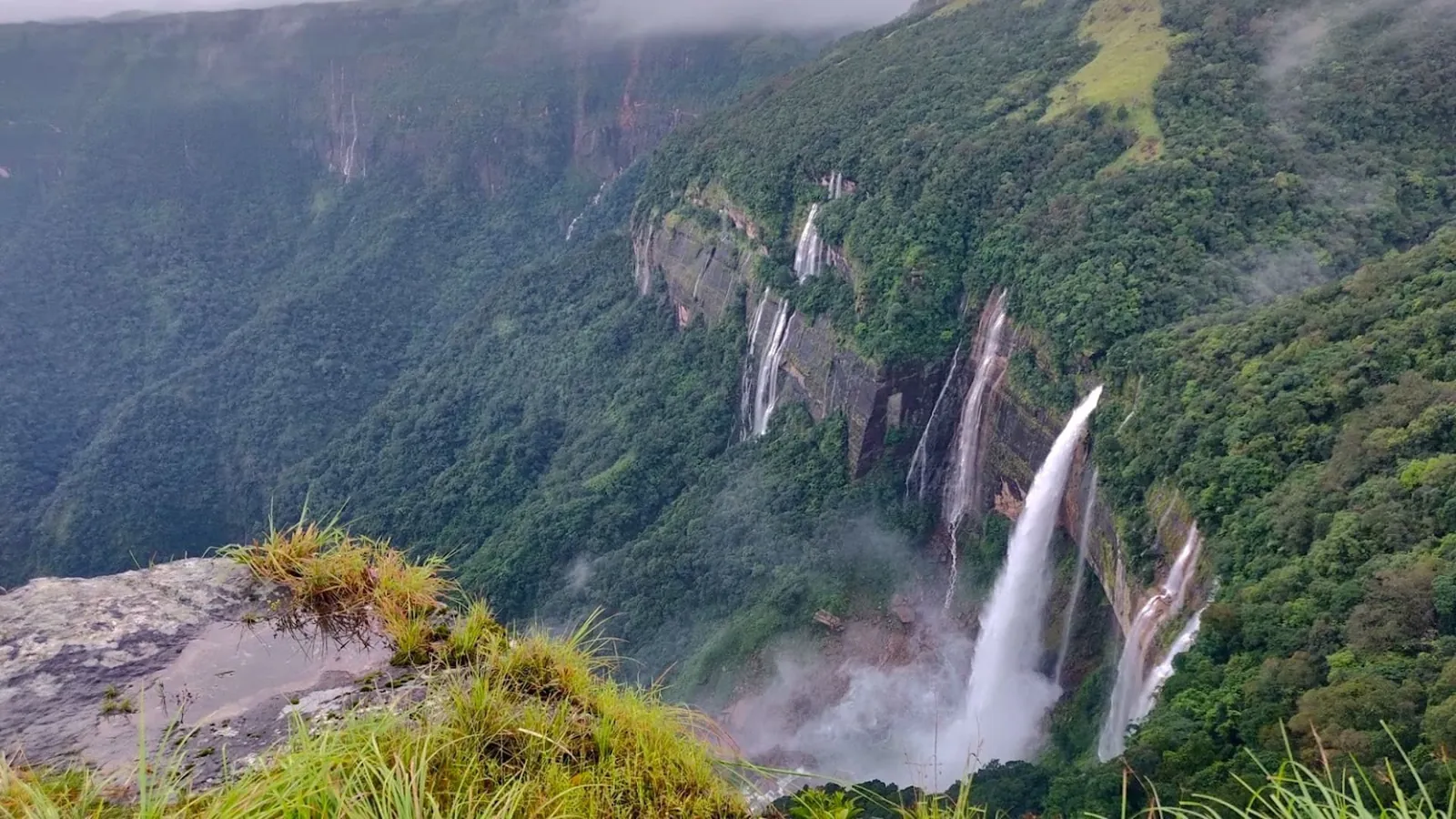
Nohkalikai Falls clears the December bar easily. Meghalaya Tourism describes it as one of the tallest falls of its kind in the country, at about 1,115 feet (roughly 340 metres) — a single plunge off the plateau into a green pool. Height does not depend on flow as width does: even at reduced volume, the drop and the gorge view make it Sohra's one unmissable sight. Incredible India likewise ranks it among India's tallest plunge waterfalls.
Seven Sisters Falls (Nohsngithiang) is the counterpoint: Incredible India describes its water descending in seven segments, echoing the seven states of Northeast India — a sight built for monsoon volume, which in December can thin to strands. See it, but let Nohkalikai carry the day. Fill the rest with sights December flatters: the limestone caves (Mawsmai and Arwah — stalactites, stalagmites, fossils) are underground, so the dry season costs them nothing.
SECTION 04The Living Root Bridges: Worth It, and Hard — Both Are True
The living root bridges are grown, not built: generations of Khasi villagers have guided the aerial roots of rubber fig trees (Ficus elastica) across streams until they thickened into spans that keep strengthening with time. Nongriat's double-decker bridge — two levels of roots over the same stream — is the famous one.
Now the effort, plainly. Meghalaya Tourism describes a descent of approximately 3,500 stone steps from Tyrna village, about 3 km each way; Nongriat is about 15 km from Sohra, Tyrna a 30–45 minute taxi ride. Down is the easy half: every step must be climbed back up, with no vehicle or shortcut out. Treat it as a full day — start early, carry water, plan nothing ambitious that evening. December is the kindest month for it: October to March is the official best window.
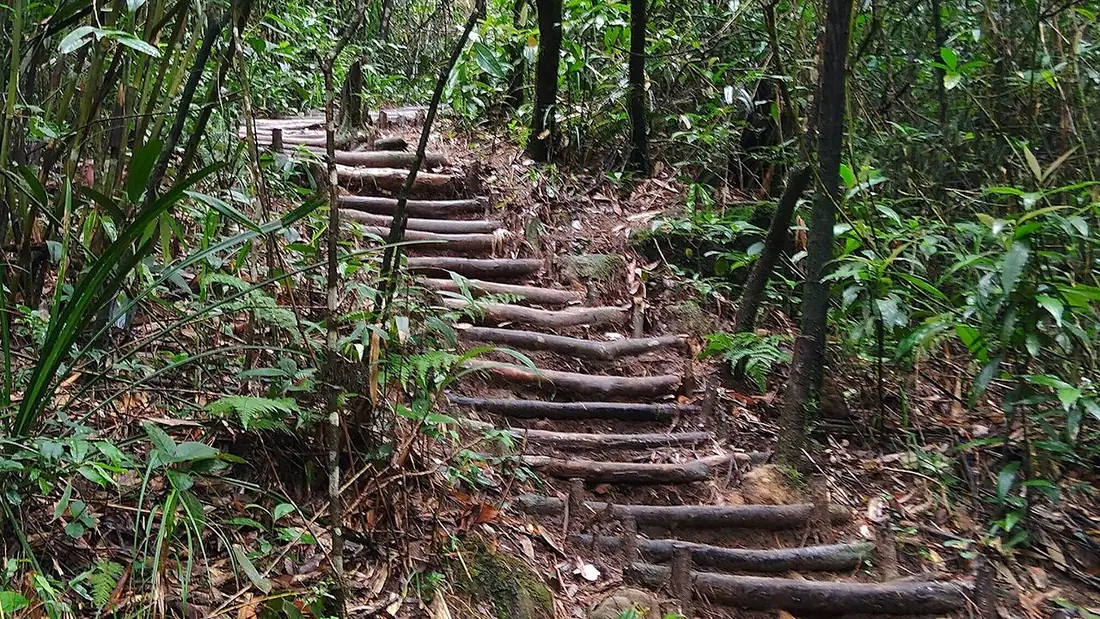
If the trek is honestly beyond your knees or schedule, take the alternative: the Nohwet Living Root Bridge near Mawlynnong, a single-decker span woven the same way, reached by a short walk (Section 06). You lose Nongriat's scale; you keep the wonder. Choose by the climb back up, not the walk down — everyone enjoys the walk down.
SECTION 05Dawki and the Umngot River: December's Payoff
If Sohra asks you to accept less in December, Dawki gives you more. The Umngot flows between Dawki and Shnongpdeng, carving the valley that splits the Khasi and Jaintia Hills before running into the Bangladesh plains. Meghalaya Tourism describes visibility of up to 30 feet in its crystal-clear water — often called the cleanest river in India — and on a calm day a boat on it appears to float on air.
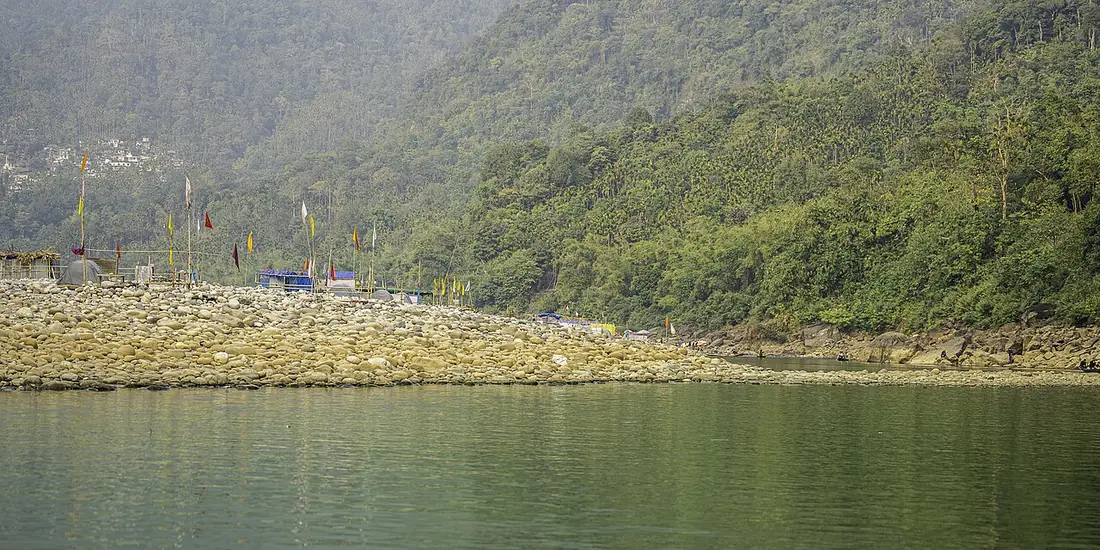
That effect is seasonal, and December is its season: Meghalaya Tourism's itinerary guidance gives winter (November–February) for crystal-clear water at Dawki, within a broader October–May pleasant window. This is the one sight where December travellers get the postcard version — though clarity is a natural condition, not a scheduled one, so keep the boat ride flexible. Dawki is roughly 82 km from Shillong (about 3 hours), near the India–Bangladesh border, under its suspension bridge; listed visiting hours are 6:00 AM to 6:00 PM, so arrive by mid-morning for unhurried time on the water before the early dusk.
SECTION 06Mawlynnong: the Village That Sweeps Itself
Mawlynnong, about 76 km from Shillong in the East Khasi Hills, carries a rare title: Meghalaya Tourism records that Discover India named it the cleanest village in Asia in 2003; it is fondly called "God's Own Garden." The appeal is the whole texture — swept lanes, gardens and orchards, and a community that treats cleanliness as a shared habit, not a performance.
Give it two unhurried hours: the Nohwet Living Root Bridge nearby, the Sky Viewpoint — a bamboo tower overlooking the Bangladesh plains — and the century-old Church of the Epiphany are the listed highlights, and post-monsoon and winter are noted as the seasons allowing more outdoor activity. One point of etiquette matters above all: you are a guest in a living village whose fame rests on how its residents keep it. Use the bins, keep to the paths, leave it as you found it.
SECTION 07A 4–5 Day Meghalaya December Itinerary
This shape follows the circuit's geography and respects the short days. It assumes early starts — in December, start at 7 AM and you see Meghalaya; start at 10 and you see its roads.
- Day 1 — Arrive in Shillong. Guwahati to Shillong (about 100 km, roughly 3 hours) via Umiam Lake; Ward's Lake and Police Bazaar in the remaining light. Early night.
- Day 2 — Shillong to Sohra. Roughly 50 km via Mawkdok Dympep Valley. Nohkalikai first, Seven Sisters with expectations set, then a cave. Sleep in Sohra.
- Day 3 — The root bridge day. Taxi 30–45 minutes to Tyrna; trek to Nongriat's double-decker bridge, allowing the whole day for descent, bridge and climb back. Sleep in Sohra. Skipping the trek? Slow this day down in Sohra, or pull Day 4 forward and rest in Shillong.
- Day 4 — Mawlynnong and Dawki. The village, its root bridge and Sky Viewpoint in the morning; Dawki for an afternoon boat ride at peak clarity. Sleep in Shillong, or near Dawki/Shnongpdeng for a second river chance.
- Day 5 — Buffer and departure. Whatever you missed — Don Bosco Museum, Shillong Peak, Elephant Falls — then back to Guwahati. On a 4-day trip, fold this into Day 1; the buffer absorbs a slow road or foggy morning.
SECTION 08What to Pack for Meghalaya in December: a Checklist
December packing fails one way only: people pack for the photographs — sunny, green, mild — not for a hill winter. Check this list before you close your bag.
- A real warm layer — a padded or fleece-lined jacket, not just a hoodie, for cold evenings and mornings.
- Layers underneath — a warm base layer, plus a mid-layer to shed at midday, when plateau sun can feel mild between cold bookends.
- Warm accessories — woollen cap, gloves, warm socks: near-weightless, and the difference between enjoying a dawn viewpoint and enduring it.
- Sturdy, broken-in shoes with grip — the trek is thousands of stone steps; December keeps them dry, but stone they remain.
- A compact rain layer — dry season is not a no-rain guarantee in one of the wettest places on Earth; a shell also cuts wind.
- A daypack and refillable water bottle — for trek and Dawki days, away from your vehicle for hours.
- A torch or headlamp — darkness comes early; useful for village lanes and any drive running late.
- Government photo ID on your person — per official entry-point guidance, and essential around the Dawki border area.
- Cash in small notes — card acceptance thins beyond Shillong; confirm amounts locally rather than trusting printed figures.
- Personal medication and motion-sickness basics — hours of winding roads, and pharmacies are a Shillong amenity, not a roadside one.
SECTION 09Practical December Notes: Roads, Darkness and Honest Expectations
Everything moves by road. After Guwahati, every leg is a hill road, and times stretch beyond what the kilometres suggest. Base yourself in a few places rather than a new bed nightly, agree each day's plan with your driver the evening before, and treat any schedule promising Shillong, Sohra, Dawki and Mawlynnong in one day as a warning sign.
Plan around the light. Dawki's listed 6:00 AM–6:00 PM window is generous next to the useful light, and the Nongriat trek should never start late — the climb out should not race the dusk. Put the furthest sight first; let evenings belong to cafés and an early bed.
Prices, timings and local rules change. This guide prints no entry fees, boat fares or taxi rates: no stable official listing for them could be checked for this draft, and figures copied from older travel writing are how travellers get caught out. Confirm current prices and timings before you go — with your hotel, your driver, or Meghalaya Tourism's official pages below.
FAQFrequently Asked Questions
Is December a good time to visit Meghalaya?
Yes — one of the best windows. Official guidance puts Cherrapunji's best period in winter (November–February), the root bridge trek's best season at October to March, and the Umngot clearest in winter. Trade-offs: thinner waterfalls, cold nights, short days.
Are the waterfalls worth seeing in December, or are they dry?
Worth seeing, honestly framed. The falls are rain-fed and run lower — Seven Sisters can thin to strands — but Nohkalikai's roughly 340-metre plunge is a major sight at any flow. If full-force falls are your single priority, that is a monsoon trip, with monsoon roads.
How hard is the living root bridge trek, really?
Hard in one specific way: about 3,500 stone steps down from Tyrna to Nongriat (roughly 3 km each way), and every step back up, with no alternative exit — a full-day effort for reasonably fit walkers. Unsure? Take the gentler Nohwet bridge near Mawlynnong.
When is the Umngot River at Dawki clearest?
In winter: Meghalaya Tourism gives November–February as the crystal-clear window, within a broader October–May pleasant season. Clarity still depends on the day, so keep the boat ride flexible.
Official references and checking status
The factual claims in this guide — distances, routes, visiting windows, seasonal characterisations and site descriptions — were checked against the official pages below on 30 October 2026 (see the accompanying sources file for the claim-by-claim record). Three honest limits: an official December climate-normals table for Shillong could not be retrieved from the India Meteorological Department in this pass, so December cold is described qualitatively and no temperature figures are printed; no entry fees, boat fares or taxi rates are printed, because no stable official listing for them could be checked — prices and timings change, so confirm them before you go; and permit rules for different categories of visitors are not stated, because they could not be confirmed on an official source in this pass — check the official pages below for your situation before travelling.
- Meghalaya Tourism — Travel by Air, Rail & Road
- Meghalaya Tourism — Nongriat
- Meghalaya Tourism — Living Root Bridges
- Meghalaya Tourism — Mawlynnong
- Meghalaya Tourism — Dawki-Shnongpdeng-Darang
- Meghalaya Tourism — Umngot
- Meghalaya Tourism — 3-Day Itinerary: Relaxing Tour Across Meghalaya
- Incredible India (Ministry of Tourism) — Places to Visit in Cherrapunji
- India Meteorological Department — Meteorological Centre Shillong
Photos in this guide: Nohkalikai Falls by Photos Worldwide / Wikimedia Commons (CC0); the forest trail near Sohra by Shreekanth Ramasamy / Wikimedia Commons (CC0); the Umngot at Dawki — Photo: Joydeep Chakraborty / Wikimedia Commons / CC BY-SA 4.0. All resized for this page.
General information only. This guide is based on official sources publicly available and checked on the date shown on this page. Visa rules change, and consular and USCIS officers decide every case on its own facts — nothing here is a confirmation or a guarantee for your individual case, and this is not legal advice. Always confirm the current requirement on the official page linked in this guide before you act, and consider a qualified immigration attorney for your specific situation.