
Researched & checked — 3 Nov 2026
Visakhapatnam and Araku: The Coast, the Valley Train and Borra Caves, Planned on Official Facts
NEW Published 3 November 2026
Visakhapatnam pairs a working naval coast — a decommissioned submarine beached as a museum, a hilltop park above the bay, a lion-man temple 16 km inland — with one great excursion: the slow train climb through the Eastern Ghats to Araku Valley and the Borra Caves. Each fact here comes from the district administrations, the authority that built the hill park, and the Airports Authority.
Base yourself on the coast for two days and give the hills one full day. On the beach road, the decommissioned submarine INS Kursura sits on the sands of RK Beach as a museum — a joint project of the Naval Ship Design and Research Centre and the Eastern Naval Command, and, in the district administration's words, the first of its kind in Asia. Above the city, Kailasagiri is a hilltop park of some 350 acres with a giant Shiva–Parvati statue, a flower clock and what the development authority calls the first ropeway in Andhra Pradesh. Sixteen kilometres inland, Simhachalam temple's deity stays covered in sandal paste all year; the paste comes off each May at Chandanayatra. The valley day runs 115 km by rail to Araku (600–900 m), through dozens of tunnels, taking in the Borra Caves — among the deepest in India, estimated at over 150 million years old — the Tribal Museum and the valley's coffee.
SECTION 01RK Beach and Beach Road: The City's Front Room
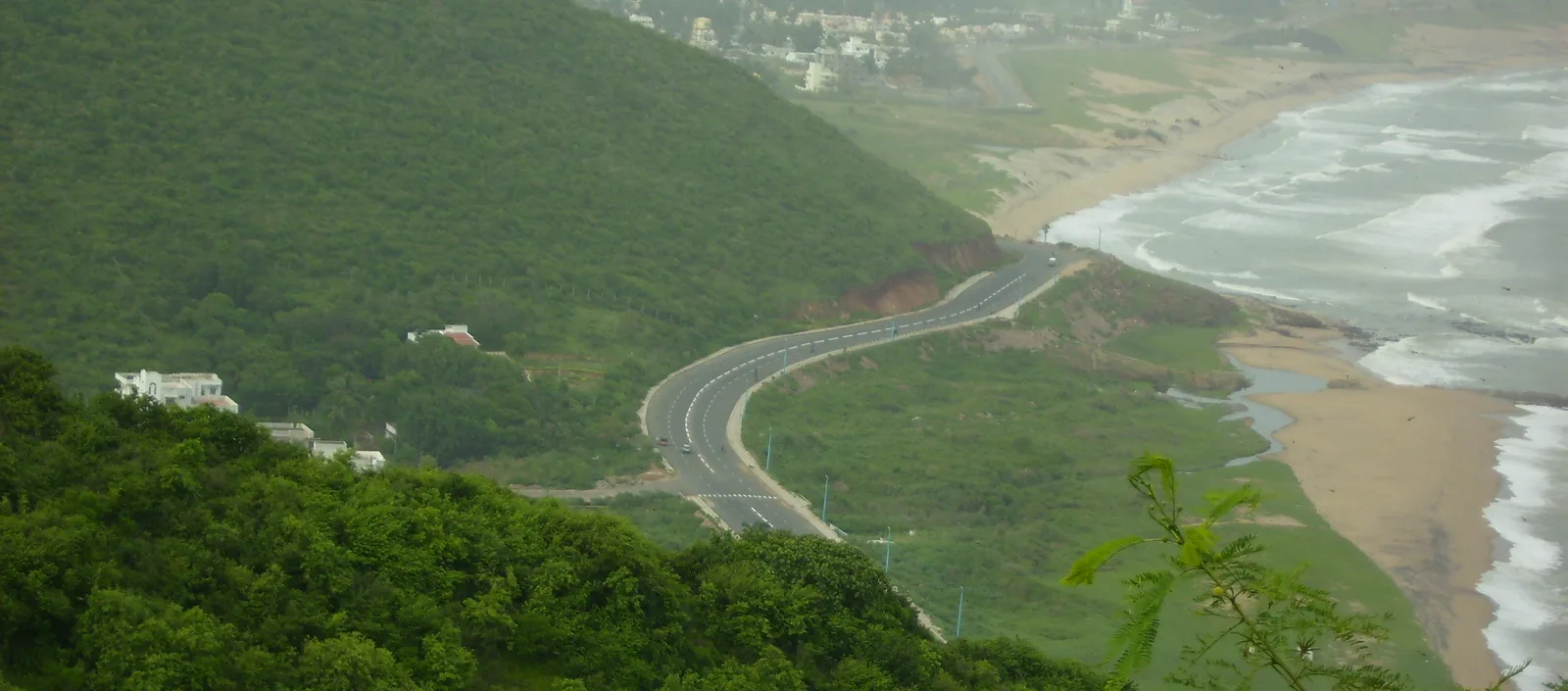
Visakhapatnam — Vizag — takes its name, the district administration records, from Vaisakha, another name of the god Kartikeya, and is built along the shore of the Bay of Bengal, its waterfront broken by the rocky headland of Dolphin's Nose. Three hills frame the old city — Ross Hill with its Roman Catholic church, Dargakonda with a mosque and a saint's tomb, and Sri Venkateswara Konda, whose temple a Captain Blackmoor built in 1886 — and the city is the seat of Andhra University. But the part a visitor lives in is the beach road, and its anchor is Ramakrishna Beach — RK Beach.
Beach Road is a museum strip as much as a promenade. The district's account of Ramakrishna Mission Beach notes the imposing Kali Temple nearby — built in 1984 by the Bhavatarani Charitable Trust — and an aquarium on the same stretch. The Victory at Sea war memorial, built in 1996 by the Eastern Naval Command, commemorates the victory of 1971. The Visakha Museum opened in 1991, and the TU 142 Aircraft Museum, further along the road, preserves an actual naval aircraft (Section 02 covers the road's two machine museums). Treat the beach road as a half-day walked slowly, memorial to museum, not a photo stop.
For sand and water, the district points 8 km along the coast to Rushikonda Beach: a clean, golden beach where its account lists swimming and wind surfing, with Andhra Pradesh Tourism's twelve cottages overlooking it. Two older excursions round out the coast: about 15 km away, Thotlakonda rises 128 m over the shore with Buddhist remains — a Maha stupa and viharas — while nearby Bavikonda preserves 26 Buddhist structures and antiquities of the 3rd century BC to 2nd century AD, Roman coins among them; and at 34 km, Bheemunipatnam keeps a 17th-century Dutch fort and factory. Together they make an unhurried second morning.
SECTION 02A Submarine on the Sand: Kursura and the TU 142
The strangest sight on Beach Road is a full-size submarine resting on the beach itself. The district administration's tourism page describes it plainly: the decommissioned submarine Kursura stands on the sands of RK Beach, developed into a museum — a joint project of the Naval Ship Design and Research Centre (NSDRC) and the Eastern Naval Command, at an estimated cost of about ₹2.55 crore — and, in the district administration's assessment, the first project of its kind in Asia and the second in the world. Its separate museum page adds the mechanics: the Soviet-built boat was decommissioned in 2001, hauled to the beach with all its weaponry and fittings in place, and set permanently on a concrete foundation on Beach Road. VMRDA likewise lists the Kursura Submarine Museum among the tourism projects it has promoted in the city.
That completeness is the point: not a model or a cutaway but the vessel itself, fittings retained, walked through at beach level. The museum page fixes its position for planning — 18 km from the airport, 5 km from the railway station. A short walk along the same road, the TU 142 Aircraft Museum applies the same idea to the air: an actual Indian Navy TU-142 aircraft, converted into a museum. No entry fee or opening hours are printed for either museum: no figure could be read on an official page when checked, and unofficial listings disagree. Both are ticketed on the spot; carry cash and read the board at the gate.
SECTION 03Kailasagiri: The Hilltop Above the Bay
Every Vizag itinerary looks down from the same hill. The district administration describes Kailasagiri as a picturesque hill overlooking the sea, developed into a lush green park of some 350 acres with a panoramic view of the sea. Its landmarks are unmissable: a giant statue of Shiva and Parvati, illuminated, and the Sanku Chakra Namalu of Lord Venkateswara; a flower clock; and a viewpoint named for the Titanic. A ropeway has been erected from the foothill, so the summit can be reached without the climb.
The authority that built it adds two claims of its own. VMRDA — successor to VUDA, the urban development authority — calls Kailasagiri its prestigious tourism project, records that the Government of Andhra Pradesh awarded it Best Tourist Spot, and states that the first ropeway in Andhra Pradesh was launched and opened to the public at Kailasagiri hill. Plan Kailasagiri for late afternoon, when the light drops and the beach road below lights up. No ropeway or entry price is printed here — VMRDA publishes no visitor tariff that could be read for this guide — so treat prices as gate information, not plan information.
SECTION 04Simhachalam: The Temple Under Sandal Paste
Sixteen kilometres from Visakhapatnam, reached by rail and road, stands the temple the district administration calls the most famous, richest and best sculptured shrine of the region: Simhachalam, temple of Varaha Lakshminarasimha, the man-lion incarnation of Vishnu, on a hill 244 m above sea level. Its recorded fabric rewards a slow visit: an inscription dated AD 1098–99, of the Chola king Kulottunga-1; the Kappa stambam, a pillar believed to have curative powers; a stone chariot with stone wheels; and a Natya mandapam carried on 96 pillars of black stone.
The temple's defining custom is unique in this guide's India series. The deity's image, the district records, is always kept covered with sandal paste — what the devotee sees through the year is the smooth, rounded form the paste makes. Once a year, at the Chandanayatra festival in May, the paste is ceremonially removed and the original form is shown. The temple's main festivals structure its calendar: Kalyanam in March–April, Chandana Yatra and Visakha Poornima in May. If dates allow one festival-season choice in this region, May at Simhachalam is the considered one — expect the crowd a once-a-year unveiling draws.
One honesty note. The temple is run by its own devasthanam, whose published material could not be read at passage level when this guide was checked; so no darshan hours and no ticket prices are printed here, though unofficial listings quote both freely. Temple days are structured by ritual, with breaks between sessions — confirm the current schedule on the devasthanam's own channels before you set out, and treat Simhachalam as what it is before it is a sight: a major working temple.
SECTION 05The Valley Day: The Train Climb and the Borra Caves
The excursion that justifies the whole trip leaves the coast behind. Araku Valley lies 115 km from Visakhapatnam, on top of the Eastern Ghats, and the Alluri Sitharamaraju district's tourism page sets the terms: a railway station at Araku on the D.B.K. line, the line passing through dozens of tunnels from Ananthagiri onwards. The district prints no tunnel count, and this guide prints none either — the figures on blogs vary and none could be read on an official page. What the official text supports is the journey's shape: a slow, winding climb from the coastal plain into forested hills, tunnel after tunnel, as the train gains the plateau. Indian Railways' own launch release for the route's glass-roofed Vistadome coach put the rail route at 128 km and named the Ananthagiri ghat section, Borra Caves and the tunnels among its sights. Book the train as the day's first event, not as transport: the climb is the attraction, and the valley is its destination.
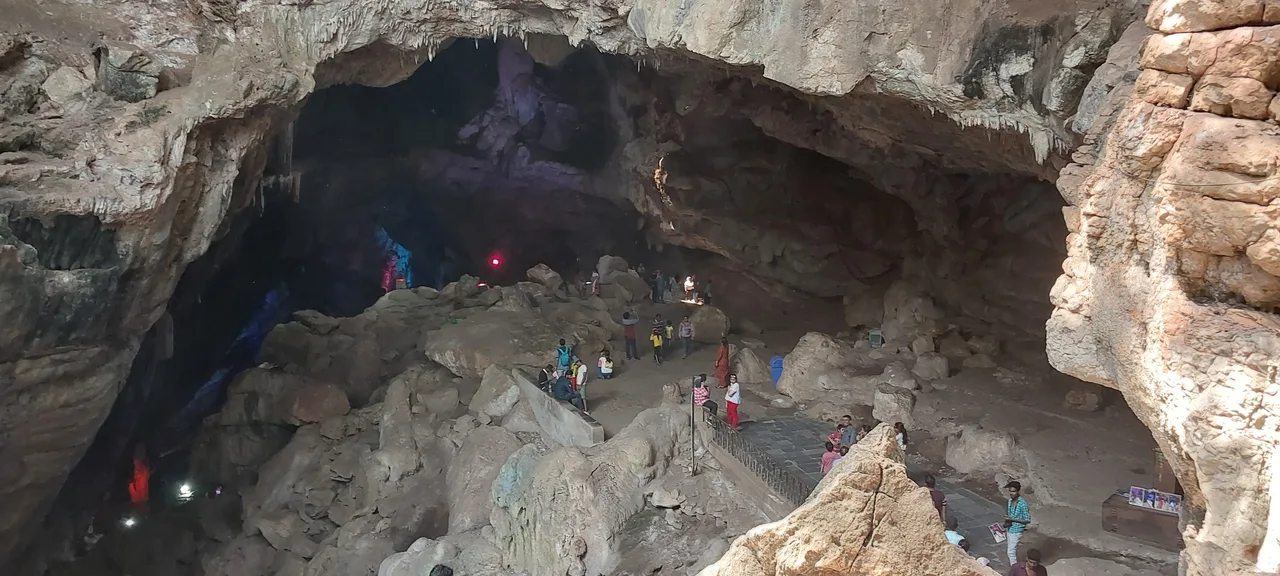
Most valley days break the journey at Borra Caves, in the Ananthagiri hills. The district's description is the measured one this guide follows: the caves are among the deepest in India, estimated to be over 150 million years old, and filled with stalactite and stalagmite formations in which locals read familiar shapes — Shiva and Parvati, the human brain, a crocodile. Deep inside stands a naturally formed Shivling, held sacred, above all at Shivaratri. The state tourism corporation, APTDC, has installed multi-coloured LED lighting inside. Practical honesty again: no entry fee for Borra Caves is printed in this guide. APTDC publishes no fee that could be read on its own pages when checked, and unofficial listings quote figures that conflict several times over. The caves are ticketed at the entrance; carry cash, and treat any price quoted online as unverified.
SECTION 06Araku Itself: Tribal Museum, Coffee and the Dhimsa
The valley the train delivers you to is compact: the district gives Araku an area of about 36 sq km at an altitude of 600 to 900 m above sea level — high enough to feel the temperature change off the coast — inhabited by the region's aboriginal tribes, with the Ananthagiri hills around it famous for coffee plantations; it also lists a government orchard, a silk farm, a demonstration farm of about 20 hectares, and a waterfall at Ranajilleda. Two museums organise the visit. The Tribal Museum displays the valley communities' material culture — traditional tools, hunting equipment, kitchen utensils and ornaments — with life-sized mud huts and clay figures, a section on the Dhimsa dance, and handicrafts in wrought iron, bamboo and textiles on sale; a habitat museum likewise reveals the valley's tribal culture, and the horticulture nursery-cum-training centre at Padmapuram is the district's other listed stop.
Coffee is the valley's second subject. The Coffee Museum traces the drink's journey from Ethiopia to Araku Valley, keeps a coffee lab and roasting on site, and retails the valley's own produce — organic Araku coffee powder and coffee chocolates. If you stay over a weekend, the district notes that the Dhimsa dance is organised on Saturday and Sunday nights for tourists: the dance of the Porja, Bagata, Valmiki and Khond tribes, whose own great occasion is the Chaitra hunting festival in April. On the train itself, one upgrade is officially documented: Indian Railways' 2017 launch release announced a Vistadome coach on the Visakhapatnam–Kirandul passenger train — large glass windows, an observation lounge, a glass-domed ceiling and seats that rotate for sightseeing — the first of its kind on Indian Railways, in the release's words. Which services carry it changes over time; check when you book, and book the valley train well ahead in season either way.
One neighbour deserves an honestly flagged sentence. Lambasingi, a village on this same hill corridor, is named in Indian Railways' Vistadome release among the sights along the route, and its winter mornings — cold enough, by wide press reporting, for frost — draw seasonal crowds. No official tourism text read for this guide describes Lambasingi or promises its cold, so it is presented as a press-famous add-on, not a documented sight: go for the drive, and treat any frost as luck.
SECTION 07The Plan: Two Days of Coast, One of Valley, and Getting There
The shape that fits the official geography: Day one, the beach road walked end to end — RK Beach, the Kali Temple and aquarium stretch, the Victory at Sea memorial, the Kursura submarine and the TU 142 — finishing on Kailasagiri for the evening view. Day two, Simhachalam in the morning, then the slower coast: Rushikonda's beach and, if the Buddhist circuit interests you, Thotlakonda and Bavikonda. Day three, the valley day entire: the morning train up through the tunnels, Borra Caves, then Araku's Tribal Museum, Coffee Museum and Padmapuram, returning by train or road — and if you can stay a weekend night, the Dhimsa performance is the argument for it.
Getting there is straightforward on the official record. By air, Visakhapatnam's airport runs domestic and international terminals; the Airports Authority of India's passenger pages list car rental at the arrival hall, cab pick-up points, round-the-clock parking, and an Andhra Pradesh Tourism information and reservation counter inside the terminal at the arrival area. RK Beach is 18 km from the airport, on the district's figure. By rail, Visakhapatnam station is 5 km from RK Beach — and is itself your departure point for the Araku line. Seasons, at the strength the sources allow: the coast is a year-round city, the valley at 600–900 m runs cooler than the shore, and the calendar is anchored by the festivals named above — Chandanayatra in May above all. No official source promises any particular weather; pack for the altitude, check the train's running status before a monsoon journey on a ghat line, and let the festivals, not the forecasts, fix your dates.
FAQFrequently Asked Questions
How much does it cost to enter the Borra Caves?
This guide prints no figure, deliberately. APTDC — the state tourism corporation that lit the caves — publishes no entry fee that could be read on its own pages when this guide was checked (3 November 2026), and unofficial listings conflict with each other several times over, for adults, children and cameras alike. The caves are among the deepest in India, estimated at over 150 million years old, with a naturally formed Shivling deep inside. They are ticketed at the entrance: carry cash, read the board on arrival, and treat any online price as unverified.
What are Simhachalam temple's darshan timings and ticket prices?
They are not printed here, because they could not be verified: the temple's own devasthanam publishes its schedules, but its material could not be read at passage level when this guide was checked, and this series prints temple timings only from the temple's own text. What the district administration establishes: Simhachalam, 16 km from Visakhapatnam, is the temple of Varaha Lakshminarasimha; the deity's image is kept covered with sandal paste, removed ceremonially each May at Chandanayatra; and its main festivals are Kalyanam (March–April), Chandana Yatra and Visakha Poornima (May). Confirm the current schedule on the devasthanam's own channels before you go.
How many tunnels does the Vizag–Araku train pass through?
No official count is printed here. The Alluri Sitharamaraju district administration — the official source for the valley — says the railway passes through "dozens of tunnels" from Ananthagiri onwards, and this guide stays at that strength. The precise counts quoted everywhere online (58 tunnels is the commonest) appear in no official text that could be read for this guide, and secondary sources disagree with each other. What is documented: Araku is 115 km from Visakhapatnam by the district's account, the line climbs to a valley at 600–900 m, and Indian Railways' Vistadome release described a 128-km route taking in the Ananthagiri ghat section, Borra Caves and the tunnels. The journey, not the count, is the point.
Can Araku be done as a day trip from Vizag, or should I stay overnight?
Both work. Araku is 115 km from Visakhapatnam, compact at about 36 sq km, and its listed sights — Borra Caves on the way, the Tribal Museum, the Coffee Museum, Padmapuram's horticulture centre — fit a long day built around the train. The case for staying is the evening: the district records that the Dhimsa dance is organised on Saturday and Sunday nights for tourists, which a day trip cannot catch, and the valley is at its best in the cool of the morning. If your days are few, take the day trip; if one is a weekend, consider the overnight.
Is Kailasagiri's ropeway really the first in Andhra Pradesh, and what does it cost?
The first part is the development authority's own claim: VMRDA states that the first ropeway in Andhra Pradesh was launched and opened to the public at Kailasagiri hill, and that the Government of Andhra Pradesh awarded Kailasagiri its Best Tourist Spot. The district describes the park — some 350 acres, a giant illuminated Shiva–Parvati statue, the Sanku Chakra Namalu, a flower clock and the ropeway from the foothill. The cost is not printed: VMRDA publishes no visitor tariff that could be read for this guide, so ropeway and entry prices are gate information — check them on arrival.
Official references and checking status
Checked on 3 November 2026 against the official sources listed below; the accompanying sources file maps each claim to its page. Four limits are flagged honestly. First, APTDC publishes no Borra Caves entry fee that could be read on its own pages, and unofficial listings conflict several times over, so no fee is printed; the same applies to the Kursura and TU 142 museums' prices and hours. Second, Simhachalam's darshan hours and ticket prices are not printed — the devasthanam's own site could not be read at passage level, and this series takes temple schedules only from the temple itself. Third, no tunnel or bridge count is printed for the Vizag–Araku line: the district says "dozens of tunnels", and the precise counts in circulation appear in no official text read for this guide; train numbers, times and fares are likewise omitted, as Indian Railways publishes no readable table for the route. Fourth, Kailasagiri's area is printed at the district's 350 acres; VMRDA's own forestry page gives 380, and the variance is recorded in the sources file. Confirm current prices and timings on the official sites before you travel.
- Visakhapatnam District Administration (official) — Tourism: RK Beach, Kailasagiri, the submarine museum, Simhachalam, Rushikonda and the Buddhist sites
- Visakhapatnam District Administration (official) — Sub Marine Museum: the Kursura's decommissioning, haul-out and distances
- Alluri Sitharamaraju District Administration (official) — Tourism: Araku Valley, Borra Caves, the Tribal and Coffee Museums, Padmapuram and the Dhimsa
- VMRDA (official) — Organisation profile: Kailasagiri's Best Tourist Spot award and the first ropeway in Andhra Pradesh
- Airports Authority of India (official) — Visakhapatnam Airport passenger information: terminals, the AP Tourism counter, car rental and parking
Photos: The Beach Road winding along the Vizag coast below the green Kailasagiri hills, by Sureshiras, via Wikimedia Commons, licensed under CC BY-SA 3.0; inside the Borra Caves, by Pinakpani, via Wikimedia Commons, licensed under CC BY 4.0. Photographers keep their copyright; the licences require this credit.
General information only. This guide is based on official sources publicly available and checked on the date shown on this page. Visa rules change, and consular and USCIS officers decide every case on its own facts — nothing here is a confirmation or a guarantee for your individual case, and this is not legal advice. Always confirm the current requirement on the official page linked in this guide before you act, and consider a qualified immigration attorney for your specific situation.