
Researched & checked — 30 Oct 2026
Delhi in 2 Days: Old Delhi, New Delhi and the Monuments, With the Real Costs Shown
NEW Published 30 October 2026
A plannable two-day Delhi itinerary — the Red Fort and Old Delhi's lanes on day one, the Qutub Minar, Lotus Temple, Humayun's Tomb and Akshardham on day two — with the entry fees, closed days and metro fares that decide what fits.
Do this: Day 1 — Red Fort first thing, walk Chandni Chowk to the Jama Masjid, rest, then India Gate and Kartavya Path in the evening. Day 2 — Qutub Minar in the morning, Lotus Temple, Humayun's Tomb in the late afternoon, Akshardham for the exhibitions and the after-sunset water show. Delhi's three great ASI monuments — the Red Fort, Humayun's Tomb and the Qutub Minar — are currently listed at ₹35 for Indian visitors and ₹550 for foreign visitors booked online (₹50 / ₹600 in cash at the gate), and children below 15 enter ASI monuments free. Get around by metro: fares were revised on 25 August 2025 and now run from ₹11 to ₹64 by distance. One warning: the Red Fort, the Lotus Temple and Akshardham all close on Mondays — if one of your days is a Monday, use the swap in Section 01.
SECTION 01How These Two Days Fit Together — and the Monday Trap
Delhi's sights punish criss-crossing. The Red Fort and Old Delhi sit in the north, the Qutub Minar far to the south, Humayun's Tomb in the centre-south and Akshardham across the Yamuna in the east. Each day below keeps its stops in one broad arc and uses the metro for the long legs, so your time goes on the monuments, not the road.
Now the trap. Three of this plan's headline stops close on the same weekday: the Red Fort on Mondays, the Lotus Temple on Mondays (its official visit page gives Tuesday to Sunday, 8:30 am to 5:00 pm), and Akshardham on Mondays too (official timings: Tuesday to Sunday, first entry 10:00 am). If one of your days falls on a Monday, do not waste it — the Qutub Minar, Humayun's Tomb and India Gate are open on Mondays. Run day two's route on the Monday (minus the Lotus Temple) and give the Red Fort and Akshardham the other day. Each section below flags its stop's Monday status.
A word on prices. Delhi's big monuments are maintained by the Archaeological Survey of India (ASI), which charges two tiers — a low Indian rate and a higher foreign rate — and discounts online bookings over cash at the gate. The figures below are the ASI's currently listed prices, checked on 30 October 2026; the references section explains how each was checked and which to reconfirm before you travel.
SECTION 02Day 1, Morning: The Red Fort and Old Delhi
Start inside the Red Fort
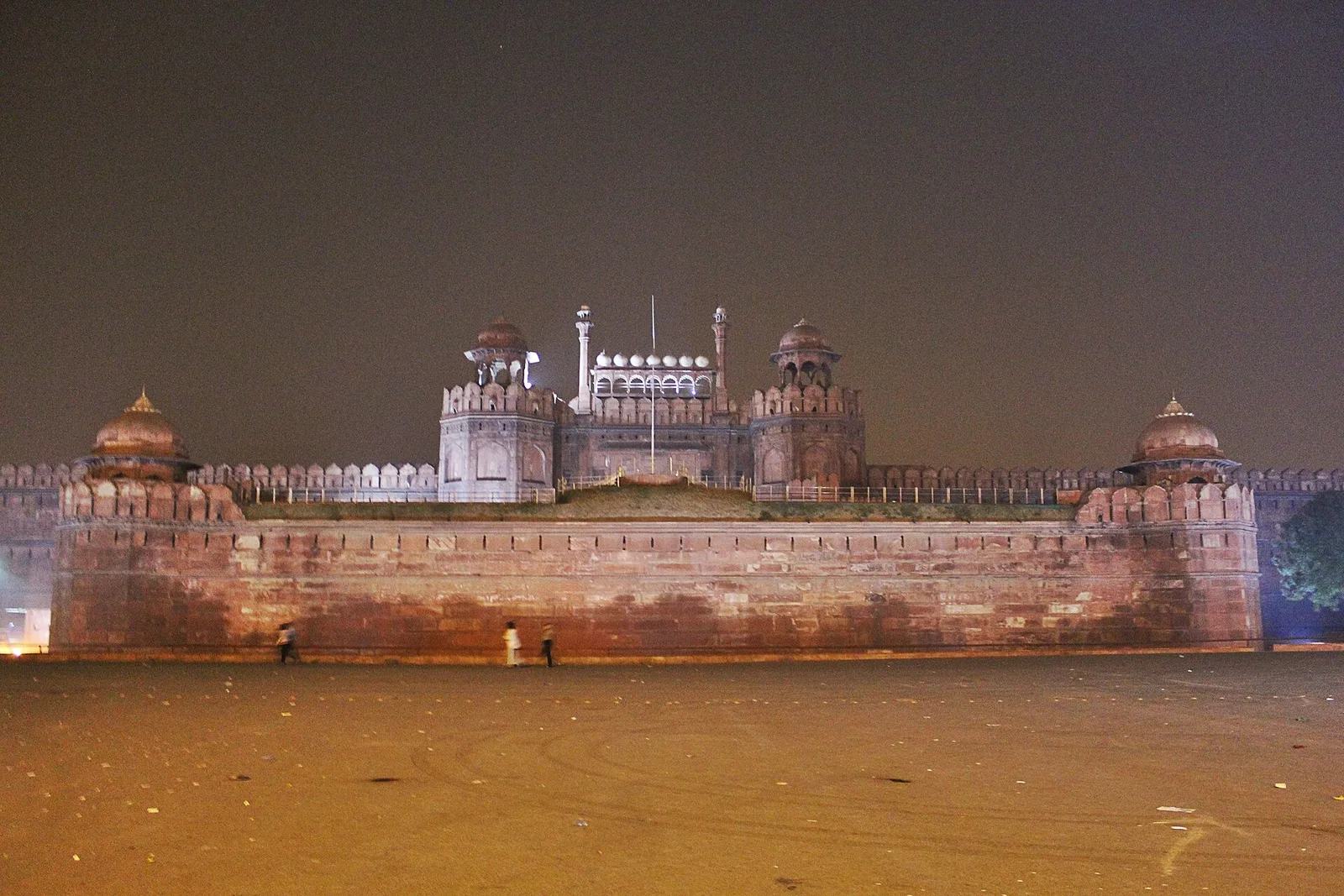
Begin at the Red Fort (Lal Qila), Shah Jahan's palace-fortress of red sandstone and the anchor of Old Delhi. Enter through the Lahori Gate, pass the Chhatta Chowk bazaar, and take the fort at walking pace: the Diwan-i-Aam where the emperor held public audience, the Diwan-i-Khas pavilions, the royal baths and the Moti Masjid. Allow two to two and a half hours; the complex is large, and midday heat is the real deadline.
The practical facts, as currently listed: the fort is closed on Mondays, with listed visiting hours of 9:30 am to 4:30 pm. Entry is currently listed at ₹35 for Indian visitors and ₹550 for foreign visitors booked online through the ASI portal, or ₹50 / ₹600 in cash at the gate — booking ahead also skips the ticket queue. Visitors from SAARC and BIMSTEC countries are listed at the Indian rate. Children below 15 enter free — the ASI's own rule, stated in its official FAQ: only persons above fifteen pay an entrance fee at its protected monuments. The nearest metro stations are Lal Qila (Violet Line) and Chandni Chowk (Yellow Line). In the evening the fort hosts a sound-and-light show on a separate ticket; this guide does not print its price, because the show operator's own pages currently disagree about it — check before you book.
Walk Chandni Chowk to the Jama Masjid
From the fort, Old Delhi is best done on foot and by appetite. Chandni Chowk's main street runs west from the fort into a braid of specialist lanes — Dariba Kalan for silver, Kinari Bazaar for wedding finery, Khari Baoli for spices. A cycle-rickshaw threads the narrowest lanes best; agree the fare before you climb in.
Above the old city rises the Jama Masjid, Shah Jahan's great courtyard mosque, reached by a broad flight of steps. Visitors are welcome outside prayer times; dress modestly, deposit your shoes at the gate, and expect the courtyard at its busiest around Friday midday prayers, when sightseeing effectively pauses. There is a separate charge to climb the minaret for the view over Old Delhi — collected at the gate, changed over the years, and not printed here; carry small notes and confirm at the steps. Give it 45 minutes, then lunch in one of the old eateries around its gates.
SECTION 03Day 1, Evening: India Gate and Kartavya Path
End the day in the open. India Gate, the war memorial arch at the eastern end of Kartavya Path, stands in lawns that the government's own inauguration release for the redeveloped avenue describes as public space — lawns with walkways opened in September 2022, with the statue of Netaji Subhas Chandra Bose under the canopy behind the arch. There is no ticket and no gate: you simply walk in, as Delhi does every evening. The National War Memorial sits in the same complex, a short walk away.
Come at dusk. The arch is floodlit after dark, the lawns fill with families, and the view west along Kartavya Path towards Raisina Hill is the defining New Delhi photograph. The nearest metro stations are Central Secretariat and Khan Market, each a short auto ride away. If energy remains, Connaught Place, close by, is the natural dinner stop.
SECTION 04Day 2: The Qutub Minar, the Lotus Temple and Humayun's Tomb
Qutub Minar, first thing
Start day two in Mehrauli, in the far south, at the Qutub Minar — the 72.5-metre tapering tower of red sandstone begun at the end of the twelfth century, among the Quwwat-ul-Islam mosque ruins and the famous rust-resistant Iron Pillar. The complex is open every day; listed hours are 7:00 am to 5:00 pm, and early arrivals get soft light and quiet grounds. Entry follows the same ASI pattern: currently listed at ₹35 Indian / ₹550 foreign online and ₹50 / ₹600 cash, SAARC and BIMSTEC visitors at the Indian rate, children below 15 free. The tower itself cannot be climbed — it has been closed to visitors for decades — so the visit is the complex, the inscriptions and the pillar, about ninety minutes. Qutub Minar metro station, on the Yellow Line, is the nearest; autos wait outside for the short ride to the gate.
The Lotus Temple, for the quiet
Next, the opposite of everything so far: the Lotus Temple in Kalkaji, the Bahá'í House of Worship shaped as a half-open lotus of white marble petals. Its official visit page gives the hours plainly — Tuesday to Sunday, 8:30 am to 5:00 pm, closed on Mondays — and the nearest metro stations, Kalkaji Mandir (Violet and Magenta lines) and Okhla NSIC (Magenta line), each about a five-minute walk away. There is no entry fee and no ticket; it is a house of prayer open to people of every faith and none. Inside, the rule is silence: no rituals, no sermons, just a soaring hall, with short prayer services through the day (10 am, 12 pm, 3 pm and 5 pm). Shoes are deposited at the shoe room before you enter the hall, and photography is permitted in the grounds but not inside the prayer hall. Forty-five unhurried minutes is right.
Humayun's Tomb, in the late light
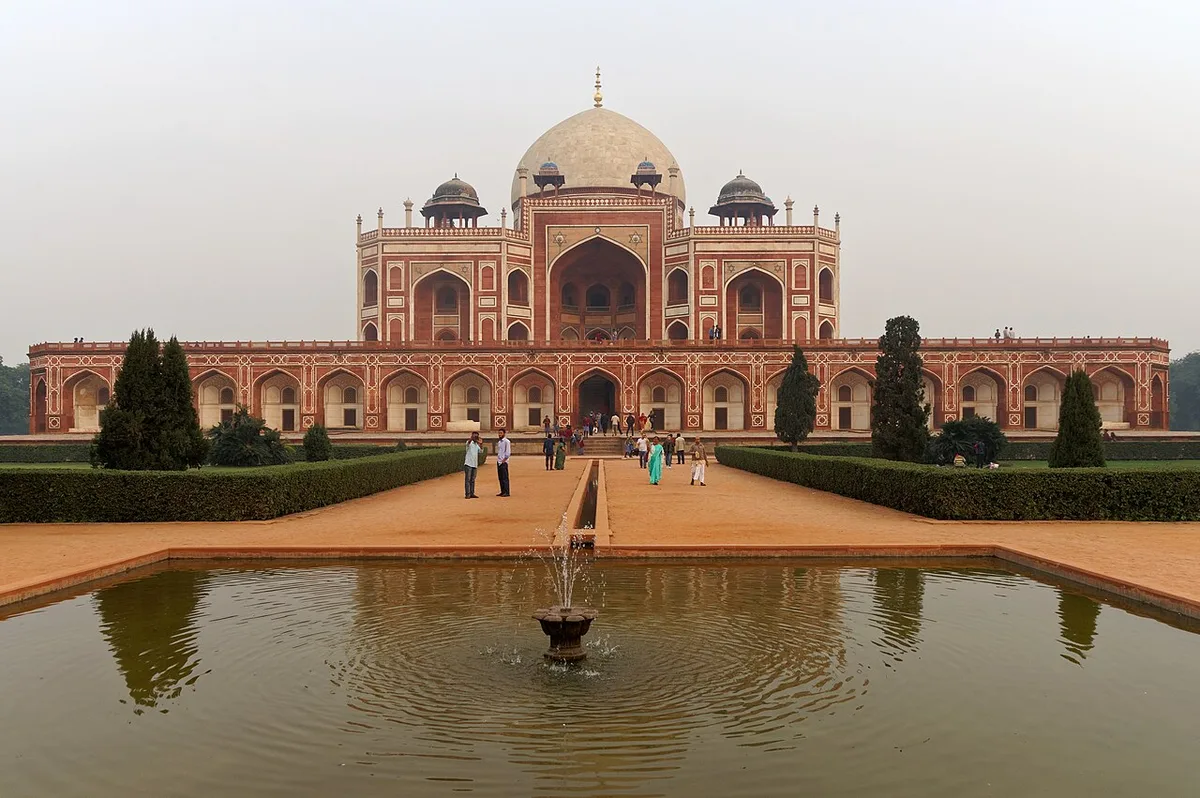
Save the day's best building for its best hour. Humayun's Tomb, in Nizamuddin, is the great garden-tomb of the emperor Humayun — the first of the dynasty's monumental tombs, set in a charbagh of lawns, water channels and fountains, and the direct ancestor of the Taj Mahal. It is open every day; listed hours run from early morning to 6:00 pm, and the last hour of light on the red sandstone and white marble is when to be here. Entry is the same ASI listing: ₹35 / ₹550 online, ₹50 / ₹600 cash, children below 15 free. Allow ninety minutes, and let the garden set the pace.
SECTION 05Day 2, Evening: Akshardham
Cross the Yamuna for the evening. Swaminarayan Akshardham, on NH-24 in east Delhi, is a modern carved-stone mandir complex — and an unusually well-organised visit. Its official visitor information is the clearest of any sight here: open Tuesday to Sunday, first entry 10:00 am and last entry 6:30 pm, closed every Monday, with Akshardham metro station on the Blue Line about 350 metres' walk away. Darshan at the mandir continues to 8:00 pm.
The money is simple and, at the gate, free: Akshardham states plainly that entry to the mandir complex and mandir darshan is absolutely free and needs no appointment. What you pay for, if you choose them, are the ticketed attractions inside. The exhibitions — three halls, sold as one ticket with no separate tickets for individual halls — are officially priced at ₹260 for adults (age 12+), ₹210 for seniors (age 60+) and ₹160 for children aged 4–11, with children below 4 free; the ticket window runs 11:00 am to 6:00 pm. The water show, staged after sunset (currently listed at 7:30 pm), costs ₹110 for adults and seniors and ₹80 for children aged 4–11. Plan an evening visit as: arrive by about 4:30 pm, do the exhibitions, take darshan, and finish with the water show in the dark. Two practical notes from the same page: there is a dress code (shoulders covered, lower wear below the knees; sarongs are sold at ₹100), and security is strict — leave large bags at your hotel and use the free cloakroom for anything prohibited.
SECTION 06Getting Around: The Metro, and What Two Days Cost
The metro is this itinerary's engine. Delhi Metro fares are distance-based and were revised with effect from 25 August 2025 — the first revision in eight years. On normal days the slabs now run ₹11 for up to 2 km, ₹21 for 2–5 km, ₹32 for 5–12 km, ₹43 for 12–21 km, ₹54 for 21–32 km and ₹64 beyond 32 km; on Sundays and national holidays a cheaper table applies, capped at ₹54. A smart card takes 10% off every journey, with a further 10% off in off-peak hours (before 8 am, between noon and 5 pm, and after 9 pm). DMRC also sells tourist cards giving unlimited travel — listed at ₹200 for one day and ₹500 for three days, each including a ₹50 refundable security deposit, sold at stations other than on the Airport Express Line. Check your exact fare in DMRC's journey planner before you travel.
The Airport Express Line is priced separately, station by station. DMRC's revision announcement confirms its fares rose by ₹1 to ₹5 in August 2025, but its station-to-station table could not be read for this guide, so no airport fare is printed here — the journey planner gives the exact figure in seconds.
Add the two days up and Delhi is kind to a budget. On the listed online prices, the three ASI monuments together cost an Indian visitor ₹105 (₹150 in cash) and a foreign visitor ₹1,650 (₹1,800 in cash). India Gate and the Lotus Temple cost nothing; Akshardham entry and darshan are free, with the exhibitions (₹260) and water show (₹110) the only optional paid extras there. Food and rickshaws will outweigh tickets for almost everyone — which is why the real costs were worth pinning down in advance.
FAQFrequently Asked Questions
What should I do if one of my two days in Delhi is a Monday?
Swap the days' contents, not the trip. The Red Fort, the Lotus Temple and Akshardham all close on Mondays. The Qutub Minar, Humayun's Tomb and India Gate are open on Mondays, so run the Qutub–Humayun's–India Gate combination on the Monday and give the Red Fort, Old Delhi and Akshardham the other day. You lose only the Lotus Temple, which needs a Tuesday-to-Sunday slot.
How much do Delhi's main monuments cost in entry fees?
Each costs ₹35 for Indian visitors and ₹550 for foreign visitors online (₹50 / ₹600 in cash) — ₹105 or ₹1,650 for all three. Children below 15 enter ASI monuments free. India Gate and the Lotus Temple are free, and Akshardham entry is free — its exhibitions (₹260 per adult) and water show (₹110) are the optional extras. Confirm the ASI figures on the ASI booking portal before you go.
Is the Delhi Metro the best way to cover this itinerary?
Yes, for the long legs. Every stop has a metro station within a short walk or auto ride: Lal Qila or Chandni Chowk for the Red Fort, Qutub Minar for the tower, Kalkaji Mandir for the Lotus Temple, and Akshardham station about 350 metres from the Akshardham gates. Fares run ₹11–₹64 by distance since the August 2025 revision; autos and rickshaws cover Old Delhi's lanes.
Can I visit the Taj Mahal from Delhi on this trip?
Yes — Agra is the classic extension, often done as a long day trip by express train or the Yamuna Expressway. Do not squeeze it into these two days, though: give it its own day, and plan around the Taj Mahal's Friday closure. Our companion Agra guide covers its fees, Friday closure and sunrise entry.
When is the best time of day for each sight?
Red Fort and Qutub Minar early, before crowds and heat; Chandni Chowk mid-morning; the Lotus Temple whenever you need quiet; Humayun's Tomb in the last hour of light; India Gate at dusk, floodlit; Akshardham late afternoon into the evening, ending with the water show. The plan above is already in that order.
Official references and checking status
The changeable facts in this guide were checked on 30 October 2026 against the official sources listed below; the accompanying sources file records which source supports which claim. The honest limits, stated plainly: the ASI publishes its Delhi monument prices through its booking portal, which could not be rendered in full in this pass — the ₹35 / ₹550 online and ₹50 / ₹600 gate figures are given exactly as the ASI's current listings are published, and you should reconfirm them on the portal when you book; DMRC's fare slabs are stated from DMRC's own revision announcement of 25 August 2025, with the Airport Express station table deliberately not printed because it could not be read; the Red Fort's evening show price and the Jama Masjid minaret charge are not printed at all, because no consistent official figure could be confirmed for either. Confirm all prices and hours before you travel.
- Archaeological Survey of India — official FAQ (entrance-fee age rule, fee categories, opening hours)
- Archaeological Survey of India — official e-ticket booking portal (current monument prices)
- Delhi Metro Rail Corporation — fares and journey planner
- Bahá'í House of Worship, New Delhi — Plan a Visit (hours, prayer services, metro stations)
- Swaminarayan Akshardham, Delhi — official visitor information (timings, free entry, exhibition and water-show tickets)
- Press Information Bureau — inauguration of Kartavya Path and the India Gate canopy statue (8 September 2022)
Photos: the Red Fort's Lahori Gate lit in the evening, by Ronakshah1990, via Wikimedia Commons, licensed under CC BY-SA 4.0; Humayun's Tomb across its charbagh garden, by Jakub Hałun, via Wikimedia Commons, licensed under CC BY-SA 4.0. Photographers keep their copyright; the licences require this credit.
General information only. This guide is based on official sources publicly available and checked on the date shown on this page. Visa rules change, and consular and USCIS officers decide every case on its own facts — nothing here is a confirmation or a guarantee for your individual case, and this is not legal advice. Always confirm the current requirement on the official page linked in this guide before you act, and consider a qualified immigration attorney for your specific situation.