
Researched & checked — 30 Oct 2026
Agra and the Taj Mahal: Entry Fees, the Friday Closure and How to Plan the Day
NEW Published 30 October 2026
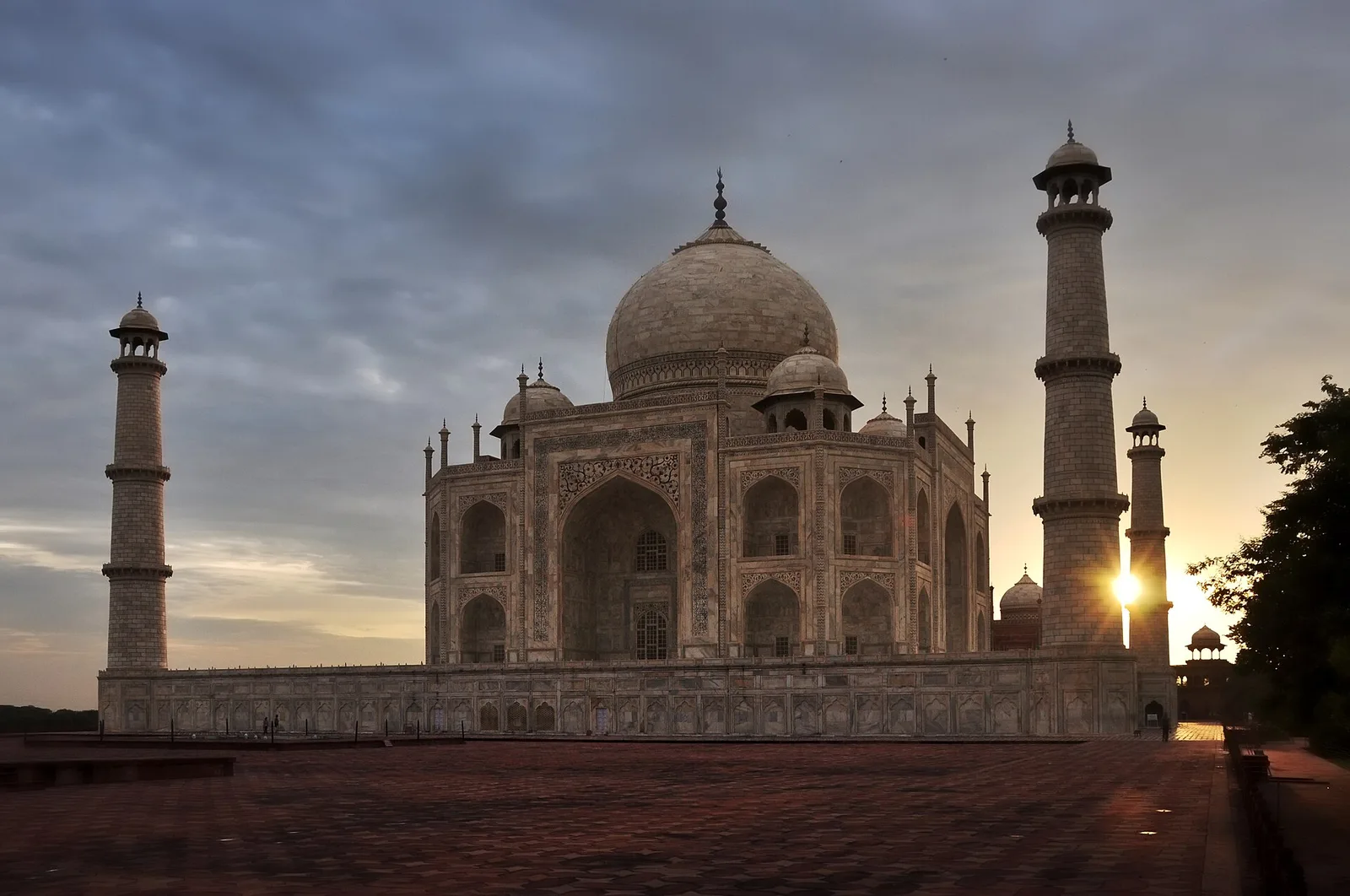
Everything a Taj Mahal day actually turns on, from the official source: what the ticket costs for Indian, SAARC and foreign visitors, why the monument closes every Friday, how sunrise entry works gate by gate, and how Agra Fort and Mehtab Bagh complete the day.
Do not go on a Friday — the Taj Mahal is closed to general viewing every Friday. On any other day it opens 30 minutes before sunrise and closes 30 minutes before sunset. The entry ticket, published as one figure inclusive of the ASI fee and the Agra Development Authority toll tax, is ₹50 for Indian visitors, ₹540 for citizens of SAARC and BIMSTEC countries, and ₹1,100 for other foreign visitors; going inside the main mausoleum costs ₹200 extra in every category, and children below 15 enter free. Booking online through the official ASI channels saves ₹5 on an Indian ticket and ₹50 on a foreign one. Pair the Taj at sunrise with Agra Fort in the middle of the day (₹50 / ₹650) and Mehtab Bagh across the river towards evening (₹25 / ₹300), and the day is complete.
SECTION 01The Friday Closure, and Choosing Your Day
The single most expensive mistake in Agra costs nothing to avoid. The official Taj Mahal website states it without decoration: "Taj Mahal is closed on every Friday", and its visiting-hours page adds that the monument "is closed on Fridays for general viewing" — the closure exists for prayers at the mosque inside the complex. It applies to everyone, in every season, and no ticket, tour or arrangement gets a general visitor inside on a Friday. If your India itinerary is fixed and lands you in Agra on a Friday, the day is not lost (see below), but the Taj itself moves to Saturday morning.
What does stay open on Fridays is everything else in this guide. The official entry-fee table for Agra's monuments — published by the same official site — actually prices Agra Fort, Fatehpur Sikri and the other ASI monuments lower on Fridays, when the Taj crowds are absent: Agra Fort drops to ₹40 for Indian visitors and ₹600 for foreign visitors on a Friday, against ₹50 and ₹650 on other days. So a Friday in Agra becomes fort, tombs and gardens day, with the Taj at sunrise the next morning — a perfectly good order, as long as it is chosen rather than discovered at a locked gate.
One more calendar note from the official site: the Taj's night viewing, offered on five nights around each full moon, is also closed on Fridays and throughout the month of Ramzan. Section 06 gives its prices and mechanics.
SECTION 02What the Taj Ticket Really Costs
The ticket is best understood as the official site itself presents it. The published price is a single figure that already combines two charges — the Archaeological Survey of India's entry fee and the Agra Development Authority's toll tax. The site states the amounts as "inclusive of ASI & ADA fees" and does not break the combined figure into its two parts, so this guide prints the combined totals exactly as published rather than inventing a split. Those totals are:
- Indian visitors (and OCI cardholders): ₹50
- Citizens of SAARC and BIMSTEC countries: ₹540
- Other foreign visitors: ₹1,100
That ticket covers the whole complex — the gateway, the charbagh gardens, the mosque and guest house, and the raised platform around the tomb. One part costs extra for everyone: entering the main mausoleum itself, to stand beneath the dome at the cenotaphs of Mumtaz Mahal and Shah Jahan, needs an additional ticket of ₹200, the same in all three categories. So the full visit costs ₹250 for an Indian visitor, ₹740 for a SAARC or BIMSTEC visitor and ₹1,300 for another foreign visitor. Children below the age of 15 pay no entry fee at all, Indian or foreign.
Three money details reward a minute's attention. First, book online if you can: the official site confirms that tickets bought online through its ASI channels (asiagracircle.in, and the ASI booking portal linked from tajmahal.gov.in) get a discount of ₹5 per Indian ticket and ₹50 per foreign ticket — and you skip the window queue at dawn. Second, the foreign visitor's ticket carries useful inclusions at no extra charge: the official site lists a water bottle, shoe covers, a tourist guide map of Agra, and the battery bus and golf cart services between the parking areas and the gates as provided free with the foreigner's entry ticket. Third, if you prefer the window, the official timings are precise: ticket windows at the Western Gate (near Saheli Burj) and the Eastern Gate open one hour before sunrise and close 45 minutes before sunset. There are separate entry queues for foreign and domestic tourists, signed at the gates.
SECTION 03Sunrise Entry, Step by Step
Sunrise is the Taj at its best — cool air, soft light on the marble, and the smallest crowds of the day — and the official visiting-hours page sets the frame: the monument opens 30 minutes before sunrise and closes 30 minutes before sunset on normal operating days. Because the ticket windows open a full hour before sunrise, the sequence for a dawn visit is simple: arrive at your gate about an hour before sunrise with tickets already bought online if possible, clear security as the windows open, and walk the charbagh axis as the light comes up. Sunrise itself moves with the season — very early in summer, gentler in winter — so check the local sunrise time for your date and work backwards from it.
Choose your gate deliberately; the official site describes all three. The Western Gate is the main entrance, facing Agra city, and carries the longest queues. The Eastern Gate, towards the Taj Nature Walk, is the official site's own tip — "one should prefer this gate to avoid crowd." The Southern Gate, towards Taj Ganj, is not an entry at present: exit only, per both the visiting-hours and entry pages. After security, the route runs through the great gateway into the garden; from the central platform you get the postcard view down the reflecting channel.Shoe covers (provided, or carry your own) are worn for the mausoleum terrace, and free shoe racks stand just below the main mausoleum. Inside the complex, the small Taj Museum is a worthwhile ten minutes and, per the official site, opens 10:00 am to 5:00 pm with free entry.
Two rules from the official do's and don'ts deserve emphasis because they end visits early. Drone cameras are strictly prohibited inside the Taj Mahal. And visitors are expected to stay within the areas and directions marked on their tickets and by ASI staff — the platform and mausoleum run one-way flows at busy times, which is another reason the first hour of the day feels so different from the fourth.
SECTION 04Agra Fort: The Other Half of the Story
Two kilometres from the Taj, Agra Fort is not an add-on but the second half of the same story: the red-sandstone palace-city from which the empire was actually governed, and where Shah Jahan spent his last years under house arrest, looking down the river at his wife's tomb. The official site gives the visiting frame plainly: the fort is open from sunrise to sunset, entry is through the Amar Singh Gate only, and one portion of the fort is used by the Indian Army and closed to the public — what you see is the palace section, and it is more than enough. The fort stands about 5.5 km from Agra Cantt railway station.
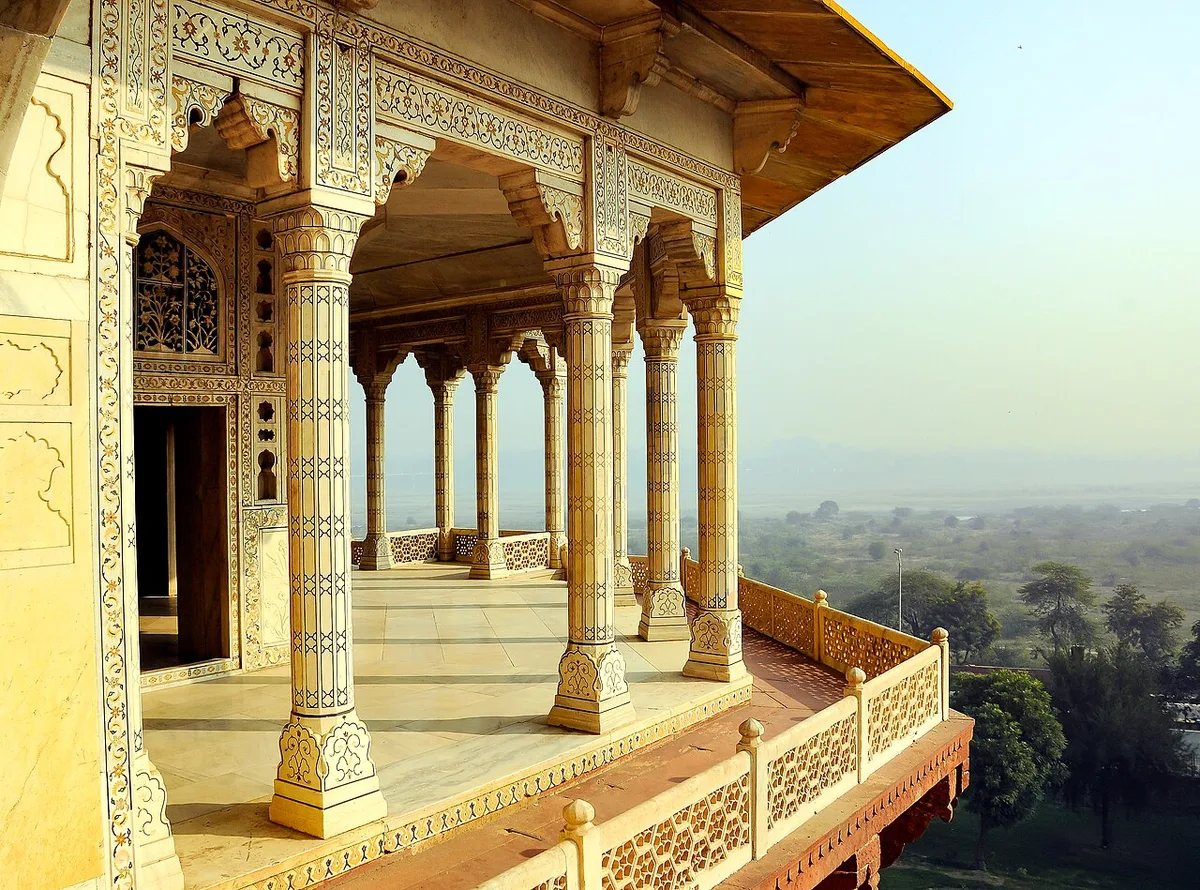
Entry is again published as one figure inclusive of ASI and ADA charges: ₹50 for Indian visitors and ₹650 for foreign visitors, dropping on Fridays to ₹40 and ₹600 — the Friday discount noted in Section 01, and one more reason a Friday Agra day starts here. Children below 15 enter free, and the official page reminds visitors to keep their ID with them. Inside, work from the Diwan-i-Am, the pillared hall of public audience the official site dates to Shah Jahan in 1628, up into the royal pavilions: the Khas Mahal, the Shish Mahal, the Nagina and Mina mosques, and the marble balconies. It is from those balconies that the official site promises — accurately — "breathtaking views of the Yamuna River and Taj Mahal." Allow two hours; the fort rewards slowness, and its shade is welcome in the middle of the day.
SECTION 05Mehtab Bagh: The Taj From Across the River
End the day where the whole composition resolves. Mehtab Bagh, on the left bank of the Yamuna directly opposite the Taj, is a charbagh garden the official site traces to the emperor Babur — the last of eleven riverbank gardens he laid out along the Yamuna — square in plan at about 300 by 300 metres and, in the site's words, "perfectly aligned with the Taj Mahal on the opposite bank," with a great octagonal tank at its centre. Stand on that axis late in the afternoon and the Taj rises from the far bank, framed by its own geometry mirrored in this garden.
The practicalities are small. Mehtab Bagh appears in the official entry-fee table at ₹25 for Indian visitors and ₹300 for foreign visitors (₹25 for SAARC and BIMSTEC visitors), and the Agra Development Authority has built a dedicated Taj View Point on the riverbank nearby for the same panorama. The garden is the natural last stop of a Taj day: the light softens, the marble warms, and most of the day's crowds are on the other bank. Photographers: the frame here is the wide one — river, garden walks and the tomb across the water.
SECTION 06Getting There From Delhi, and the Night Viewing
Agra is close enough to Delhi to be done as a day trip and interesting enough to deserve a night. By rail, the fastest express trains between New Delhi and Agra Cantt cover the journey in roughly two hours — treat that as an approximation and confirm the exact train and timing on Indian Railways' official channels when you book, since schedules are revised; Agra Fort station is the alternative arrival point for the old city. By road, the Yamuna Expressway is the standard route, a motorway drive of roughly three and a half to four hours depending on traffic and your Delhi starting point — again an approximation, not a timetable figure. The day-trip calculus is honest: a train out before dawn, the Taj in its first hour, the fort and Mehtab Bagh, and an evening train back is entirely workable; staying the night buys you the sunrise without the 4 am start, and the evening light at Mehtab Bagh at the end of a relaxed day.
If your dates coincide with the full moon, the official site documents one of Agra's rarest tickets: night viewing of the Taj Mahal on five nights a month — the full-moon night and the two nights before and after it. Viewing runs from 8:00 pm to midnight in eight batches of at most 50 people, each batch lasting half an hour, with visitors reporting at Shilpgram, near the Eastern Gate, half an hour before their slot for security checks, ID in hand. The official prices are ₹510 for an Indian adult, ₹750 for a foreign adult and ₹500 for a child aged 3–15. Night viewing is closed on every Friday and during the month of Ramzan. It is a moonlight silhouette from a fixed viewpoint, not a night opening of the complex — set expectations by that, and it is unforgettable.
FAQFrequently Asked Questions
Is the Taj Mahal really closed every Friday?
Yes. The official Taj Mahal website states "Taj Mahal is closed on every Friday" for general viewing — the mosque inside the complex is used for Friday prayers. There are no exceptions for tours or tickets. Agra Fort, Mehtab Bagh and the other Agra monuments remain open on Fridays, and Agra Fort is even slightly cheaper that day (₹40 Indian / ₹600 foreign, against ₹50 / ₹650 on other days).
How much does a full Taj Mahal visit cost in total?
On the official figures checked 30 October 2026: entry is ₹50 for Indian visitors, ₹540 for SAARC and BIMSTEC citizens and ₹1,100 for other foreign visitors — each figure already inclusive of the ASI fee and the Agra Development Authority toll tax. Add ₹200 in any category to enter the main mausoleum, making full totals of ₹250, ₹740 and ₹1,300 respectively. Children below 15 enter free. Booking online through the official ASI channels saves ₹5 on an Indian ticket and ₹50 on a foreign one.
How early should I arrive for sunrise, and which gate should I use?
The monument opens 30 minutes before sunrise, and its ticket windows open one hour before sunrise. Arrive at the gate about an hour before sunrise, ideally with tickets bought online. The Eastern Gate is the official site's own recommendation for avoiding the crowd; the Western Gate is the main and busiest entrance; the Southern Gate is exit-only at present.
Can Agra be done as a day trip from Delhi?
Yes. The fastest express trains between New Delhi and Agra Cantt take roughly two hours each way (approximate — confirm your train's timing when booking), and the Yamuna Expressway offers a road option of roughly three and a half to four hours. A day trip works best with the Taj first, at sunrise, then Agra Fort and Mehtab Bagh. Staying overnight removes the pre-dawn start and adds the full-moon night viewing: five nights a month at ₹510 (Indian adult), ₹750 (foreign adult) and ₹500 (child 3–15).
What does the foreign visitor's Taj ticket include?
Per the official site, the foreigner's entry ticket provides, free of cost, a bottle of water, shoe covers, a tourist guide map of Agra, and the battery bus and golf cart services between the parking areas and the gates. Entry to the main mausoleum is not included — that is the separate ₹200 ticket — and the Taj Museum inside the complex is free, open 10:00 am to 5:00 pm.
Official references and checking status
Every changeable fact in this guide — fees, the Friday closure, opening rules, gate arrangements and night-viewing prices — was checked on 30 October 2026 against the official Taj Mahal website listed below, and the sources file that accompanies this draft records which page supports which claim. Two honest limits: the official site publishes the Taj and Agra Fort entry prices as single totals "inclusive of ASI & ADA fees" and does not print the split between the components, so this guide prints the totals and says so; and the Delhi–Agra train and road times are approximations, flagged in the text, because they are timetable-dependent. Confirm current prices and timings on the official site before you travel.
- Taj Mahal (official, U.P. Tourism) — ticketing and entry-fee table for the Taj Mahal, Agra Fort, Mehtab Bagh and other Agra monuments
- Taj Mahal (official) — visiting hours, ticket outlets, entry fees and online discounts
- Taj Mahal (official) — entry gates: Eastern, Western and Southern
- Taj Mahal (official) — Agra Fort: entry gate, hours and entry fees
- Taj Mahal (official) — nearby attractions, including Mehtab Bagh and the ADA Taj View Point
- Taj Mahal (official) — night viewing: nights, batches and ticket prices
Photos: the Taj Mahal at sunrise from the mausoleum platform, by MarcBW, via Wikimedia Commons, licensed under CC BY-SA 3.0; a marble pavilion balcony inside Agra Fort, by Kanad Sanyal, via Wikimedia Commons, licensed under CC BY-SA 4.0. Photographers keep their copyright; the licences require this credit.
General information only. This guide is based on official sources publicly available and checked on the date shown on this page. Visa rules change, and consular and USCIS officers decide every case on its own facts — nothing here is a confirmation or a guarantee for your individual case, and this is not legal advice. Always confirm the current requirement on the official page linked in this guide before you act, and consider a qualified immigration attorney for your specific situation.