
Researched & checked — 30 Oct 2026
Goa in 3 Days: North, South and Old Goa, With the Real Costs Shown
NEW Published 30 October 2026
Three days that cover Goa properly — Old Goa's great churches, the fort and beaches of the north, the quieter south, and a decision about Dudhsagar — with costs taken from Goa's own government sources, including the famous free ferries.
Spend Day 1 in Old Goa — the Basilica of Bom Jesus (public viewing Monday–Saturday 9:00 am–5:00 pm, Sunday 11:00 am–5:00 pm) and the Se Cathedral across the square (open daily 7:30 am–6:00 pm), both free to enter. Day 2 in the north — Fort Aguada (open daily 9:30 am–6:00 pm, no entry ticket) and the beaches, finishing in Panaji. Day 3 is a choice: the South Goa beaches, or Dudhsagar — the guided trek books through the official GTDC–Forest platform at ₹527 plus GST, while the jeep circuit runs in the dry season under Forest Department rules. Throughout, use the ferries: the River Navigation Department states that foot passengers and two-wheelers travel free on all its crossings; only cars pay a toll.
SECTION 01How These Three Days Fit Together
Goa divides naturally into three trips wearing one name. Old Goa, the former Portuguese capital on the Mandovi, is a compact cluster of enormous churches and convents — an hour at each of two great buildings covers its heart. North Goa is the developed beach belt: the Aguada headland, then Candolim, Calangute and Baga up the coast, with Panaji at its southern end. South Goa is the same coastline at lower volume — longer, paler beaches and villages that keep Goan hours. Dudhsagar Falls, inland on the Karnataka border inside the Bhagwan Mahavir Wildlife Sanctuary, are a full-day expedition that replaces a beach day rather than squeezing into one.
Old Goa's churches keep viewing hours, not monument hours, and the Basilica's Sunday viewing starts late because of Mass. Put Old Goa on a weekday morning and everything is simple. Dudhsagar, in season, needs a booking made before the day itself — so it is planned, not improvised.
On money, this guide follows the site's usual discipline: figures come from Goa's official sources — GTDC, the River Navigation Department and Kadamba Transport — and where an official page prints no figure, none is invented. That is why you will find an exact price for the Dudhsagar trek but no quoted Kadamba bus fare: the corporation's website lists its routes without publishing a fare table.
SECTION 02Day 1: Old Goa — Bom Jesus and the Se Cathedral
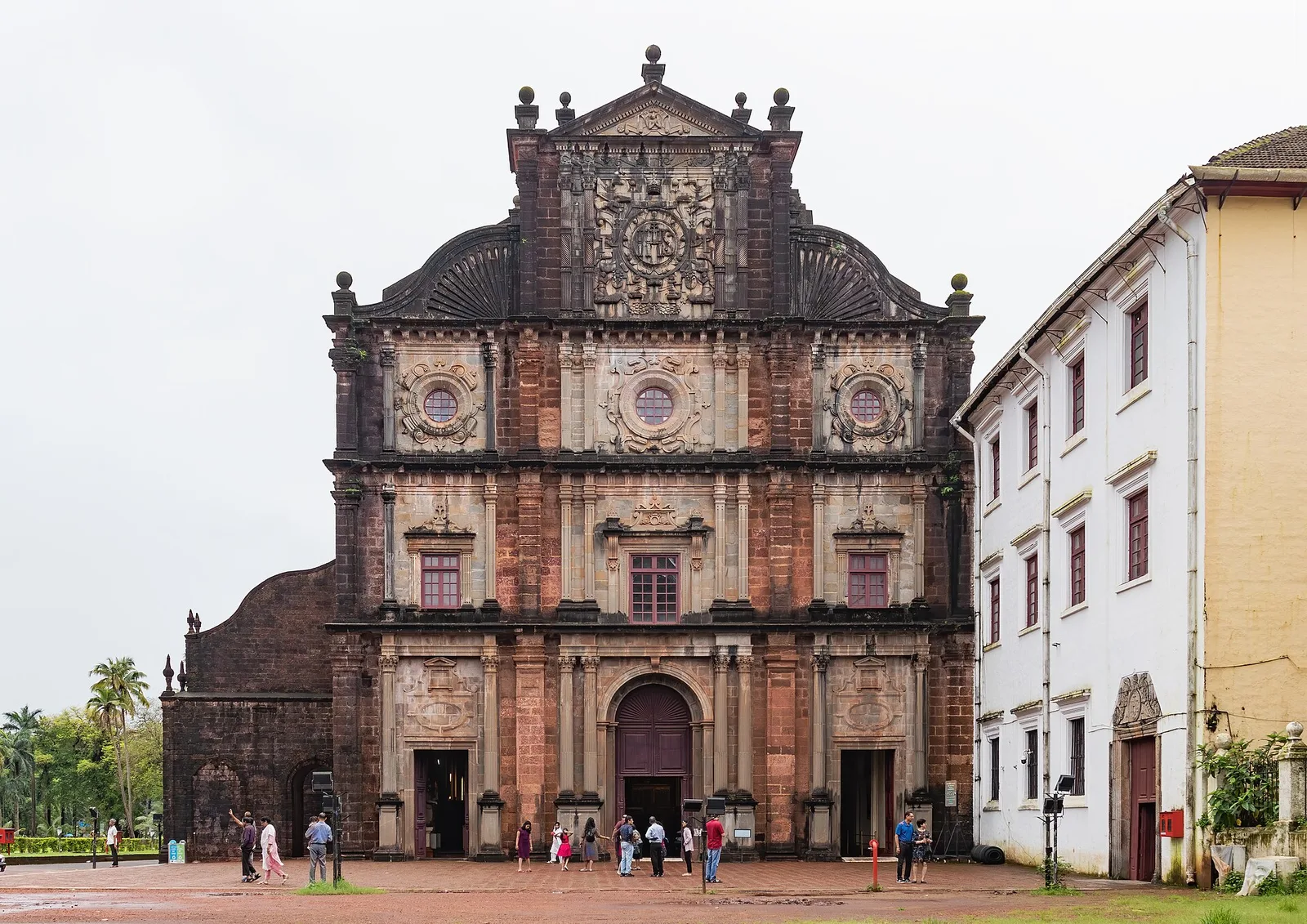
Start at the Basilica of Bom Jesus, the church that holds the relics of St Francis Xavier. Its exterior is famously un-plastered — dark laterite where its neighbours are white — and GTDC, the state's tourism corporation, points out that the plainness deceives: this is a UNESCO World Heritage monument, rich in art and history inside. The saint's silver casket sits in a chapel on the southern side of the transept, and it is the casket that draws pilgrims from across the world.
Plan around the church's own rhythm — it is a working church first and a sight second. GTDC publishes the Mass pattern plainly: Sundays at 7:00 am (Konkani) and 9:15 am (English); Monday to Saturday at 7:00 am (Konkani) and 8:00 am (English). For visitors, the Basilica is open to the public for viewing Monday to Saturday, 9:00 am to 5:00 pm, and on Sundays from 11:00 am to 5:00 pm. There is no entry ticket — you are entering a church, not a monument counter — but dress and behave as a guest in one: shoulders and knees covered, voices low, and no sightseeing during Mass.
Cross the square to the Se Cathedral, and the scale changes. GTDC gives its dimensions with pride — 250 feet long, 181 feet broad, a frontispiece 115 feet high — and calls it the largest church in Asia, built to commemorate Afonso de Albuquerque's victory on the feast of St Catherine, to whom it is dedicated. It is open every day from 7:30 am to 6:00 pm; Masses are at 7:30 am and 6:00 pm on weekdays, and 7:15 am, 10:00 am and 4:00 pm on Sundays. In the surviving bell tower hangs the Golden Bell, named for the richness of its tone; the second tower fell in 1776 and was never rebuilt. The adjoining convent houses the Archaeological Museum — GTDC notes it as part of the same visit.
Give the two churches a full morning. By lunch you will understand what no beach day teaches: for three centuries this small riverside city was one of the great ports of Asia, and these buildings are its remains.
SECTION 03Day 2: Fort Aguada, the North Beaches and a Panaji Evening
Begin the north day at Fort Aguada, on the headland where the Mandovi meets the sea. GTDC describes it as the best-preserved Portuguese fort in India: built of laterite, its bulwarks five metres high and over a metre thick, covering the whole peninsula at the river's mouth, and named for the freshwater spring inside it — agua, water — where ships once refilled. The fort is open all days of the week from 9:30 am to 6:00 pm, and GTDC lists no entry fee for it: you walk in and wander the ramparts. Beside it stands the 1864 lighthouse, which GTDC calls the oldest of its kind in Asia; the old light is mostly closed, but a newer lighthouse by the cliff edge can be climbed, in GTDC's words, "for a small fee" — the corporation prints no figure, so carry small notes.
From the fort, the coast runs north through Sinquerim and Candolim to Calangute and Baga. The essential cost fact about every Goan beach is the same: the beach itself is public and free. No authority charges for sand or sea. What you pay for, if you choose them, are the private layers on top — a shack's sunbed and lunch, a parasailing run — priced by the operators who provide them and negotiated on the day. Candolim is the calm end of the strip, Baga the loud end.
End the day in Panaji. The capital's Latin Quarter, Fontainhas, is a maze of Portuguese-era houses in ochre, blue and green; the Mandovi promenade fills at sunset; and anchored on the river you will see the offshore casino vessels Goa is known for — part of the riverscape, boarded from city jetties in the evening. Then do the most Goan thing available to a visitor: take a ferry. The Ribandar–Chorao crossing, minutes from the city, now runs modern roll-on roll-off ferries — announced by the River Navigation Minister at their July 2025 launch as a 12-minute crossing, free for passengers and two-wheelers, with cars charged a toll announced at ₹15. Ride it to Chorao and back at dusk for the river, the mangroves and the company of islanders going home.
SECTION 04Day 3, Option A: The South Goa Beaches
If the third day is for slowing down, go south. The coast below the Zuari river runs in long, pale arcs — Colva and Benaulim near Margao, then Varca, Cavelossim and, at the far end, Palolem's curved bay. The same rule applies as in the north: the beaches are public and free, lifeguarded in season, and spending is entirely optional and private — a shack lunch, a boat trip from Palolem, a rented bicycle for the village lanes behind the sand.
The south is also where Goa's other pace survives: whitewashed chapels on hillocks, paddy fields running to the coconut line, fishermen mending nets where the boats come in. Base the day on one beach rather than three — distances are longer than the map suggests. Margao, the south's commercial capital, is the natural lunch stop, with grand Portuguese-era mansions to admire from the street. If your three days include a Sunday, note that the south's churches fill for morning Mass exactly as Old Goa's do — visit as a guest, outside service times.
SECTION 05Day 3, Option B: Dudhsagar — the Trek, the Jeeps and the Monsoon Closure
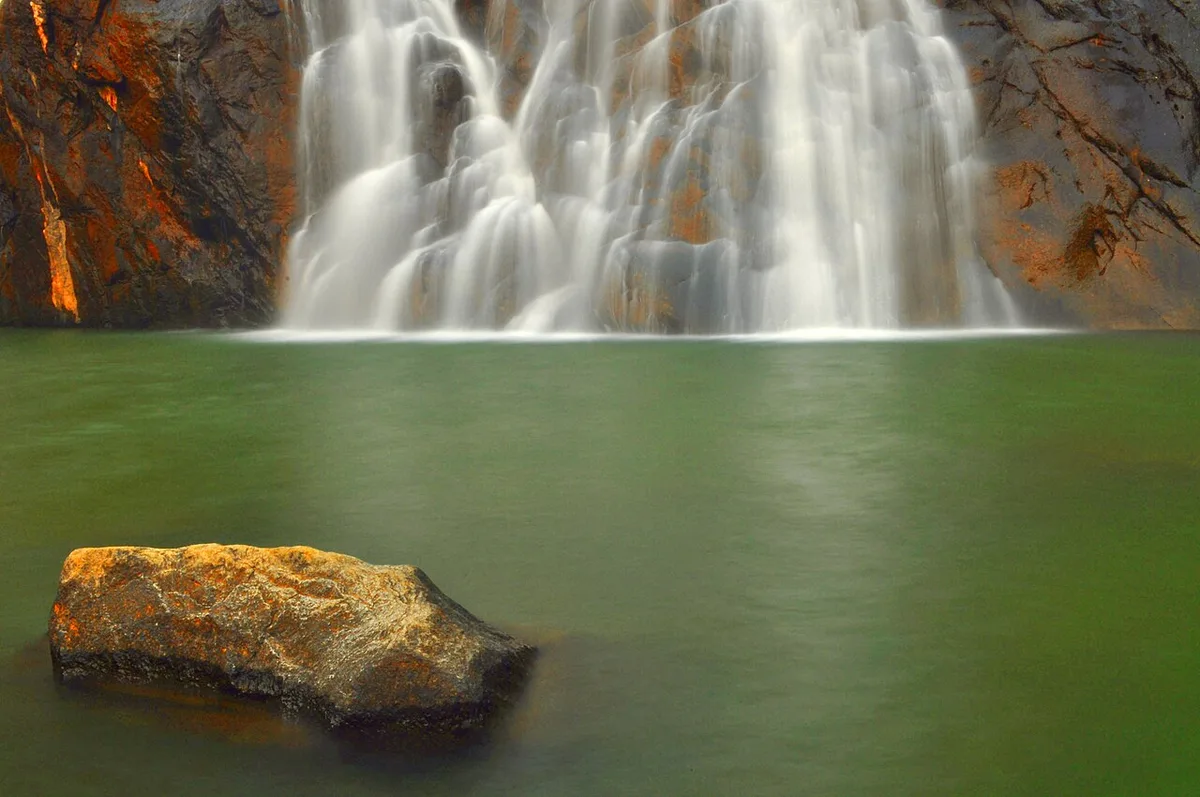
Dudhsagar — "sea of milk" — is a four-tiered waterfall about 310 metres high on the Mandovi river, inside the Bhagwan Mahavir Wildlife Sanctuary near Collem (also spelt Kulem), on Goa's eastern border. It is the one sight in this guide that cannot simply be walked up to: the falls sit at the end of a forest track inside a protected area, and how you reach them is regulated by the Forest Department. There are two official ways in.
The guided trek. GTDC and the Goa Forest Development Corporation run an official online booking platform for trekking to the falls (dudhsagartrekking.com), and GTDC's own announcement fixes the terms: the booking fee is ₹527 plus GST; treks are capped at 500 trekkers a day; a trained nature guide is assigned to every group of ten, allocated first-come-first-served at the Collem office; and every trekker must carry valid photo identification. Alcohol is prohibited and plastics are banned inside.
The jeep circuit. In the dry season, the established route is the jeep track from Collem: per the Forest Department's order for the current (2026–27) season, as reported when the circuit reopened in early October 2026, only jeeps registered with the Forest Department may enter; private vehicles and two-wheelers are turned back at the gate; bookings go through the government-authorised GTDC portal; the entry gates run 8:00 am to 3:00 pm, trips are capped at 240 a day on the State Board for Wildlife's recommendation, and life jackets are compulsory at the falls. Two honest cautions. First, this guide prints no jeep fare: the amounts in circulation come from operators and reports that do not agree, and the department publishes rules, not a tariff — the fare is confirmed on the portal when you book. Second, the circuit closes for the monsoon, when the track's river crossings turn dangerous, and reopens when the Forest Department judges it safe — early October in 2026. In the monsoon months the falls are at their fullest and their least reachable, and no booking changes that.
Dudhsagar is a full day from the coast — start early, and carry water and the ID the rules require.
SECTION 06Getting Around: Ferries, Buses and the Two Airports
Goa's ferries deserve their own section — they are the state's best travel bargain and a sight in themselves. The River Navigation Department, on its official Government of Goa page, describes a network of 19 routes across the Mandovi, Zuari, Sal, Terekhol and Chapora rivers, run with 38 vessels for the island communities the bridges never reached — and states the policy plainly: "The Department is providing free ferry services to foot passengers w.e.f. 1/4/2000 and two wheelers w.e.f. 1/1/2006 at all ferry crossings", with a minimum toll levied on cars and other vehicles. Crossings a visitor can use include Panaji–Betim, Old Goa–Piedade to Divar island, and Ribandar–Chorao (listed hours 6:00 am to 2:00 am). Ride them as the islanders do: walk on, stand at the rail, and be across in minutes.
For the airports and longer hops, the state bus corporation is Kadamba Transport (KTCL). Its official website lists dedicated airport routes — Dabolim Airport to Calangute via Panaji, and from Manohar International Airport (Mopa) to Mapusa, to Panaji, to Calangute and to Margao — but publishes no fare table, so this guide quotes no Kadamba fare: confirm it when you book through KTCL's official channels. One warning for a three-day trip: Goa's airports are at opposite ends of the state — Dabolim (GOI) in the centre-south, Mopa (GOX) in the far north — and the wrong one can add two hours to a beach transfer. Check the airport code on your ticket against where you are staying.
FAQFrequently Asked Questions
Are the Old Goa churches free to enter?
Yes. The Basilica of Bom Jesus and the Se Cathedral are working churches, not ticketed monuments, and GTDC — Goa's official tourism corporation — publishes their visiting hours with no entry fee. The Basilica opens for public viewing Monday to Saturday 9:00 am–5:00 pm and Sunday 11:00 am–5:00 pm; the Se Cathedral is open every day 7:30 am–6:00 pm.
Are Goa's ferries really free?
For most travellers, yes. The River Navigation Department states on its official Government of Goa page that foot passengers have travelled free on all its crossings since 2000 and two-wheelers since 2006; only cars and other vehicles pay a toll (₹15 per car was the toll announced for the new Ribandar–Chorao roll-on roll-off ferries at their July 2025 launch).
How do I visit Dudhsagar Falls, and what does it cost?
Two official routes, both from Collem. The guided trek books on the GTDC–Goa Forest Development Corporation platform at ₹527 plus GST, capped at 500 trekkers a day, with a nature guide per group of ten and photo ID required. The dry-season jeep circuit uses only Forest Department-registered jeeps (private vehicles are turned back), with gates at 8:00 am–3:00 pm and trips capped at 240 a day; this guide prints no jeep fare because no official tariff is published — it is confirmed on the booking portal. The circuit closes entirely during the monsoon.
Which airport should I use — Dabolim or Mopa?
It depends where you are staying, and it matters: Dabolim (GOI) sits in centre-south Goa, Mopa (GOX) in the far north. For South Goa beaches, Dabolim is far closer; for the Candolim–Baga belt, either works, with Mopa usually quicker. Kadamba runs airport buses from both — from Dabolim to Calangute via Panaji, and from Mopa to Mapusa, Panaji, Calangute and Margao — but publishes no fares on its official site, so confirm the fare when you book.
Can Goa be done without hiring a car?
Yes, with a little planning. The ferries are free for foot passengers, Kadamba buses link the airports and main towns, and Old Goa's sights sit within a few hundred metres of each other. What a car buys is spontaneity — the far south and the Dudhsagar day are easier with wheels arranged (licence and helmet required for a rented two-wheeler).
Official references and checking status
Every changeable fact in this guide — church viewing hours, fort hours, the ferry policy, the Dudhsagar trek fee and rules — was checked on 30 October 2026 against the official pages listed below, and the sources file that accompanies this draft records which page supports which claim. Three honest limits: Kadamba's site lists routes without a fare table, so no bus fare is quoted; the jeep circuit's rules are stated as the Forest Department's 2026–27 season order was reported when the circuit reopened in October 2026, and no jeep fare is printed because no official tariff is published; and the Aguada lighthouse charges what GTDC calls only "a small fee", so no figure is given for it either.
- River Navigation Department, Government of Goa — ferry network, routes and the free ferry policy for foot passengers and two-wheelers
- River Navigation Department — route list and crossing timings, including Ribandar–Chorao
- GTDC (Goa Tourism Development Corporation) — Basilica of Bom Jesus: Mass and public viewing times
- GTDC — Se Cathedral: opening hours, Mass times, the Golden Bell
- GTDC — Fort Aguada: opening hours and the lighthouse
- GTDC — Dudhsagar trekking platform: booking fee, daily limit, guides and rules
- Kadamba Transport Corporation — routes operated, including the airport services
Photos: the un-plastered laterite facade of the Basilica of Bom Jesus in Old Goa, by iMahesh, via Wikimedia Commons, licensed under CC BY-SA 4.0; the lowest tier of Dudhsagar Falls spilling into its pool, by Soumyajit Pramanick, via Wikimedia Commons, licensed under CC BY-SA 2.0. Photographers keep their copyright; the licences require this credit.
General information only. This guide is based on official sources publicly available and checked on the date shown on this page. Visa rules change, and consular and USCIS officers decide every case on its own facts — nothing here is a confirmation or a guarantee for your individual case, and this is not legal advice. Always confirm the current requirement on the official page linked in this guide before you act, and consider a qualified immigration attorney for your specific situation.