
Researched & checked — 30 Oct 2026
Amritsar: The Golden Temple, Jallianwala Bagh and the Wagah Border Ceremony
NEW Published 30 October 2026
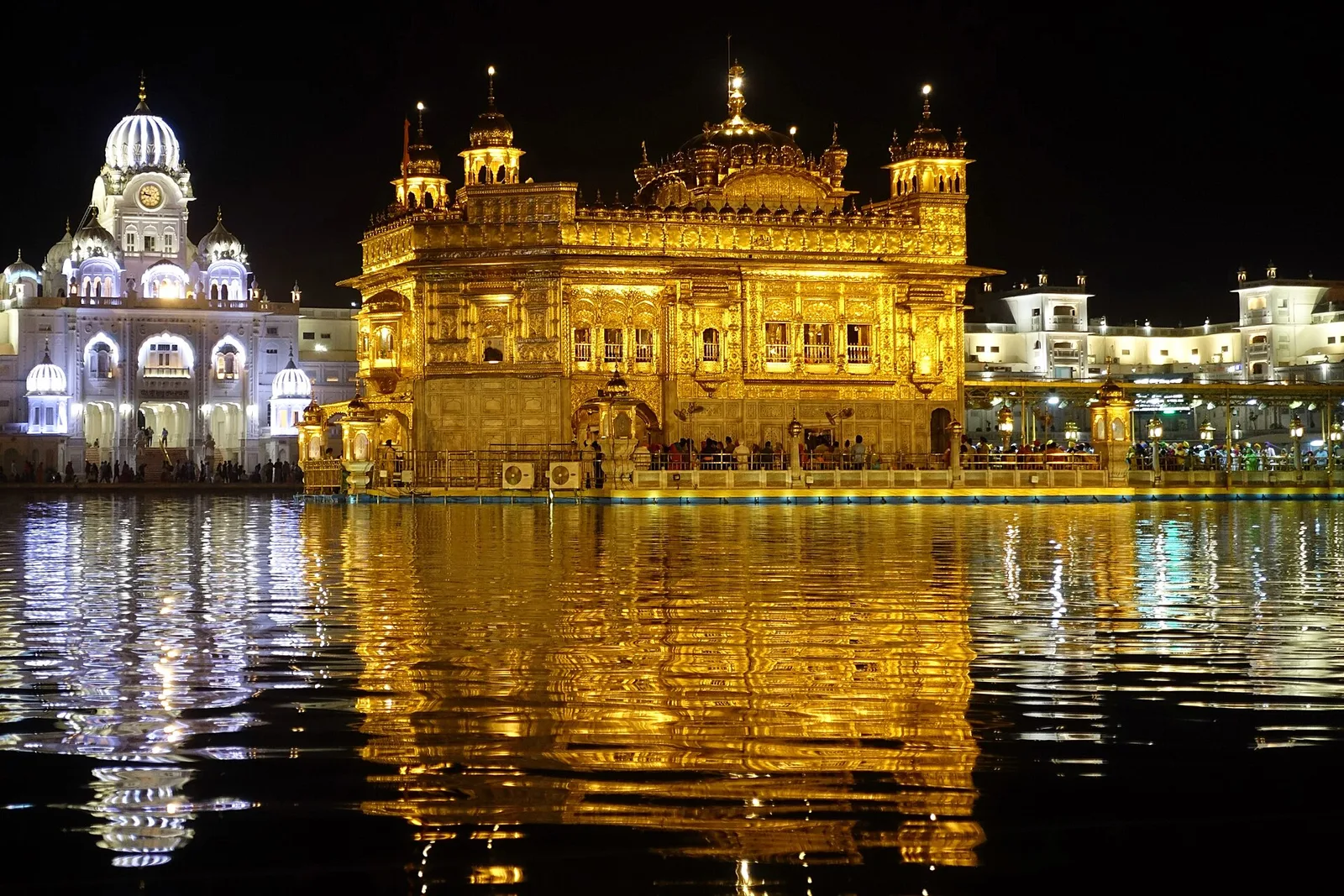
Amritsar's three essential experiences — darshan at Sri Harmandir Sahib, the memorial garden of 1919, and the evening flag ceremony at the Pakistan border — with what each one actually costs, taken from the SGPC, the district administration and the BSF.
The Golden Temple is completely free — no entry fee, no darshan ticket, no VIP queue; the SGPC sells none, and the langar meal is free to everyone, around the clock. Jallianwala Bagh is free too, five minutes' walk away, and its evening sound-and-light show is free of cost. The one paid old-city sight is the Partition Museum: ₹10 for Indian nationals, ₹250 for foreign nationals, open Tuesday–Sunday 10:00 am–6:00 pm, closed Mondays. For the Attari–Wagah ceremony, seats are free — book them on the BSF's portal (attari.bsf.gov.in) up to 48 hours ahead with photo ID, or carry ID and come early; the start time shifts with the season, so confirm it when you book. The SGPC's own sarais start at no rent at all — just a refundable ₹100 security at Sri Guru Ram Das Niwas.
SECTION 01The Golden Temple: Darshan, the Queue and the Rules
Sri Harmandir Sahib stands on a platform in the middle of the Amrit Sarovar, the Pool of Nectar that gives Amritsar its name. The SGPC's own description fixes the geometry every visitor walks: the sanctum is built on a 67-foot-square platform in the centre of the tank; the Darshani Deori, the arch at the shore end, opens onto a causeway 202 feet long and 21 feet wide; and the temple has a door on each of its four sides. That last detail is the theology of the place made architectural: Guru Arjan, who designed the shrine, had it built on a lower level than the surrounding city and opened on all four sides, in the SGPC's words, making it "accessible to every person without any distinction of Caste, creed, sex and religion."
There is, accordingly, no commercial machinery at the door at all. No entry fee, no ticket, no advance booking, and no paid priority of any kind — the SGPC offers no VIP darshan, and anyone in the lanes outside offering to sell you one is selling something that does not exist. What you do instead is simple, and the same for a farmer from Tarn Taran. Cover your head — a scarf or handkerchief is enough, and coverings are available at the entrances. Leave your shoes at the free shoe-keeping counters (the jora ghar), wash your hands and feet at the channels by the entrance, walk the parikrama — the marble circuit of the sarovar — clockwise, and join the causeway queue when you are ready. The queue is the darshan: it shuffles forward over the water to the sound of kirtan, and inside the sanctum you pass before the Guru Granth Sahib, receive karah prasad, and come out the other side.
The temple's day has no real beginning or end. The district administration describes the rhythm: devotees bathe in the sarovar, and the kirtan "begins from Amrit Vela (early dawn) till Sukhasan" — the evening ceremony in which the Guru Granth Sahib is carried in procession to rest for the night in the Akal Takht. Both ends of that day are worth witnessing: the pre-dawn procession that brings the scripture across the causeway in the dark, and the temple after dark, when the gilded sanctum doubles itself in the still water.
SECTION 02The Langar: Eating in the World's Largest Free Kitchen
Do not leave the complex without eating in the langar — it is not a sideshow but half the point of the place. Punjab Tourism, the state tourism authority, puts the scale in one line: at the Guru-ka-Langar, "around 35,000 people a day are fed for free by temple volunteers." The district administration adds the hours: the multi-storied langar hall "remains open for 24 hours", with the sangat taking their meal in pangat "without any discrimination". Punjab Tourism says the same of the whole complex: all persons, "irrespective of race, religion, or gender, are lodged and fed for free".
Taking part asks nothing but manners. Keep your head covered, take a steel plate from the stacks, join a row on the floor, and accept what the volunteers ladle out — typically dal, a vegetable, rotis and a sweet, with seconds offered as a matter of course. Eat what you take; waste is the one real discourtesy. Afterwards, carry your plate to the washing area, where visitors are welcome to join the seva — the voluntary service — of washing up or rolling rotis. No one will ask what you believe, where you are from, or whether you can pay. That is not an oversight; it is the institution working exactly as designed, as it has for centuries.
SECTION 03Staying at the Temple: The SGPC Sarais
Amritsar's most remarkable budget accommodation is run by the temple itself. The SGPC's sarai information page lists six niwas (pilgrim lodges), notes that their reception counters work around the clock, and points pilgrims to online room booking at sgpcsarai.com. The tariffs it publishes are unlike anything else in Indian travel:
- Sri Guru Ram Das Niwas — the oldest and largest, built in 1931, with 228 rooms and 18 halls: charges none, but a refundable security of ₹100. Common bathrooms; a dispensary within the precincts.
- Sri Guru Arjan Dev Niwas, Sri Guru Hargobind Niwas, Mata Ganga Ji Niwas and the New Akal Rest House — rooms with geyser or air-conditioning at ₹500 per day, plus a refundable security of ₹1,000, per the SGPC's table.
Practical notes: rooms go on availability, and on gurpurab and festival weekends the whole old city fills — book on the portal ahead rather than trusting the counter. What you get is simple, clean and close: most niwas stand within a few minutes' walk of the parikrama, so the dawn procession and the late-night temple are part of your stay, not excursions. Conventional hotels fill the lanes around the complex at every price — but none is better located, or more in the spirit of the city, than the sarai.
SECTION 04Jallianwala Bagh and the Partition Museum: The City's Two Wounds
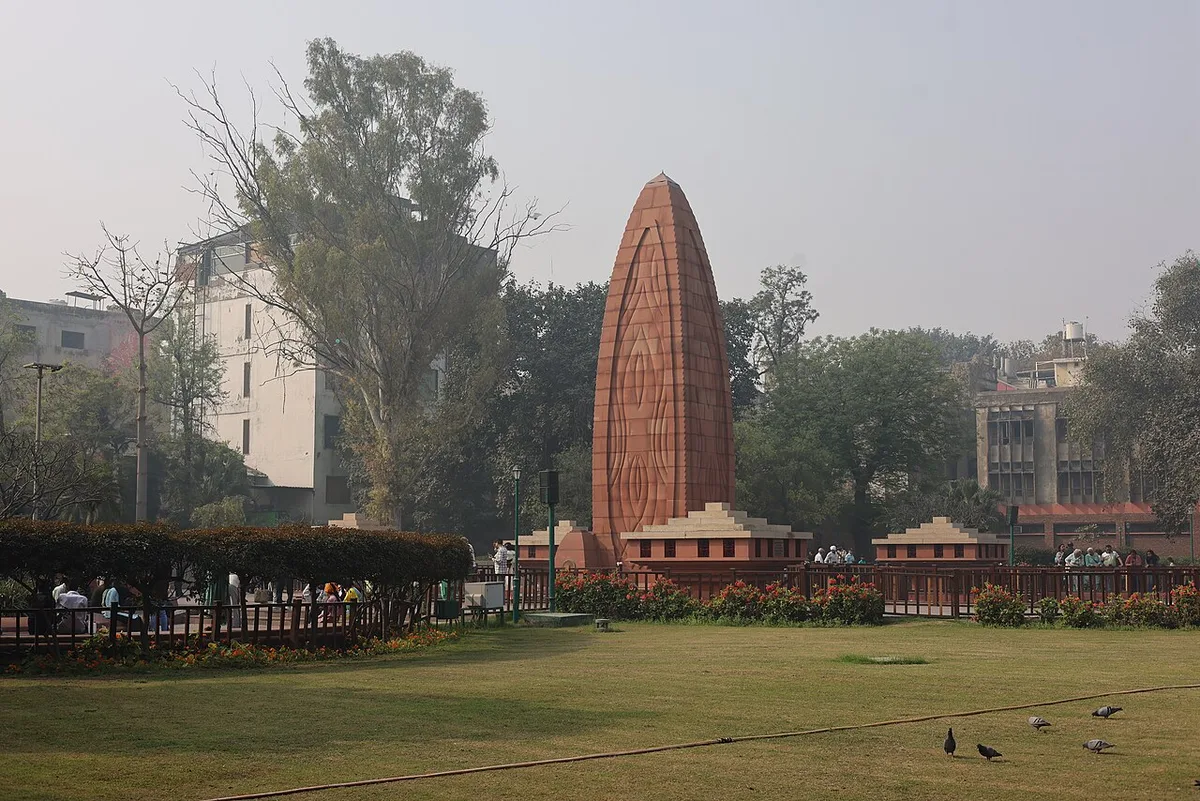
Five minutes' walk from the temple's eastern side, the lanes open into Jallianwala Bagh. The district administration's account is unflinching: the memorial "commemorates the 2000 Indians who were killed or wounded, shot indiscriminately by the British under the command of Gen Michael O'Dyer on April 13, 1919 while participating in a peaceful public meeting" — a crowd gathered on Baisakhi day in a walled garden with one narrow entrance. The story is told in the Martyrs' Gallery; a section of wall with bullet marks still visible is preserved; and so is the memorial well, into which some people jumped to escape. Entry is free — the Bagh is a public memorial garden, not a ticketed attraction.
The renovated complex was dedicated to the nation in August 2021, and the Prime Minister's Office's account of the dedication records what was added: four museum galleries in reused buildings, and a sound-and-light show re-enacting the events of 13 April 1919, shown free of cost every evening — a 28-minute telling, in the garden where it happened.
On the same Heritage Street stands the Town Hall, home to the Partition Museum — the world's only museum devoted to the Partition of 1947, and the one old-city sight with a ticket. Its official site is precise: open Tuesday to Sunday, 10:00 am to 6:00 pm; closed on Mondays, 26 January, 15 August and 2 October. Tickets: ₹10 for Indian nationals, ₹250 for foreign nationals; children of five and below free — and Partition survivors free. Allow at least an hour, as the museum itself advises. The museum also fixes the geography: the Town Hall is a 5–7 minute walk from both the Golden Temple and Jallianwala Bagh, 2.1 km from the railway station and 13 km from the airport. See the three together — temple, Bagh, museum — and Amritsar's story tells itself in sequence.
SECTION 05The Attari–Wagah Ceremony: Free Seats, an Online Booking and No Fixed Clock
Every evening, at the Joint Check Post at Attari — about 27 km west of Amritsar — the Border Security Force and the Pakistan Rangers lower their flags in a ceremony that fills a purpose-built gallery on the Indian side. It is free and open to the public: there is no ticket to buy, from anyone, ever.
What has changed is the queue. The BSF's own announcement of its booking portal describes the system: seats in the numbered gallery (capacity roughly 20,000–25,000) can be booked free of cost at attari.bsf.gov.in, with booking available 48 hours before the date of visit; registration is OTP-based, asks for photo-ID details, and generates a QR code for faster identification at the venue; one person can book for a group of up to 12. Without a booking, visitors are seated on production of an ID card, space permitting. Book if you can — weekends and holidays fill the gallery — and either way, carry your photo ID (passport for foreign nationals), expect security checks, and travel light: bags are a hindrance at the checkpoints.
One thing this guide deliberately does not print is a start time. The ceremony is tied to sunset, and the BSF revises its timing seasonally so the confident single times quoted on many websites are routinely a season out of date. The portal shows the day's timing when you book; plan instead on the shape of the afternoon: leave Amritsar by early-to-mid afternoon, be seated a good two hours before the flags come down. Afterwards the whole gallery pours back onto the highway at once — a pre-arranged car is worth more after the ceremony than before it. And keep the obvious caveat in mind: this is a live border post, and the ceremony can be scaled down or suspended at short notice — check the portal close to your day.
SECTION 06Gobindgarh Fort, and What an Amritsar Day Actually Costs
If the old city leaves you an evening Gobindgarh Fort is the city's other ticketed sight: the 18th-century fort of Maharaja Ranjit Singh's era. Its official site lists the fort as open 10:00 am to 10:00 pm daily, selling packages rather than a bare entry: for Indian guests, the main daytime combination — fort entry, the 7D Sher-e-Punjab show, live performances and the Pagdi (turban) Museum — is ₹380 per ticket; for foreign guests, entry with live performances and the Pagdi Museum is ₹300, and ₹750 adds the 7D show, with evening packages up to ₹1,400 built around the Whispering Walls show (Kandha Boldiyan Ne). From the fort's timings page: the Toshakhana coin museum and the Warfare Museum keep shorter hours — 10:00 am to 5:00 pm, Tuesday to Sunday, closed Mondays and government holidays — so museum visitors should come in the day, show audiences in the evening.
Amritsar's arithmetic is unlike any other major destination in India. The Golden Temple: free, including the meal. Jallianwala Bagh: free, including its evening show. The border ceremony: free. The Partition Museum: ₹10 or ₹250. A sarai bed: nothing but a refundable deposit, or ₹500 with air-conditioning. Amritsar is not cheap by accident — its central institutions were built, deliberately and centuries ago, to be given away — and an extra dawn at the sarovar is worth more than any upgrade.
FAQFrequently Asked Questions
Is the Golden Temple really free? What about VIP darshan?
Really free — entry, darshan and the langar all cost nothing, and there is no booking system for darshan at all. There is also no VIP darshan to buy: the SGPC, which administers Sri Harmandir Sahib, offers no paid priority entry, and the shrine was designed to open equally to everyone. Anyone offering to sell you VIP entry is offering something that does not exist; join the ordinary queue, which is the only queue there is.
Can anyone eat in the langar, and how does it work?
Anyone. Punjab Tourism puts the scale at around 35,000 people fed free every day by volunteers. Keep your head covered, take a plate, sit in a row on the floor, eat what you are served, and carry your plate to the washing area afterwards. Donations are voluntary.
How do I book seats for the Wagah border ceremony, and what time does it start?
Seats are free. Per the BSF's announcement of its portal, you can book at attari.bsf.gov.in up to 48 hours before your visit — registration is by OTP, needs photo-ID details, covers groups of up to 12, and issues a QR code. There is no fixed start time to quote: the ceremony is tied to sunset and the BSF revises the timing seasonally, so check the time shown on the portal for your date, and plan to be seated about two hours beforehand.
When is the Partition Museum closed, and what does it cost?
It closes on Mondays, and also on 26 January, 15 August and 2 October; otherwise it is open Tuesday to Sunday, 10:00 am to 6:00 pm. Tickets are ₹10 for Indian nationals and ₹250 for foreign nationals; children aged five and below enter free, and Partition survivors enter free.
Where should I stay to be close to everything?
The SGPC's own sarais are the closest and the cheapest: six pilgrim lodges around the complex. Sri Guru Ram Das Niwas charges no rent at all — only a refundable ₹100 security — while the niwas with geyser or air-conditioned rooms list them at ₹500 per day plus a ₹1,000 refundable security. Stay in the old city either way — the temple at dawn and at night belongs to those who can walk to it.
Official references and checking status
Every changeable fact in this guide — the sarai tariffs, the museum's prices and closed days, the fort's ticket packages, the border booking mechanics — was checked on 30 October 2026 against the official pages listed below, and the sources file that accompanies this draft records which page supports which claim. Two honest limits: the BSF's booking portal itself could not be reached during checking, so its mechanics are stated exactly as the BSF announced them; and the ceremony's start time is not printed at all, because the BSF revises it with the seasons. Free entry at the temple and the Bagh rests on the administering bodies' own material, which lists no charge for either.
- SGPC — Sri Harmandir Sahib: the shrine, its platform, causeway and four doors
- SGPC — Sarai information: the six niwas, their rooms and charges, online booking
- Amritsar district administration — Sri Harmandir Sahib: kirtan hours and the 24-hour langar hall
- Amritsar district administration — Jallianwala Bagh: the memorial, the gallery, the bullet-marked wall and the well
- Punjab Tourism — Golden Temple: the langar's scale and free lodging and feeding
- The Partition Museum (official) — hours, closed days and ticket prices
- Gobindgarh Fort (official) — ticket packages for Indian guests
- Gobindgarh Fort (official) — ticket packages for foreign guests
- Gobindgarh Fort (official) — fort and show timings
Photos: Sri Harmandir Sahib lit at night and reflected in the Amrit Sarovar, by Marsmux, via Wikimedia Commons, licensed under CC BY-SA 4.0; the flame-shaped memorial tower at Jallianwala Bagh, by Gannu03, via Wikimedia Commons, licensed under CC BY-SA 4.0. Photographers keep their copyright; the licences require this credit.
General information only. This guide is based on official sources publicly available and checked on the date shown on this page. Visa rules change, and consular and USCIS officers decide every case on its own facts — nothing here is a confirmation or a guarantee for your individual case, and this is not legal advice. Always confirm the current requirement on the official page linked in this guide before you act, and consider a qualified immigration attorney for your specific situation.