
Researched & checked — 31 Oct 2026
Hampi: The Vijayanagara Ruins Planned Properly — Sites, Timings and Real Costs
NEW Published 31 October 2026
Hampi runs on a small set of official facts: one Archaeological Survey of India ticket for the whole monument group, priced by nationality; ruins open from sunrise to sunset; a living temple that no ticket governs; and a railhead 13 km away at Hosapete. Every figure here comes from the ASI, UNESCO or Karnataka's own tourism and district pages.
The ASI's published entry fee for the Hampi monuments is ₹40 per head for Indian citizens — the same ₹40 the ASI's page prints for visitors from SAARC and BIMSTEC countries — and ₹600 in total for other foreign visitors; children below 15 enter free. The ruins are open from sunrise to sunset. Plan on two full days at minimum, three to do it justice: one for the Sacred Centre and the Vittala Temple, one for the Royal Centre, and a third for the hills. The nearest railway station is Hosapete Junction, about 13 km away. The comfortable season is winter (November–February); Karnataka Tourism also names the monsoon (July–September).
SECTION 01Two Cities in One: The Sacred Centre and the Royal Centre
Hampi is not one site but a whole capital city, spread along the southern bank of the river Tungabhadra in a landscape of granite boulders and craggy hills. UNESCO's listing describes the remains of the capital city of the Vijayanagara Empire — the last great Hindu kingdom of the 14th–16th centuries — covering 4,187.24 hectares and more than 1,600 surviving remains — temples, pillared halls, royal and sacred complexes, bazaars, stables and water structures. The ASI dates the city's building to AD 1336–1570, from Harihara-I to Sadasiva Raya, with a large number of its royal buildings raised by Krishnadeva Raya (1509–30), the dynasty's greatest ruler. UNESCO records what ended it: the Battle of Talikota in 1565, after which the city was pillaged and abandoned. The Group of Monuments at Hampi was inscribed on the World Heritage List in 1986, under criteria (i), (iii) and (iv).
For the visitor, the city divides into two great clusters, and the division is the whole secret of planning it. To the west, around the modern village and its bazaar street, lies the Sacred Centre — the temples, headed by the living Virupaksha Temple and running east along the river to the Vittala Temple. To the south, around Kamalapura, lies the Royal Centre — the walled enclosures of the court: the Zenana Enclosure with the Lotus Mahal, the elephant stables, the Queen's Bath, the Mahanavami Dibba platform and the palaces' stone basements. The ASI describes a city of nearly 26 square kilometres once enclosed by seven lines of fortifications; nobody walks all of it. You work the two centres on separate days, and let the hills and the river fill the gaps.
SECTION 02The Sacred Centre: Virupaksha, the Living Temple
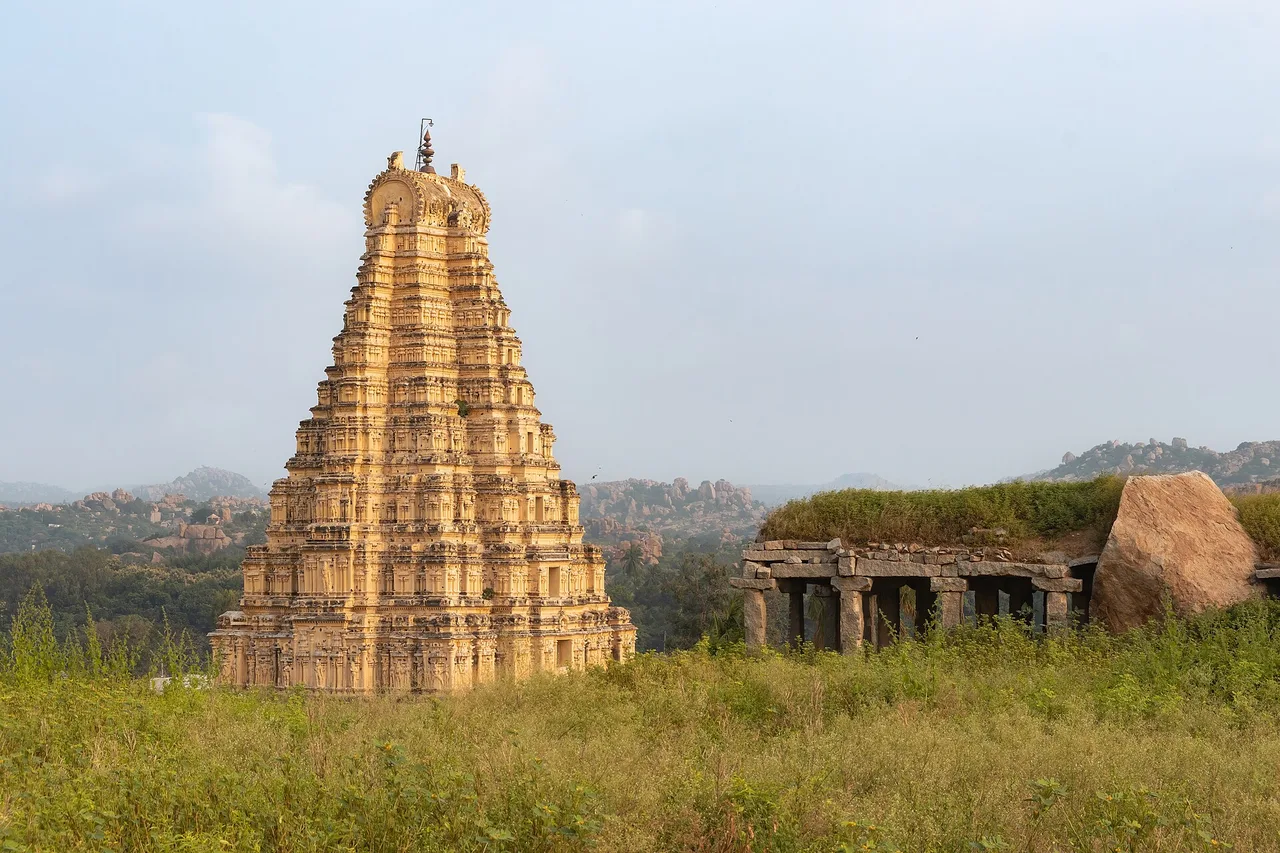
Start where the city still breathes. The Virupaksha Temple, at the western end of the Hampi Bazaar street, is dedicated to Lord Shiva and his consort Pampadevi — and the Vijayanagara district administration's own words are the ones to trust: it is "the only temple here that is still used for worship." Parts of the temple predate the Vijayanagara Empire itself; the ASI calls it the largest extant temple of the city — the temple of Pampapati, now in worship — and credits its magnificent entrance tower to Krishnadeva Raya. The district page adds the details to look for: the nine-storied gopuram that towers above every other structure at Hampi, and the ceiling of the Ranga Mantapa, painted with scenes from the epics and the Puranas. UNESCO's listing makes the same point from the heritage side: the temple is in constant worship, which is precisely why it has grown and changed in ways the dead temples have not.
That living status changes how you visit. This is a place of worship first and a monument second: Karnataka Tourism's own visitor guidance for Hampi is to remove footwear inside temple precincts, and to dress and behave accordingly. It also changes what this guide will print about it. The temple's darshan hours are quoted all over the internet — in at least three mutually contradictory versions — but no official page that could be read for this guide publishes the temple's darshan clock times. So no session times are printed here. Go in the morning or the evening, when a living temple is at its most itself. The bazaar street running east from the temple — a wide chariot street flanked by the rows of pillared mandapas UNESCO describes — is the Sacred Centre's spine: walk it, and the smaller shrines, the monolithic Ganesha statues the ASI singles out, and the river are all within reach.
SECTION 03Vittala Temple and the Stone Chariot
At the eastern end of the Sacred Centre stands the complex UNESCO calls "the most exquisitely ornate structure on the site" and the culmination of Vijayanagara temple architecture: the Vittala Temple. It is a fully developed temple in a cloistered enclosure pierced by three entrance gopurams, with its Kalyana and Utsava mandapas, a large stepped tank, and a grand bazaar street running down toward the river. Its most famous element stands in the courtyard: the Stone Chariot — in UNESCO's words, a Garuda shrine fashioned as a granite ratha, a temple car in stone, testifying to the chariot festivals that were integral to the temple's rituals. Karnataka Tourism adds the two facts every visitor repeats: the chariot is featured on the Indian fifty-rupee currency note, and its wheels were originally designed to rotate. The same official page lists the complex's other draw, the musical pillars — carved stone pillars that produce musical tones.
The approach is part of the visit. The riverside path east from the bazaar passes shrines and carved rocks the whole way; the road approach ends at a parking area short of the enclosure. Either way you arrive on foot for the last stretch, which is as it should be. Go early — Karnataka Tourism's guidance for the complex is that early mornings are best for photography, and the chariot courtyard fills fast once the day-trip vehicles arrive from Hosapete.
SECTION 04The Royal Centre: Lotus Mahal, Elephant Stables and the Queen's Bath
The Royal Centre is the empire's other face — not gods but government. The ASI's account of the Zenana Enclosure describes a massive stone basement of the Queen's palace and an ornate pavilion called the Lotus Mahal as the surviving remnants of a luxurious royal household, ringed by tall corner watchtowers. Karnataka Tourism's page on the Lotus Mahal explains its name: a two-storeyed, perfectly symmetrical pavilion whose arched windows resemble lotus petals and whose central dome is carved like a lotus bud — a building where Hindu and Islamic design blend, and one of the few at Hampi to survive the city's fall largely intact. UNESCO makes the wider point: Vijayanagara's secular buildings, the Queen's Bath and the Elephant Stables among them, adopted elements of Indo-Islamic architecture — domes and arches set down in a Hindu imperial capital.
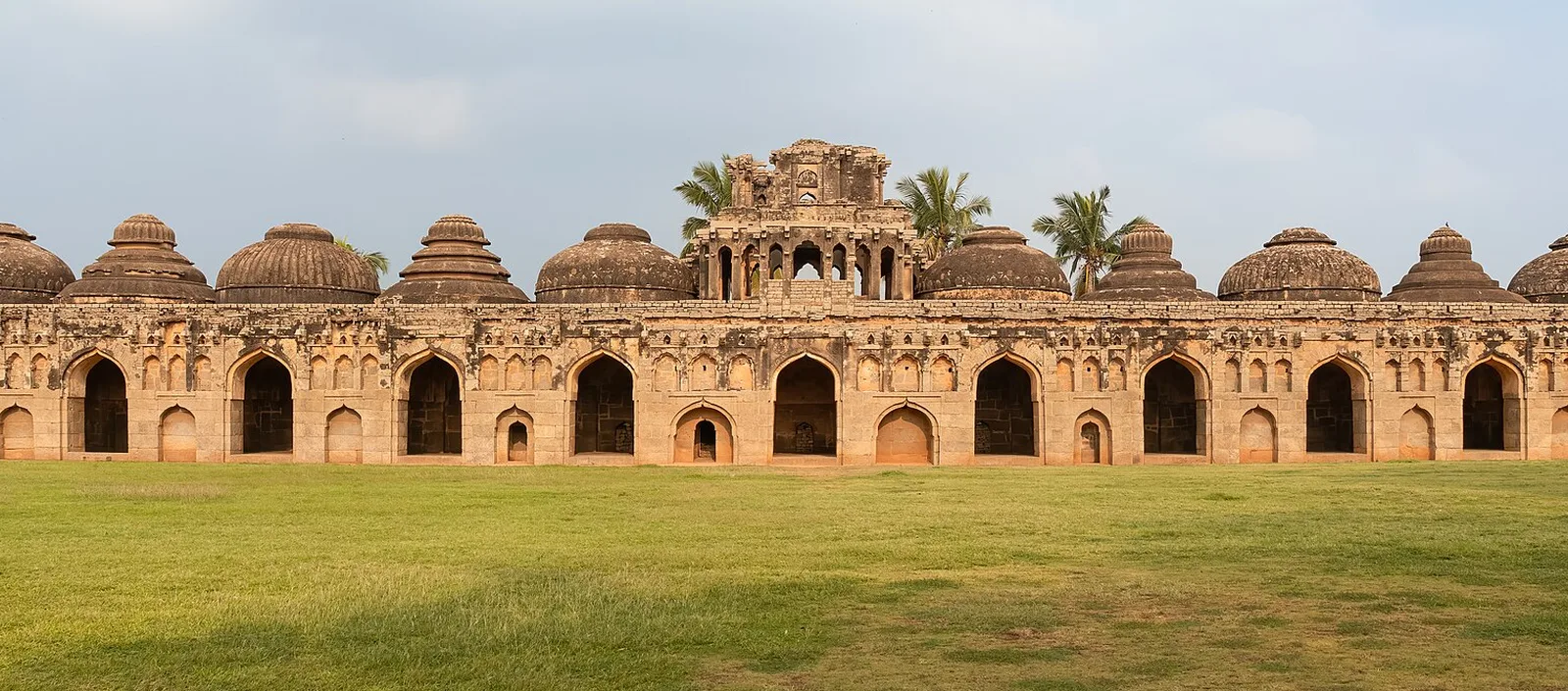
Walk the enclosure group as one visit. Beside the Zenana Enclosure stand the elephant stables — a long, domed row of chambers built for the royal elephants, as grand in its way as any temple here. The ASI's list of the centre's remains runs on: the Mahanavami Dibba, the great throne platform carrying beautifully sculptured panels, from which the king witnessed the festivals; the treasury enclosure; ponds and tanks, including the square stepped tank excavation brought to light south-west of the Dibba; and the audience hall and palace basements. The royal temples belong to this day too — the ASI names the Hazara Ramachandra temple among the city's notable shrines, the king's own chapel in the heart of the court. None of this needs a temple-by-temple ticket strategy; the money section below explains the single ASI arrangement that covers the day.
SECTION 05Hemakuta and Matanga: The Two Hills
Two hills frame the Sacred Centre, and each earns its climb. Hemakuta Hill, rising immediately beside the Virupaksha Temple, carries what UNESCO's listing names as the Hemakuta group of temples — a scatter of early shrines across a granite slope, and the finest view over the temple's gopuram and the bazaar street. It is the sunset climb for anyone staying in the village: ten minutes up, an hour's worth of looking. Matanga Hill, the high boulder ridge east of the bazaar, is the sunrise climb — the classic Hampi dawn, from the highest ground in the Sacred Centre, with the river bending away north and the whole sacred geography laid out like the map you have been walking. Neither hill is a ticketed monument; both are simply granite, and in the middle of the day both are furnaces. Dawn and dusk are the whole strategy — time the rest of the day around them.
SECTION 06Tickets, Timings and the Money
The money at Hampi is simpler than at almost any comparable site, because the ASI publishes one arrangement for the whole monument group. Its Hampi page states the opening hours first: the monuments are open from sunrise to sunset. Then the entry fee, in full: entry is free for children below 15 years; visitors from the SAARC countries the page names — Bangladesh, Nepal, Bhutan, Sri Lanka, Pakistan, Maldives and Afghanistan — and from the BIMSTEC countries — the same list plus Thailand and Myanmar — pay ₹40 per head; and the other foreign visitor total is ₹600. The Indian citizen rate is the same ₹40: the ASI's rate policy, as the Ministry of Culture has stated it, sets one citizens-of-India rate that applies equally to SAARC and BIMSTEC visitors.
Two practical consequences follow. First, this is a single ticket for the group of monuments, not a pay-per-temple system — the ASI accounts for Hampi as one ticketed monument, and the gated enclosures of the Vittala complex and the Zenana group work from that one ticket. Buy it once, and keep it on you for the whole day. Second, most of what you will see costs nothing at the gate at all: the bazaar streets, the riverside shrines, the hills and the open ruins of both centres are walked freely, and the Virupaksha Temple is a living place of worship, not a ticketed enclosure. No prices are printed here for battery carts, guides, cameras or cycle hire — none could be read from an official page — so expect modest local charges, agree them before you start, and carry cash in small notes.
SECTION 07Getting There and Getting Around
Hampi has no railway station of its own; it borrows Hosapete's. Hosapete Junction (HPT) is the railhead — about 13 km from Hampi on Karnataka Tourism's reckoning (the district administration says 12 km; either way, a short hop by bus or auto-rickshaw). The district page notes daily trains to Hosapete from the Hubballi and Guntakal junctions, and the overnight trains from Bengaluru are the route most visitors actually use. By road, Karnataka Tourism times Bengaluru at about six hours via NH48/NH50, and buses serve Hosapete and Ballari (65 km). By air, the closest airport is Jindal Vijayanagar Airport (Vidyanagar) — 38 km on the district page, with daily flights to Bengaluru and Hyderabad under the UDAN scheme; Hubballi Airport, 150 km away, is the larger alternative.
Inside Hampi, slow down — the site rewards it and the distances allow it. Karnataka Tourism's own summary is exact: auto-rickshaws and bicycles are the common modes within Hampi. The Sacred Centre is a walking site: bazaar, temple, hills and riverside path all join up on foot, and a hired bicycle extends the day's range to the Vittala Temple. The Royal Centre, spread around Kamalapura a few kilometres south, is where the auto-rickshaw earns its fare — hire by the trip or by the half-day, agree the price first, and cluster the enclosure, the stables and the Dibba into one circuit rather than paying for three separate hops.
SECTION 08Days, Season and the Rules That Matter
How long? Two full days is the honest minimum — one for the Sacred Centre with the Vittala Temple, one for the Royal Centre — and three days is the right allowance, buying you a sunrise on Matanga, a sunset on Hemakuta, and time for the river and the smaller shrines instead of a checklist march. When? Karnataka Tourism's official fast facts give two seasons: the monsoon (July–September) and the winter (November–February). Winter is the comfortable choice — cool mornings built for hill climbs — and it carries the festival calendar: the Virupaksha Temple Car Festival in January–February, and the Hampi Utsava, the state festival of music, dance and illuminated monuments, whose most recent edition ran 13–15 February 2026. The season to think twice about is high summer, when the granite holds the day's heat and the sunrise-to-sunset hours become a negotiation with the sun.
The rules are few, official and worth printing exactly as the authorities state them. From Karnataka Tourism's visitor guidance for Hampi: remove footwear inside temple precincts; carry water and sun protection — its festival guidance adds comfortable footwear for a site that involves walking, and hats, sunglasses and sunscreen against warm days. And from the same official guidance: Hampi is a strict plastic-free zone — carry a reusable water bottle. Add the obvious corollaries: the carvings are protected stone, not climbing frames, and the one living temple asks for a worshipper's manners, not a tourist's. Follow those, start early, and Hampi gives you back the rarest thing in Indian heritage travel — a great city with room to breathe in it.
FAQFrequently Asked Questions
How much is the entry fee at Hampi, and who pays what?
The ASI's published table for the Hampi monuments: ₹40 per head for Indian citizens — the same ₹40 the ASI's page prints for visitors from SAARC and BIMSTEC countries — ₹600 in total for other foreign visitors, and free entry for children below 15. It is one ticket for the monument group rather than a charge per temple, so buy it once and keep it with you through the day. The monuments are open from sunrise to sunset.
How many days do you need for Hampi?
Two full days at minimum: one for the Sacred Centre — Virupaksha Temple, the bazaar street, Hemakuta Hill and the Vittala Temple — and one for the Royal Centre around Kamalapura: the Zenana Enclosure and Lotus Mahal, the elephant stables, the Queen's Bath and the Mahanavami Dibba. A third day is strongly worth it for a Matanga Hill sunrise and a slower pace; Hampi punishes rushing more than almost any site in India.
When is the best time to visit Hampi?
Karnataka Tourism's official fast facts name two seasons: the monsoon (July–September) and the winter (November–February). Winter is the comfortable pick, with cool mornings for the hill climbs, and it holds the festival calendar — the Virupaksha Temple Car Festival in January–February and the Hampi Utsava, whose most recent edition ran 13–15 February 2026. Whatever the season: the ruins open at sunrise, and the hills are for dawn and dusk, not midday.
How do you reach Hampi from Bengaluru?
By train, take an overnight service to Hosapete Junction (HPT), about 13 km from Hampi, and continue by local bus or auto-rickshaw. By road, Karnataka Tourism times the drive at about six hours via NH48/NH50, and buses run to Hosapete and to Ballari (65 km away). The nearest airport is Jindal Vijayanagar (Vidyanagar), 38 km from Hampi with daily flights to Bengaluru and Hyderabad; Hubballi Airport, 150 km away, is the larger alternative.
Is the Virupaksha Temple included in the ASI ticket, and what are its darshan timings?
The Virupaksha Temple is a living temple — the district administration calls it the only temple at Hampi still used for worship — and it is visited as a place of worship, not as a ticketed enclosure: remove footwear inside the precincts, as Karnataka Tourism's guidance directs. Its darshan clock times are quoted inconsistently across unofficial pages, and no official page that could be read for this guide publishes them, so this guide prints no session times: go in the morning or evening and take the day's rhythm from the temple itself.
Official references and checking status
Every changeable fact in this guide was checked on 31 October 2026 against the official sources listed below, and the accompanying sources file records which page supports which claim. Three limits are flagged where they occur in the text: the Indian-citizen ₹40 rate is printed on the basis of the ASI's Hampi fee table read together with the ASI rate policy the Ministry of Culture has stated (one citizens-of-India rate, applying equally to SAARC and BIMSTEC visitors); the single-ticket coverage of the monument group is stated at the strength of the ASI's own accounting for Hampi as one ticketed monument; and the Virupaksha Temple's darshan times are not printed at all, because no official page that could be read publishes them and unofficial listings contradict each other. Confirm current prices and timings on the official sites before you travel.
- Archaeological Survey of India (official) — Hampi: the city's history and remains, opening hours (sunrise to sunset) and the entry-fee table
- UNESCO World Heritage Centre (official) — Group of Monuments at Hampi: inscription, criteria (i)(iii)(iv), 4,187.24 hectares, the Vittala Temple and Stone Chariot, the Queen's Bath and Elephant Stables, the Virupaksha Temple in constant worship
- Karnataka Tourism (official) — Vijayanagara district: when to go (monsoon July–September, winter November–February), the Hampi Fest and the Virupaksha Temple Car Festival
- Karnataka Tourism (official) — the Stone Chariot: the fifty-rupee note, Garuda shrine, musical pillars, Hosapete station 13 km, footwear and photography guidance
- Karnataka Tourism (official) — Hampi Utsava 2026 (13–15 February): how to reach Hampi, the plastic-free-zone rule and visitor guidance
- Vijayanagara District Administration (official) — the Virupaksha Temple: the only temple at Hampi still used for worship, its nine-storied gopuram, and how to reach Hampi by air, train and road
Photos: the Elephant Stables at Hampi, photographed across their full domed length in the Royal Centre, by iMahesh, via Wikimedia Commons, licensed under CC BY-SA 4.0; the gopuram of the Virupaksha Temple in morning light above the boulder landscape, by iMahesh, via Wikimedia Commons, licensed under CC BY-SA 4.0. Photographers keep their copyright; the licences require this credit.
General information only. This guide is based on official sources publicly available and checked on the date shown on this page. Visa rules change, and consular and USCIS officers decide every case on its own facts — nothing here is a confirmation or a guarantee for your individual case, and this is not legal advice. Always confirm the current requirement on the official page linked in this guide before you act, and consider a qualified immigration attorney for your specific situation.