
Researched & checked — 3 Nov 2026
Gulmarg: The Gondola, the Ski Slopes and the Meadow, Planned on Official Facts
NEW Published 3 November 2026
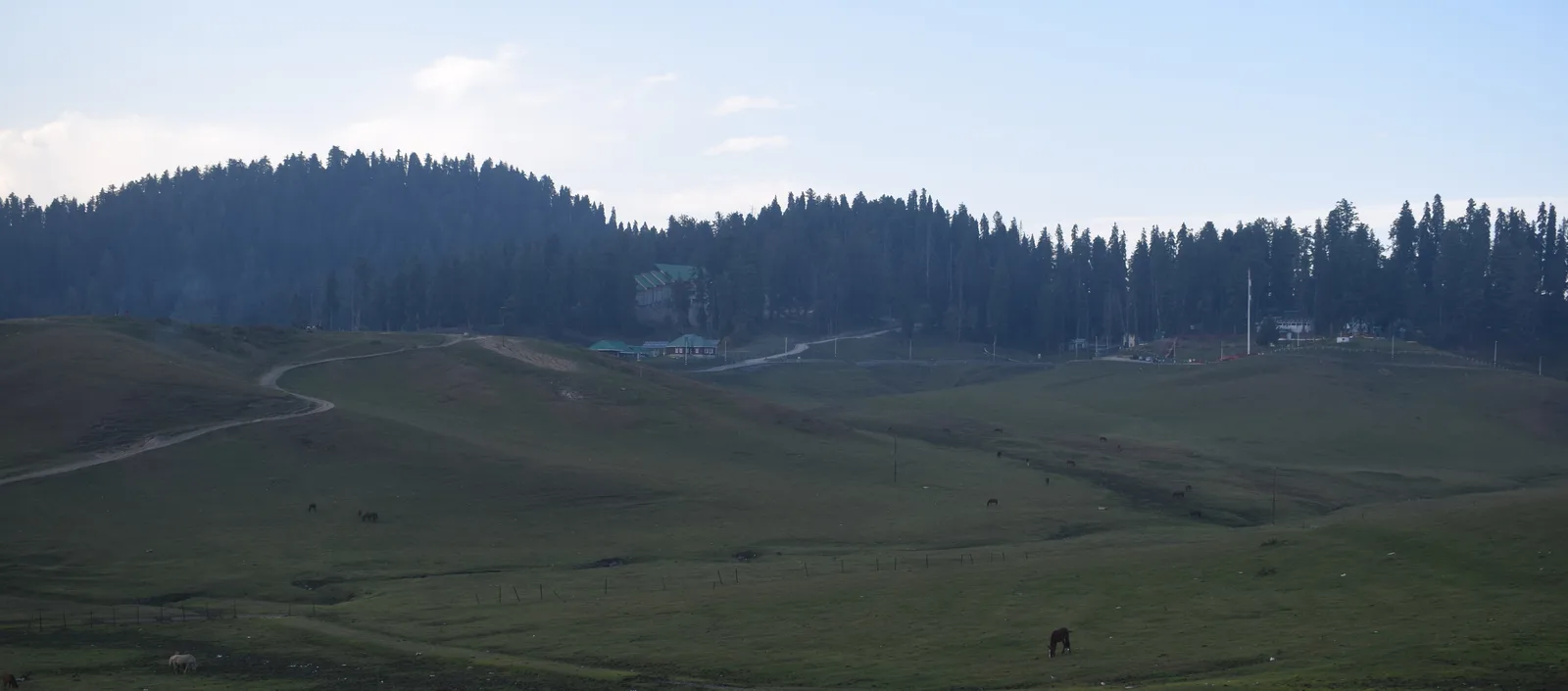
Gulmarg is two destinations sharing one bowl of grass: a winter ski resort whose gondola climbs in two phases to nearly 4,000 metres on Apharwat, and a summer meadow of wild flowers with one of the world's highest golf courses at its centre. It is planned here from J&K Tourism, JKTDC, the Cable Car Corporation and the district administration — except the gondola's current fare, which is left blank, with the reason stated.
The Gulmarg Gondola, run by the J&K Cable Car Corporation, climbs in two phases: Phase 1 from Gulmarg to Kongdoori (about 10 minutes) and Phase 2 from Kongdoori to Apharwat (about 12 minutes, to 3,980 m), in small yellow six-seat cabins. JKTDC puts the best skiing season from November to February, on slopes between 8,700 and 10,500 feet. In summer the same bowl is the flower meadow its name promises, with an 18-hole golf course at 2,650 m. Gulmarg is under two hours by road from Srinagar, via Tangmarg. Book only through the Corporation's own online booking, and take the fare from there — this guide prints none.
SECTION 01First, the Meadow: What Gulmarg Actually Is
Start with the name, because both the district administration and JKTDC translate it the same way: Gulmarg literally means "meadow of flowers". The Baramulla district administration records that the place was earlier called Gaurimarg, after the goddess Gauri, and that the Kashmiri ruler Yousuf Shah Chak renamed it Gulmarg — the place of roses. It is a town and hill station in Baramulla district, which JKTDC places about 52 km southwest of Srinagar — a resort long before it was a ski destination: the district page notes it drew the kings Yousuf Shah Chak and Jahangir, and was a favourite summer retreat for the British in India.
The shape of the place is a wide, open bowl of sloping grass, and it sits high. JKTDC's ski slopes begin at 8,700 feet (about 2,650 m), and the golf course in the middle of the meadow is measured by both JKTDC and the Tourism Department at 2,650 m above sea level — high enough that the air is thin and the sun strong, even for a walk across the grass. Everything else hangs off that bowl: the gondola climbs out of it, the ski runs descend it, and in winter, in the district administration's words, it lies under "a white blanket of snow" and becomes a skier's paradise.
That gives Gulmarg two seasons rather than one best time: winter for the snow sports of Section 05, late spring and summer for the meadow, pony rides and golf of Sections 06 and 07 — and the gondola, which runs across both, gets the next two sections.
SECTION 02The Gondola: Two Phases, Two Different Mountains
The Gulmarg Gondola is the reason most people come, and JKTDC describes it plainly: it operates in two levels. The first carries you from Gulmarg up to Kongdoori; the second continues from Kongdoori to Apharwat. The system as a whole, in JKTDC's figures, uses 36 six-seat cabins, rises through 1,330 m of height and covers nearly 5 km to reach the second level at 3,980 m on Apharwat Peak. The cabins are small and yellow, with room for six adults — a working mountain lift, not a scenic capsule, so expect to share.
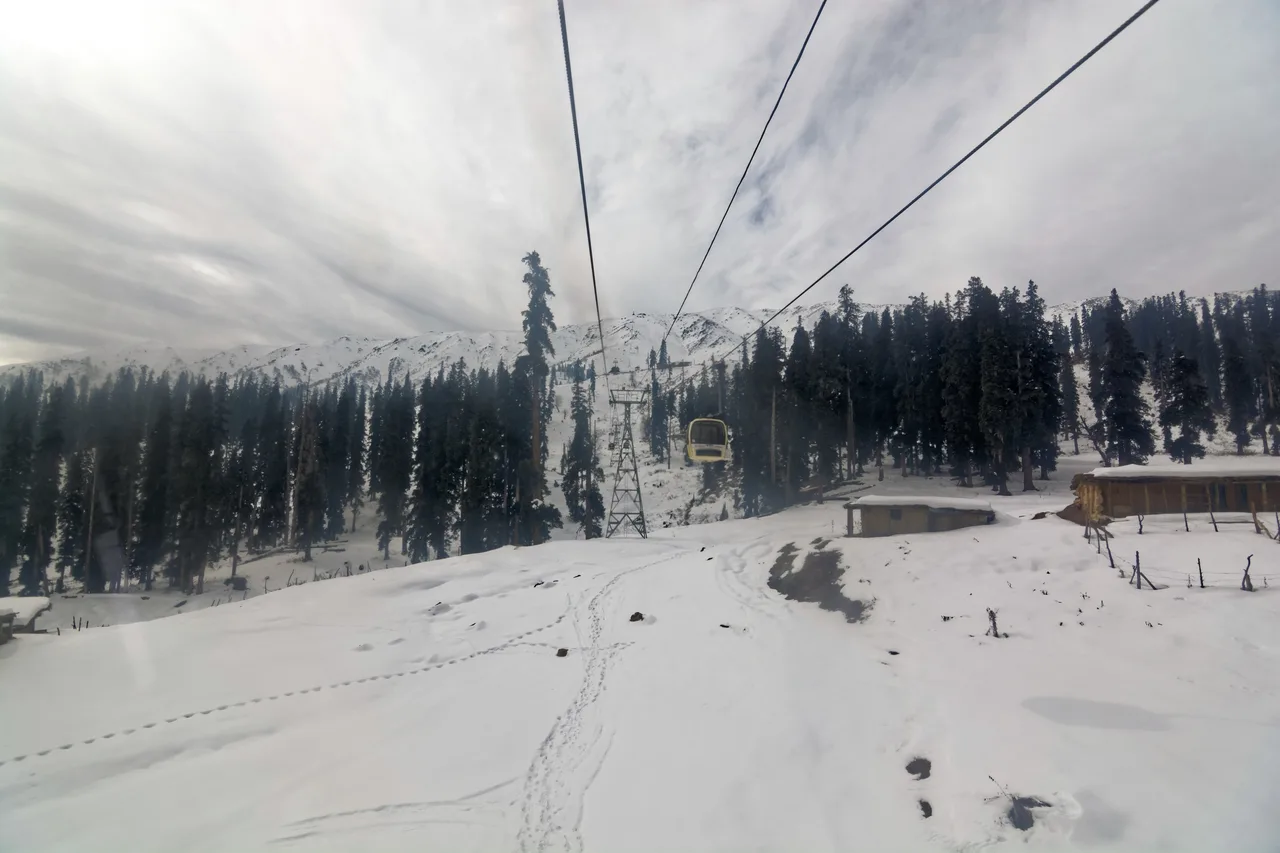
Phase 1 — Gulmarg to Kongdoori — takes about 10 minutes and climbs to about 3,100 m. Kongdoori is a broad mountain bowl in its own right: in winter, the snow-play and learner-skiing level most day visitors are picturing, and the district administration notes that riders come up here for the view towards the frozen lake of Al-Pathar.
Phase 2 — Kongdoori to Apharwat — takes about 12 minutes and is a different proposition: a steep climb to the station at 3,980 m, on Apharwat Peak's shoulder. From the top station, JKTDC notes, a thirty-minute walk takes you to the actual peak. What Phase 2 reaches is the high snow country — the long ski descents' starting point in winter and, in summer, snowfields above a green valley. It is also the exposed end of the system, the phase bad weather stops first. Decide about it on the day, at Kongdoori, with the weather in front of you.
SECTION 03Booking the Gondola — and the Fare This Guide Will Not Print
The operator matters, so name it: the gondola is run by the Jammu & Kashmir Cable Car Corporation, established in 1988 — its own site describes it as the organisation developing and operating ropeways across Jammu and Kashmir. Its website, jammukashmircablecar.com, carries the online booking, which leads to the Corporation's e-ticket portal: that portal alone is the authoritative place to book and to learn the fare. Book there, in advance, in season.
Now the honesty this guide owes you. No gondola fare is printed here, deliberately. When checked on 3 November 2026, the Corporation's e-ticket portal could not be read — it refused the connection — so the current tariff could not be verified from the operator's own channel. The fallback sources contradict each other: one JKTDC page quotes ₹100 and ₹250, figures from another era, while a second quotes ₹750 and ₹950, and unofficial pages offer still other numbers. Printing any of these as "the fare" would be a guess dressed as a fact. So: the fare the Corporation's portal shows for your date and phase is the fare — the phases are ticketed separately, and Phase 2 presupposes Phase 1. Anything quoted by a tout at Tangmarg or a reseller near the base is a markup on that figure.
Two practical corollaries. Carry the booking on your phone with matching ID, and arrive for your slot in good time — a missed slot on a sold-out day is simply lost. And check the Corporation's website before you set out: its notifications and announcements page is where a maintenance or weather closure appears first.
SECTION 04Apharwat: The Peak Above the Lift
Apharwat is the mountain the whole system leans against. JKTDC gives Apharwat Peak as 13,500 feet high, thirteen kilometres from Gulmarg, and notes the fact that shapes everything about it: it lies close to the Line of Control. No permit regime for the gondola ride itself appears in the official descriptions — but expect a visible army presence at altitude, follow instructions, and do not wander from the station areas and marked ground.
The most useful sentence in JKTDC's material warns that the Apharwat area is covered in snow even in summer, and advises carrying adequate winter protection — with the rider that some items can be hired locally. Take both halves seriously: at 3,980 m, in any month, you step out into snow, wind and high-altitude sun wearing whatever suited a green meadow at the bottom — unless you planned otherwise. Hire boots and a jacket at the base or at Kongdoori if your kit stops at trainers and a fleece.
JKTDC's description of the high ride also carries a blunt caution: it states that the climb is not allowed for people with heart or respiratory problems, or for children below five years of age. This guide reports that caution as the department prints it. If it touches anyone in your group, settle Phase 2 with the Cable Car Corporation before you travel — not at the turnstile, at 3,980 metres, with a child in your arms.
SECTION 05Skiing: The Season, the Slopes and the Setup
JKTDC states the season without qualification: the best season for skiing is from November to February. Its slope figures are equally direct — the slopes in Gulmarg vary between 8,700 and 10,500 feet, and the department calls them the highest ski slopes in India; of Apharwat's slopes above the lift it goes further, calling them the longest and highest in Asia. Treat the superlatives as the department's own billing. The substance beneath them is real: a gondola topping out at 3,980 m serves descents no other Indian resort matches, and the district administration adds that the natural slopes are untouched and challenge even accomplished skiers.
The ski area, as JKTDC lays it out, has three layers: the gondola terrain on Apharwat, where the long runs begin; the lower tree-skiing areas on the wooded slopes above town; and the poma-lift terrain in the town itself, the gentle ground where beginners learn. The department notes that ski lifts and chair lifts are available for amateurs. Around the edges sits the rest of its winter menu: snowboarding, tobogganing, snow scooters and snow bobbing.
For visitors who arrive with nothing, the department assures that skis, sticks, boots and other equipment are easily available in Gulmarg, and so are ski instructors — hire and tuition are part of the town's winter economy. For structured teaching, the Indian Institute of Skiing and Mountaineering, established here by the Ministry of Tourism in 1968 (as the Gulmarg Winter Sports Project), runs 14-day snow skiing and snowboarding courses, booked through its own site; no course fee is printed here, as none could be read on its official text. And a season is a window, not a promise — a poor-snow January is possible in any year.
SECTION 06The Summer Meadow: Khilanmarg and the Green Season
Strip the snow away and the bowl justifies its name: the summer Gulmarg of the official pages is a walking destination, its excursions measured in strolls rather than expeditions. The classic one is Khilanmarg, which JKTDC places 4 km from the Gulmarg bus stop, reached by walking out across the meadows. JKTDC promises what the walk delivers: wild flowers in spring, and on a clear day the long northern view — Nanga Parbat on the horizon, and the twin peaks of Nun and Kun. No ticket, no lift, no schedule — the anti-gondola excursion, and on a fine June morning arguably the better one.
The district administration's page fills in the gentler circuit: horse riding out to Strawberry Valley and Leopards Valley, and ponies up to Kongdoori for the gondola's first level at walking pace. Add the golf course of the next section, and summer Gulmarg explains itself — a summer resort for a century before it was a ski resort, asking nothing of you except time. The one discipline summer shares with winter is the top of the lift: even in July, Section 04's snow warning for Apharwat stands.
SECTION 07The Golf Course: Eighteen Holes at 2,650 Metres
In the middle of the meadow sits one of the more improbable sporting grounds in Asia. JKTDC and the Tourism Department agree on the essentials: the Gulmarg golf course lies at 2,650 m above sea level, and both describe it as the highest green golf course in the world. It is an 18-hole course — par 72 in the department's account — and no relic behind glass: JKTDC, which manages the course completely, notes that temporary membership, even for a single day, is available, and the department adds that golf sets and balls can be hired from professionals registered with the department.
The history is layered, and the two official accounts layer it slightly differently — this guide reports both rather than fusing them. The Tourism Department records that a first six-hole course was laid out in 1890–91 by Colonel Neville Chamberlain, its greens then called "browns", and dates the Gulmarg Golf Club's start to 1911; JKTDC dates the course's opening to 1904 and likewise credits the British with the club. Both agree the first golf championship was played here in 1922; the department adds the Nedou's Cup in 1929. It remains one of India's oldest courses, still in use in season.
The season has a hard edge the department states plainly: the course remains covered under snow from December to April — golf here is a late-spring-to-autumn game. One honesty note: the department's page remarks that the course has been under a major renovation, but the remark is undated, so this guide asserts nothing about its present works status. If a round is the point of your trip, confirm through JKTDC that the course is open and playing before building the journey around it.
SECTION 08Getting There — and the Day-Trip Question
Almost everyone arrives from Srinagar — if you are basing yourself on Dal Lake first, read our Srinagar and Dal Lake guide alongside this one. JKTDC's access summary: Gulmarg can be reached from Srinagar city or from Srinagar's airport (SXR) in under two hours by car or bus, with the airport put at about 57 km from Gulmarg. The road divides in two: the valley run to Tangmarg takes about an hour; from Tangmarg, in the department's words, the Gulmarg plateau is just 30 minutes of travel — the climbing half-hour that does the real ascent. The district administration's figures sit nearby rather than identical (about 54–60 km from Srinagar, the nearest railhead at Baramulla about 53 km), so the honest planning unit is the department's: under two hours, in fair conditions. In snow months, allow more.
So: day trip or stay? The day trip is feasible and is what most Srinagar-based visitors do — up after breakfast, gondola mid-day, back by evening; it suits a Phase 1 ride and a meadow walk in settled weather. Stay when you are skiing (the mountain's day starts before the day-trippers' road does), when you want Phase 2 with a weather margin rather than a slot gambled against the return drive, or for the meadow's quiet hours. JKTDC counts around 40 hotels in Gulmarg, and in peak snow weeks it is the day-trippers who lose hours to the road and the base-station queue.
SECTION 09Weather and Closures: What No One Can Promise You
End with the discipline the whole guide runs on. The gondola is a high mountain ropeway, and ropeways stop: for scheduled maintenance, for high wind, for the weather a 3,980 m station attracts in every season. This guide prints no closure calendar and no daily timings, because no official page read for it publishes a schedule it could stand behind — any fixed closure-day rule or guaranteed first-cabin time you are quoted is material the operator has not published in readable form. The operator's actual channel is the one named in Section 03: the Cable Car Corporation's notifications page. Check it the day before and again on the morning of your gondola day.
The same honesty governs snow. JKTDC's November-to-February season states when Gulmarg skiing happens — it is not, and no official source pretends it is, a guarantee of snowfall on your dates; cover varies year to year and week to week. Build the trip so a closed Phase 2 or a thin-snow week spoils a day rather than a holiday: keep Khilanmarg, the meadow, the golf and Srinagar itself in reserve, travel in the deepest part of the season for snow, and let the mountain make the final decision. It will anyway.
FAQFrequently Asked Questions
Do I need both gondola phases, or is Phase 1 enough?
Phase 1 alone is a complete trip: about 10 minutes to Kongdoori at roughly 3,100 m — snow play, learner skiing and the Al-Pathar view. Phase 2, 12 more minutes to 3,980 m on Apharwat, adds the high snow country, the long ski descents and a 30-minute walk to the peak. Add it for skiing or on a clear, settled day; skip it in poor weather, or where JKTDC's caution applies — the high climb is not allowed for people with heart or respiratory problems or children below five.
How much does the Gulmarg Gondola cost?
This guide prints no fare, deliberately. The operator is the J&K Cable Car Corporation, and its e-ticket portal is the only authoritative source — but the portal could not be read when checked (3 November 2026), and JKTDC's pages quote two conflicting, dated tariffs (₹100/₹250 on one, ₹750/₹950 on another). The only figure vouched for here is the one the Corporation's booking at jammukashmircablecar.com shows for your date. The phases are ticketed separately; anything a tout or reseller quotes is a markup on it.
When should I come — for snow, or for the meadow?
Different trips. For snow, JKTDC's ski season is November to February, on slopes of 8,700–10,500 feet — though no official source guarantees snowfall in any month. For the meadow, late spring and summer: Khilanmarg's wild flowers, the golf course out from under its December-to-April snow, the bowl green. Either way, Apharwat is snow-covered even in summer — carry winter protection for Phase 2 in any month.
Can I do Gulmarg as a day trip from Srinagar?
Yes — the standard pattern. JKTDC puts the drive at under two hours each way (airport about 57 km): an hour to Tangmarg, then 30 minutes up to the plateau. A day trip suits a Phase 1 ride and the meadow in settled weather. Stay overnight — around 40 hotels, per JKTDC — if skiing, if you want a weather margin for Phase 2, or for the meadow's quiet hours.
What if the gondola is closed on the day I go?
It happens, and no honest guide can timetable it away: a ropeway topping out at 3,980 m stops for maintenance and weather, and the operator publishes no closure calendar that could be read for this guide. Check the Corporation's notifications page the day before and on the morning. Keep a non-gondola day in reserve — Khilanmarg, the golf course and the meadow need no lift. And if only Phase 2 is closed, Phase 1 to Kongdoori remains a complete trip, weather allowing.
Official references and checking status
Checked on 3 November 2026 against the official sources below; the accompanying sources file maps each claim to its page. Four limits are flagged honestly. First, no gondola fare is printed: the Corporation's e-ticket portal refused the reader's connection, and JKTDC's two pages quote conflicting, evidently dated tariffs (₹100/₹250 with a ₹1,000 day pass on one; ₹750/₹950 on the other) — the portal's figure for your date is the only fare vouched for here. Second, no timings or closure calendar are printed, because no official page read publishes them in checkable form; the Corporation's notifications page is the live source. Third, official pages disagree on the Srinagar distance (52 km in JKTDC's destination text; about 54–60 km on the district page), the phase stations' heights (JKTDC's 3,980 m against the district's 12,293 feet) and the golf club's founding (1904 against 1911); the guide prints the tourism corporation's figures and records the variants in its sources file. Fourth, IISM course fees are not printed, as they could not be read on the Institute's official text. Confirm current prices and timings on the official sites before you travel.
- J&K Cable Car Corporation (official) — the gondola's operator: about the Corporation, online booking and notifications
- JKTDC (official) — Gulmarg: the gondola's two levels, Kongdoori, Apharwat, skiing, the golf course, Khilanmarg and access
- J&K Tourism (official) — Gulmarg Golf Club: altitude, par, history, snow cover and equipment hire
- Baramulla District Administration (official) — Gulmarg: the name, the phases' heights, excursions and road distances
- Indian Institute of Skiing and Mountaineering, Gulmarg (official) — ski and snowboard courses
Photos: The Gulmarg meadow in summer, by Mr. Debapriya Hore, via Wikimedia Commons, released under CC0; a Gulmarg Gondola cabin in winter, by Slyronit, via Wikimedia Commons, licensed under CC BY-SA 4.0.
General information only. This guide is based on official sources publicly available and checked on the date shown on this page. Visa rules change, and consular and USCIS officers decide every case on its own facts — nothing here is a confirmation or a guarantee for your individual case, and this is not legal advice. Always confirm the current requirement on the official page linked in this guide before you act, and consider a qualified immigration attorney for your specific situation.