
Researched & checked — 30 Oct 2026
Kolkata in 2 Days: Victoria Memorial, the Metro and the City of Trams
NEW Published 30 October 2026
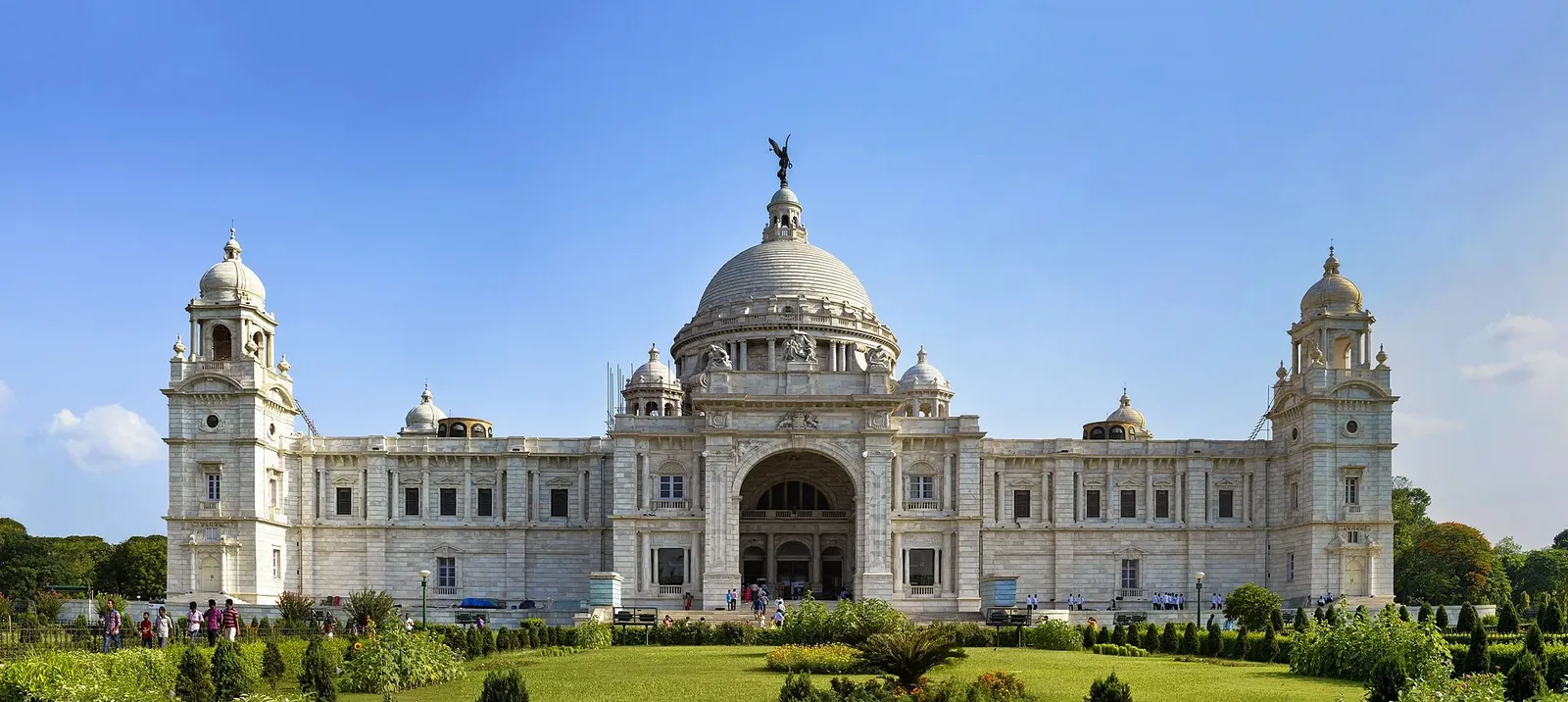
A two-day Kolkata plan in two clusters — the Maidan, the Victoria Memorial and the Indian Museum on Day 1; the river temples of Dakshineswar and Belur Math, the Howrah Bridge and a tram ride on Day 2 — with the ticket tiers, closed days and metro fares that decide what fits where.
Day 1 (the centre): the Victoria Memorial gardens early, the museum galleries when they open at 10:00 AM (₹50 for Indian nationals, ₹500 for other foreign nationals; gardens are a separate ₹30 ticket), then the Indian Museum (₹75 / ₹500, closed Mondays — as is the Victoria Memorial, so never make Day 1 a Monday). Day 2 (the river): metro north to Dakshineswar temple (free entry), across the Hooghly to Belur Math (free entry), back via the Howrah Bridge on foot, and a tram ride from Esplanade if the day allows. Confirm current prices and timings on the official pages below before you go.
SECTION 01How This Two-Day Plan Is Shaped
The plan follows Kolkata's geography. Day 1 stays in the centre, around the Maidan — the great open ground that gives the city its breathing space — where the Victoria Memorial stands at the southern end and the Indian Museum sits a short walk north near Park Street. Nothing on Day 1 needs more than a short metro hop or a walk, which is what makes room for two major museums in one day without the day feeling like transit.
Day 2 goes north along the river. Dakshineswar, the Kali temple town at the metro's northern end, and Belur Math, the Ramakrishna monastery headquarters on the opposite bank, are a natural pair joined by a short river crossing. The day returns south through Howrah — across the bridge every photograph of Kolkata knows — and ends in the centre, where the surviving tram routes run.
One calendar rule shapes everything: both Day 1 museums close on Mondays. If one of your two days is a Monday, make it the river day — the temples keep their own daily rhythm regardless. The rest of the plan rearranges freely.
SECTION 02Day 1, Morning: The Victoria Memorial — Gardens First, Then the Galleries
The Victoria Memorial is Kolkata's centrepiece: a vast white marble memorial-museum set in gardens at the Maidan's southern edge, at 1 Queen's Way. The institution's own visitor page splits the visit into two separately ticketed parts, and understanding that split is the key to planning the morning.
The gardens open first and open every day: 6:00 AM to 6:00 PM, at ₹30 per head per entry. An early garden visit — the marble bright, the lawns quiet, the city's walkers out — is the calmest hour the memorial offers. If you will return across a longer stay, the same page lists annual garden passes at ₹1,000 for senior citizens (60+) and ₹2,000 for others. Note the line the institution prints in terms: a garden ticket does not entitle entry to the museum building.
The museum galleries open at 10:00 AM and close at 6:00 PM, and are closed on Mondays and on designated national holidays — the institution lists Republic Day, Holi/Dol Yatra, Id-ul-Fitr, Independence Day, Gandhi's Birthday, Dussehra/Vijay Dashami and Christmas Day. The museum ticket is tiered by nationality: ₹50 for Indian nationals, ₹100 for citizens of SAARC countries (passport required) and ₹500 for nationals of all other countries. Entry is free for school students up to Class XII in uniform with a school ID, for differently-abled visitors with a UDID card, and for serving and retired Army, para-military, West Bengal Police and Kolkata Police personnel and their immediate families with ID. Ticket counters close 30 minutes before the museum does, so a late-afternoon entry needs the counter by 5:30 PM. The memorial also runs a light and sound show; its own page warns the schedule is subject to last-minute change and publishes no fare, so check at the gate and treat any printed show price elsewhere with caution.
Pacing: gardens early, then the galleries at the 10:00 AM opening for two hours or so — leaving the afternoon free for the second museum.
SECTION 03Day 1, Afternoon: The Indian Museum and Park Street
A short walk north brings you to the Indian Museum at 27 Jawaharlal Nehru Road, by Park Street. The museum's own site describes it as founded in 1814 at the Asiatic Society of Bengal, and the earliest and largest multipurpose museum in the Indian subcontinent and the Asia-Pacific region. Two centuries of collecting means the visit is a selection, not a survey: most first-timers head for the Egyptian gallery, the sculpture and the natural history halls.
The museum publishes its ticket plainly on its official site: adults ₹75, visitors below 18 years ₹20, and foreign nationals ₹500, with organised school groups (to Std XII) admitted free. Photography is charged separately and precisely: a smartphone camera is ₹50 plus 18% GST, a DSLR ₹100 plus 18% GST — so decide at the counter whether the camera comes out. Hours are 10:00 AM to 6:00 PM, Tuesday to Sunday; the museum is closed on Mondays — the second half of this itinerary's Monday rule.
Finish Day 1 around Park Street and Chowringhee, the city's old dining quarter, a few minutes from the museum's door — dinner here, and the metro home from Park Street station.
SECTION 04Getting Around: The Kolkata Metro
Kolkata's metro is part of the city's story: Metro Railway's official history records that the system began in 1984, the first metro in India, and calls it the lifeline of the "City of Joy". For this itinerary the line that matters is the north–south Blue Line, linking the centre — Esplanade, Park Street and Maidan serve Day 1 — with Dakshineswar at its northern end for Day 2. It is the fastest way across a city whose surface traffic is famously slow.
Fares are zone-based by distance, and here this guide prints its position with a flag. Metro Railway's published fare structure for the North–South line, as reproduced from its official fare circular, runs: ₹5 for journeys up to 5 km, ₹10 for 5–10 km, ₹15 for 10–20 km, ₹20 for 20–25 km and ₹25 for 25–30 km, with the same fare for a single-journey token or a smart card. On that structure, most hops within the centre cost ₹5–₹10, and the long run from the centre to Dakshineswar falls in the ₹15 zone. The same circular prices a smart card recharge bonus (₹100 paid gives ₹110 of ride value) and a one-day Tourist Smart Card at ₹250 plus a ₹60 refundable deposit, for unlimited rides. We flag these figures as partially verified: Metro Railway's own website did not render its fare chart in a form we could read when we checked on 30 October 2026, so confirm your journey's fare against the chart displayed at the station.
SECTION 05The Trams, Honestly: What Still Runs
Every older account of Kolkata gives the trams a starring role, so this guide states the current position plainly: the network has contracted sharply, and what survives is a remnant. Kolkata remains India's only tram city — electric trams have run here since 1902 — but the network that once covered the city now operates, on the best corroborated position we could establish, just two routes: Route 5 between Esplanade and Shyambazar, and Route 25 between Gariahat and Esplanade, run by the West Bengal Transport Corporation (WBTC), into which the old Calcutta Tramways Company was merged. Treat the tram as an experience, not transport: ride Route 5 from Esplanade up through the old north-city streets, slowly, for the ride itself.
This guide prints no tram fare. No WBTC page rendering current tram fares could be read when we checked, and this site does not print fares it cannot verify — expect a small cash fare and confirm at the depot or with the conductor. The same honesty applies to frequencies: the surviving services run to a local rhythm rather than a published visitor timetable, so build the tram into Day 2's loose end rather than a timed connection.
SECTION 06Day 2: Dakshineswar, Belur Math and the Howrah Bridge
Morning at Dakshineswar
Ride the Blue Line north to its end. Dakshineswar's Kali temple stands on the eastern bank of the Hooghly, built in 1855 by Rani Rashmoni — a philanthropist and devotee of Kali — with the goddess worshipped here as Bhavatarini. The compound centres on the nine-spired main temple, with twelve Shiva shrines along the riverfront, a Radha-Krishna temple and the Nahavat-Khana, the room where Ramakrishna — the 19th-century mystic whose association made this temple famous across India — spent much of his life.
Entry position, stated as this guide found it: Dakshineswar is a working temple and entry carries no ticket. Its day runs in two sessions — morning and afternoon–evening — with a closure between them, and the exact hours vary with the season. We print the pattern rather than precise times because the temple's own website could not be used as a source (the domain returned unrelated spam content when checked) and listings disagree on the hour. Arrive in the morning session, and confirm the day's timings locally before you set out.
Across the river to Belur Math
Directly across the Hooghly from Dakshineswar stands Belur Math, the headquarters of the Ramakrishna Math and Mission founded by Swami Vivekananda — a serene monastery campus whose main temple blends church, mosque and temple forms in a way found nowhere else. Like Dakshineswar, it is a place of worship open to visitors with no entry ticket, keeping morning and afternoon sessions with a midday closure. A local ferry links the two ghats when it is running — the natural way to pair the two — with the road bridge at Bally as the fallback.
If you stay into the evening, the Math's own website publishes its Sandhya Arati (evening prayer) times by date through the year, because the arati follows the sunset: in late October it falls at about 5:25 PM. It is a calm, fitting way to end the river day — check the exact date's timing on the Math's site, arrive before the gates' session ends, and keep the silence the campus asks for.
Back south: the Howrah Bridge
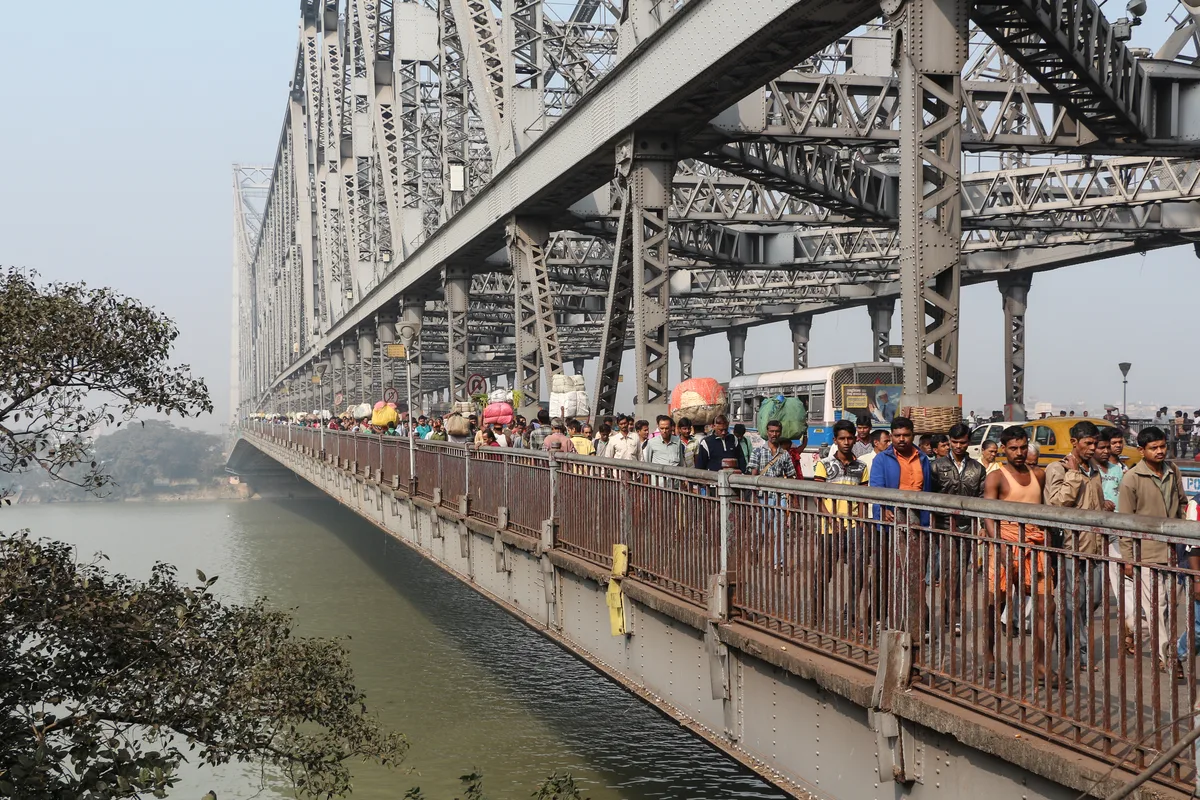
Return to the centre via Howrah, and cross the Howrah Bridge the way Kolkata does — on foot, on its pedestrian paths, alongside the traffic. The bridge is working public infrastructure, a road bridge over the Hooghly between Howrah and Kolkata: no ticket, no tour, nothing to book; you simply walk it, with the river below and the skyline opening up as you cross. Below the Kolkata end spreads the Mallick Ghat flower market, at its most colourful early in the day. From the bridge's eastern end, Esplanade is a short hop — and the tram terminus, if the day still has room for the ride north.
SECTION 07Before You Go: Checks for the Two Days
- ☐ Never make the museum day a Monday. The Victoria Memorial galleries and the Indian Museum both close on Mondays; put the river day there instead.
- ☐ Budget the two Victoria Memorial tickets separately — gardens ₹30 (open daily, 6:00 AM–6:00 PM), museum ₹50 / ₹100 (SAARC) / ₹500, counters closing 30 minutes before the 6:00 PM close.
- ☐ Carry ID that matches your ticket tier. The Memorial's SAARC rate requires a passport; its free categories require the listed ID or uniform.
- ☐ Decide on photography at the Indian Museum counter — ₹50 plus GST for a phone camera, ₹100 plus GST for a DSLR; entry itself is ₹75 / ₹20 / ₹500.
- ☐ Check the metro fare at the station chart. The zone structure in this guide (₹5–₹25 on the North–South line) is partially verified; the station chart is the authority on the day.
- ☐ Confirm temple session times locally. Dakshineswar and Belur Math both close over the middle of the day; arrive in a morning session, and check Belur Math's published arati time for your date.
- ☐ Keep the tram flexible. Two routes survive (5 and 25, both via Esplanade); ride for the experience, pay the small cash fare on the day, and do not build a timed connection around it.
FAQFrequently Asked Questions
What is the best way to split Kolkata into 2 days?
By cluster. Day 1 in the centre: the Victoria Memorial (gardens early, galleries from 10:00 AM) and the Indian Museum, around the Maidan and Park Street. Day 2 on the river: Dakshineswar and Belur Math in the morning, back across the Howrah Bridge, with a tram ride from Esplanade if time allows. The one hard rule is the calendar — both museums close on Mondays, so a Monday must be the river day.
How much does the Victoria Memorial cost, and are the gardens separate?
Yes, separate. On the institution's official visitor page, checked 30 October 2026: the museum ticket is ₹50 for Indian nationals, ₹100 for SAARC citizens (passport required) and ₹500 for other foreign nationals, with free entry for the listed categories including school students to Class XII in uniform. The gardens — open daily 6:00 AM to 6:00 PM — are a separate ₹30 per-entry ticket that does not include the museum. Annual garden passes are ₹1,000 (age 60+) and ₹2,000.
What does the Kolkata Metro cost?
Fares are zone-based by distance. Metro Railway's published structure for the North–South line runs from ₹5 (up to 5 km) to ₹25 (25–30 km), the same for tokens and smart cards, with the centre-to-Dakshineswar run in the ₹15 zone, a 10% bonus on smart card recharge value, and a one-day Tourist Smart Card at ₹250 plus a ₹60 deposit. This guide flags those figures as partially verified — the operator's site did not render its fare chart when checked — so confirm against the chart at the station.
Do Kolkata's trams still run, and can visitors ride them?
Yes, but only just. The network has contracted to, on the best corroborated position, two routes — Route 5 (Esplanade–Shyambazar) and Route 25 (Gariahat–Esplanade) — operated by the West Bengal Transport Corporation. Visitors can board and pay the conductor; this guide prints no fare because no official WBTC page rendering current tram fares could be read when checked. Ride Route 5 for the experience, not for speed.
Are Dakshineswar and Belur Math free, and can they be combined?
Both are working places of worship with no entry ticket, and they pair naturally: they face each other across the Hooghly, a local ferry links their ghats when running, and the road bridge at Bally is the fallback. Both keep morning and afternoon sessions with a midday closure, and timings vary seasonally — Dakshineswar's own website could not be used as a source for this guide, so confirm the day's sessions locally. Belur Math publishes its evening arati time by date on its own site (about 5:25 PM in late October).
Official references and checking status
The changeable facts in this guide were checked on 30 October 2026 against the official pages below; the accompanying sources file records which page supports which claim. The honest limits: the metro's zone fares are printed as partially verified, because Metro Railway's site did not render its fare chart in a readable form in this check; no tram fare is printed, because no WBTC page rendering current fares could be read; no precise session hours are printed for Dakshineswar, whose own website returned unrelated spam content, or for Belur Math's visiting sessions; and the Memorial's light and sound show is mentioned without a fare, as its page publishes none. Confirm current prices and timings before you go.
- Victoria Memorial — official visitor page (tickets, gardens, hours)
- Indian Museum, Kolkata — official site (entry and camera charges, hours)
- Metro Railway, Kolkata — official site
- Belur Math (Ramakrishna Math & Mission) — Sandhya Arati timings by date
Photos in this guide: the Victoria Memorial by Subhrajyoti07 / Wikimedia Commons (CC BY-SA 4.0); the Howrah Bridge by Bernard Gagnon / Wikimedia Commons (CC BY-SA 3.0).
General information only. This guide is based on official sources publicly available and checked on the date shown on this page. Visa rules change, and consular and USCIS officers decide every case on its own facts — nothing here is a confirmation or a guarantee for your individual case, and this is not legal advice. Always confirm the current requirement on the official page linked in this guide before you act, and consider a qualified immigration attorney for your specific situation.