
Verified against official sources — 29 Oct 2026
F-1 Arrival in the USA: Customs and Immigration Checklist
NEW Published 29 October 2026
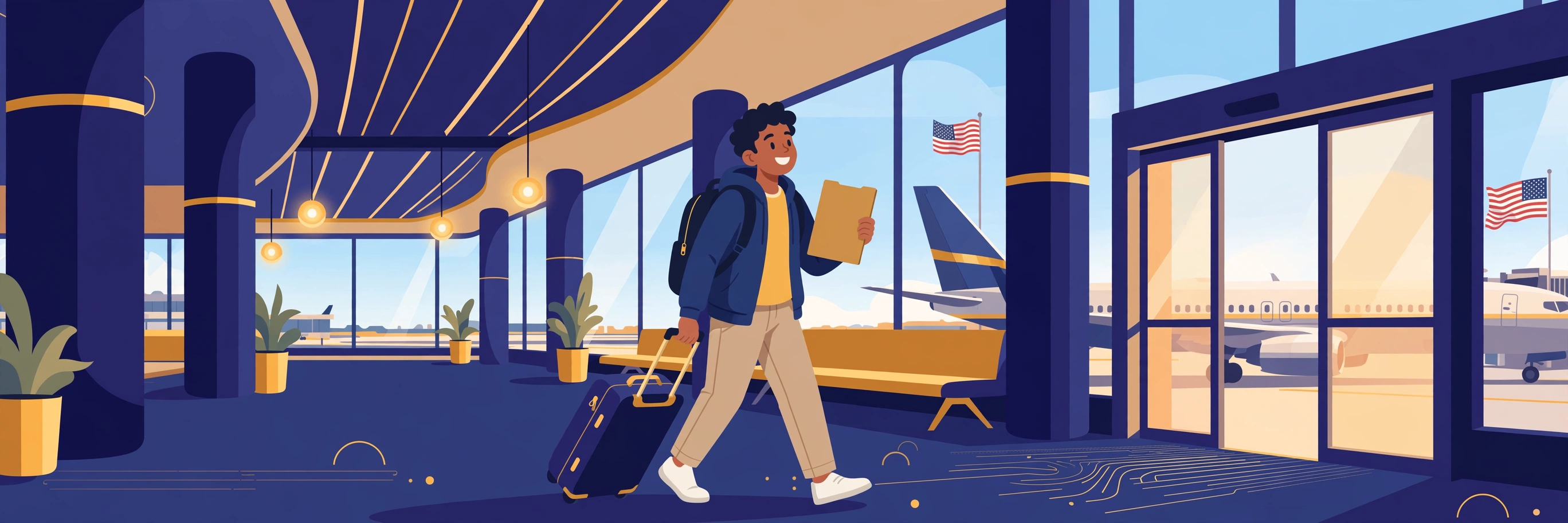
What to hand-carry, what happens at the port of entry, what to declare at customs, and the checks to complete in your first days in the United States.
Hand-carry — never in checked baggage — your passport with your F-1 visa, your printed, signed Form I-20, and your I-901 SEVIS fee receipt. Enter no earlier than 30 days before the program start date on your Form I-20. At the port of entry a CBP officer inspects you and decides admission. Complete CBP Declaration Form 6059B, declare all food and agricultural items, and report currency or monetary instruments over $10,000 on FinCEN Form 105 — carrying that amount is not prohibited, but reporting it is mandatory. Afterwards, retrieve your Form I-94 online, check that your class of admission is F-1 and "Admit Until" reads "D/S", and report to your school and designated school official (DSO) by the program start date on your Form I-20.
SECTION 01Before You Fly: What to Hand-Carry
You cannot access checked baggage until after the port of entry, so everything an officer might ask for must be in your carry-on. Study in the States, the Department of Homeland Security's student site, is explicit on this.
Documents the officer will ask for
- RULE — Passport with your F-1 visa. You must present your valid visa and passport. Your passport must be valid for at least six months beyond your period of stay, unless exempt under a country-specific agreement.
- RULE — Printed, signed Form I-20. Present a printed copy of your signed Form I-20 at the port of entry. Do not pack it in checked luggage.
- RULE — I-901 SEVIS fee receipt. Keep your I-901 receipt, and check before travel that its SEVIS ID matches the SEVIS ID on your Form I-20. Carry it with your arrival documents for quick verification if needed.
Documents Study in the States says to have ready
- ADVICE — School acceptance letter. Study in the States says it is a good idea to have your acceptance letter with you.
- ADVICE — Evidence of financial support. The same guidance recommends carrying evidence of how you will pay for studies and living costs.
- ADVICE — Your DSO's name and telephone number. Your designated school official is the person your school has named for verification if an officer needs it.
Preparation that makes arrival easier
- ADVICE — Know your U.S. address. Have your first U.S. address, plus your school's name and address, written down and easy to reach.
- ADVICE — Keep copies. Keep paper and phone copies of your passport, visa, Form I-20 and receipt separate from the originals.
- ADVICE — Allow time for connections. Inspection happens at your first U.S. airport, before any connecting flight. Leave a generous gap.
General information only. This guide is based on official sources publicly available and checked on the date shown on this page. Visa rules change, and consular and USCIS officers decide every case on its own facts — nothing here is a confirmation or a guarantee for your individual case, and this is not legal advice. Always confirm the current requirement on the official page linked in this guide before you act, and consider a qualified immigration attorney for your specific situation.
CBP's travel tips tell every traveller to have documents ready when approaching the officer — carry them; do not pack them. If your checked bag is delayed and your Form I-20 is inside it, you may be unable to show what the officer needs, and missing documents can lead to denial of entry or a Form I-515A notice instead of a straightforward admission (see Section 04).
SECTION 02The 30-Day Entry Rule
RULE — As a new F-1 student, you may enter no earlier than 30 days before the program start date listed on your Form I-20 — the Department of State and Study in the States state the limit identically. Count from the date printed on your Form I-20, not from your visa's issue date, which can be much earlier and does not move your earliest entry date.
Arriving earlier requires separately qualifying for a visitor (B) visa, and you could not begin studying until a change of status was approved — a process State warns can be lengthy. Booking inside the window is simpler for almost every new student.
SECTION 03At the Port of Entry: Primary Inspection
Everyone arriving at a U.S. port of entry is inspected. CBP describes its officers as authorised to ask about your trip and personal background, including your citizenship, the nature of your trip, and anything you are bringing into the United States. Officers also have legal authority to search you, your baggage, or your vehicle. Primary inspection normally follows this sequence:
SECTION 04If You Are Sent to Secondary Inspection
CBP explains that travellers whose processing may take more than a few moments, or who may warrant extra scrutiny, may be referred to secondary inspection, with broad officer discretion to refer with or without suspicion of wrongdoing. Listed reasons include documentation issues, possible administrative immigration questions, further enquiries, and random screening; about 3 percent of arriving travellers were referred in CBP's most recently reported year. Study in the States adds that the officer may interview you further to determine whether you may enter — which is why having your DSO's name and telephone number in hand luggage matters.
CBP states that all persons, baggage and merchandise crossing the border are subject to inspection, including electronic devices. A device search is not a required part of secondary inspection: in fiscal year 2024 CBP searched the devices of 47,047 travellers out of more than 420 million — under 0.01 percent of arrivals. Possible, but statistically rare.
If the officer verifies your information, you are admitted and the process ends. If you lack documents, or the officer cannot verify your information, Study in the States warns the officer may deny entry — or instead issue a Form I-515A, "Notice to Student or Exchange Visitor," which you must work with your DSO to answer within 30 days. ADVICE — Stay calm, keep documents together, and answer from your own knowledge; secondary inspection runs for routine verification every day.
SECTION 05Customs: The Declaration, Food, and Currency
Immigration inspection decides whether you may enter; customs decides what may enter with you. RULE — Complete the CBP Declaration Form 6059B. Every arriving traveller must complete it, covering who you are and what you are bringing in, including agricultural products and whether you visited a farm. One form can cover immediate family members travelling together. Declare truthfully everything brought from abroad, including duty-free purchases.
Answer "Yes" and let an inspector decide
- RULE — Declare all food and agricultural items. All travellers must declare meats, fruits, vegetables, plants, seeds, soil, animals, and plant and animal products — including soup products — in checked baggage, carry-on luggage, or a vehicle.
- RULE — Mark Question 11 "Yes." Declare agricultural items by checking "Yes" on Question 11 of Form 6059B; also check "Yes" if you have been on a farm or near livestock.
- RULE — Declaring is not the same as losing the item. A CBP agriculture specialist examines declared items and decides whether each meets entry requirements; some may be allowed depending on origin, once declared and inspected.
Items that may not enter, or need a permit
- RULE — Meat is heavily restricted. Many fresh, dried, and some canned meats and meat byproducts are prohibited from many countries because of animal-disease risk; a restricted-country meat ingredient usually makes the whole product prohibited.
- RULE — No soil without a permit. No soil or earth may enter without a permit issued in advance by the U.S. Department of Agriculture.
- RULE — Prohibited differs from restricted. Prohibited merchandise is forbidden by law to enter; restricted merchandise needs a special permit or licence first. Check the official lists before packing.
Prescription items still count
- RULE — Declare all medicines. CBP requires travellers to declare all medicine and similar products when entering the United States.
- ADVICE — Keep prescriptions in original containers. CBP advises personal-use quantities — a rule of thumb of no more than a 90-day supply — and a prescription copy or doctor's letter for anything not in its original container.
Undeclared prohibited agricultural items are confiscated and disposed of, and CBP warns civil penalties for failure to declare may reach $1,000 per first-time offence for non-commercial quantities. Declaring an inadmissible item simply means it is taken; declaring is always the safer answer.
RULE — Currency over $10,000 must be reported; it is not prohibited. There is no limit on how much currency a traveller may bring into or out of the United States, but federal law requires reporting currency or monetary instruments totalling more than $10,000, at one time, on FinCEN Form 105. Monetary instruments include coins and currency of any country, traveller's checks, and bearer negotiable instruments, among others; for families or groups the combined total counts. File electronically, on paper before travel, or on arrival. Failing to file risks seizure and forfeiture and possible civil or criminal penalties.
SECTION 06After You Clear: I-94, Documents, and Reporting to Your School
Clearing the airport is not the last step of arrival.
SECTION 07What Not to Bring
Most luggage problems at arrival come from food packed with good intentions.
- ADVICE — Leave homemade meat dishes and meat pickles behind. A meat ingredient can make a whole product inadmissible, and an undeclared homemade dish is the item most often confiscated — and penalised.
- ADVICE — Treat fresh fruit, vegetables, plants and seeds as "declare or leave." Some are admissible once declared and inspected; others are not. Never bury them undeclared in checked baggage.
- ADVICE — Do not carry soil, or items caked in soil. Soil needs an advance USDA permit, and after a farm visit a specialist may check your shoes or luggage for soil traces — another reason to answer the farm question honestly.
- ADVICE — Check anything unusual against the official lists first. Rules change with disease outbreaks, so check CBP's current guidance for your country of origin before travel — not what another student carried last year.
- ADVICE — If in doubt, declare it. Declaring costs a few minutes; not declaring can cost the item, a fine of up to $1,000, and a longer inspection.
FAQFrequently Asked Questions
Can I enter the United States 40 days before my program starts?
No — not in F-1 status. A new student may enter no earlier than 30 days before the program start date on the Form I-20. Entering earlier would require separately qualifying for a visitor (B) visa, and you could not start studying until a change of status was approved.
My Form I-94 shows the wrong date or the wrong status — what do I do?
Re-check the record on i94.cbp.dhs.gov, entering details exactly as in the passport you entered on. If the class of admission is not F-1, or "Admit Until" shows a date instead of "D/S," contact a CBP Deferred Inspection Site as soon as possible — CBP's guidance says within thirty days of admission, or use its "Ask a Question" portal. Tell your DSO too.
Can I carry homemade food or spices from home?
Declare it — there is no exception for homemade items. CBP requires declaration of meats, fruits, vegetables, plants, seeds and plant and animal products, including soup products, in carry-on and checked baggage alike, via Question 11 of Form 6059B. Declare everything edible and let the specialist decide. Meat-based homemade dishes face the highest confiscation risk, and undeclared prohibited items can bring a penalty of up to $1,000 for a first non-commercial offence.
How much cash can I carry into the United States?
There is no legal limit. Reporting is what the law requires: currency or monetary instruments over $10,000, brought in at one time, must be reported on FinCEN Form 105 — cash in any currency, traveller's checks and bearer instruments, with a family's combined total counting. Failing to report risks seizure and penalties.
What happens if my first U.S. airport is not near my school?
That is normal and changes nothing. Admission is decided at the first U.S. port of entry where you are inspected — usually where your international flight lands. Have documents ready there and allow a generous connection time. School reporting happens after you travel on, by the program start date on your Form I-20. (Practical guidance; no official page sets a separate rule for connecting arrivals.)
What is a Form I-515A, and should I worry if I receive one?
If you arrive without all your documents, or an officer cannot verify your information, the officer may deny entry or instead issue a Form I-515A, "Notice to Student or Exchange Visitor." It is fixable, with a firm deadline: work with your DSO to respond within 30 days, and keep every document the officer gave you.
Official references and verification status
These official references were accessed and checked on 29 October 2026, and this guide's RULE items were verified claim-by-claim against them (verification record on file with this draft). Two honest limits: CBP's student-specific "arrival procedures" page could not be retrieved in full during that check, so the specific questions a student may be asked are presented above as preparation advice rather than as an official list — the question topics CBP does publish (citizenship, the nature of your trip, and what you are bringing in) are stated as CBP states them. The duty to report to your school is verified from Study in the States' entry-process steps, with the program start date on your Form I-20 as the reference date. Agricultural and currency rules are stated as CBP published them on the check date and can change; re-check before travel.
- Study in the States (DHS) — F-1 Postsecondary guide, including arriving at a U.S. port of entry
- Study in the States (DHS) — Understanding the Form I-20
- Study in the States (DHS) — Understanding the Form I-94
- Study in the States (DHS) — SEVIS Help Hub: student entry steps
- U.S. Department of State — Student Visa
- U.S. Customs and Border Protection — Traveler Entry Forms (Form 6059B)
- U.S. Customs and Border Protection — Bringing Agricultural Products Into the United States
- U.S. Customs and Border Protection — Money and Other Monetary Instruments (FinCEN Form 105)
- U.S. Customs and Border Protection — Border Search of Electronic Devices at Ports of Entry
- CBP — Official Form I-94 website
- CBP — Form I-94 Frequently Asked Questions
General educational information, not individualized legal or financial advice. Follow official instructions and consult your designated school official (DSO) or a qualified U.S. immigration attorney for case-specific questions.
General information only. This guide is based on official sources publicly available and checked on the date shown on this page. Visa rules change, and consular and USCIS officers decide every case on its own facts — nothing here is a confirmation or a guarantee for your individual case, and this is not legal advice. Always confirm the current requirement on the official page linked in this guide before you act, and consider a qualified immigration attorney for your specific situation.