
Researched & checked — 30 Oct 2026
Yosemite National Park: The Valley, Glacier Point and What Entry Really Costs in 2026
NEW Published 30 October 2026
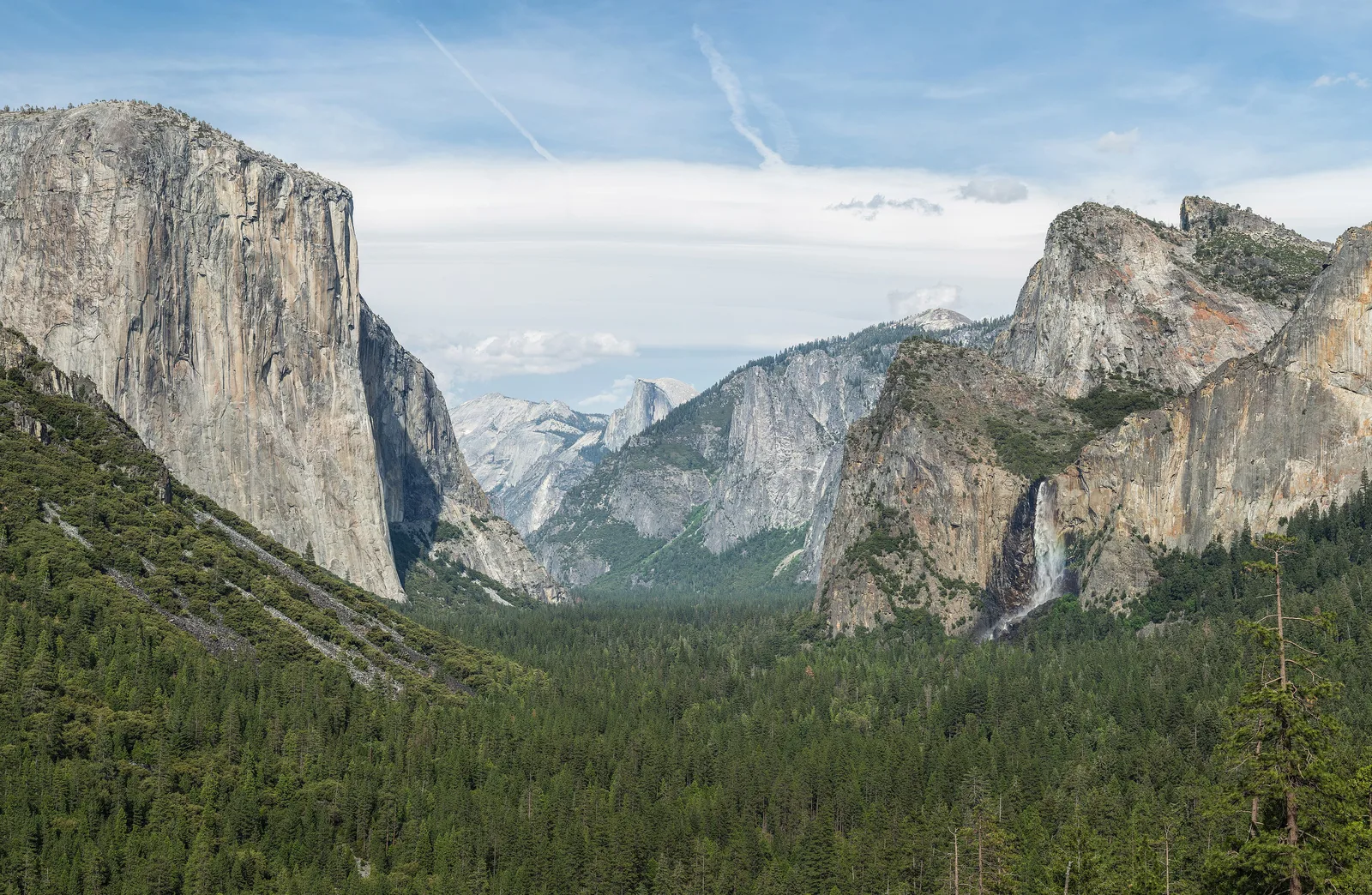
A first-timer's guide to Yosemite — the Valley's waterfalls and granite walls, Glacier Point and the seasonal high country, what entry really costs in 2026 with the new non-resident fee worked through in real numbers, and the campground and Half Dome booking races explained before you lose them.
A standard pass costs $35 per vehicle, valid seven days — but since 1 January 2026, non-US-resident visitors aged 16 or over pay an additional $100 per person at Yosemite unless they hold the $250 America the Beautiful non-resident annual pass, which for two or more adults usually wins. There is no entrance reservation in 2026: the park dropped its timed reservation system for the whole year, and gates take cards and mobile payment only — no cash. Inside the Valley, park once and use the free shuttle buses (7 a.m. to 10 p.m.). Glacier Point is a summer-and-autumn extra: its road typically opens in late May and closes with the first big snow.
SECTION 01The Valley Is Only the Beginning — But Start There
Yosemite is a park of levels. The Valley floor, at about 4,000 feet, is the warm, walkable, waterfall-hung bowl holding the visitor centres, lodges and campgrounds. The south rim, reached by the Glacier Point Road, looks down on it from some 3,200 feet above the floor. The high country along the Tioga Road — Tuolumne Meadows, Tenaya Lake — is higher still and open barely half the year. Build a first trip from the Valley up: a day on the floor, then the rim and meadows if the season allows.
Your first view should be the park's own introduction. Drivers entering from the south, on Highway 41, emerge from the Wawona Tunnel at Tunnel View: El Capitan on the left, Bridalveil Fall on the right, Half Dome centred in the distance — the composition every Yosemite poster uses, because the park genuinely looks like that. Other arrivals use the Arch Rock Entrance on Highway 140, the low-elevation, all-season route up the Merced River canyon from Mariposa and Merced, or the Big Oak Flat Entrance on Highway 120, the usual approach from San Francisco — about a four-hour drive to the Valley in good conditions. A fifth gate, Tioga Pass from the east, opens only when the Tioga Road does. All entrances except Hetch Hetchy are open 24 hours a day, and the park itself never closes.
One expectation to set honestly: in summer the Valley is busier than first-timers expect. The Park Service warns that delays of an hour or more at entrance stations are possible, and its advice, once you find a Valley parking space, is blunt: leave the car there, because you are unlikely to find another. The next section but one is designed around that reality.
SECTION 02What Does Entry Cost in 2026 — Including the Non-Resident Fee?
The National Park Service's standard entrance pass for Yosemite costs $35 per private vehicle (everyone inside included), $30 per motorcycle and $20 per person entering on foot, by bicycle or on a non-commercial bus, each valid for seven consecutive days. A Yosemite annual pass costs $70. The gates are cashless — cards and mobile payment only — and digital passes can be bought in advance through Recreation.gov. Children 15 and under enter free on the per-person rate and are exempt from the fee that comes next.
Since 1 January 2026, Yosemite is one of eleven named national parks — alongside the Grand Canyon, Yellowstone, Zion, Glacier and six others — where each visitor who is not a US resident and is aged 16 or over pays a $100 non-resident fee on top of the standard entrance fee, per person. The exception works the same way as at the Grand Canyon: the America the Beautiful annual pass now comes in two prices, $80 for US residents and $250 for non-residents, and the $250 pass covers the entrance fee and the non-resident fees for the pass holder and everyone travelling with them in the same vehicle. Two details from the park's own guidance are worth knowing. If someone in your car is a US resident holding any annual or lifetime pass, that pass covers the whole vehicle — mixed families do not pay per-head fees. And residency is proven with a US passport, a state-issued driver's licence or ID card, or a permanent resident (green) card.
The arithmetic, for the cases visitors actually face:
- Two non-resident adults in a car, Yosemite only: $35 vehicle pass + 2 × $100 = $235. The $250 non-resident annual pass costs $15 more and then covers every other federal recreation site for a year — add any second park (the Grand Canyon, Zion and Yellowstone are all on the same eleven-park list) and the pass wins outright.
- A family with two adults and children 15 or under: the same $235 — the fee follows the adults only.
- Four non-resident adults sharing a car: $35 + 4 × $100 = $435 without the pass, against $250 with it.
- US residents: the $35 vehicle pass, or the $80 annual pass if more parks are on the route.
And the reservation question, because Yosemite's recent history confuses everyone: you do not need an entrance reservation in 2026. After timed vehicle reservations in 2024 and 2025, the park announced it would not use a reservation system at all in 2026 — not in peak summer, not even for the February firefall period. Instead it manages crowds in real time, temporarily diverting parking areas as they fill. No decision for 2027 had been published as of this check on 30 October 2026 — for a next-year trip, confirm the position on the park's reservations page, linked below. What always needs booking ahead is where you sleep, and (for one famous hike) a permit — section 06 covers both.
SECTION 03One Day in Yosemite Valley: The Shuttle Is the Strategy
The park runs a free shuttle system around the Valley, and using it is the whole trick. The Valleywide shuttle serves every stop — lodges, food, campgrounds, trailheads — every 12 to 22 minutes; the East Valley shuttle loops Yosemite Village, Curry Village, the Pines campgrounds and the eastern trailheads every 8 to 12 minutes. Both run 7 a.m. to 10 p.m., no ticket, no booking. Park once, early, and let the bus do the rest.
A Valley day that works: Start at Lower Yosemite Fall, a short, easy trail to the footbridge beneath the final 320-foot drop — in spring the spray reaches the bridge, and the full falls, all 2,425 feet in three tiers, show best from across the Valley floor. Cross Cook's Meadow for the postcard alignment of Sentinel Rock and the Merced River, and call at the Valley Welcome Center for the day's conditions and ranger programmes. Ride east to Happy Isles and walk to the Vernal Fall footbridge — a taste of the park's great waterfall staircase without the climb. Afternoon: Bridalveil Fall, the 620-foot fall at the Valley's west end that runs all year, then El Capitan Meadow, where in climbing season volunteers point out climbers on the great wall. Evening: the meadows again, when day-trippers have gone and the granite takes the last light.
With a second day, swap breadth for height: the full Mist Trail past Vernal Fall (317 feet) to Nevada Fall (594 feet), or the long, steep pull up the Yosemite Falls Trail to the lip of the falls. With a third, leave the Valley entirely: Glacier Point and the giant sequoias wait in the next section.
SECTION 04Glacier Point and the High Country: The Seasonal Half of the Park
Glacier Point is the Valley seen from its own rim — a railing some 3,200 feet above the floor, looking straight across at Half Dome and down the line of Vernal and Nevada Falls; on a clear evening it is the finest sunset in the park. The catch is the calendar: Glacier Point Road typically opens in late May and closes in October or November, the exact dates set by snow, not schedule. Open, it is about an hour's drive from the Valley, with Washburn Point and the rim walks at Sentinel Dome and Taft Point on the way. Closed, Glacier Point belongs to strong hikers: the Four Mile Trail climbs 4.8 miles and some 3,200 feet of switchbacks from the Valley floor — allow most of a day for the round trip — and in winter even that closes under snow and ice. A paid bus tour also runs from the Valley in season; many visitors ride it up one-way and hike down the Four Mile Trail, a combination worth copying.
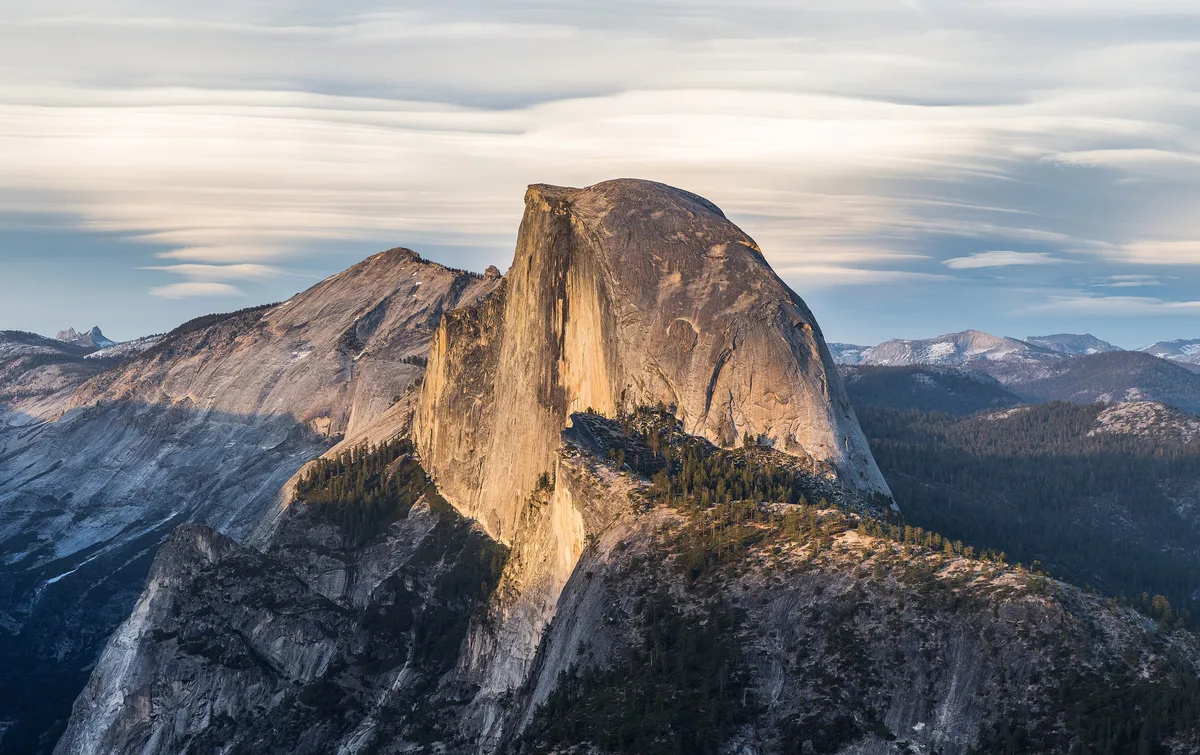
The Tioga Road crosses the park's high spine, typically opening in late May or June and closing with the first lasting snow. Its country is different in kind: the open granite and meadows of Tuolumne Meadows, Tenaya Lake's shore, and Olmsted Point's unexpected angle on Half Dome. Give it a full day if it is open; accept its absence without regret if it is not — a second park that shares a gate fee. Nearer and open far longer, the Mariposa Grove, by the South Entrance, protects hundreds of mature giant sequoias, the Grizzly Giant among them. Access is by a free shuttle from the grove's Welcome Plaza — the primary way in — in a long season that can start as early as mid-April and end as late as the end of November, conditions deciding. Pair the grove with a south-entrance arrival or departure.
SECTION 05Waterfalls Run on a Calendar: When to Come
Yosemite's waterfalls are snowmelt with a stage name, and their season is short. The Park Service's summary: they run best in spring, with peak runoff in May and June. Yosemite Falls (2,425 feet) generally flows from around November to July, peaking in May — by August it is often a trickle or dry, and the Lower Fall can run dry from late summer into autumn. Bridalveil Fall (620 feet) and Vernal and Nevada Falls flow all year, though slimmer by late summer. So the park presents two faces: May or June for maximum water and almost everything open; September or October for thin waterfalls but thinner crowds, golden meadows and roads still open; winter for a quiet, cold Valley — and one February phenomenon.
That phenomenon is Horsetail Fall, a modest seasonal waterfall off El Capitan's shoulder that flows roughly December to April. On clear evenings in mid-to-late February, the setting sun can strike the falling water at an angle that makes it glow orange — the natural "firefall". It needs water, clear sky and luck in the same ten minutes, and it draws photographers from around the world. Go if your dates align; promise yourself nothing if they do not. Whatever the season, the park's waterfall warning is plain: stay on the trails — polished rock near falls is extremely slick even when dry, and gentle-looking currents are powerful.
SECTION 06Sleeping in the Park: Two Booking Races and a Lottery
Yosemite rewards sleeping inside it — mornings and evenings are the park's best hours, and they belong to the people already there — but beds and campsites are won months ahead. Lodging in the Valley, from The Ahwahnee through Yosemite Valley Lodge to Curry Village's tent cabins, is run by the park's concessioner and opens for booking 366 days in advance; for peak season, use that window. Campgrounds book separately, through Recreation.gov, and the Valley's Pines campgrounds — Upper, Lower and North Pines — release sites five months ahead, on the 15th of the month at 7 a.m. Pacific time, in month-long blocks; they typically sell out in minutes, so be logged in and decided before the clock. Upper Pines, open all year with 236 sites, charges $36 a night. From spring through autumn there are no first-come, first-served campgrounds at all — the park says plainly: do not come expecting a site without a reservation. (In winter, Camp 4 — $10 per person, hard by the climbing walls — plus Hodgdon Meadow and Wawona run first-come.) Gateway towns are the fallback: El Portal is closest, on the Highway 140 side; Mariposa, Groveland, Oakhurst and Fish Camp edge the other gates; and YARTS buses run into the Valley year-round on Highway 140 from Merced, Mariposa and El Portal, with Amtrak trains connecting at Merced — a workable way to arrive without a car.
Then there is Half Dome. The cables route to the summit is open, conditions allowing, from the Friday before Memorial Day to the Tuesday after Columbus Day, and a permit is required for the Sub Dome and cables section around the clock. Permits come only through two Recreation.gov lotteries: a preseason lottery each March (results mid-April) and a daily lottery two days ahead. It costs $10 to apply, plus $10 per hiker if you win, for up to six people per application. Winning is the beginning, not the end: the hike is 14 to 16 miles round trip, climbing some 4,800 feet to an 8,800-foot summit, and takes most people 10 to 12 hours. If Half Dome is the point of your trip, build the trip around the lottery calendar — and if the lottery says no, Glacier Point looks straight at the summit and charges nothing.
FAQQuick Questions
How much does Yosemite cost for international visitors in 2026?
A standard pass is $35 per vehicle for seven days, but each non-US-resident aged 16 or over adds a $100 fee. Two adults in a car pay $235 for Yosemite alone; the $250 America the Beautiful non-resident annual pass covers the holder and everyone in their vehicle at all eleven fee parks, and usually wins from two adults or two parks upwards.
Do I need a reservation to enter Yosemite?
Not in 2026 — the park dropped its entrance reservation system for the whole year, including peak summer and the February firefall period, managing crowds with real-time traffic diversions instead. No 2027 decision had been published at checking (30 October 2026); re-check before a 2027 trip. Campgrounds, lodging and Half Dome permits still need advance booking.
When are the waterfalls dry?
Yosemite Falls runs roughly November to July, peaks in May, and is often a trickle or dry by August; the Lower Fall can be dry from late July into autumn. Bridalveil, Vernal and Nevada Falls flow all year but slim by late summer. For full water, come in May or June.
Can I visit Yosemite as a day trip from San Francisco?
You can — roughly four hours' driving each way in good conditions, usually via the Big Oak Flat Entrance on Highway 120 — but you will spend as long on the road as in the park, and miss the quiet early and late hours. One night in or near the park transforms the trip; two or three make it unhurried.
How do I get a Half Dome permit?
Only through Recreation.gov lotteries: the preseason lottery runs through March (results mid-April), and a daily lottery opens two days before each hike date. Applying costs $10, plus $10 per hiker if awarded. The cables season typically runs from the Friday before Memorial Day to the Tuesday after Columbus Day, conditions permitting.
Official references and checking status
Checking status: every fee, reservation rule, season and booking window here was checked in full on nps.gov, the official non-resident fees page and Recreation.gov on 30 October 2026. The honest limits: reservation policy is confirmed for 2026 only — no 2027 system had been announced; road, grove-shuttle and campground dates are typical windows set by snow, not fixed dates; waterfall flow varies with each year's snowpack; and drive times are approximate road times, worst in summer traffic and winter storms.
- Yosemite National Park — Fees and passes
- National Park Service — Non-resident fees
- Yosemite — Entrance reservations
- Yosemite — Public transportation and shuttles
- Yosemite — Waterfalls
- Yosemite — Campgrounds
- Recreation.gov — Half Dome permits
Photos in this guide: Yosemite Valley from Tunnel View (El Capitan, Bridalveil Fall and Half Dome) by David Iliff / Wikimedia Commons (CC BY-SA 3.0); Half Dome from Glacier Point by David Iliff / Wikimedia Commons (CC BY-SA 3.0). Both resized and converted for this page.
General information only. This guide is based on official sources publicly available and checked on the date shown on this page. Visa rules change, and consular and USCIS officers decide every case on its own facts — nothing here is a confirmation or a guarantee for your individual case, and this is not legal advice. Always confirm the current requirement on the official page linked in this guide before you act, and consider a qualified immigration attorney for your specific situation.