
Researched & checked — 30 Oct 2026
Grand Canyon South Rim: Viewpoints, Free Shuttles and the Real Cost of Entry in 2026
NEW Published 30 October 2026
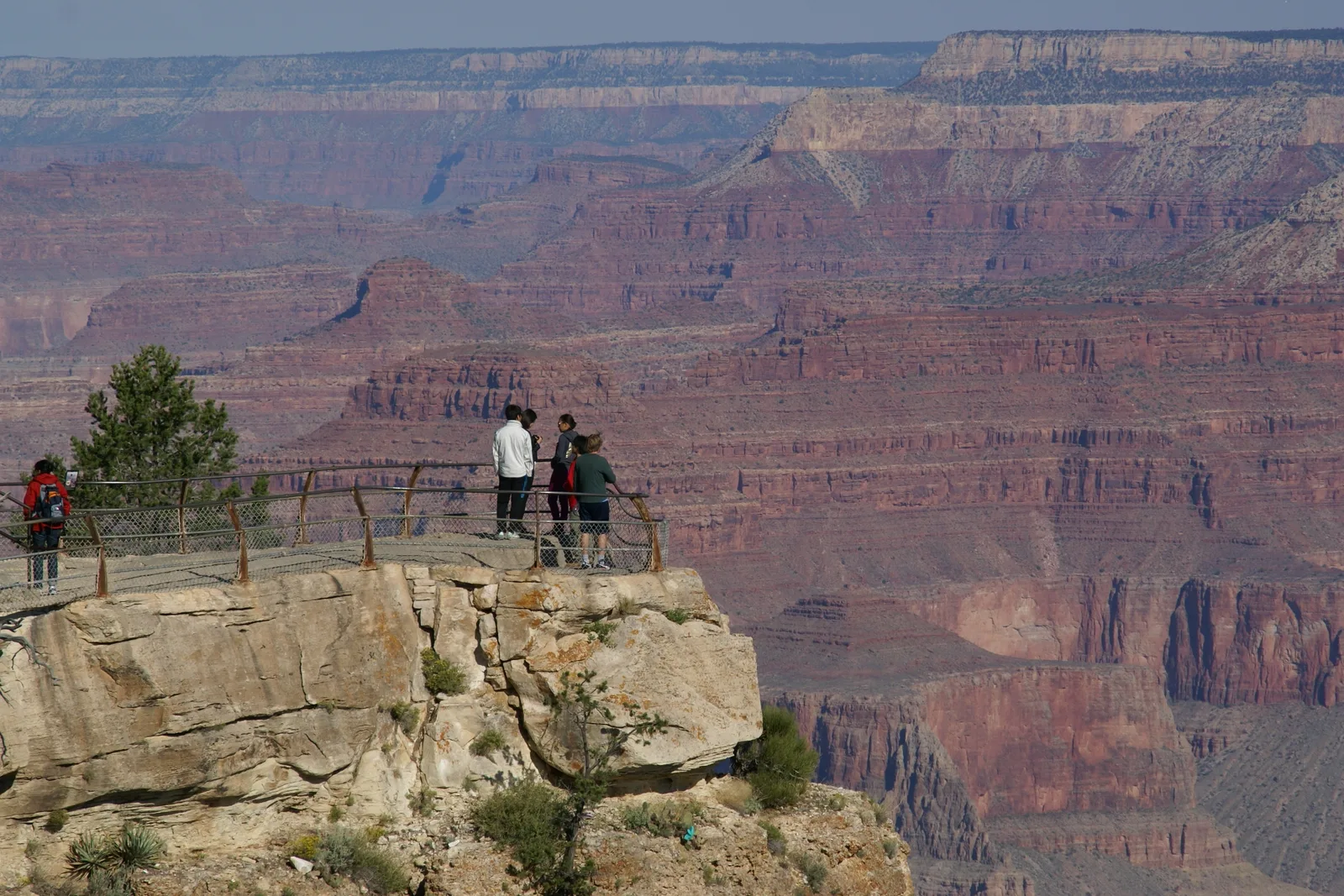
A first-timer's guide to the Grand Canyon's South Rim — which entrance, what the pass costs (including the 2026 non-resident fee most international visitors have not heard of), how the free shuttle routes divide the rim, a one-day route that works, and the safety rules for stepping below the rim.
Enter through the South Entrance near the town of Tusayan. A standard pass costs $35 per vehicle, valid seven days for both rims — but since 1 January 2026, visitors who are not US residents and are 16 or older pay an additional $100 per person at the Grand Canyon unless they hold the $250 America the Beautiful non-resident annual pass, which for two or more adults usually wins. Entrance stations take cards and passes only — no cash. Inside, park the car and use the free shuttles: the Orange route for sunrise at Yaki Point, the Red route for the Hermit Road viewpoints and sunset, the Rim Trail on foot in between.
SECTION 01South Rim or North Rim — and Why Almost Everyone Chooses South
The canyon has two developed rims, and they are not interchangeable. The North Rim is higher, quieter and seasonal — its visitor season runs roughly mid-May to mid-October — and reaching it from the South Rim means a drive of some four to five hours around the canyon. The South Rim is open all year, holds the main visitor centre at Mather Point, the historic village with its lodges and the trailheads of the two great corridor trails, and sits about 7,000 feet above sea level — high enough that nights are cold even in summer and the air is noticeably thin on your first day. This guide is a South Rim guide; the North Rim is a second trip, not a detour.
Most visitors arrive by road: roughly an hour and a half from Flagstaff, three and a half to four hours from Phoenix, and about four and a half hours from Las Vegas, in good conditions. The gateway town of Tusayan sits just outside the South Entrance with hotels, food and an IMAX theatre; the Desert View (East) Entrance, 25 miles of rim drive from the village, suits anyone arriving from the east or combining the canyon with Monument Valley and Page. There is no bad choice — but know which entrance your route uses, because the two are an hour apart inside the park.
SECTION 02What Does Entry Cost in 2026 — Including the Non-Resident Fee?
The National Park Service's standard entrance pass for the Grand Canyon costs $35 per private vehicle (everyone inside included), $30 per motorcycle and $20 per person entering on foot or by bicycle, and each pass is valid for seven days and covers both rims. A Grand Canyon annual pass costs $70. Two practical points before the big one: the park's entrance stations accept credit and debit cards and passes — cash is no longer accepted — and no reservation is needed to enter in 2026; you simply pay or show a pass at the gate.
Now the change that matters most to international readers. Since 1 January 2026, at eleven of the most-visited national parks — the Grand Canyon among them — each visitor who is not a US resident and is aged 16 or over pays a $100 non-resident fee on top of the standard entrance fee, per person. Children 15 and under do not pay it. The exception is the annual pass: the America the Beautiful pass now has two prices, $80 for US residents and $250 for non-residents, and a non-resident pass covers the entrance and non-resident fees for the pass holder and everyone travelling with them in a private vehicle. Passes bought before 2026 are honoured on their original terms — and note that from 2026 the parks' fee-free days are free for US residents only; non-residents pay normally.
The arithmetic, worked through for the cases visitors actually face:
- Two non-resident adults in a car, Grand Canyon only: $35 vehicle pass + 2 × $100 = $235. The $250 non-resident annual pass costs $15 more and then covers every other federal park for a year — add one more of the eleven listed parks (Zion, Bryce Canyon and Yellowstone are common partners on the same road trip) and the pass wins outright.
- A family with two adults and children under 16: the same $235 — the fee follows the adults only.
- Four non-resident adults sharing a car: $35 + 4 × $100 = $435 without the pass, against $250 with it. For groups, the pass is not close.
- US residents: unchanged maths — the $35 vehicle pass, or the $80 annual pass if more parks are on the route.
Buy the pass at the entrance station or in advance through the Park Service's channels, keep it with you, and check the NPS non-resident fees page linked below if your situation is unusual (tour groups, for instance, are handled per person under the same rule).
SECTION 03How Do the Free Shuttle Buses Work?
Once you are in, the car becomes a liability — village parking fills by mid-morning — and the park's answer is a genuinely good free shuttle system. No ticket, no booking: you board with your entrance pass already paid. The routes that matter to a first visit:
- Village route (Blue), all year: the backbone — visitor centre, lodges, campgrounds, Market Plaza and the Backcountry Information Center.
- Kaibab Rim route (Orange), all year: visitor centre to the Yavapai Geology Museum, the South Kaibab Trailhead and Yaki Point. The road beyond is closed to private cars, so the shuttle is the only way to reach Yaki Point — the South Rim's classic sunrise spot.
- Hermits Rest route (Red), 1 March to 30 November: seven miles of rim road closed to private vehicles in season, served viewpoint by viewpoint out to Hermits Rest. This is the sunset route — Hopi Point, along it, is the rim's most famous sunset viewpoint.
- Tusayan route (Purple), in season: park-and-ride from the gateway town into the visitor centre, for days when the entrance queues and the village lots are at their worst.
- Hikers' Express: an early-morning shuttle from Bright Angel Lodge to the South Kaibab Trailhead, timed for hikers starting at dawn.
Between the stops, walk: the Rim Trail runs for some 13 paved miles along the edge between the village and Hermits Rest, and the shuttle system is built for one-way walking — ride out, walk back along the rim, hop on again when your legs say so. All park shuttle buses are wheelchair accessible.
SECTION 04One Day at the South Rim: A Route That Works
Sunrise: Yaki Point, on the Orange route — arrive in the dark and watch the canyon fill with light. Morning: back to the visitor centre and Mather Point, then the Yavapai Geology Museum, whose picture windows and exhibits explain the layers you are looking at better than any sign. Midday: the historic village — lunch, the Kolb Studio and Lookout Studio on the rim, Bright Angel Lodge — and a walk along the Rim Trail while the light is harsh and photography is pointless anyway. Afternoon: a short descent below the rim if you want the canyon from inside (next section), or the Desert View Drive east to the Watchtower if you have your own car and a second block of hours. Sunset: the Red route to Hopi Point, riding back under the first stars. Every part of that day after the entrance gate is free.
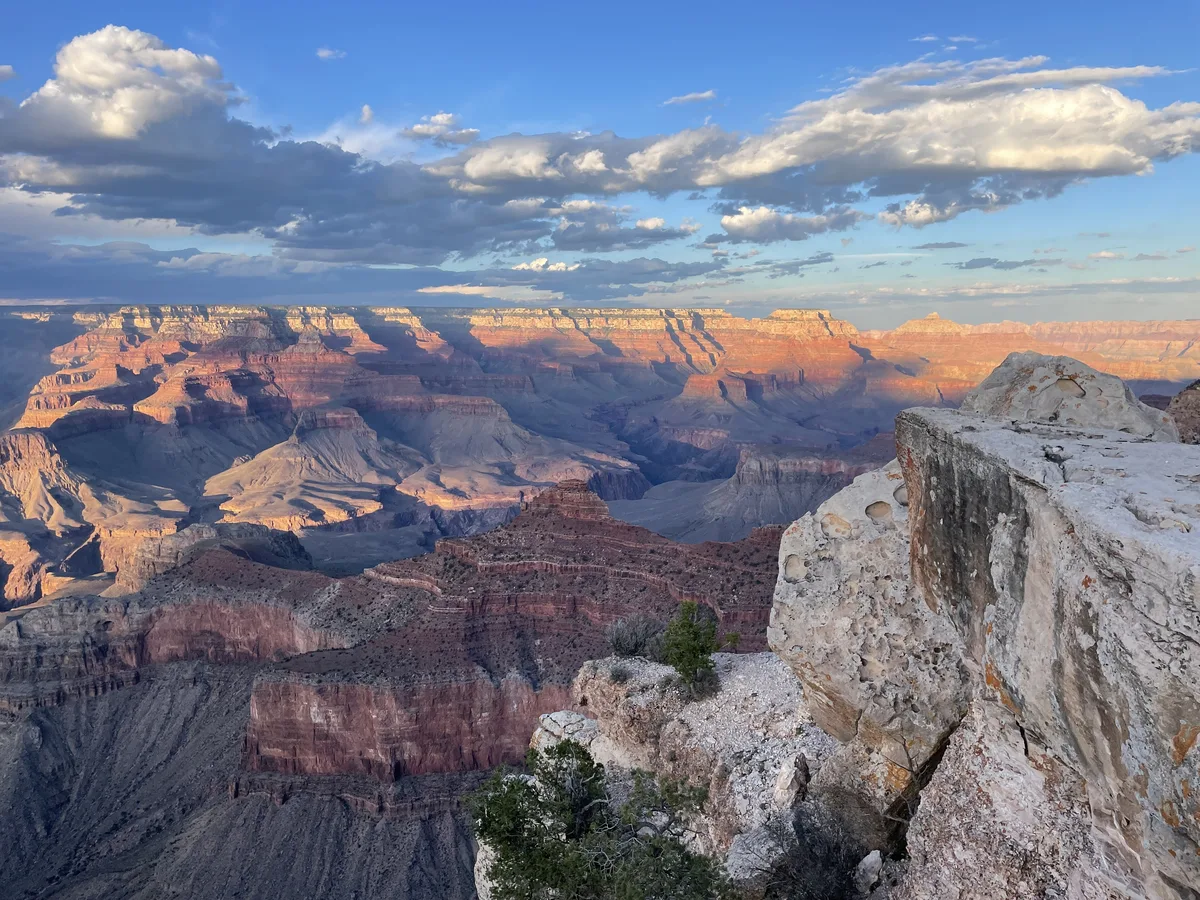
A second day is where the canyon changes character: a proper below-rim hike in the cool of the morning, the viewpoints you skipped, perhaps the Grand Canyon Railway's day excursion down at Williams. Stay inside the park if you can book it — the in-park lodges fill months ahead for the warm season — with Tusayan as the practical fallback and Flagstaff or Williams as the budget bases an hour or more away.
SECTION 05Going Below the Rim: The Rules That Keep People Safe
Walking even a short way below the rim transforms the visit — the scale only makes sense from inside. Two corridor trails start at the South Rim. The Bright Angel Trail is the gentler introduction: a first tunnel a few minutes down, a 1.5-mile resthouse as the classic short target, water available in season and some shade. The South Kaibab Trail is steeper, drier and more exposed — no water at all along it — with Ooh Aah Point and Cedar Ridge as its short targets and the finest wide views of the two. Either way, the rangers' rules are not decoration:
- Never attempt to hike to the river and back in one day. The Park Service warns against it in terms, every season, and rescues a steady stream of people who tried. A one-day descent of an hour or two is a taste, not a failure.
- The way up takes roughly twice as long as the way down. Turn around by the clock, not by how you feel at the bottom of your descent.
- Carry water — more than you expect — and drink it. The rim's 7,000-foot altitude and desert air dehydrate quietly, and summer temperatures at the river run far hotter than at the rim.
- Start at dawn in summer, and treat any ranger's advice on the day as final. Conditions, water availability and closures change; the park's alerts page, linked below, is the last word.
SECTION 06When Should You Go?
Spring and autumn are the South Rim's sweet seasons — walkable temperatures, thinner crowds, and in autumn the clearest light. Summer brings the crowds, full car parks by mid-morning (the shuttle-first strategy exists precisely for this), afternoon thunderstorms and dangerous heat below the rim — but also the full shuttle network and every service open. Winter is the connoisseur's season: icy rim trails and short days, but empty viewpoints, possible snow on the upper walls, and a silence the summer never offers. Whenever you come, the rim at 7,000 feet is colder and windier than the desert below suggests — a warm layer is not optional kit, even in July.
How much is Grand Canyon entry in 2026?
$35 per vehicle, $30 per motorcycle or $20 per person on foot or bicycle, valid seven days for both rims. Since 1 January 2026 non-US residents aged 16 and over also pay a $100 per-person non-resident fee at the Grand Canyon, unless entering on an America the Beautiful pass ($250 for non-residents, $80 for residents). Entrance stations are card-and-pass only — no cash.
Is the $250 non-resident pass worth it?
For two or more non-resident adults it usually is: two adults pay $235 in combined fees for the Grand Canyon alone, so the $250 pass is nearly even on one park and clearly ahead if your trip adds any other major park. For a solo traveller visiting only the Grand Canyon, paying the $100 fee on a $20–$35 entrance is cheaper.
Are the Grand Canyon shuttles really free?
Yes — every park shuttle route on the South Rim is free with your entrance pass, with no ticket or booking. The Orange route is the only way to reach Yaki Point and the South Kaibab Trailhead, and the Red route serves the Hermit Road viewpoints while it is closed to private cars (1 March to 30 November).
Can I see the Grand Canyon in one day?
Yes, honestly — sunrise at Yaki Point, the visitor centre and geology museum, the village and Rim Trail, a short below-rim taste, and sunset from the Hermit Road covers the South Rim's essentials. A second day is for a longer hike and a slower rim; the North Rim is a separate trip.
Do I need a reservation to enter the Grand Canyon in 2026?
No reservation is required for entry in 2026 — you pay or show a pass at the entrance station. What does need booking well ahead is in-park lodging in the busy season, and any below-rim overnight trip, which runs on a separate permit system.
Official references and checking status
The fees and park arrangements in this guide were checked against the National Park Service pages below on 30 October 2026. Two honest limits: the shuttle routes' seasons and the North Rim's operating dates are set by the park each year and the current published pattern is what this guide reports — the park's own pages govern on the day; and driving times from Flagstaff, Phoenix and Las Vegas are approximations for good conditions, not schedules. Fees and rules change — re-check the relevant page below before you travel.
- National Park Service — Grand Canyon: Fees & Passes (standard passes, validity, payment methods)
- National Park Service — Nonresident Fees (the $100 fee, the eleven parks, the $250 non-resident annual pass)
- National Park Service — Grand Canyon: Plan Your Visit (alerts, shuttles, trails and current conditions)
Photos in this guide: Mather Point and its viewpoint by Hermann Luyken / Wikimedia Commons (CC0); the Grand Canyon from Mather Point at sunset by Vulturesong / Wikimedia Commons (CC0). Both resized and converted for this page.
General information only. This guide is based on official sources publicly available and checked on the date shown on this page. Visa rules change, and consular and USCIS officers decide every case on its own facts — nothing here is a confirmation or a guarantee for your individual case, and this is not legal advice. Always confirm the current requirement on the official page linked in this guide before you act, and consider a qualified immigration attorney for your specific situation.