
Researched & checked — 3 Nov 2026
Port Blair and Havelock: The Cellular Jail, the Ferries and Radhanagar, Planned on Official Facts
NEW Published 3 November 2026
An Andaman trip runs on a short list of checkable facts: a national memorial whose hours the Directorate of Tourism publishes, a government ferry timetable from the Shipping Services' citizen charter, a Blue Flag beach, and a permit position the Administration states in plain words — all from UNESCO, the Administration and the bodies that run the places.
The Cellular Jail in Sri Vijaya Puram (the renamed Port Blair) is open as a Museum & Jail Complex from 8:30 AM to 5:00 PM, with its Light & Sound Show from 5:30 PM to 6:30 PM, per the Directorate of Tourism. Government ferries leave for Swaraj Dweep (Havelock) three times a day — 0615, 1130 and 1700 hrs — under the Shipping Services' citizen charter, with tickets at the shipping counter and on the STARS portal. Radhanagar Beach holds Blue Flag certification. Foreign nationals may visit 30 listed islands, including Swaraj Dweep and Shaheed Dweep, without a Restricted Area Permit, the Administration states — exceptions in Section 07.
SECTION 01Arriving: Sri Vijaya Puram and Veer Savarkar Airport
Start with the name, because the announcements have moved on. The Directorate of Tourism writes it directly: the Cellular Jail stands in "Sri Vijaya Puram (earlier known as Port Blair)" — the capital has been officially renamed, and the islands carry new names too: Havelock Island is Swaraj Dweep, Neil Island is Shaheed Dweep, and Ross Island is Netaji Subhas Chandra Bose Island. This guide uses both names — older signage says Port Blair and Havelock; official documents say Sri Vijaya Puram and Swaraj Dweep.
Almost everyone arrives by air. Veer Savarkar Airport at Port Blair is an international airport, connected with Chennai, Kolkata, New Delhi and Bangalore, the Administration records. The Airports Authority of India's release gives its new terminal's measure: inaugurated on 18 July 2023, with flight operations from 20 August 2023, it covers 40,837 sq m, can serve 1,200 passengers in the peak hour and about 50 lakh passengers annually, with 28 check-in counters, 12 immigration counters and three passenger boarding bridges, in a shell-shaped building depicting the sea and islands. One practical relief, stated by the Administration: Indian citizens do not require a passport to visit the Andamans.
The slow route still exists. Regular passenger ship services run to Port Blair from Chennai, Kolkata and Visakhapatnam — three to four sailings a month from Kolkata and Chennai, one a month for Visakhapatnam — and the Administration puts the voyage at about 50 to 60 hours in fair weather: a journey measured in days, sparse enough that the ship must be planned around, never improvised.
SECTION 02The Cellular Jail: What the Kala Pani Prison Was
The jail is the reason Port Blair is on the national map, and its history is documented in India's own UNESCO Tentative List submissions, which this account follows. The penal settlement's idea dates to 1857, the year of the First War of Independence: the first batch of 200 convicts arrived on 10 March 1858 under Dr J. P. Walker. A committee under Lyall and Lethbridge in 1890 recommended a dedicated cellular prison; construction started in 1893 — the settlement order is dated 13 September 1893 — and the jail was completed in 1905–06, built using prisoners only as labour. Its material tells the story: some 20,000 cubic feet of local stone and 30,00,000 bricks made by the prisoners themselves, with other material brought from Burma.
The design was the punishment. India's submission describes a massive three-storeyed structure whose seven unequal wings radiated from a central watch tower like the spokes of a wheel, built on the Pennsylvania or Separate System under the influence of Bentham's Panopticon, so that no communication of any kind was possible between prisoners. The serial proposal for the colonial penal settlements counts 693 cells, each with a high ventilator beyond reach; the jail's own submission gives each cell as 13½ feet by 7 feet, closed by a heavy iron grill door with a specially designed latch. The men held here were the freedom struggle's prisoners — the proposal names Veer Savarkar, Batukeshwar Dutt, Barindra Kumar Ghosh and Ullaskar Dutt — and the Directorate preserves the name Indians gave the place: the Kala Pani jail, the prison across the black water.
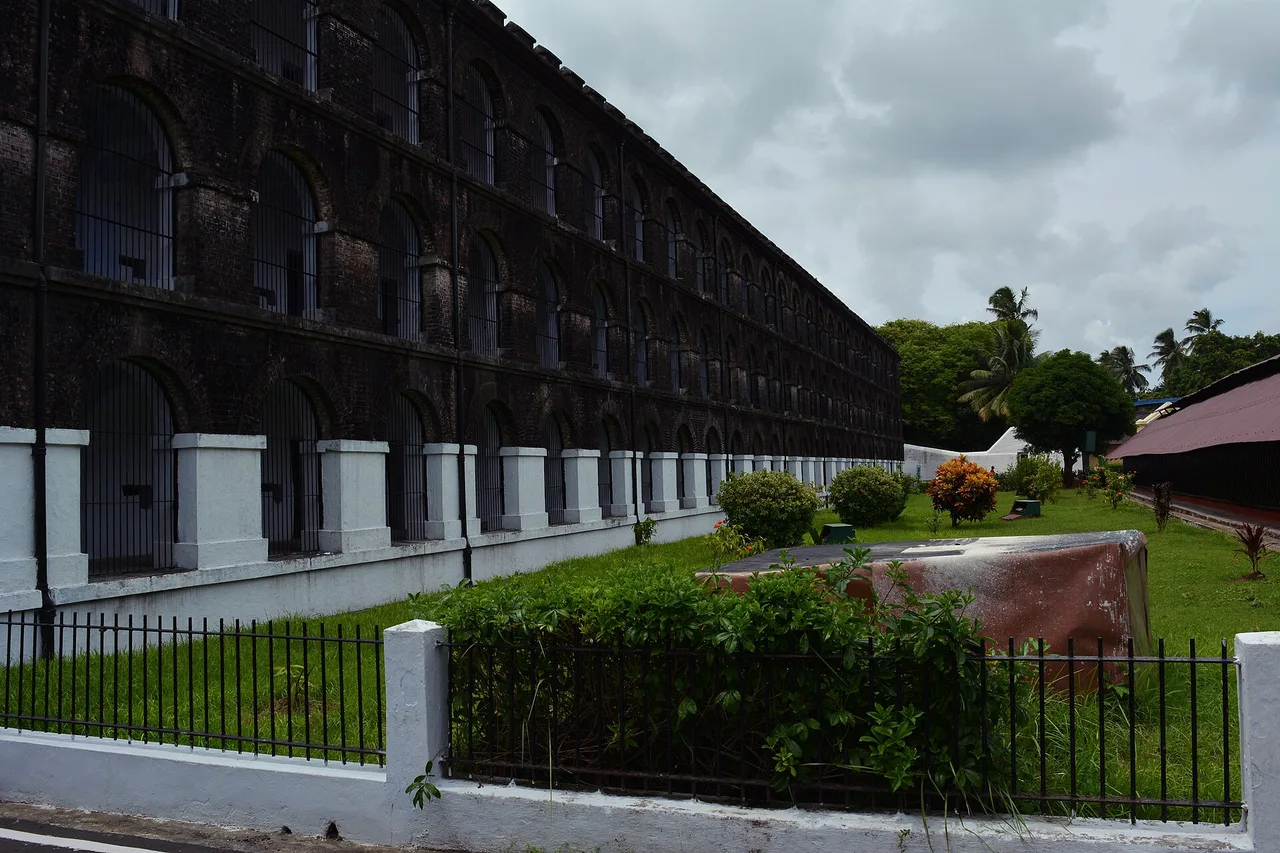
The end came by protest and by war. Hunger strikes ran from 1932 to 1937; the last began in July 1937, lasted 45 days, and ended after the intervention of Mahatma Gandhi and Rabindra Nath Tagore, with the political prisoners repatriated by January 1938. The Japanese occupied the islands from 1942 to 1945, and Netaji Subhas Chandra Bose visited the jail on 29 December 1943 and called it the "Indian Bastille". Of the original seven wings, four were demolished after damage in the 1941 earthquake; three wings remain — the building you walk through today is a fragment of the wheel. On 11 February 1979 it was declared a National Memorial: not a ruin to be photographed and left, but a memorial to be read.
SECTION 03Visiting the Memorial Today: Hours, the Show, and the Island Across the Water
The Directorate of Tourism's heritage page publishes the visit's frame in full. The Museum & Jail Complex is open from 8:30 AM to 5:00 PM, and the Light & Sound Show runs from 5:30 PM to 6:30 PM — the evening show, which narrates the jail's story after dark, is the visit's second half. On money, this guide follows its rule: the Directorate's page publishes no entry fee, so none is printed here; the figures on commercial sites for entry, cameras and the show appear on no official page checked for this guide. The booking channel is official: the Administration names the e-Tourist portal (andamantourism.gov.in/etourist) for booking the show and the Tourism Department's guesthouses.
One conflict must be flagged plainly, because both figures are official. The Administration's general information page says the jail is "open all days from 8:30 AM to 4:00 PM for general visit", with the show from 5:30 PM onwards — an hour earlier than the Directorate states. This guide prints the Directorate's hours, as the department that runs the memorial; the safe rule follows: do the jail in the morning or early afternoon, and either version covers you.
Pair the jail with the island in its view. Across the harbour lies Netaji Subhas Chandra Bose Island — the old Ross Island — which the UNESCO serial proposal calls the settlement's administrative nerve centre, once known as the "Paris of the East". The Administration states that it is open all days, that boats ply from Port Blair from 8:30 AM to 2:00 PM, and that its own Sound & Light Show runs from 4:00 PM onwards. Boats in the morning, the jail in the afternoon, the show at dusk: the settlement's two halves fit one well-planned day.
SECTION 04Port Blair Beyond the Jail: Corbyn's Cove and the Museums
The town's own beach is Corbyn's Cove, which the Directorate's beach listings place in the top category for Sri Vijaya Puram, among the islands' swimming beaches — the natural first-evening stop after a flight in.
The museums are the town's quiet strength, described by the official CGEWCC guide at a strength this guide keeps. The Anthropological Museum, started in 1975–76, is ethnographic: it illustrates the lives of the Jarawas, Sentinelese, Great Andamanese and Onges of the Andamans and the Nicobarese and Shompens of the Nicobars. The Fisheries Museum, near the Rajiv Gandhi Water Sports Complex, exhibits the marine life of the islands, the Indo-Pacific and the Bay of Bengal, and is closed on Mondays, public holidays and second Saturdays. The Samudrika, the Naval Marine Museum opposite Andaman Teal House at Delanipur, was built to raise awareness of the oceanic environment, with shells, corals and colourful fishes. No museum entry fees or further hours are printed here: none could be read on an official page checked for this guide, beyond that closure line. One more survivor: the UNESCO serial proposal notes the Chatham sawmill still stands, one of the oldest in Asia.
SECTION 05The Ferries: The Islands' Spine, on the Charter's Own Timetable
Everything after Port Blair moves by boat, and the government network is run by the Directorate of Shipping Services, whose citizen charter — last reviewed on 15 July 2026 — prints the foreshore sailings from Sri Vijaya Puram. Read them as the trip's skeleton. To Shaheed Dweep: three sailings daily, at 0615, 1100 and 1430 hrs. To Swaraj Dweep: three sailings daily, at 0615, 1130 and 1700 hrs. Two combined routings widen the choice: Shaheed Dweep via Swaraj Dweep sails once daily at 1100 hrs, and Swaraj Dweep via Shaheed Dweep twice daily, at 1130 and 1430 hrs — the pattern that lets a traveller chain the two islands without backtracking. A longer working, to Rangat via Swaraj Dweep and Long Island, leaves daily at 0600 hrs. The islands keep ferry hours, not flight hours; build inside them.
Booking is a two-channel affair, and the charter names both: tickets are sold "across the Shipping Counter and STARS e-Ticketing Portal, subject to availability", under the Directorate's Assistant Director (Commercial). Documents are simple but checked: a general passenger needs any photo ID proof at booking and at boarding; islanders travel on a Local Certificate or Islander Card. Alongside the government boats, the Administration records the market plainly: "Regular Govt. and Private Ferries are plying between Port Blair and Swaraj/Shaheed Dweep" — private operators exist, but their names, prices and timings are not official text, so this guide prints none. The Administration's advice is the section's most important sentence: "Visitors are advised to reserve and confirm their to and fro tickets well in advance."
On fares, the guide's rule bites hardest here. The citizen charter publishes schedules but no fares, so no government ferry fare is printed — operator and blog figures are commercial text, not evidence. Two further gaps deserve honesty: the official text read publishes no crossing durations and no return-sailing times. So check the current STARS timetable for both legs before fixing hotel nights, and book the return with the outward, as the Administration advises.
SECTION 06Swaraj Dweep: Radhanagar and the Beaches of Havelock
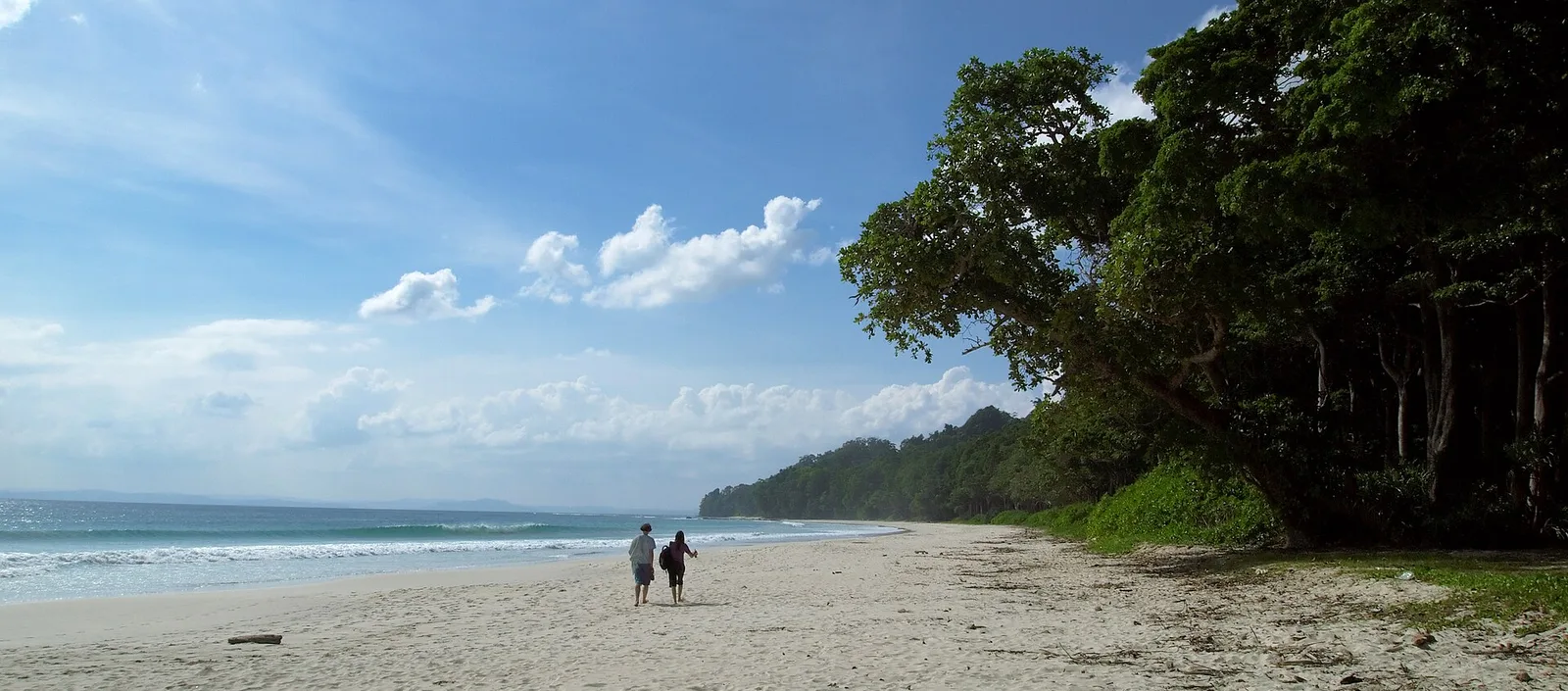
Havelock — Swaraj Dweep — is where the Andamans keep their postcard, and its certificate is a matter of record, not reputation. The Directorate's beach listings state that Radhanagar Beach "has been awarded the prestigious 'Blue Flag' certification by the Foundation for Environmental Education (FEE), Copenhagen" — the flag certifying world-class standards in cleanliness, eco-friendly amenities and visitor safety. The Administration dates the honour: Radhanagar "bagged the prestigious blue flag certification in 2020". The Directorate's beach page describes what the flag flies over — powdery white sands and calm turquoise waters, with safe netted swimming zones and a gradual water depth.
Radhanagar is a sunset beach, and the Directorate's advice is specific: famous for sunsets, the northern end is best — arrive by 4 PM. Photography is allowed, but drone use requires official permits — leave the drone packed unless the permit is in hand. Nature-walk trails lead to viewpoints overlooking Kalapathar Bay, and the page is honest about the beach's limits: food stalls and vendors are very limited, so eat before you go or carry what you need.
The island's other two named beaches divide the remaining pleasures. Elephant Beach, in the Directorate's top category for Swaraj Dweep, is the water-sports shore: the department's experience listings place snorkelling and diving there. Kalapathar Beach, listed a category below, is the quieter shore on the island's other side — the morning counterpoint to Radhanagar's evening. A Swaraj Dweep day organises itself: a morning in the water at Elephant Beach, an unhurried afternoon, and Radhanagar's northern end before four.
SECTION 07Shaheed Dweep, a Five-Day Split, the Seasons and the Permit Position
The third island completes the classic triangle. Shaheed Dweep — Neil Island — is the small, slow add-on, and the Directorate's beach listings give it three shores: Bharatpur Beach, listed among the islands' swimming beaches; Laxmanpur Beach, the sunset shore; and Sitapur Beach, for early risers. It needs no more than a day and a night; after Havelock's scale, Neil's quiet is the point.
A realistic five days, built inside the ferry hours of Section 05, looks like this. Day one: arrive in Sri Vijaya Puram; Corbyn's Cove in the evening, a museum if the flight was early. Day two: the Cellular Jail in the morning, Netaji Subhas Chandra Bose Island by boat, the Light & Sound Show at 5:30 PM. Day three: a morning ferry to Swaraj Dweep, Elephant Beach, and Radhanagar by 4 PM for sunset. Day four: Swaraj Dweep at leisure — Kalapathar, a second Radhanagar evening, or a dive morning. Day five: Shaheed Dweep's Bharatpur and Laxmanpur, or the sailing back in good time for the flight out. Two nights in Port Blair, two on Swaraj Dweep, the fifth split between Shaheed Dweep and the return — the split the timetable supports without a rushed jetty.
Season decides more here than in most of India, because everything floats. The Directorate's Radhanagar page puts the best time from October to May, with temperatures around 25–30°C, the peak season from December to February — more crowds, calm seas, clear skies — and October and April as good shoulder months. Of the monsoon it is blunt: June to September is "best avoided due to rough waters and travel disruptions". The Administration is more permissive — it lists monsoon tourism from June to October alongside the same best season — but together they make the honest position: a monsoon trip is possible, its boats and beaches weather's to revise. Build slack around every sailing, or come between October and May.
Finally, the permit position, printed exactly as the Administration states it today. Foreign nationals are permitted to visit 30 listed islands without a Restricted Area Permit, and the list includes South Andaman, Swaraj Dweep and Shaheed Dweep — the whole of this guide's triangle. The exception is named in the same text: citizens of Afghanistan, China and Pakistan, and foreign nationals having their origin in these countries, continue to require a Restricted Area Permit, granted only after the prior approval of the Ministry of Home Affairs, and visiting without it draws penal action under the Foreigners Act, 1946. Carry passport and visa papers when booking and boarding. One further rule admits no exceptions: entry into tribal reserves, and meeting or photographing the indigenous tribes, is strictly prohibited and an offence under the PAT Regulation 1956. The reserves are not an attraction, and no itinerary here goes near them.
FAQFrequently Asked Questions
Do I need a permit or passport to visit the Andamans?
Indian citizens do not require a passport to visit, the Administration states. Foreign nationals may visit 30 listed islands — including South Andaman, Swaraj Dweep (Havelock) and Shaheed Dweep (Neil) — without a Restricted Area Permit. The exception: citizens of Afghanistan, China and Pakistan, and foreign nationals having their origin in these countries, still require one, granted only after prior approval of the Ministry of Home Affairs; visiting without it draws penal action under the Foreigners Act, 1946. Carry passport and visa papers when booking and boarding ferries.
How do I book the government ferries, and what do they cost?
Tickets are sold across the Shipping Counter and on the STARS e-ticketing portal, subject to availability, under the Shipping Services' citizen charter; a general passenger needs any photo ID proof at booking and boarding. Sailings from Sri Vijaya Puram run to Swaraj Dweep at 0615, 1130 and 1700 hrs daily, and to Shaheed Dweep at 0615, 1100 and 1430 hrs daily. This guide prints no fare: the charter publishes schedules but no fares, and operator prices are not official text. The Administration advises reserving to-and-fro tickets well in advance.
When is the Cellular Jail open, and what does entry cost?
The Directorate of Tourism lists the Museum & Jail Complex at 8:30 AM–5:00 PM and the Light & Sound Show at 5:30 PM–6:30 PM; one Administration page gives a 4:00 PM close, so plan the jail for the morning or early afternoon. The show is bookable through the official e-Tourist portal (andamantourism.gov.in/etourist). No entry fee is printed here: the Directorate's page publishes none, and commercial-site figures appear in no official text read.
When is the best time to visit, and is the monsoon really that bad?
The Directorate of Tourism puts the best time from October to May (around 25–30°C), the peak from December to February, and October and April as good shoulder months. Of the monsoon it says June to September is best avoided due to rough waters and travel disruptions — where every onward move is a boat, rough water cancels plans. The Administration lists monsoon tourism June to October, so a monsoon trip is possible — with slack days around every sailing.
How many days do I need, and can Havelock be a day trip?
Five days is the comfortable minimum: two nights in Sri Vijaya Puram (jail, harbour island, museums), two on Swaraj Dweep (Elephant Beach, Kalapathar, Radhanagar's sunset), the fifth for Shaheed Dweep or the return. A day trip is possible on paper — the first sailing to Swaraj Dweep leaves at 0615 hrs — but the charter publishes no return timings, and Radhanagar's sunset, the island's best hour, would be spent travelling back. Sleep on the island; check STARS for both legs before fixing your nights.
Official references and checking status
Checked on 3 November 2026 against the official sources listed below; the accompanying sources file maps each claim to its page. Five limits are flagged honestly. First, the Directorate of Tourism's Cellular Jail page publishes hours and show timings but no entry fee, so no fee or show price is printed. Second, the charter publishes schedules but no fares, and no crossing durations or return times could be read, so none appear. Third, the jail's closing time is stated two ways by officialdom — 5:00 PM by the Directorate of Tourism, 4:00 PM in the Administration's general information — so this guide prints the Directorate's hours and advises arriving well before late afternoon. Fourth, the Administration's 30-island permit exemption carries no end date in the text read, so none is printed. Fifth, Radhanagar's verified honour is its Blue Flag certification; the "best beach in Asia" title repeated elsewhere appears in no official text read for this guide and is not claimed. Confirm current prices and timings on the official sites before you travel.
- UNESCO (official) — Tentative List: the Cellular Jail, Port Blair — India's submission
- UNESCO (official) — Tentative List: Colonial Penal Settlement in the Andaman and Nicobar Islands
- Directorate of Tourism, Andaman & Nicobar (official) — Cellular Jail and Radhanagar pages, beach listings
- Andaman & Nicobar Administration (official) — general information: access, ships and the permit position
- Directorate of Shipping Services (official) — citizen charter: ferry schedules, tickets and documents
- Andaman & Nicobar Tourism (official) — e-Tourist portal: show and guesthouse booking
- Airports Authority of India (official) — Press Release 15/2023-24: the new airport terminal
- CGEWCC, Port Blair (official) — the town's museums
Photos: Radhanagar Beach on Swaraj Dweep, by Vyacheslav Argenberg, via Wikimedia Commons, licensed under CC BY 4.0; a surviving wing of the Cellular Jail, by Vidit Goyal, via Wikimedia Commons, licensed under CC BY-SA 4.0. Photographers keep their copyright; the licences require this credit.
General information only. This guide is based on official sources publicly available and checked on the date shown on this page. Visa rules change, and consular and USCIS officers decide every case on its own facts — nothing here is a confirmation or a guarantee for your individual case, and this is not legal advice. Always confirm the current requirement on the official page linked in this guide before you act, and consider a qualified immigration attorney for your specific situation.