
Researched & checked — 3 Nov 2026
Puducherry in 2 Days: The French Quarter, the Ashram and the Bay of Bengal
NEW Published 3 November 2026
Puducherry rewards planners, because almost everything a visitor needs is published by the people who run it: the UT portal describes the old town's grid and colours, the Sri Aurobindo Ashram prints its Samadhi hours and pass rules, Auroville sets out how its viewing passes and Inner Chamber bookings work, the government's tourism corporation runs the boat house for Paradise Beach, and the UT's Climate Change Cell fixes the monsoon calendar. This guide is built from those pages.
Plan the two days as town first, township second. Day 1 belongs to the old town: the White Town (French Quarter) grid, the Promenade, and the Sri Aurobindo Ashram, whose Samadhi receives visitors 8:00–11:30 a.m. and 2:00–6:00 p.m. Day 2 starts at Auroville: the Matrimandir Viewing Point is free — collect a pass at the Visitors Centre after a short video; visits run daily 9:00 a.m.–5:30 p.m. — while the Inner Chamber is a separate, advance-booked act of concentration (no same-day bookings; closed to visitors on Sundays and Tuesdays), so it must be requested 3–5 days ahead. Finish at the water: Paradise Beach is reached only by boat from the government tourism corporation's Chunnambar Boat House. Come outside the mid-October to December north-east monsoon, when the UT receives the bulk of its annual rainfall.
SECTION 01Two Towns in One Grid: White Town and the Tamil Quarter
Puducherry exists because of an accident of empire: the Government of Puducherry's own climate assessment states that the Union Territory was formed out of four enclaves of former French India — Puducherry, Karaikal, Yanam and Mahe. The capital kept the deepest imprint. The UT portal's tourism page places it on the east coast about 162 km south of Chennai, on the Coromandel Coast of the Bay of Bengal, and describes its oldest part — colonial buildings, some tracing back to the 18th century, lining a grid of straight, clean streets along the seashore boulevard, housing French institutions, private homes and businesses, and the sprawling premises of the Sri Aurobindo Ashram. The palette is part of the record too: mellow colours of cream, yellow, pink and grey, with bougainvillea bursting over gates and compound walls.
That grid, east of the canal, is the White Town — the French Quarter: right-angled streets with French names, shuttered villas behind high walls, the sea at the end of every east–west lane. Cross the canal westward and the town changes register: the Tamil Quarter, denser and louder, Tamil street names, houses built around courtyards, temples and markets at full volume. The UT portal sums up the blend — a mix of spiritual aura, French colonial heritage, Tamil culture and the cosmopolitan flair of many nationalities — and the honest way to see Puducherry is as both towns: the quiet grid in the morning, the Tamil streets in the afternoon. The old town is compact, flat and entirely walkable. The Department of Tourism describes the offer in its own words — sandy beaches, clean promenades, temples, monuments, heritage villas, quaint old-world town planning and a lingering French ambience — and calls the town a great weekend getaway from Chennai or Bangalore. That is the trip this guide plans.
SECTION 02The Promenade: The Town's Front Room on the Bay of Bengal
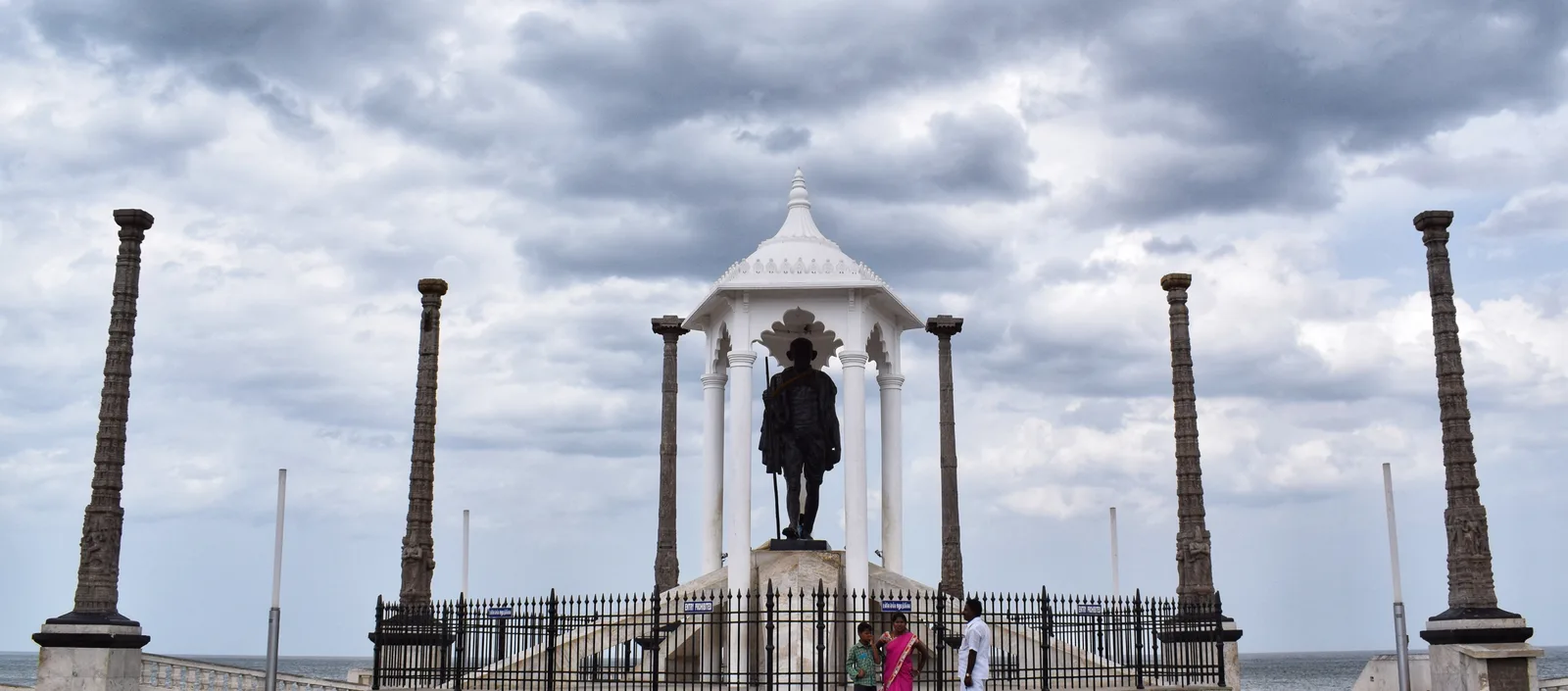
The old town's eastern edge is its drawing room. The UT portal notes that the town's ambience becomes most evident in the oldest part of the town, which flanks the seashore boulevard — the Promenade, a paved seafront along the Bay of Bengal in front of White Town. This is a rocky shore, not a swimming beach: the pleasure is the walk itself, and the landmarks the district's own disaster-management plan lists among Puducherry's major attractions: the Promenade, the French War Memorial, the 19th-century lighthouse, and the park monument, the Aayi Mandapam, in the government park just inland.
Use the Promenade twice a day, the way the town does. Early morning belongs to walkers and the sunrise over the Bay. The evening brings the whole town out for its stroll. Between those hours the seafront is hot and exposed; that is when the shaded grid and the Ashram's quiet earn their place. If you want sand rather than paving, the beaches are excursions: Paradise Beach (Section 05) is the set-piece, reached by boat. The Promenade asks nothing of you but time — no ticket, no timing, no booking — which is why it bookends both days.
SECTION 03The Sri Aurobindo Ashram: A Visit on the Ashram's Own Terms
The Ashram is not a monument that happens to have residents; it is a living spiritual community that receives visitors on stated terms, published on its own website. Its heart is the Samadhi of Sri Aurobindo and the Mother in the main Ashram building. The visitor pages give the hours exactly: you can go to the Samadhi for pranam and meditation from 8:00 to 11:30 a.m. and from 2:00 to 6:00 p.m. After 6:00 p.m., a visitor's pass is required to enter; passes can be issued to those staying in an Ashram guest house, or by the Bureau Central, the Ashram's information centre. The main building can be entered freely during visiting hours; some other sections require a pass, which guest-house residents receive; others ask the Bureau Central.
Plan the visit as the Ashram intends it: quietly. The Bureau Central is designed as an exhibition hall and provides an introduction to the vision of Sri Aurobindo and the Mother through permanent exhibits of photographs, captions, text, videos and books; it also runs video programmes on most days and allots the guest-house rooms — limited and often fully booked, so reservations in advance are advisable. On Monday, Tuesday, Wednesday and Friday there is a collective meditation around the Samadhi from 7:25 to 7:50 p.m., open to all those with a visitor pass. One service ties this guide's halves together: Autocare Services, the Ashram's transport arm, operates two conducted tours every weekday — at 8:15 a.m. to see the Ashram and some of its departments, and at 1:30 p.m. to visit Auroville and the Matrimandir Viewing Point. On cost: the visitor pages publish hours, pass rules and tours, and no entry fee for the Samadhi appears anywhere in them — so none is printed here.
SECTION 04Auroville and the Matrimandir: The Viewing Point, and the Chamber Beyond It
Auroville, the international township the UT portal calls the City of Unity, lies outside town. Its golden sphere, the Matrimandir, offers two entirely different visits, and only one can be improvised. The first is the Matrimandir Viewing Point, which Auroville's own pages describe. The Viewing Point, south of the Park of Unity, is a raised garden area offering a beautiful view of the Matrimandir and its surroundings. Visits are free of cost: passes are obtained at the Auroville Visitors Centre, after watching a short introductory video. Visits run daily from 9:00 a.m. to 5:30 p.m., starting from the Visitors Centre; a partially shaded walk of about 10 minutes leads to the Viewing Point. A free electric shuttle serves visitors who may find the walk difficult, and a free bus makes the return journey.
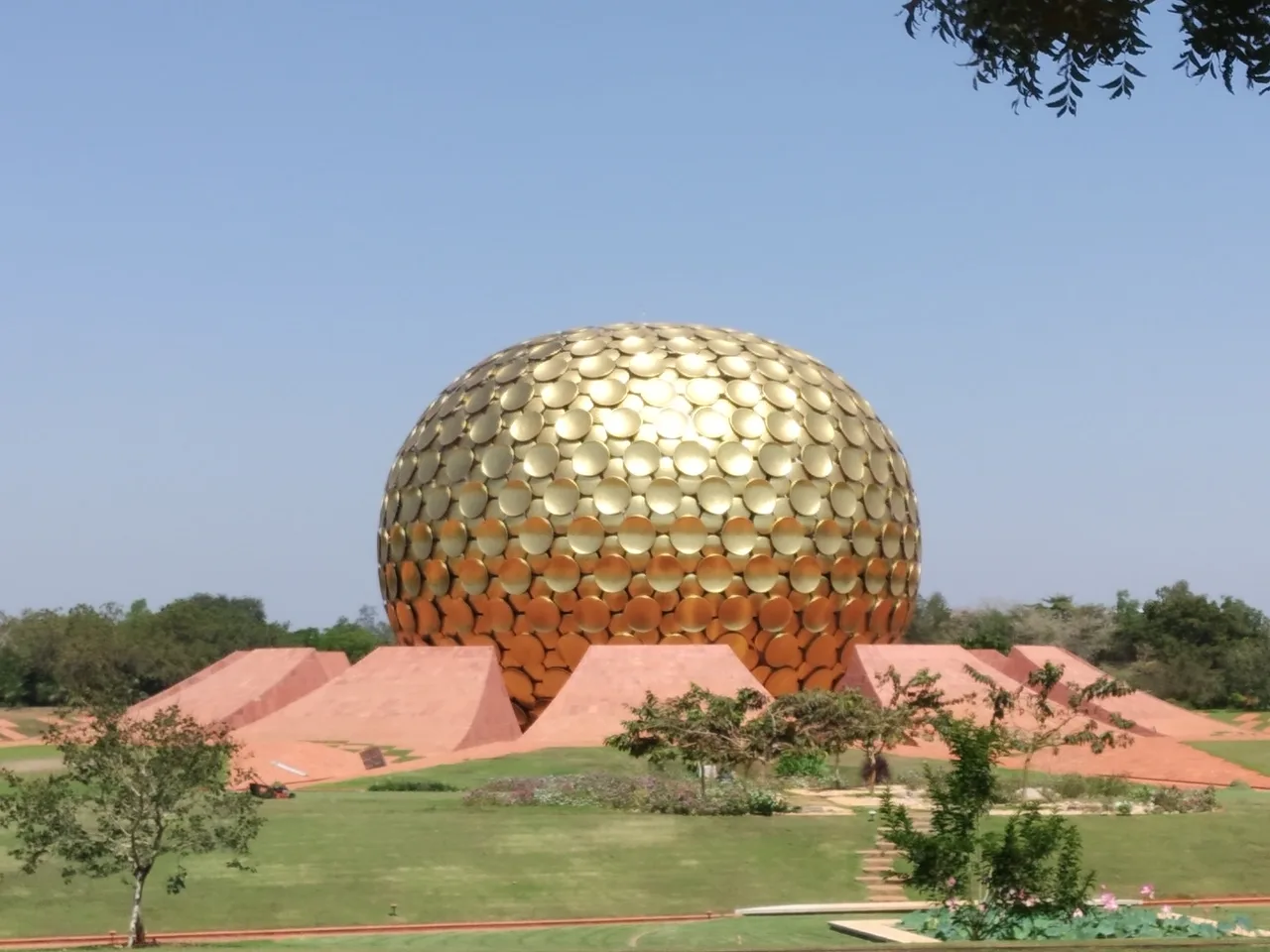
Two of Auroville's rules shape behaviour, both stated plainly on its site. Free passes to the Viewing Point must be obtained directly by the visitors themselves — not left to agents, guides, tour operators or drivers. And vehicle access to the Matrimandir is restricted and not provided to private or hired vehicles: vehicles stay at the Visitors Centre parking, in the interest of the peace and tranquillity the site asks everyone to help maintain. The Information Desk is open every day from 9:00 a.m. to 5:00 p.m. For most two-day visitors, this visit — video, pass, shaded walk, the sphere across its gardens — is the Auroville experience.
The second visit is of another kind. The Inner Chamber of the Matrimandir is a place for individual, silent concentration — not a tourist sight — and its rules are strict. Visitors' concentration is scheduled only in the morning, with a reporting time of 8:00 a.m. The Matrimandir remains closed for visitors' concentration on Sundays and Tuesdays. Same-day bookings are not available: bookings must be requested for subsequent days, booking dates open 5 working days in advance, and Auroville asks visitors to book at least 3–5 days ahead. Group bookings are not accepted. Only children aged 10 years and above are allowed into the Matrimandir; younger children stay at the Visitors Centre with an accompanying adult. And the weather has a vote: in rainy weather the Matrimandir closes and the day's bookings are cancelled, with visitors notified by email no later than 7:35 a.m. So if the Inner Chamber matters to you, book before the trip begins, for your second morning — and if that day is a Sunday or Tuesday, it cannot happen at all.
SECTION 05Chunnambar and Paradise Beach: The Boat Is the Only Way In
South of town, where the Chunnambar river meets the sea, the geography makes the arrangement for you: Paradise Beach — Plage Paradiso — is a sand spit at the mouth of the backwaters, and it can only be reached by boat. The boat house is an official operation. The Puducherry Tourism Development Corporation (PTDC), a Government of Puducherry undertaking, runs the Chunnambar Boat House campus at Nonankuppam, down the Cuddalore Main Road; its own project profile calls it a popular tourism facility 6 km from downtown, with boating among its listed facilities. The Government of India's India Cine Hub profile adds the operating shape: the ferry to Paradise Beach starts from the Chunnambar Boat House and Water Sports Centre, and the ferry service runs from 9 a.m. to 5 p.m. Go in the morning, and do not leave the last boat to chance.
On the fare, this guide follows its rule. No Paradise Beach boat fare is printed here, because no official tariff could be read: PTDC's published pages describe the facility and its projects, but not a visitor price list, and unofficial listings belong to different years and disagree. Buy the ticket at the boat house and carry cash. What can be said on the record is the outing's shape — a short backwater crossing, a broad sand spit with the river behind and the Bay of Bengal in front, and a hard stop set by the last return ferry.
SECTION 06Arikamedu: The Ancient Mound, at Its Official Strength
Every account of Puducherry tells the story of Arikamedu — the port that traded with Rome two thousand years ago. This guide prints only what the official record read for it establishes, and the record is narrower than the legend. The Ministry of Culture has told Parliament that there are seven centrally protected monuments in Puducherry under the Archaeological Survey of India, and the ASI's list, annexed to the Ministry's 2024 answer, names among them the "Archaeological site and remains" at Arikamedu (Ariankuppam). The same answer records a practically useful fact: no entry fee is charged on these protected monuments and protected areas. The district's own disaster-management plan lists Ariyankuppam (Arikamedu) among the district's major tourist attractions, alongside the Ashram, Auroville, the Promenade and Chunnambar.
So go, but with calibrated expectations. What the protection covers is an archaeological site — an excavated mound and remains in a village south of town — not a standing monument with gates, galleries and labels. The excavation narrative repeated in guidebooks (who dug, in which year, what came out of the trenches) appears in no official text read for this guide, and it is not asserted here. What is solid is enough: this quiet ground is on the nation's protected list, entry costs nothing because the ASI charges nothing at Puducherry's protected monuments, and it is a thoughtful counterweight in the itinerary. Allow it an hour.
SECTION 07The Two Days, Getting There, and the Monsoon Calendar
Day 1 — the town. Start early on the Promenade for the sunrise, then walk the White Town grid while it is cool. Give the Ashram its morning window (8:00–11:30 a.m.) — Bureau Central's exhibition first, then the Samadhi in silence. Spend the hot midday slowly: lunch, then the Tamil Quarter's temples and bazaars. Return by evening — pass-holders can join the collective meditation around the Samadhi (7:25–7:50 p.m. on Monday, Tuesday, Wednesday and Friday) — and end on the Promenade. Day 2 — the township and the water. Be at Auroville in the morning: video and free pass at the Visitors Centre, the shaded walk to the Viewing Point; if you booked the Inner Chamber days ahead and today is eligible, its 8:00 a.m. reporting time reorganises the morning around itself — Viewing Point afterwards. Then south: the Chunnambar boat to Paradise Beach inside its 9-to-5 ferry frame, Arikamedu on the same corridor, and back for a last evening on the seafront.
Getting there. Almost everyone comes through Chennai, and the Ashram's own visitor pages say so: Pondicherry is a small coastal town 160 km south of Chennai (the UT portal says about 162 km), most travellers pass through Chennai by air, train or road, and the onward road journey generally takes about 3 hours. Private and government buses leave Chennai for Pondicherry every half-hour; a taxi from Chennai airport is convenient with luggage. Chennai's is the international airport that matters — the UT portal notes it directly connects to the highway to Puducherry. The town has its own small airport, also connected directly by air with Bengaluru, with a few flights a week — worth checking when you book, but the Chennai road transfer remains the default plan. Rail is the third route, sold through IRCTC; Indian Railways publishes no timetable page that could be read for this guide, so no train times or fares are printed — check IRCTC for your date.
Seasons. Puducherry's calendar is written by a monsoon most of India barely feels. The UT's Climate Change Cell describes a hot, tropical maritime climate: summer lasts from April to early June, when maximum temperatures may reach 41 °C; high humidity and occasional thunder showers follow from June to September; and the north-east monsoon sets in during the middle of October, and the region gets the bulk of its annual rainfall during the period from October to December. Plan against that calendar: the window is the dry, mild stretch after the monsoon, broadly January to March; a trip in the mid-October-to-December window gambles on rains that can close the Matrimandir and roughen the sea.
FAQFrequently Asked Questions
Can I go inside the Matrimandir, or only see it from outside?
Both are possible, but they are different arrangements. The Viewing Point is simple: visits are free, daily 9:00 a.m.–5:30 p.m., pass collected in person at the Visitors Centre after a short introductory video, then a roughly 10-minute shaded walk (free electric shuttle and return bus for those who need them). The Inner Chamber is a booking for silent individual concentration, not sightseeing: mornings only (reporting 8:00 a.m.), closed to visitors on Sundays and Tuesdays, no group bookings, no same-day bookings — dates open 5 working days in advance and Auroville advises booking 3–5 days ahead. Only children aged 10 and above may enter, and rain closes the Matrimandir and cancels the day's bookings. On a two-day trip, book before you travel.
What are the Sri Aurobindo Ashram's visiting hours, and is there an entry fee?
The Ashram's own pages state the hours: the Samadhi can be visited for pranam and meditation from 8:00 to 11:30 a.m. and from 2:00 to 6:00 p.m. After 6:00 p.m. a visitor's pass is required, issued to guest-house residents or by the Bureau Central; the main building is otherwise entered freely during visiting hours, though some other sections also require a pass. No entry fee is published anywhere in the Ashram's visitor information, and this guide prints none.
How do I reach Paradise Beach, and what does the boat cost?
Only by boat. Paradise Beach (Plage Paradiso) is a sand spit at the mouth of the Chunnambar backwaters, and the ferry starts from the Chunnambar Boat House at Nonankuppam — a facility of the Puducherry Tourism Development Corporation, the Government of Puducherry's tourism undertaking. The Government of India's India Cine Hub profile gives the ferry's hours as 9 a.m. to 5 p.m. The fare is not printed here: no official PTDC tariff could be read when this guide was checked (3 November 2026), and unofficial listings disagree. Buy at the boat-house counter, carry cash, and plan around the last return boat.
When is the best time of year to visit Puducherry?
After the north-east monsoon, not during it. The UT's Climate Change Cell records that it sets in during the middle of October and the region receives the bulk of its annual rainfall from October to December — months that also risk a cancelled Matrimandir booking, since Auroville closes it in rainy weather. Summer, April to early June, can reach 41 °C; June to September is humid with thunder showers. The mildest, driest window is broadly January to March. Whenever you come: sights early and late, shade at midday.
How do I get from Chennai airport to Puducherry?
By road, in about 3 hours. The Ashram's visitor pages — written for exactly this journey — put Pondicherry 160 km south of Chennai (the UT portal says about 162 km) and record that private and government buses leave Chennai for Pondicherry every half-hour; a hired taxi is the convenient choice from the airport, especially with luggage, and Chennai's airport connects directly to the highway. Puducherry also has a small airport with a direct Bengaluru link a few times a week, but schedules there change — the Chennai transfer is the plan to build on.
Official references and checking status
Checked on 3 November 2026 against the official sources below; the accompanying sources file maps each claim to its page. Four limits are flagged honestly. First, PTDC publishes its Chunnambar facility and projects but no visitor tariff that could be read, so no boat fare is printed; unofficial figures conflict. Second, the ferry's 9 a.m.–5 p.m. hours and the Plage Paradiso name rest on the India Cine Hub profile, read in reproduction after the portal page failed to load. Third, Arikamedu's Roman-era fame appears in no official text read: the Ministry of Culture and the ASI list establish its protected status and that no entry fee is charged at Puducherry's protected monuments — the guide prints exactly that. Fourth, train times and fares are not printed (no Indian Railways timetable page could be read), and airport services are stated only at the strength of the Ashram's visitor page. Confirm current prices and timings before you travel.
- Government of Puducherry (official UT portal) — Tourism: the town, its grid, colours and access
- Department of Tourism, Government of Puducherry (official) — the destination in the department's own words
- Sri Aurobindo Ashram (official) — Visitors' Information: reaching Pondicherry, passes, Bureau Central
- Sri Aurobindo Ashram (official) — FAQ, Activities: Samadhi hours, meditations, conducted tours
- Auroville (official) — Visiting the Matrimandir: Viewing Point, free passes, timings, vehicle rules
- Auroville (official) — Concentration in the Inner Chamber: closed days, booking rules, children, rain
- PTDC via py.gov.in (official) — the floating jetty at Paradise Beach, Chunnambar
- India Cine Hub, Government of India — Puducherry Beach profile: Chunnambar and the Paradise Beach ferry
- Ministry of Culture, Rajya Sabha answer (2024) — monuments of national importance, incl. Arikamedu; no entry fee
- Puducherry District Disaster Management Plan 2024 (official) — the district's major tourist attractions
- Puducherry Climate Change Cell (official) — Regional Climate Change Vulnerability Assessment: climate and the north-east monsoon
Photos: Mahatma Gandhi's statue on the Promenade, by Purnim, via Wikimedia Commons, licensed under CC BY-SA 4.0; the Matrimandir across its gardens at Auroville, by Mohan Babu V, via Wikimedia Commons, licensed under CC BY-SA 4.0. The licences require this credit.
General information only. This guide is based on official sources publicly available and checked on the date shown on this page. Visa rules change, and consular and USCIS officers decide every case on its own facts — nothing here is a confirmation or a guarantee for your individual case, and this is not legal advice. Always confirm the current requirement on the official page linked in this guide before you act, and consider a qualified immigration attorney for your specific situation.