
Researched & checked — 30 Oct 2026
Jaipur in 2 Days: Amber Fort, the Pink City and What Entry Really Costs
NEW Published 30 October 2026
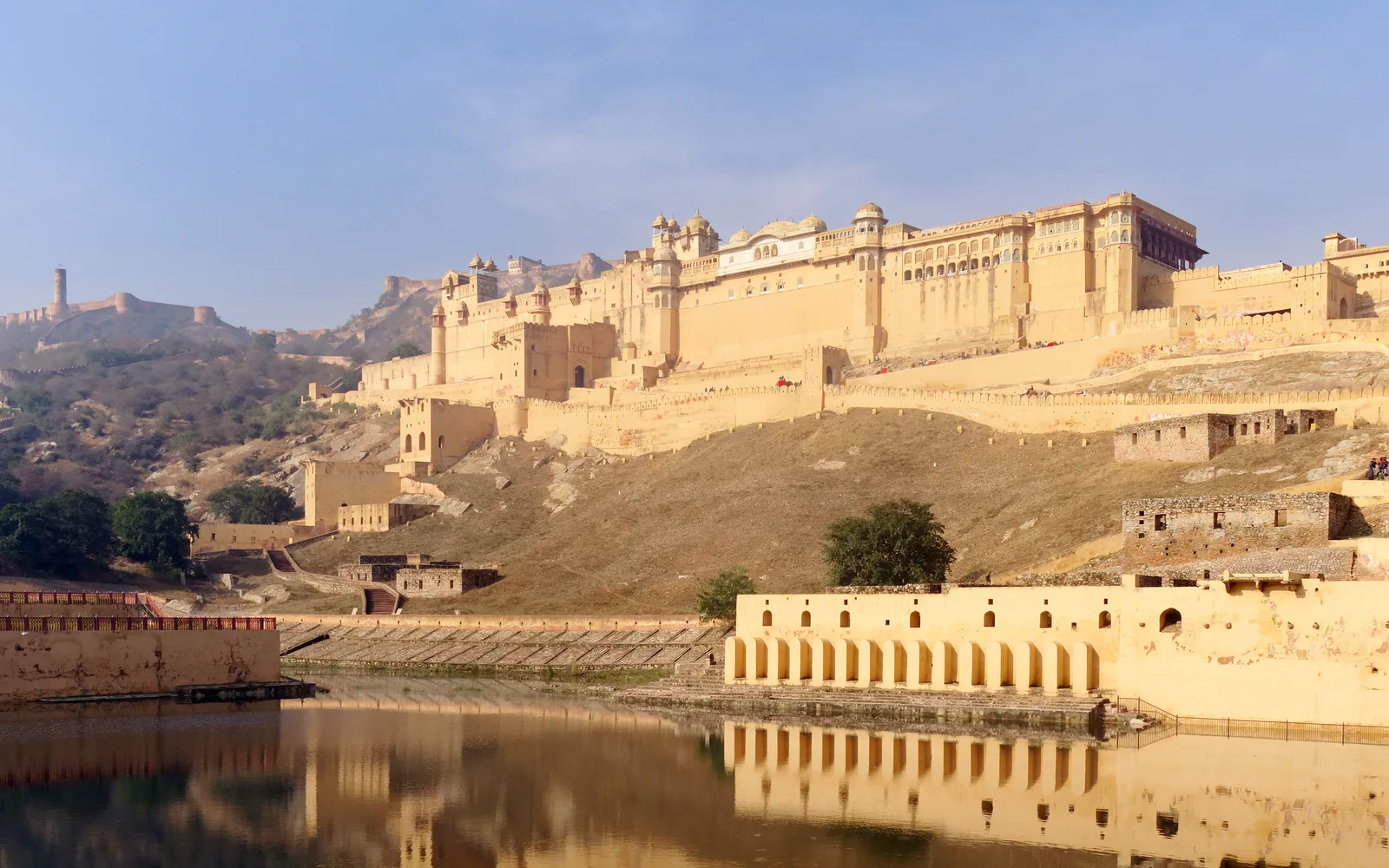
Two days in Rajasthan's capital shaped around how the city is actually laid out — Amber Fort and the lake road on day one, the walled Pink City's palace, observatory and bazaars on day two — with an honest account of what entry costs, including why one famous set of prices appears nowhere in this guide.
For Jaipur in 2 days, do this: Day 1 — Amber Fort first thing, the Jal Mahal lake viewpoint on the drive back, and the Albert Hall Museum in the late afternoon. Day 2 — the Hawa Mahal facade, the City Palace, the Jantar Mantar next door, and the Pink City bazaars. The one fully published price list is the City Palace's own: museum ticket ₹400 for Indian adults and ₹1,200 for international adults; its City Palace Composite — also covering Jaigarh Fort and the Royal Cenotaphs — ₹500 / ₹1,700. Amber, the Hawa Mahal interior, Jantar Mantar and Albert Hall are state monuments sold through the government's OBMS portal, which also sells a Jaipur composite; their rates were revised from 1 January 2026 and live prices sit inside the portal's booking flow, so this guide prints no figure for them — check OBMS or the counter.
SECTION 01How These Two Days Fit Together
The classic Jaipur mistake is zig-zagging — Amber in the morning, back to the old city for lunch, out again in the afternoon — because the traffic between the hills and the walled city eats the day. This plan draws one line instead. Day 1 runs north along a single corridor — out to Amber, back past the Jal Mahal on its lake, and into the Albert Hall Museum just south of the old city walls as the light softens. Day 2 never leaves the Pink City: everything is walkable, and the one ride worth taking is the metro into Badi Chaupar station, which surfaces inside the old city itself. Amber gets the morning, when the sandstone is at its best and the climb is coolest; Day 2 is built for lingering, with the bazaars saved for after the midday heat breaks. If one of your days is short, cut from Day 2's tail, not from Amber.
SECTION 02Day 1, Morning: Amber Fort, Taken Slowly
Amber Palace — most visitors call it Amber Fort — stands in the town of Amer, roughly 11 kilometres from Jaipur's main city. Rajasthan Tourism's own description sets the scene: you enter through Suraj Pol or Chand Pol, the sun and moon gates, into Jaleb Chowk, the great courtyard, and climb past the Diwan-e-Aam, the public audience hall, into royal apartments that build up the hillside, room by painted room.
Leave the most famous room for when you reach it: the Sheesh Mahal, whose walls and ceiling are inlaid with tiny mirrors and coloured glass that scatter lamplight across the chamber. Rajasthan Tourism also notes the restored tunnels running from Amber towards Jaigarh Fort on the ridge above, part of which is open. There is a light and sound show in the evenings; confirm the day's show time on the OBMS listing rather than relying on any printed schedule, this guide included.
Give Amber a full morning — three hours is comfortable, two the minimum — arriving at opening time, before the courtyards fill. Entry is through the state monuments system described in Section 04: tickets are sold at the monument and through the government's OBMS portal, which also sells the Jaipur composite. If the composite fits your two days, Amber is where it starts paying for itself.
The way back: Jal Mahal and the Albert Hall
The road back passes Man Sagar lake, where the Jal Mahal appears to float on the water. The palace is not open to visitors: this is a ten-minute stop on the lakeside promenade for the view and the photograph — free and ungated — then on into the city.
End the day at the Albert Hall Museum in Ram Niwas Garden, just outside the old city wall. It is the state museum of Rajasthan, housed in one of the city's finest Indo-Saracenic buildings — designed by Sir Samuel Swinton Jacob and opened as a public museum in 1887 — with rich collections of paintings, sculpture and decorative art. Late afternoon suits it twice over: the galleries are a cool change from the fort, and the building itself is the photograph, its domes and chhatris catching the last of the light. For ticketing it is a state monument — the same OBMS system and composite logic apply.
SECTION 03Day 2: The Pink City — Hawa Mahal, City Palace, Jantar Mantar
Start with the facade: Hawa Mahal
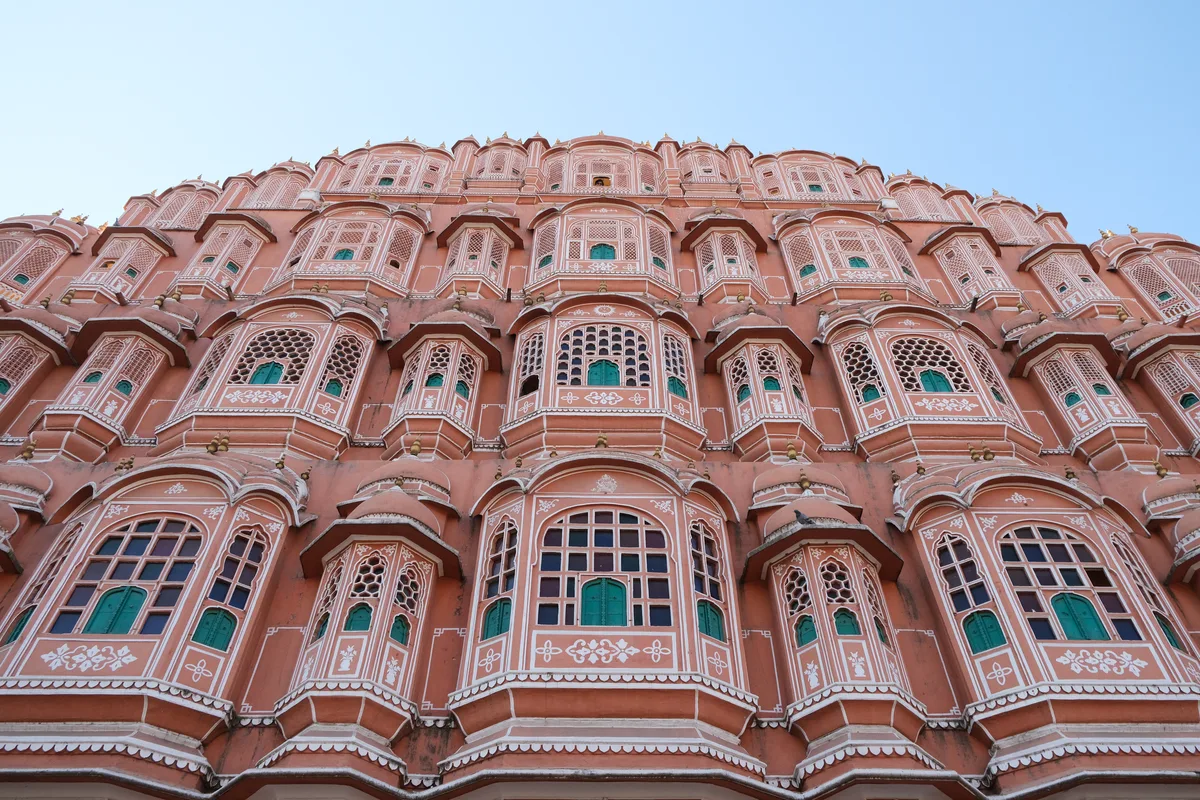
Begin Day 2 on the street, looking up. The Hawa Mahal — the Palace of Winds — is a five-storey facade of latticed windows and small balconies, built, as Rajasthan Tourism describes it, so the royal household's ladies could watch Johari Bazaar below through its jharokhas without being seen. The same official account adds that it was raised without a foundation and leans at 87 degrees, its pyramidal shape holding it up for over two centuries, and that its outline is said to resemble the crown of Lord Krishna; the front mixes Rajput domes and canopies with Mughal stone-inlay and arches. The street view is free and is, frankly, the main event; the interior, entered from behind, is a state monument on the OBMS system, worth it for the view back over the old city from those same jharokhas.
The City Palace, and what its tickets actually cover
A few minutes' walk away, the City Palace publishes its prices on its own official site — which is why this guide can print them in full. The standard Museum ticket — the courtyards and the galleries — costs ₹400 for an Indian adult and ₹1,200 for an international adult, with youth concessions (students, children below 12) at ₹200 / ₹600 and a ₹200 concession for senior citizens and defence personnel. The museum tour runs 9:30 AM to 6:30 PM, with last tickets at 6:00 PM.
Read the next ticket before you buy the first. The palace's own City Palace Composite — ₹500 for an Indian adult (₹300 youth and concession) and ₹1,700 for an international adult (₹850 youth) — covers the courtyards and galleries plus Jaigarh Fort, up on the Amber ridge, and the Royal Cenotaphs. If Jaigarh is anywhere in your plans, the composite is the better buy and it is not close. Do not confuse it with the state government's Jaipur composite in Section 04: different authorities, different lists, neither sold by the other. The palace also runs a guided Chandra Mahal Royal Tour of the royal residence — ₹4,000 Indian adults, ₹5,000 international adults, youth at half — sold only at the palace ticket counter. Two cautions from the palace's own page: its Museum at Night opening is temporarily closed, and the Textile Gallery (Mubarak Mahal) is closed for restoration from 27 March 2026 — check before you promise yourself either. The palace names Badi Chaupar, on the metro's Pink Line, as its closest station.
Jantar Mantar: astronomy you can walk through
Next door stands the day's most quietly astonishing sight. The Jantar Mantar is a royal observatory of 19 instruments built as monumental stone sculptures — Rajasthan Tourism counts nineteen, each a fixed structure carved to measure the positions and distances of celestial bodies. Its centrepiece, the Vrihat Samrat Yantra, is a 27-metre equinoctial sundial — the tallest in the world — credited by the same account with telling time to an accuracy of two seconds. Look too for the paired Ram Yantra tubes, found only in Jaipur and Delhi, and the Jai Prakash bowls that map the sky in inverted shadow. UNESCO inscribed it on the World Heritage List in 2010. For ticketing it belongs to the state system: OBMS or the counter, composite-eligible, same story as Amber.
Finish in the bazaars — which cost nothing to walk
The Pink City's bazaars are public streets, not attractions, and wandering them is free: Johari Bazaar for jewellery and gemstones below the Hawa Mahal, Tripolia and Bapu Bazaar for textiles, bangles and the blue pottery Jaipur is known for. Go in the late afternoon, when the pink facades deepen in colour and the whole grid is awake.
SECTION 04What Entry Really Costs: Jaipur's Two Ticket Systems
Jaipur pricing makes sense once you see that two authorities sell tickets here. The City Palace publishes its prices on its own site — the figures printed above, and the only monument prices in this guide stated as exact. The state monuments — Amber, the Hawa Mahal interior, Jantar Mantar, Albert Hall, Nahargarh and other department sites — belong to Rajasthan's Department of Archaeology and Museums. Their tickets are sold at the monuments and online through the government's OBMS portal, which also sells a Jaipur composite ticket covering several state monuments on one ticket, plus a longer Rajasthan-wide pass.
Here is the honest limit, stated plainly. The department revised its monument fees with effect from 1 January 2026 — the first revision in a decade — and the live rates for the state monuments and the composite are shown inside the OBMS booking flow rather than on a public price page this guide could read and quote. Figures circulating in news reports and travel blogs disagree with each other, sometimes by a factor of two. So this guide prints no price for Amber, Hawa Mahal, Jantar Mantar, Albert Hall or the composite, rather than print one it cannot stand behind. What it can give you is the mechanism, which is what actually saves money: this itinerary takes in four state monuments, so price the OBMS composite first, compare it with the individual tickets the portal quotes for your dates and category, and buy whichever total is lower.
Getting around otherwise costs little: Jaipur Metro's Pink Line runs from Mansarovar to Badi Chaupar — 11 stations, the underground Chandpole-to-Badi Chaupar stretch in service since September 2020 — the natural arrival point for Day 2. Reported fares run from around ₹10 for a short hop to around ₹30 across the line; the corporation's own fare notice could not be read as published text for this guide, so treat the range as approximate and confirm at the station. Auto-rickshaws cover the Amber corridor and the Albert Hall run; agree the fare before you set off.
SECTION 05Plan Your Two Days: The Jaipur Checklist
Work through this list the evening before, and the two days mostly run themselves.
- ☐ Do the OBMS check first. Price the Jaipur composite on the OBMS portal against individual tickets for Amber, Hawa Mahal, Jantar Mantar and Albert Hall in your category, and buy the cheaper total — rates were revised from 1 January 2026 and the portal is the live source.
- ☐ Do not mix up the two composites. The City Palace Composite (₹500 / ₹1,700) is the palace's own, adding Jaigarh and the Royal Cenotaphs; the OBMS composite is the state's. Neither covers the other's sights.
- ☐ Give Amber the morning. Arrive at opening time, allow two to three hours, and carry water — the courtyards are exposed and the site is a climb.
- ☐ Check the City Palace page before Day 2. The palace posts closures on its visit page — night opening paused, one gallery under restoration at checking.
- ☐ Ride the metro into the old city. Badi Chaupar station (Pink Line) lands you inside the walls, a short walk from all three Day 2 sights — and skips old-city parking.
- ☐ Keep the bazaars for late afternoon. They are free public streets; go when light and temperature are kindest, and save your budget for what you buy.
- ☐ Carry ID for concession tickets. City Palace concessions (youth, student, senior citizen, defence) are priced on its official list — expect the category to be checked.
- ☐ Reconfirm every price and hour on the official pages linked below — figures here were checked on 30 October 2026 and can change.
FAQFrequently Asked Questions
How much does the City Palace in Jaipur cost to enter?
On the palace's official price list, checked 30 October 2026: the Museum ticket (courtyards and galleries) is ₹400 for Indian adults and ₹1,200 for international adults, youth concessions ₹200 / ₹600. The City Palace Composite, adding Jaigarh Fort and the Royal Cenotaphs, is ₹500 / ₹1,700. Museum hours: 9:30 AM to 6:30 PM, last tickets 6:00 PM.
How much are tickets for Amber Fort, Hawa Mahal and Jantar Mantar?
Deliberately, this guide prints no figure for them. All three are Rajasthan state monuments whose fees were revised from 1 January 2026; the live rates sit inside the government's OBMS booking portal rather than on a readable public price page, and figures reported elsewhere conflict. Price them — and the Jaipur composite — on OBMS or at the counter for your dates and category before you pay.
What is the Jaipur composite ticket, and which one should I buy?
There are two, sold by different authorities. The state's composite, sold through the OBMS portal, covers Jaipur's state monuments — Amber, Hawa Mahal, Jantar Mantar, Albert Hall and others — on one ticket. The City Palace Composite (₹500 / ₹1,700) covers the palace plus Jaigarh Fort and the Royal Cenotaphs. Seeing sights from both lists, as this itinerary does, means one of each; neither is accepted at the other's sights.
Can I do Jaipur's main sights without a car?
Day 2, yes, entirely: the Pink Line metro to Badi Chaupar puts all three sights within a short walk, and the bazaars are the streets around them. Day 1 needs wheels — a hired car, taxi or auto-rickshaw for the roughly 11 km out to Amer, the Jal Mahal stop on the way back, and the Albert Hall — but none of it needs to be your own car.
Which order should I see the Pink City sights in?
Hawa Mahal first, for the morning light on the facade; then the City Palace for its 9:30 AM opening and a full two hours; Jantar Mantar next door after; and the bazaars last, in the late afternoon. The sights sit minutes apart, so the order is about light and energy, not distance.
Official references and checking status
The prices, hours and descriptions in this guide were checked against the official pages below on 30 October 2026. Two honest limits: first, the entry fees for the state monuments (Amber, Hawa Mahal, Jantar Mantar, Albert Hall) and for the state composite ticket are not printed, because the revised rates are quoted inside the OBMS booking flow rather than on a public price page that could be read for this guide, and figures reported elsewhere conflict — the mechanism, and where to price it, are described in Section 04 instead. Second, Jaipur Metro's ₹10–₹30 fare range is approximate — its fare notice could not be read as published text in this pass — so confirm at the station. Everything else priced here — the City Palace tickets, hours and closures — is quoted from the palace's own official visit page. Prices and rules change — re-check the relevant page below before you travel.
- City Palace, Jaipur — official visit page (ticket prices, hours, closures)
- Rajasthan Tourism — Amber Palace (the gates, courtyards, Sheesh Mahal and the Jaigarh tunnels)
- Rajasthan Tourism — Hawa Mahal (the facade, its jharokhas and the foundation-free structure)
- Rajasthan Tourism — Jantar Mantar (the 19 instruments and the Samrat Yantra)
- Rajasthan government OBMS portal — online booking for state monuments and composite tickets
- Jaipur Metro Rail Corporation — the Pink Line (Mansarovar to Badi Chaupar)
- UNESCO World Heritage Centre — The Jantar Mantar, Jaipur (inscribed 2010)
Photos in this guide: Amber Fort above Maota Lake by Jakub Hałun / Wikimedia Commons (CC BY-SA 4.0), cropped to a wide frame; the Hawa Mahal facade by Adityaoberai / Wikimedia Commons (CC BY 4.0). Both resized and converted for this page.
General information only. This guide is based on official sources publicly available and checked on the date shown on this page. Visa rules change, and consular and USCIS officers decide every case on its own facts — nothing here is a confirmation or a guarantee for your individual case, and this is not legal advice. Always confirm the current requirement on the official page linked in this guide before you act, and consider a qualified immigration attorney for your specific situation.