
Researched & checked — 3 Nov 2026
Madurai: The Meenakshi Temple, the Palace and the Temple City, Planned on Official Facts
NEW Published 3 November 2026
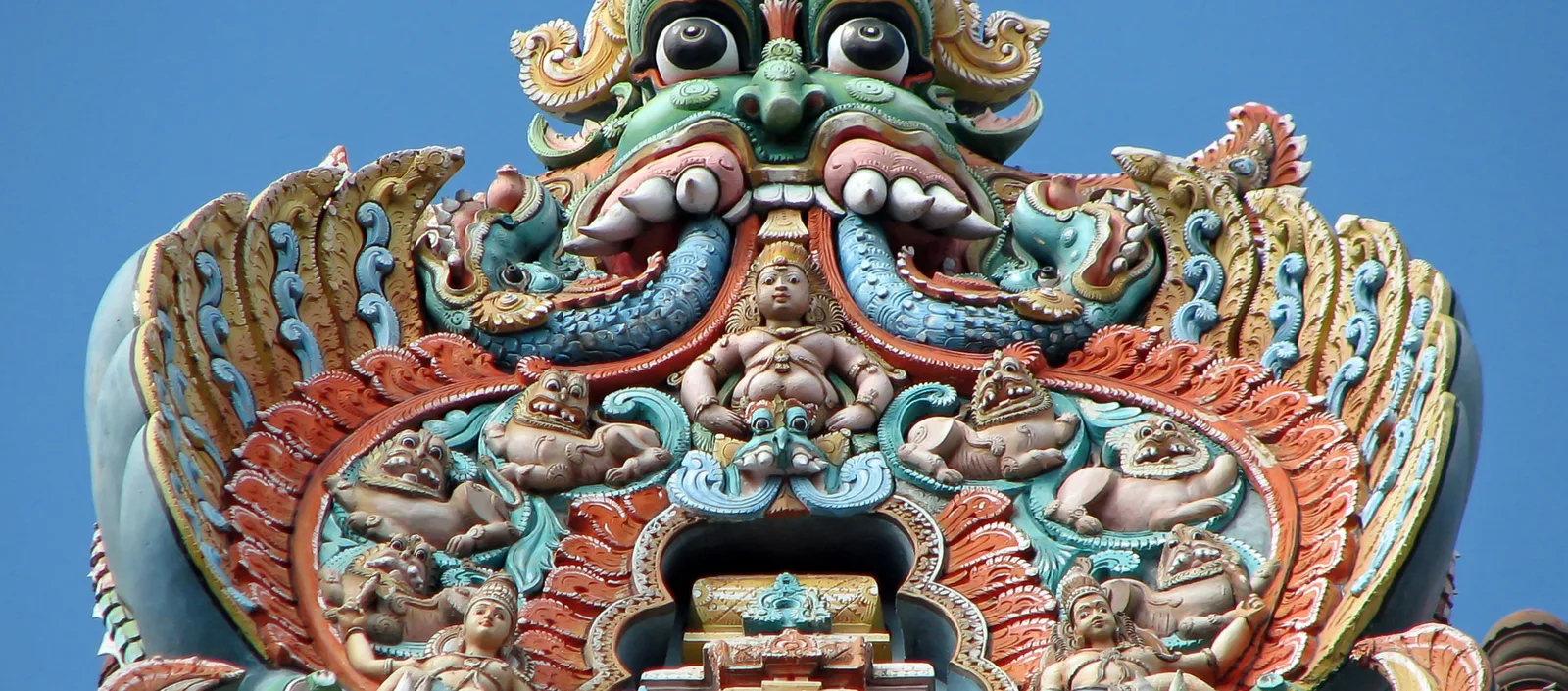
Madurai is organised around one building: a walled temple city on the south bank of the Vaigai, ringed by fourteen painted towers and run to a timetable its own administration publishes. This guide plans the visit on the temple's HR&CE page, the district administration and the airport authority — and says plainly where no official figure could be read.
The Arulmigu Meenakshi Sundaraswarar Temple — the temple of the goddess Meenakshi and of Sundareswarar — stands on the southern bank of the Vaigai river at the centre of Madurai. Its administration publishes the darshan hours: 5:00 AM–12:30 PM and 4:00 PM–10:00 PM daily, closed in between, with pooja timings liable to change on festival days. The rebuilt complex is ringed by 14 gopurams averaging 45–50 m; the southern tower is the tallest at 51.9 m (170 ft). A short walk away, the Thirumalai Nayakkar Palace (1636) runs a daily sound-and-light show at 6:45 PM in English and 8:15 PM in Tamil (district administration).
SECTION 01A City Built Around a Goddess
Begin with what the temple itself claims, because its own description is measured. The temple's official page — maintained under the HR&CE Department, temple code TM031962 — records that the Arulmigu Meenakshi Sundaraswarar Temple stands on the southern bank of the Vaigai river, at the centre of Madurai, a city the page notes is mentioned in Sangam literature. Its presiding deities are Meenakshi, an aspect of Parvati, and Sundareswarar, an aspect of Shiva, and the page records that the deities were praised in literature of the sixth century. Madurai is therefore not a city with a famous temple in it; it is a city that has grown for well over a thousand years around a shrine — the streets of the old town still ring the temple walls, and the towers are the compass points by which the whole centre is navigated.
The complex a visitor enters today is the rebuilt temple, and the administration's own figures frame it: the enclosure is surrounded by 14 gopurams — gateway towers — of an average 45 to 50 metres in height, their surfaces carrying tiers of painted stucco figures, and the southern tower is the tallest of them at 51.9 metres (170 feet). Inside the walls the complex works as a small sacred city: two principal shrines, for the goddess and for Sundareswarar; pillared halls and corridors that the temple's description notes for their sculpture; the temple tank; and the offices and queues of a working institution that opens before dawn and closes after dark.
That living quality is the point of the visit: this is simultaneously one of India's great architectural compositions and a functioning place of worship whose day is structured by poojas. Sightseeing here is done on the temple's terms and inside its timetable — which is why the next section, the published hours, matters more than any list of sights.
SECTION 02Darshan: The Temple's Own Hours, and How a Visit Flows
The temple publishes its opening and closing timings on its own page, and they are the spine of any Madurai plan: the temple opens at 5:00 AM and remains open until 12:30 PM; it then closes, and reopens at 4:00 PM until 10:00 PM. The same page carries the administration's caution, in its Tamil note, that daily pooja timings may change during festivals — so on a festival day, treat the frame as a guide and the temple's own notices as the authority. Two practical consequences follow. First, the midday closure is absolute: a visitor who arrives at 1 PM has three hours to fill, which is exactly when the palace and the old-city streets (Sections 05 and 07) earn their place in the day. Second, the two sessions have different characters — the early morning is the devotee's temple, quieter and cooler; the evening session is when the complex is at its most animated.
The flow of a visit is the flow of the complex itself: in through one of the gopuram gateways, footwear left at the stands by the entrances, then through the outer corridors towards the two shrines — the goddess's shrine is the heart of the complex and the usual first darshan, with Sundareswarar's beside it. Queues form and move with the pooja rhythm; on ordinary days the visit absorbs an hour or two, on festival days and weekends considerably more. The temple's website also runs the department's e-services — the channel for its online services and donations — the only channel this guide will point you to for anything involving payment to the temple.
On money, this guide follows its rule, and the position is stated plainly: no darshan fee is printed here. The temple's readable official pages publish its hours but no fee table that could be checked for this guide, and the figures quoted elsewhere for special-darshan tickets disagree with each other. So nothing is quoted — if you choose a paid seva or a special-darshan ticket, buy it only through the temple's official e-services or its own counters, and let the price on that official screen be the one you trust.
SECTION 03Inside the Walls: Towers, Pillars and the Golden Lotus Tank
Seen from the old city's streets, the gopurams do the talking: fourteen towers, each a stepped pyramid of painted figures — gods, guardians, dancers and demons tiered to a barrel-vaulted top — with the southern tower, at the administration's published 51.9 metres, standing over the quarter as the city's fixed landmark. They repay slow looking from outside the walls as much as from within: the sculpture is repainted and renewed in the temple's continuing life, which is why the colours read as vividly as they do.
Within, the complex's most celebrated interior is its great pillared hall — the hall of a thousand pillars, whose rows of carved columns, each a sculpture in its own right, form the temple's secular showpiece: part sculpture gallery, part ceremonial hall, and the place where a sightseeing visitor can spend the longest time simply looking. This guide deliberately prints no pillar count and no dimensions for it: the temple's own readable description anchors the complex's towers and deities, but no official descriptive text for the hall could be read in full for this guide, and the counts in unofficial accounts vary. What needs no figure is the experience — a forest of carved stone figures, horsemen and deities, aligned in long perspectives.
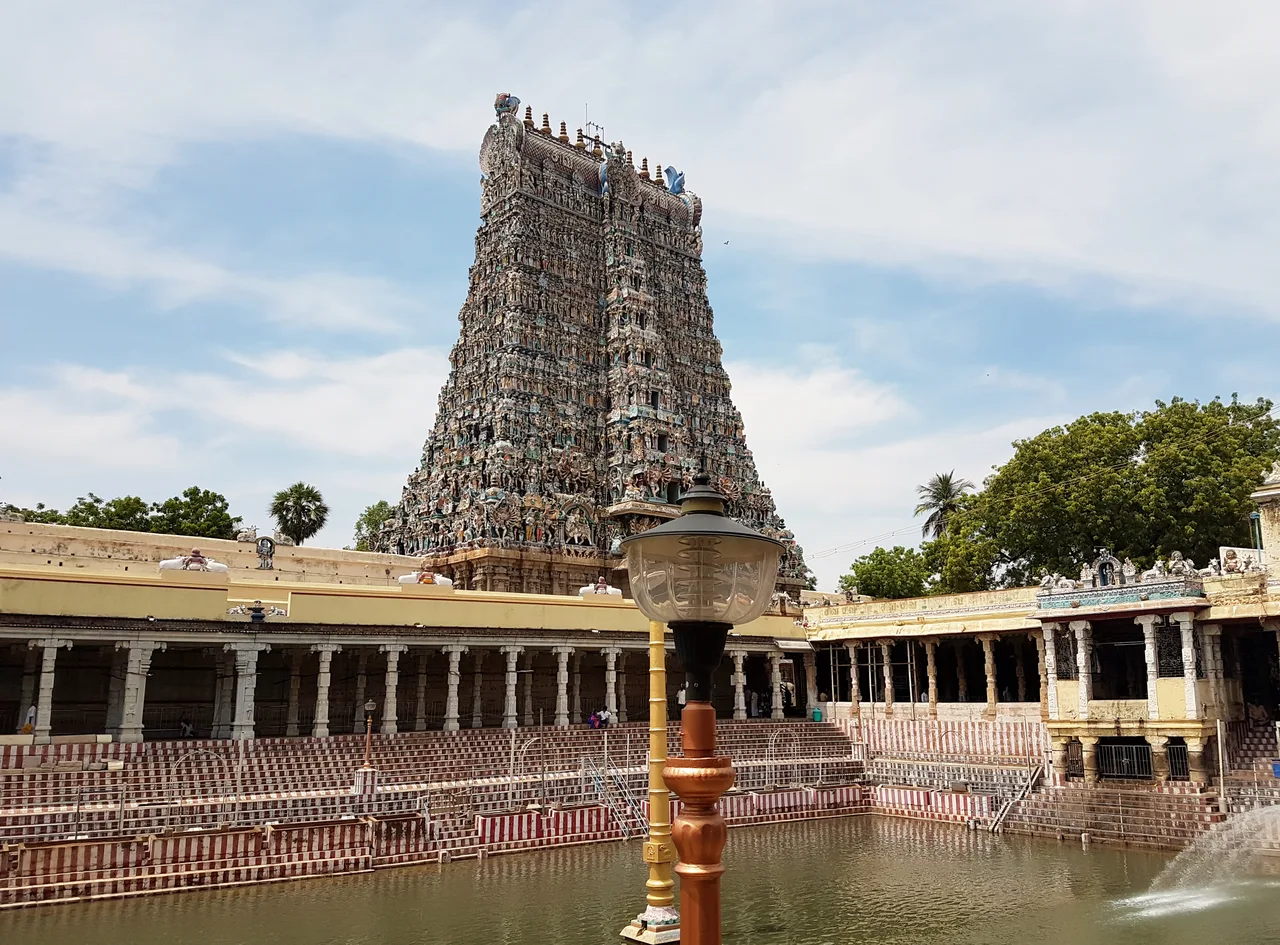
The complex's still centre is its tank, the Porthamarai Kulam — the Golden Lotus Tank — the stepped, corridor-ringed water court shown in the photograph above, named for the golden lotus of the temple's own tradition. It is the natural pause in a visit: the place to sit at the edge of the water, take in the towers reflected around it, and let the shrines' queue rhythm settle before moving on. Between the tank, the hall and the two shrines, an unhurried circuit of the complex fills the better part of a morning or an evening session on its own.
SECTION 04Visiting Respectfully: Dress, Devices and the Inner Shrines
A frank note on sourcing before the advice: the temple's readable official pages publish its hours and its description, but no dress-code or device text that could be quoted for this guide — so what follows is practical etiquette for a working temple, offered as advice rather than as the temple's printed rule, and the boards and staff at each entrance remain the final word on the day.
Dress as for a place of worship, because that is what it is: clothing that covers the shoulders and the legs is the expected norm for entering South Indian temples of this standing, and visitors in shorts or sleeveless tops should expect to be turned back at the gate. Footwear comes off before entry — stands near the entrances hold it. Treat photography the same way: assume cameras and phones are restricted inside the complex, above all near the shrines, and take your cue from the entrance boards and staff. Finally, hold the distinction the complex itself holds: the halls, tank and corridors are the visitor's ground, while the innermost shrines are for worship — sightseeing stops where darshan begins, and a visitor who respects that line will find the temple generous with everything else.
SECTION 05Thirumalai Nayakkar Palace: The Other Madurai
About 1.5 km from the temple stands the city's second great interior, and the district administration's account of it is unusually complete. The palace was built in 1636 by King Thirumalai Nayak, whose name it bears, and the district singles out the stucco work on its domes and arches. Its centrepiece is the Sorgavilasam — the Celestial Pavilion — measuring 75 m by 52 m and constructed entirely of brick and mortar without the support of a single rafter or girder, which the district calls a marvel of Indo-Saracenic architecture. Around the courtyard run corridors of massive white pillars, 20 m in height and 4 m in circumference, connected by high decorated arches, with polished black stone pillars of varying heights elsewhere in the building.
What survives is a fraction, and the district tells that story honestly too: the king's grandson demolished much of the palace and carried off its jewels and woodcarvings to build a palace of his own at Tiruchirapalli — a dream, the district notes drily, that never came true — and Lord Napier, then Governor of Madras, partially restored what remained in 1866–72, with further restoration since. Today's visitor sees the Entrance Gate, the Main Hall and the Dance Hall. The palace's daily finale is published by the district: a half-hour sound-and-light show, in English at 6:45 PM and in Tamil at 8:15 PM, telling the story of Thirumalai Nayak — his passion for the arts, his victories and his love for his subjects. One gap, stated plainly: the district page gives the show but no entry tariff that could be read for this guide, so no palace entry fee is printed here — it is ticketed at the gate; carry cash and read the board.
SECTION 06A Palace of Memory, and the Great Tank
Madurai's third interior belongs to a different century of its story. The Gandhi Memorial Museum is housed, its own official site records, in the Tamukkam Palace of Rani Mangammal of the Nayak dynasty, built about 1670 AD — a building that later served the Nawab of Carnatic, the East India Company and, for many years, as the official residence of the British District Collector of Madurai. In 1955 the palace, with about 13 acres of land, was gifted by the Tamil Nadu State Government to the All India Gandhi Smarak Nidhi to house the museum, and a new northern wing was added for its library and open-air theatre. The museum tells Gandhi's life and the freedom movement he led; allow it an unhurried hour, in a garden setting that is itself a relief from the old city's density. Its hours and entry terms are the museum's to publish and could not be read for this guide, so none are printed — check its official site before you go.
East of the old city lies the visit's quiet counterpoint: the Vandiyur Mariamman Teppakulam, the great temple tank of the Vandiyur Mariamman temple — a vast stepped water square with an island pavilion at its centre, built in the same Nayak age as the palace and best known for the float festival at which the deities are taken out on the water. A candour note, in this guide's usual form: no official descriptive text for the tank could be read for this guide, and unofficial accounts disagree on its dimensions and even its distance from the temple — so none are printed. What needs no citation is the place itself: go in the early morning or towards evening, walk the steps, and take the tank as Madurai's residents take it — as the city's great open room of water and sky.
SECTION 07The Old City: Streets, Flowers and Food
The temple's midday closure (12:30–4:00 PM) is not dead time; it is when the old city around the walls does its own work. The streets ringing the complex are Madurai's original shopping quarter — flower sellers stringing the jasmine the city is famed for, shops selling bronzes, textiles and temple goods, and eating places that serve the neighbourhood as much as the visitor. This is the Madurai to browse slowly: banana-leaf meals, filter coffee, and the city's signature cold drink, jigarthanda — a rich, chilled milk-based drink sold across the old city and made for exactly the heat of a Madurai afternoon. This guide prints no prices — street prices are read off the board and the menu on the day, not off a webpage — and needs none: eating in the old city is inexpensive by any traveller's standard, and the choosing is half the pleasure. After the evening darshan, the same streets — towers lit, flower stalls reopened — are the city's second act.
SECTION 08Getting There, and When to Come
The Airports Authority of India fixes the approach: Madurai Airport lies 12 km from Madurai railway station, a customs airport whose commercial operations began in 1957 (the site served as a Royal Air Force airfield in 1942 and opened as a civil airport in 1952). AAI lists its direct international connections as Colombo, Dubai and Singapore, and its domestic network as including Chennai, Bengaluru, Hyderabad, Mumbai and New Delhi — so most international visitors arrive on a short domestic hop into the old city. By rail, Madurai's junction is one of southern India's established rail hubs with services from Chennai and across Tamil Nadu; this guide prints no train numbers or times, which change and belong on the railway's own booking channels.
Madurai is a hot city, and the honest season advice is simple: the winter months are the kind ones, the summer midday is fierce, and in any season the temple's own timetable is your friend — darshan in the early session, the palace and the streets in the middle of the day, and the tank, the palace show and the evening darshan after four. Festivals remake the city through the year and, as the temple's own page warns, can change the daily pooja timings: if your visit meets one, expect crowds, expect splendour, and confirm the day's hours at the temple. One day, well built — morning darshan, palace and old city at midday, evening return — covers the essentials; two days let the museum, the tank and a slower second temple circuit join them.
FAQFrequently Asked Questions
What are the Meenakshi temple's opening hours?
The temple's own administration (HR&CE) publishes them: open 5:00 AM–12:30 PM and 4:00 PM–10:00 PM daily, closed between 12:30 PM and 4:00 PM. The same page cautions that daily pooja timings may change during festivals, so on a festival day confirm at the temple. Plan around the midday closure — it is the natural slot for the palace and the old-city streets.
How much does darshan cost? Is there a special-darshan ticket price?
This guide prints no figure, deliberately. The temple's readable official pages publish its hours but no fee table that could be checked on 3 November 2026, and the amounts quoted on unofficial pages for special-darshan tickets disagree with each other. For any paid seva or ticket, use only the temple's official e-services or its own counters, and take the price from that official screen.
What should I wear, and can I take photos inside?
Dress for a place of worship: shoulders and legs covered is the expected norm, and footwear is left at the stands by the entrances. Treat cameras and phones as restricted inside the complex, especially near the shrines. A sourcing note: the temple's readable official pages state its hours but no dress or device text that could be quoted here, so this is practical etiquette, not a quoted rule — the entrance boards and staff on the day are the final word.
What is there to see at the Thirumalai Nayakkar Palace, and when is the light show?
The district administration describes a palace built in 1636 by King Thirumalai Nayak, about 1.5 km from the temple: the Sorgavilasam (Celestial Pavilion), 75 m × 52 m of brick and mortar built without a single rafter or girder; corridors of white pillars 20 m high and 4 m in circumference under decorated arches; and the surviving Entrance Gate, Main Hall and Dance Hall, after the king's grandson demolished much of the original and Lord Napier partially restored the rest in 1866–72. Its daily half-hour sound-and-light show runs at 6:45 PM in English and 8:15 PM in Tamil. No entry fee is printed here — the district page gives no readable tariff; it is ticketed at the gate.
Is one day enough for Madurai?
For the essentials, yes — if the day is built around the temple's published hours: darshan in the 5:00 AM–12:30 PM session, the palace (with its evening show) and the old-city streets across the midday closure, and the evening session or the tank to close. A second day adds the Gandhi Memorial Museum — housed in Rani Mangammal's Tamukkam Palace of about 1670, gifted to the All India Gandhi Smarak Nidhi in 1955 — and a slower second circuit of the temple, and is the better plan for anyone arriving by air (the airport is 12 km from the railway station, per the Airports Authority).
Official references and checking status
Checked on 3 November 2026 against the official sources listed below; the accompanying sources file maps each claim to its page. Five limits are flagged honestly. First, the temple's HR&CE page publishes its opening hours and its own description of the complex, but no fee table that could be read at passage level, so no darshan or special-darshan price is printed, and no dress-code or device rule is quoted — that guidance is given as etiquette. Second, the district administration's palace page publishes the building's description and its sound-and-light show times but no entry tariff that could be read, so no palace fee is printed. Third, the thousand-pillared hall and the Golden Lotus Tank are described without counts or dimensions, because the temple's published description readable for this guide anchors the towers, deities and hours rather than the interiors' statistics, and unofficial counts vary. Fourth, no official descriptive text for the Vandiyur Mariamman Teppakulam could be read, so it is covered briefly and without dimensions or distances. Fifth, the Gandhi Memorial Museum is described from its own official site, which publishes its building's history but no hours or entry terms readable for this guide, so none are printed. Confirm current prices and timings on the official sites before you travel.
- Arulmigu Meenakshi Sundaraswarar Temple (HR&CE, official) — temple description, deities, gopuram figures, opening & closing timings
- Madurai District Administration (official) — Thirumalai Nayak Palace: the building, its pillars and pavilion, restoration, sound-and-light show
- Airports Authority of India (official) — Madurai Airport: distance from the city, customs status, history, connections
- Gandhi Memorial Museum, Madurai (official site) — the Tamukkam Palace building and its history
Photos: a painted gopuram of the Meenakshi temple against the sky, by Bernard Gagnon, via Wikimedia Commons, licensed under CC BY-SA 3.0; the Golden Lotus Tank inside the temple, by Richard Mortel, via Wikimedia Commons, licensed under CC BY 2.0. Photographers keep their copyright; the licences require this credit.
General information only. This guide is based on official sources publicly available and checked on the date shown on this page. Visa rules change, and consular and USCIS officers decide every case on its own facts — nothing here is a confirmation or a guarantee for your individual case, and this is not legal advice. Always confirm the current requirement on the official page linked in this guide before you act, and consider a qualified immigration attorney for your specific situation.