
Researched & checked — 30 Oct 2026
Yellowstone and Grand Teton: Two Parks, One Trip — Loops, Seasons and 2026 Entry Costs
NEW Published 30 October 2026
A first-timer's guide to America's most natural double act — Yellowstone's geysers and Grand Teton's range front planned as one trip, with the 2026 non-resident fee worked through for both parks in real numbers, the road-closure calendar that quietly decides when this trip is even possible, and the wildlife distances that are not negotiable.
Each park charges $35 per vehicle for seven days — and since 1 January 2026, both Yellowstone and Grand Teton sit on the National Park Service's eleven-park list where every non-US-resident aged 16 or over pays an extra $100 per person, per park. Two non-resident adults in one car pay $470 in pay-as-you-go fees for the pair, against $140 for the two parks' own $70 annual passes or $250 for the non-resident America the Beautiful pass, both of which cover the vehicle and its passengers. Neither park needs an entrance reservation — but most Yellowstone roads close to cars on 1 November and reopen only from mid-April, so the season matters more than the booking.
SECTION 01Two Parks, One Trip: How They Fit Together
Geography does the planning for you. Grand Teton lies directly south of Yellowstone, and the two are joined by the John D. Rockefeller Jr. Memorial Parkway, a corridor of forest and river flats between Grand Teton's northern end and Yellowstone's South Entrance. Drive south to north and the trip reads as an overture and a main act: the Tetons first — a range you can take in whole from a single turnout — then Yellowstone's plateau, where the sights spread across a figure-of-eight road system no single viewpoint explains.
That road system, the Grand Loop, runs about 142 miles in two stacked loops sharing a middle section — Canyon, Norris and Madison appear on both. It is a full day's driving before you stop anywhere, and you will stop constantly: for geyser basins, for the Grand Canyon of the Yellowstone, and for wildlife standing in the road, which sets the park's real speed limit. Treat the loop as a framework for two or three days, not a day trip. Grand Teton, by contrast, has two parallel roads along the range front — the outer highway, US 89/191, with its wide Snake River turnouts, and the slower Teton Park Road running at the mountains' feet past Jenny Lake — and its essentials fit into one long, unhurried day.
Gateways, for orientation: Gardiner, Montana, at the North Entrance, is the year-round door and the base for Mammoth Hot Springs and the Lamar Valley. West Yellowstone, Montana, serves the geyser basins from the West Entrance in season. Jackson, Wyoming, the valley town south of Grand Teton, is the Tetons' base and the usual fly-in point for the pair. Cody, Wyoming, approaches Yellowstone's East Entrance through the Wapiti Valley. Which gate you use matters less than when — and when is decided by snow, in section 05.
SECTION 02What Entry Really Costs in 2026 — the Non-Resident Fee, Twice
The base fees match. At each park, the National Park Service's standard pass costs $35 per private vehicle (everyone inside included), $30 per motorcycle and $20 per person on foot, bicycle or ski, each valid for seven consecutive days; visitors under 16 need no per-person pass. Each park also sells its own annual pass for $70, valid a year at that park only. One practical difference catches people out: Grand Teton does not accept cash — its entrance stations and visitor centres take cards only — while Yellowstone's entrance stations still take cash or card.
Now the 2026 change, verified park by park because it does not apply everywhere: both Yellowstone and Grand Teton are individually named on the Park Service's list of eleven parks where, since 1 January 2026, each visitor who is not a US resident and is aged 16 or over pays a $100 non-resident fee on top of the standard entrance fee. The fee is per person and per park. It is waived for everyone travelling in a private vehicle covered by a valid annual pass: the America the Beautiful pass — now $80 for US residents and $250 for non-residents — and, importantly here, each park's own $70 annual pass both cover the entrance and non-resident fees for the pass holder and the passengers in their vehicle, at the park or parks the pass covers. Residency is proven with a US passport, a state-issued driver's licence or ID card, or a permanent resident (green) card.
The arithmetic, for the cases visitors actually face:
- Two non-resident adults in a car, both parks, pay as you go: ($35 + 2 × $100) at Yellowstone and the same again at Grand Teton = $470.
- The same trip on the two park annual passes: $70 + $70 = $140, covering the car and everyone in it at both parks for a year — the cheapest route if these are the only two parks on your trip.
- The same trip on the $250 non-resident America the Beautiful pass: $250 covers both parks and every other federal recreation site for a year — it overtakes the park passes the moment a third fee-charging site (the Grand Canyon, Zion and Yosemite are on the same eleven-park list) joins the itinerary.
- Yellowstone only, two non-resident adults: $235 pay as you go, $70 with the Yellowstone annual pass, $250 with the interagency pass.
- US residents, both parks: $35 + $35 = $70 in seven-day passes, or the $80 America the Beautiful annual.
One more reassurance: neither park requires an entrance reservation. Yellowstone's position is stated plainly — no reservation is needed to enter, just a park entrance pass — and Grand Teton says the same on its fees page. What does need booking ahead is lodging and campsites in summer, which sell out months in advance; the gates themselves are turn-up-and-pay.
SECTION 03Yellowstone: Geysers, the Grand Loop and the Boardwalk Rules
Start where everyone starts. Old Faithful, in the Upper Geyser Basin near the park's southwest corner, is one of only six geysers in the park whose eruptions rangers currently predict — and the predictions are easy to find: posted at the Old Faithful Visitor Education Center, at the lodges, and in the NPS App. As of January 2025 the median interval between eruptions was 102 minutes, give or take ten, with intervals ranging from under an hour to nearly two, and eruptions averaging 130 feet high. So build the basin, not the clock, into your plan: arrive, note the predicted time, and walk the basin's boardwalks in the meanwhile. Within one square mile here sit at least 150 hydrothermal features — Castle, Grand, Daisy and Riverside geysers among them — so a "wait" for Old Faithful is really the main event wearing a disguise. One seasonal caveat: predictions pause when the visitor education centre is closed, typically early November to mid-December and mid-March to mid-April.
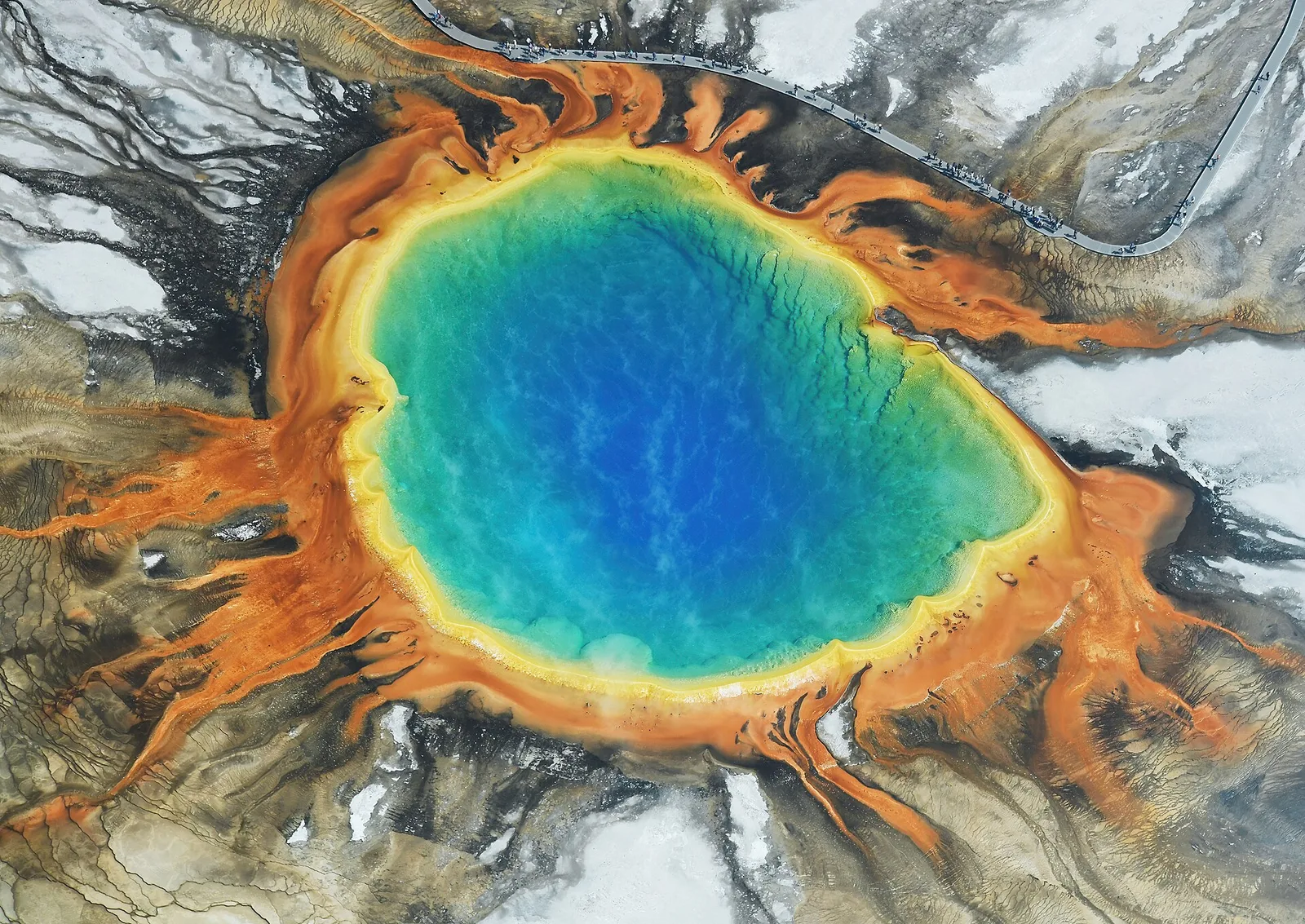
Twenty minutes north, Midway Geyser Basin holds Grand Prismatic Spring, Yellowstone's largest hot spring at 370 feet across — and the park's most mis-seen sight. The boardwalk gives you the spring at ground level: steam, heat shimmer and hints of colour. The photograph in every brochure is taken from above, from the Grand Prismatic Overlook, reached by a short side-trail from the Fairy Falls Trailhead just south of the basin. Do both, in that order, and go to the overlook towards midday when the sun burns the steam thinnest. The Park Service is blunt about the shortcut some attempt: off-trail travel in this area is prohibited, and parking at both the basin and the trailhead is very limited — another argument for starting early.
The rule underneath every thermal stop: stay on the boardwalks and trails. The crust around hot springs can be tissue-thin over scalding water, and it does not announce itself. Children hold hands here; nobody dips a toe anywhere. Entry to every geyser basin is included in your park pass — there are no separate tickets, tours or bookings for Old Faithful, Grand Prismatic or any other roadside thermal area. Beyond the basins, the loop's other anchors — the terraces of Mammoth Hot Springs in the north, the canyon and its Lower Falls between the loops, and the Lamar Valley's wildlife in the northeast — reward the days section 01 promised them.
SECTION 04Grand Teton: The Range Front, Up Close
Grand Teton's miracle is its abruptness: no foothills. The range rises some 7,000 feet straight from the Jackson Hole valley floor, and the park's two roads run along the foot of it like a gallery. From the outer highway (US 89/191) come the composed, whole-range views — the Snake River turnouts and Oxbow Bend, where Mount Moran reflects in a slow side-channel. From the Teton Park Road, the inner road through the park's Moose entrance, you get intimacy instead: Jenny Lake at the mountains' feet, trailheads climbing into the canyons, and the morning's best light on the Cathedral Group. The park is open 24 hours a day, all year; what changes by season is which roads and buildings are open, not the park itself.
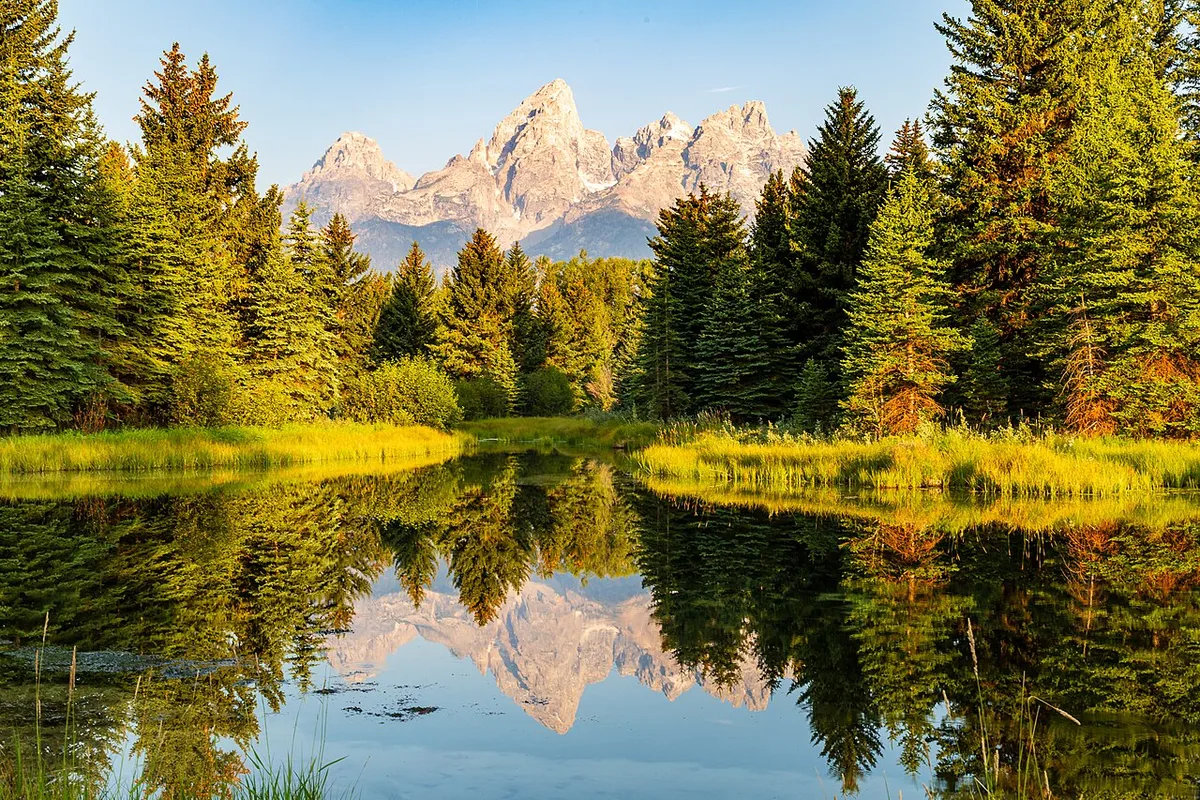
Give the park one full day at minimum: dawn at Schwabacher Landing or Oxbow Bend for the reflections, a late-morning walk at Jenny Lake, the Teton Park Road's turnouts through the afternoon, and the highway's long views at golden hour. Wildlife here runs to moose in the willow flats and elk on the valley floor; the distances in section 06 apply exactly as in Yellowstone.
SECTION 05Seasons and Roads: The Calendar That Decides Everything
For most of the year, the two-park trip is straightforward: both parks' roads open in spring — Yellowstone ploughs from mid-March and reopens roads in stages from mid-April — and the full loop-and-range season runs roughly May to October. The hard edge is autumn. In 2026, the Park Service confirms, most Yellowstone roads, and the West, South and East entrances, close to regular vehicles on 1 November — 31 October is the last day to drive most of the park. Grand Teton's inner roads close the same day: the Teton Park Road is closed to vehicles from 1 November to 30 April between Taggart Lake Trailhead and Signal Mountain Lodge, and the Moose-Wilson Road closes from 1 November until mid-May — though both corridors stay open to skiers, snowshoers and walkers, and the Teton Park Road is groomed for them from mid-December to mid-March.
Winter is not a lesser version of this trip; it is a different one. In Yellowstone, exactly one road stays ploughed for cars: the corridor from the North Entrance at Gardiner through Mammoth Hot Springs and Tower Junction to Cooke City at the Northeast Entrance, open year-round, weather permitting — the Lamar Valley's wolves and wintering herds are its reward. Everything else, from mid-December to mid-March, is oversnow travel only: guided snowcoach and snowmobile tours entering a white, steaming, almost empty park — Old Faithful in winter is a genuine expedition, bookable through authorised operators and worth it if winter is your season. Grand Teton's outer highway, US 89/191, is ploughed all winter from Jackson to Flagg Ranch at Yellowstone's doorstep, so the Tetons remain a drive-past spectacle even in January — the range front in snow, with the inner road given over to skiers. Check both parks' road pages in the week before any shoulder-season trip: openings and closures move with storms, not timetables.
SECTION 06Wildlife: Distances That Are Not Negotiable
Yellowstone's animals are wild, free-roaming and closer to the roads than you expect — bison graze the picnic areas, elk wander Mammoth's lawns, and bears work the Lamar Valley slopes. The Park Service's distances are precise and enforced: stay at least 100 yards (91 metres) from bears and wolves, and at least 25 yards (23 metres) from every other animal, bison and elk emphatically included. The test is behavioural: if an animal notices you, changes what it is doing or moves because of you, you are too close — back off, whatever your lens says. Bison are the park's most-injuring animal precisely because they look placid; they are neither, and they can run three times faster than you.
Practical corollaries: watch from pullouts and through binoculars or a spotting scope, never from the road's travel lanes; expect "bison jams" and treat them as part of the schedule, not a delay to it; never feed anything, and store food as the parks direct, because fed animals here are usually dead animals soon after. In Grand Teton the same rules hold, with moose the special case — cows with calves in the willow flats defend a wide, invisible perimeter. Both parks are better for these rules: an animal behaving naturally at 100 yards through binoculars is the sight you came for; an animal reacting to you at ten is an incident report.
FAQQuick Questions
How much does the two-park trip cost for international visitors in 2026?
Each park charges $35 per vehicle for seven days, and both parks — verified individually on the Park Service's non-resident fees page — add $100 per non-US-resident aged 16 or over. Two adults in a car pay $470 across both parks pay-as-you-go, $140 with the two $70 park annual passes, or $250 with the non-resident America the Beautiful pass, which also covers any further federal sites for a year.
Do I need a reservation to enter Yellowstone or Grand Teton?
No. Neither park operates an entrance reservation system — you need only a park entrance pass, bought at the gate (card at Grand Teton, which takes no cash; cash or card at Yellowstone). What does need advance booking in summer is where you sleep: in-park lodging and campgrounds go months ahead.
Can I visit both parks in winter?
Yes, but as a different trip. From 1 November most Yellowstone roads close to cars; the Gardiner–Mammoth–Cooke City road stays open year-round, weather permitting, and from mid-December guided snowcoach and snowmobile tours run into the interior. Grand Teton's highway stays ploughed from Jackson to Flagg Ranch, but its inner Teton Park Road closes to vehicles from 1 November to 30 April and becomes a ski and snowshoe corridor.
How long do I need for the two parks?
Four to six days is the honest span: two to three for Yellowstone's two loops and basins, one to two for Grand Teton's range front and lakes, plus the driving between gates. The Grand Loop alone is about 142 miles before stops — do not schedule it as a single day's sightseeing with geyser basins added.
When does Old Faithful erupt, and is it free?
Rangers predict its eruptions — posted at the Old Faithful Visitor Education Center, at the lodges and in the NPS App — and as of January 2025 the median interval was 102 minutes, plus or minus ten. Watching costs nothing beyond park entry: no ticket, tour or booking exists for it, or for Grand Prismatic Spring and the other thermal areas. Stay on the boardwalks — the ground off them is thin crust over scalding water.
Official references and checking status
Checking status: every fee, pass rule, closure date and safety distance here was checked in full on nps.gov — the non-resident fees page, both parks' own fees pages, Yellowstone's Old Faithful page and Grand Teton's roads page — on 30 October 2026. The honest limits: the Grand Loop's roughly 142 miles is the Park Service's long-published route figure, quoted here as approximate because the current road pages give the loop by segments rather than as a single total — drive times on it vary enormously with wildlife stops and summer traffic; road opening and closing dates follow the 2026 announcements and the parks' standing seasonal patterns, and both move with storms; and geyser prediction intervals drift over the years, so use the posted prediction on the day, not any figure printed anywhere, including here.
- National Park Service — Non-resident fees
- Yellowstone National Park — Fees and passes
- Grand Teton National Park — Fees and passes
- Yellowstone — Old Faithful and the Upper Geyser Basin
- Grand Teton — Park roads and seasonal closures
- National Park Service — Photography and wildlife safety in Yellowstone
Photos in this guide: Grand Prismatic Spring from above, Midway Geyser Basin, by Carsten Steger / Wikimedia Commons (CC BY-SA 4.0); Grand Teton reflected at Schwabacher Landing by Andrew Parlette / Wikimedia Commons (CC BY 2.0). Both resized and converted for this page.
General information only. This guide is based on official sources publicly available and checked on the date shown on this page. Visa rules change, and consular and USCIS officers decide every case on its own facts — nothing here is a confirmation or a guarantee for your individual case, and this is not legal advice. Always confirm the current requirement on the official page linked in this guide before you act, and consider a qualified immigration attorney for your specific situation.