
Researched & checked — 3 Nov 2026
Bodh Gaya: The Mahabodhi Temple, the Bodhi Tree and the Monasteries, Planned on Official Facts
NEW Published 3 November 2026
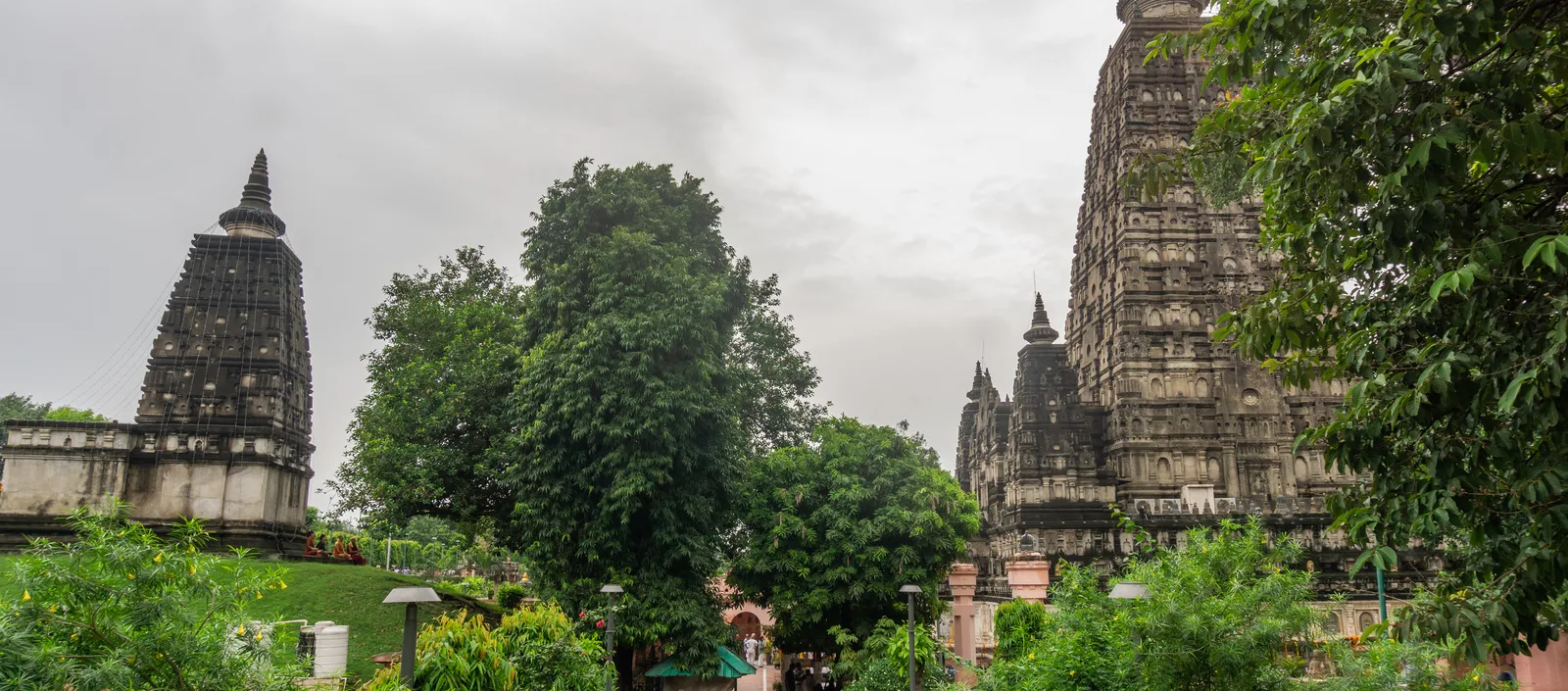
Bodh Gaya runs on a short list of checkable facts: a 5th–6th-century brick temple UNESCO counts among the earliest of its kind, a sacred tree measured against its own ancestry, a temple committee created by a Bihar Act of 1949, and a town ringed by monasteries built by Buddhist nations. Each fact here comes from UNESCO, Bihar Tourism, the Airports Authority of India and the state's own Bodhgaya page — and where official text could not be read, this guide says so and prints nothing.
The Mahabodhi Temple Complex at Bodh Gaya — where the Buddha is believed to have attained enlightenment under the Bodhi Tree — has been a UNESCO World Heritage Site since 2002. The complex stands 115 km south of Patna and 16 km from Gaya (UNESCO). Its grand temple rises 50 m; inside the sanctum sits a gilded Buddha of over 5 ft in the earth-witness posture. Entry is free, and mobile phones, cameras and other electronic gadgets are prohibited inside (Bihar Tourism). Bihar Tourism's season runs September to April. The nearest airport is Gaya (GAY) and the railhead is Gaya Junction. Pair the visit with the Vishnupad Temple at Gaya, 16 km away.
SECTION 01The Mahabodhi Temple Complex: A World Heritage Site Around a Tree
Begin with the status, because the heritage label understates the thing. UNESCO inscribed the Mahabodhi Temple Complex in 2002 under criteria (i), (ii), (iii), (iv) and (vi). Its significance statement is precise: the complex is one of the four holy sites related to the life of the Buddha, particularly to the attainment of Enlightenment. The first temple on the site was built by Emperor Asoka in the 3rd century BC; the present temple dates mainly from the 5th and 6th centuries, and UNESCO counts it among the earliest Buddhist temples built entirely in brick, a survivor of the late Gupta period. The inscribed property is small — 4.86 hectares — and dense: the grand temple, the Vajrasana (the Diamond Throne marking the seat of the enlightenment), the sacred Bodhi Tree and six other sacred sites, ringed by votive stupas and three circular boundaries — inner, middle and outer. A seventh sacred place, the Lotus Pond, lies outside the enclosure to the south.
The complex is the property of the State Government of Bihar and is managed, under the Bodh Gaya Temple Act of 1949, through the Bodhgaya Temple Management Committee and an Advisory Board, with conservation under the expert guidance of the Archaeological Survey of India (UNESCO). The temple itself faces east and rises in a pyramidal tower — 50 m by UNESCO's measure; Bihar Tourism gives the total height as 170 ft and notes that the chatras on the summit symbolise the sovereignty of religion. Inside the sanctum is a gilded image of the seated Buddha, over 5 ft high, his right hand holding earth as witness — the posture of the enlightenment. The state's older Bodhgaya page adds texture: the image is of black stone, gilded by devotees; the courtyard is studded with votive stupas built across 2,500 years; and the ancient railings around the temple date to the 1st century BC. A hall above the sanctum is set apart, UNESCO notes, for senior monks to meditate.
The working rules, as Bihar Tourism publishes them, are few and firm. Entry to the complex is free — the department's district listing states the entry fee as free. Mobile phones, cameras and electronic gadgets are prohibited inside; expect to leave them before you enter. The department's etiquette line asks visitors to dress modestly, remove footwear before entering, maintain silence and respect the sanctity of the site. Bihar Tourism's temple page states no opening time — see the FAQ below: this guide prints no opening hours for the Mahabodhi Temple, because the committee that sets them could not be read and the listings that can be read disagree.
SECTION 02The Bodhi Tree, the Vajrasana and the Seven Weeks
West of the temple stands the tree the whole complex exists to remember. UNESCO calls the present Bodhi Tree "a supposed direct descendant of the original Bodhi Tree" under which the Buddha sat; Bihar Tourism's Bodhgaya page puts it slightly differently — the present tree is "probably the fifth succession of the original tree". Between tree and temple sits the Vajrasana, the Diamond Throne: a polished sandstone platform marking the seat of the enlightenment, originally installed, UNESCO records, by Emperor Asoka. Pilgrims circle the tree and sit in its shade; of all Bodh Gaya, this railed patch of ground is the point.
Around the temple, UNESCO maps the seven weeks the Buddha is believed to have spent at Bodh Gaya after the enlightenment, each with its station, and the complex is best read as a walk through them. The first week was spent at the Bodhi Tree itself. In the second week he stood gazing at the tree in gratitude — the Animeshlochan Chaitya, north of the central path; the state's account says he looked towards the tree for a week "without twinkling his eyes". The third week was spent walking — the Ratnachakrama, the Jewelled Ambulatory near the temple's north wall, its eighteen paces marked by raised stone lotuses where his feet are believed to have fallen. The fourth week belongs to the Ratnaghar Chaitya in the north-east, near the enclosure wall, where the state's page holds that five colours shone from his body.
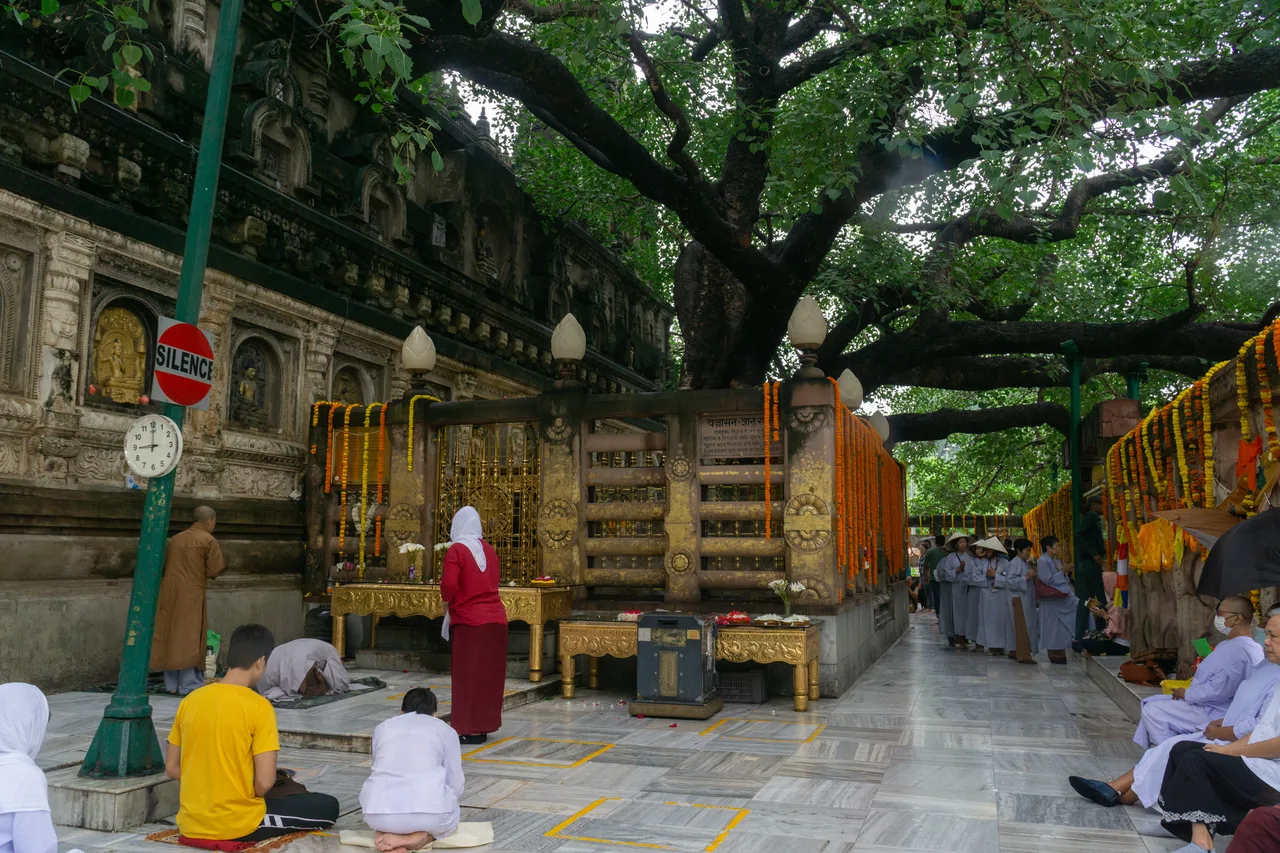
The fifth week's station is the Ajapala Nigrodh Tree, marked by a pillar beside the steps of the temple's eastern entrance, where the Buddha answered the questions of Brahmins. The sixth week was passed beside the Lotus Pond, south of the enclosure — the one sacred site outside the boundary walls. The seventh week was spent under the Rajyatana Tree at the south-east of the complex, marked today by a tree. Walked in order, they carry you around all three circular boundaries: the biography of a month, in a four-hectare garden.
SECTION 03The Great Buddha and the Monasteries of Many Nations
Bodh Gaya's second landmark is modern and unmissable. The Great Buddha — the 80 Feet Buddha of Bihar Tourism's listing — stands in the open about 2 km from the Mahabodhi Temple. The statue is built of sandstone blocks and red granite and shows the Buddha seated in deep meditation; smaller statues of his disciples stand around it. Its timeline is published by Bihar Tourism: the foundation stone was placed in 1982, and the statue was consecrated on 18 November 1989 by the 14th Dalai Lama. The department calls it "possibly the largest built in India" — a hedge this guide keeps. Bihar Tourism's district listing shows the grounds open 24 hours; go in morning or evening light, when the stone reads best.
Around the temple, Bodh Gaya performs its second identity: a parliament of Buddhist nations. UNESCO notes the sanctuaries and monasteries built here by foreign kings; Bihar Tourism's Bodhgaya page names the circuit — the Chinese Temple and Monastery, the Burmese Temple, the Buddhist Monastery of Bhutan, the Thai Temple and Monastery, the Tibetan Monastery, and the Japanese Temple with its International Buddhist House. Each tradition has built in its own idiom, so the circuit is an architecture walk as much as a pilgrimage, all within a few rickshaw-able streets. Bihar Tourism's district listing gives visiting hours for individual houses — the Royal Bhutan Monastery 5 AM–8 PM, the Tibetan Temple 6 AM–7 PM and the Metta Buddharam Temple 9 AM–6 PM, the last two with free entry; treat those as the department's listing; each house keeps its own rhythm around prayer.
The Metta Buddharam Temple shows what the circuit offers at its most distinctive. Bihar Tourism describes a Thai temple sheathed in stainless steel with a decorative mirror mosaic, a main hall floored in wood, sculptures handmade from white cement, clay and epoxy — and, underneath the temple, a marble-floored meditation room. Unlike the Mahabodhi, gadgets are allowed here. On meditation courses this guide is deliberately limited: meditation is the living practice of the complex and houses like Metta, but no official source read for this guide publishes a course calendar or a price for Bodh Gaya, and the monasteries arrange their own teaching. Nothing is printed rather than inventing a schedule — ask at the monastery you hope to sit with.
SECTION 04Before the Enlightenment: Sujata's Village and the Dungeshwari Caves
The enlightenment had a long prologue, and Bodh Gaya's outskirts keep its two stations. In the Dungeshwari Hills, along the Falgu river, are the Mahakala caves where, Bihar Tourism records, the Buddha sheltered and meditated for six years before descending to Bodh Gaya — the years of severe fasting that preceded the middle path. The caves now hold Hindu and Buddhist shrines, one cave temple dedicated to the goddess Dungeshwari, and the Chinese pilgrim Hiuen Tsang mentioned these hills in his travelogue. Bihar Tourism places the hills about 12–15 km from Gaya and notes the approach is easier from the Gaya side; auto-rickshaws and private vehicles run from Bodh Gaya. The district listing gives the cave temples 6 AM–7 PM with free entry — and, in pointed contrast to the Mahabodhi, gadgets are allowed.
Across the river lies the gentler half of the story. Bihar Tourism's Bodhgaya page lists Sujata village, 2 km away among its sights, and its district listing gives the Sujata Stupa hours of 9 AM–6 PM with free entry. The tradition attached to the village is the hinge of the Buddha's story: here, it is told, the village girl Sujata offered the fasting ascetic a bowl of milk-rice — the meal that ended his years of self-mortification and set him on the middle path towards the Bodhi Tree. Come after the caves, and the two visits explain each other.
SECTION 05The Paired Visit: Vishnupad Temple and Gaya
Sixteen kilometres north, Bodh Gaya's twin town keeps the other half of the region's sacred geography. Gaya is one of Hinduism's great cities of ancestral rite, and its Vishnupad Temple stands, Bihar Tourism records, on the bank of the Phalgu river, with rugged rocks on three sides and water on the fourth. The present temple was erected in 1787 by Queen Ahilyabai. Its shrine enshrines the sacred footprint of Lord Vishnu impressed in a rock, and the temple is the major site for Pind Daan — the offering made for the salvation of one's ancestors. The city around it, the department notes, belongs to the Ramayana and the Mahabharata alike: Rama himself is said to have performed pind-daan here for his father Dashrath.
The pairing is easy to make. The Airports Authority of India lists the Vishnupad Temple just 6 km from Gaya airport, and the two temples anchor the ends of the Gaya–Bodh Gaya road. Bihar Tourism's district listing gives the Vishnupad's hours as 5 AM–9 PM with free entry; its temple page applies the same gadget prohibition as the Mahabodhi — mobile phones, cameras and electronic gadgets prohibited — and the same September-to-April season. Do the two towns in either order; what matters is not to treat Gaya as merely Bodh Gaya's railway station.
SECTION 06One Day in Bodh Gaya, or Two
One day is enough for the essentials, spent in the right order. Give the Mahabodhi complex the first and quietest part of the day: the sanctum, the Bodhi Tree, then the seven weeks' stations walked in order. Late morning belongs to the monastery circuit — the Thai, Bhutanese, Tibetan, Japanese and Chinese houses by auto-rickshaw — and the Great Buddha, 2 km from the temple, fits the same loop. If your train or flight leaves from Gaya in the evening, the Vishnupad Temple sits naturally on the way out of town.
A second day changes the visit's character. It buys the Dungeshwari caves and Sujata village — the prologue without which the main story is thinner — and, just as valuable, a return to the Bodhi Tree with nothing left to tick off. On season, the official word is consistent: Bihar Tourism gives September to April as the best time for the Mahabodhi, the Great Buddha, Dungeshwari and the Vishnupad alike, and the state's Bodhgaya page narrows it to October to March. That page's climate figures explain why: summer temperatures reach 47°C.
SECTION 07Getting There: Gaya Airport, Gaya Junction and the Patna Road
By air, the gateway is Gaya Airport — also known, the Airports Authority of India notes, as Bodhgaya Airport (IATA: GAY, ICAO: VEGY). The AAI describes it as standing about 5 km from the temple city of Bodhgaya, and its tourist listing measures 8 km from the terminal to the Mahabodhi Temple. It is a seasonal, pilgrimage-shaped operation: the AAI says the airport mainly handles seasonal pilgrimage flights from Thailand, Myanmar and Bhutan, with IndiGo the only airline running scheduled services, to Delhi and Kolkata — the position on an AAI page last updated in August 2024, so check schedules before relying on a connection. The all-season alternative is Patna, 135 km away by road (Bihar Tourism).
By rail, the railhead is Gaya Junction: UNESCO measures the complex 16 km from Gaya, Bihar Tourism's Bodhgaya page puts the station 17 km away, and the department's district page adds that Patna to Gaya takes approximately 2 hours by train. By road, Bihar Tourism lists Bodh Gaya connected to Gaya (17 km), Rajgir (78 km), Nalanda (101 km), Patna (135 km), Varanasi (252 km) and Kolkata (495 km), with Bihar State Tourism Development Corporation buses running the Patna–Bodhgaya route twice a day, plus regular direct buses from Gaya, Patna, Nalanda, Rajgir and Varanasi. In town the department lists taxis, tongas, auto-rickshaws and cycle-rickshaws, and almost everything in this guide is a short rickshaw ride.
One last practical note: the two great temples of the twin towns — the Mahabodhi and the Vishnupad — both bar electronic gadgets, while the caves, the stupa and the monasteries in Bihar Tourism's listings do not. Plan your photographs for the monastery circuit and the Great Buddha, and give the temple courtyards the older kind of attention.
FAQFrequently Asked Questions
What are the Mahabodhi Temple's opening hours?
This guide prints none, deliberately. The temple is managed by the Bodhgaya Temple Management Committee under the Bodh Gaya Temple Act of 1949, whose own website — the authority for the day's timings — could not be read when this guide was checked. The official listings that could be read disagree: Bihar Tourism's district page shows 6 AM–6 PM, while other listings give a longer day. Rather than guess between them, this guide prints no hours: check the committee's notice at the entrance on the day. What is verified: entry is free (Bihar Tourism).
Can I take a phone or camera into the Mahabodhi Temple?
No. Bihar Tourism's page for the temple states it plainly: mobile phones, cameras and electronic gadgets are prohibited. Expect to deposit devices before you enter. The same prohibition is listed for the Vishnupad Temple at Gaya, while the Dungeshwari caves and the monasteries allow them. This guide prints no camera-permit fee: the committee's own fee text could not be read, and unofficial listings quote contradictory figures.
When is the best time to visit Bodh Gaya?
The official sources agree on the cool season. Bihar Tourism gives September to April as the best time for the Mahabodhi Temple, the Great Buddha, the Dungeshwari caves and the Vishnupad Temple; the state's Bodhgaya page gives October to March, and records summer temperatures reaching 47°C against winter minima of 4°C, with heavy woollens advised in winter. The monsoon on that page runs mid-June to mid-September. If you come in winter — the pilgrimage season — book rooms and trains early.
How do I get to Bodh Gaya from Patna?
Three ways. By road it is 135 km (Bihar Tourism), and the Bihar State Tourism Development Corporation runs buses on the Patna–Bodhgaya route twice a day. By train, Patna to Gaya takes approximately 2 hours (Bihar Tourism's district page), and Gaya Junction is 16–17 km from Bodh Gaya by road. Or fly: Gaya Airport (GAY) sits just outside Bodh Gaya, though the AAI describes its traffic as mainly seasonal pilgrimage flights — Patna's airport is the all-season fallback, 135 km away.
Can I join a meditation course in Bodh Gaya?
Meditation is the living practice of the place — the hall above the Mahabodhi sanctum is set apart for senior monks to meditate (UNESCO), and temples such as the Metta Buddharam keep a marble-floored meditation room beneath the main hall (Bihar Tourism). But no official source read for this guide publishes a course calendar, dates or fees, and teaching is arranged house by house. So no course is listed here: arrive, visit the monastery you hope to sit with, and ask. Any website quoting a fixed course price for Bodh Gaya is not quoting an official figure this guide could verify.
Official references and checking status
Checked on 3 November 2026 against the official sources listed below; the accompanying sources file maps each claim to its page. Four limits are flagged honestly. First, the Bodhgaya Temple Management Committee's own website could not be read with this guide's tools, so the Mahabodhi Temple's opening hours are not printed: the official listing that could be read (Bihar Tourism's district page, 6 AM–6 PM) conflicts with the longer hours shown elsewhere, and the committee is the managing authority. Second, no camera fee is printed, for the same reason — the committee's fee text could not be read and unofficial figures contradict each other. Third, no meditation-course schedule or price is printed: no official source read describes one. Fourth, distances vary slightly between official pages (Gaya: 16 km by UNESCO's measure, 17 km in Bihar Tourism's Bodhgaya page); the sources file records which page each figure came from. Confirm current timings and rules on the official sites before you travel.
- UNESCO — Mahabodhi Temple Complex at Bodh Gaya: the listing, the seven weeks' sites and the management framework
- Bihar Tourism (official) — Mahabodhi Temple: description, best time, gadget prohibition and etiquette
- Bihar Tourism (official) — 80 Feet Buddha: materials, the 1989 consecration and the disciples
- Bihar Tourism (official) — Dungeshwari Mandir: the Mahakala caves and the six years
- Bihar Tourism (official) — Metta Buddharam Temple: the steel Thai temple and its meditation room
- Bihar Tourism (official) — Vishnupad Temple: the 1787 temple, the footprint and Pind Daan
- Bihar Tourism (official) — Gaya Ji district listing: per-sight timings and entry fees, and the Patna train time
- Bihar Tourism (official state page) — Bodhgaya: how to reach and what to visit
- Airports Authority of India (official) — Gaya Airport: codes, character and scheduled services
- Airports Authority of India (official) — Gaya tourist places: distances from the airport
Photos: The Mahabodhi Temple and the Animesh Lochan Chaitya across the temple walkway, by Sumitsurai, via Wikimedia Commons, licensed under CC BY-SA 4.0; the Bodhi Tree and the Vajrasana, with pilgrims at prayer beneath the branches, by Sumitsurai, via Wikimedia Commons, licensed under CC BY-SA 4.0. Photographers keep their copyright; the licences require this credit.
General information only. This guide is based on official sources publicly available and checked on the date shown on this page. Visa rules change, and consular and USCIS officers decide every case on its own facts — nothing here is a confirmation or a guarantee for your individual case, and this is not legal advice. Always confirm the current requirement on the official page linked in this guide before you act, and consider a qualified immigration attorney for your specific situation.