
Researched & checked — 3 Nov 2026
Puri and Konark: Jagannath Darshan and the Sun Temple, Planned on Official Facts
NEW Published 3 November 2026
Two of India's most visited sacred places stand a short coastal drive apart: a living temple where darshan is arranged around an unbroken round of ritual, and a thirteenth-century stone chariot on UNESCO's World Heritage List. This guide plans both from the records of the bodies that run them — the Shree Jagannatha Temple Administration, the Archaeological Survey of India, UNESCO, Odisha Tourism and the Puri district administration — and prints no timing, fee or rule that could not be read on an official page.
Puri is one of Hinduism's four Dham, where Lord Jagannath, his elder brother Balabhadra and their sister Subhadra are worshipped on the Ratna Simhasana. Entry to the Jagannath Temple is restricted — Odisha Tourism states it directly: non-Hindus are not allowed — and visitors who cannot enter can view the temple from the Old Library roof across the Grand Road. At Konark, the Sun Temple — a gigantic stone chariot of the Sun God with twelve pairs of carved wheels and seven horses, inscribed by UNESCO in 1984 — is open, the ASI states, from sunrise to sunset. Its published entry fees are ₹40 per head (₹35 online) for the SAARC and BIMSTEC visitor groups it lists and ₹600 per head (₹550 online) for other foreign visitors, with children below 15 free; no separate Indian-citizen rate is stated, so confirm it at the counter. The two places are linked by the Puri–Konark marine drive; Raghurajpur stands 14 km from Puri.
SECTION 01Shree Jagannath Temple: Darshan at a Living Shrine
Start with what Puri is, in the district administration's own account. Puri is one of the four Dham — the holiest places of India, along with Dwarka, Badrinath and Rameswaram — famous for the world-renowned Jagannath Temple. In the temple, Lord Jagannath, his elder brother Balabhadra, his sister Subhadra and the goddess Lakshmi are worshipped on the Ratna Simhasana, the bejewelled pedestal. The temple is administered by the Shree Jagannatha Temple Administration (SJTA), and the year turns on its festivals, of which the district names the world-famous Car Festival and its return procession as the most important, drawing immense crowds.
Plan darshan as worship, not as sightseeing with a slot. The temple's day is a continuous round of ritual service, and public darshan is arranged around that round by the administration; festival days reshape it entirely. That is why this guide prints no darshan clock-times: the administration's darshan pages could not be read in text form when checked — its homepage carries notices, not a readable timetable — and unofficial times disagree with each other. Read the current notices on the official website, shreejagannatha.in, before you travel.
One warning from the administration deserves printing in full. The SJTA's notice records that fraudsters created a fake website cheating devotees and tourists who wanted to book rooms in the temple's accommodation on the Grand Road, that an FIR was lodged at the Cyber Police Station, Puri, and that the administration's only official websites are shreejagannatha.in and stayatpurijagannatha.in — the addresses for booking its Neelachal Bhakta Niwas, Neelachal Yatri Niwas, Neeladri Bhakta Niwas, Shree Purushottama Bhakta Niwas and Shree Gundicha Bhakta Niwas. A lookalike site offering a temple room is not the administration.
SECTION 02Who May Enter, What Everyone Else Can See, and the Rath Yatra
The entry rule should be read plainly, because it decides itineraries. Odisha Tourism's Golden Triangle tour states it in a parenthesis that leaves nothing to interpretation: a visit to the Jagannath Temple comes with the note "non hindus are not allowed". Entry to Srimandir is for Hindu devotees; the rule is the temple's own, administered at its gates, and this guide states it as the official sources state it. A traveller who learns it at the gate has lost a day; one who plans around it loses nothing.
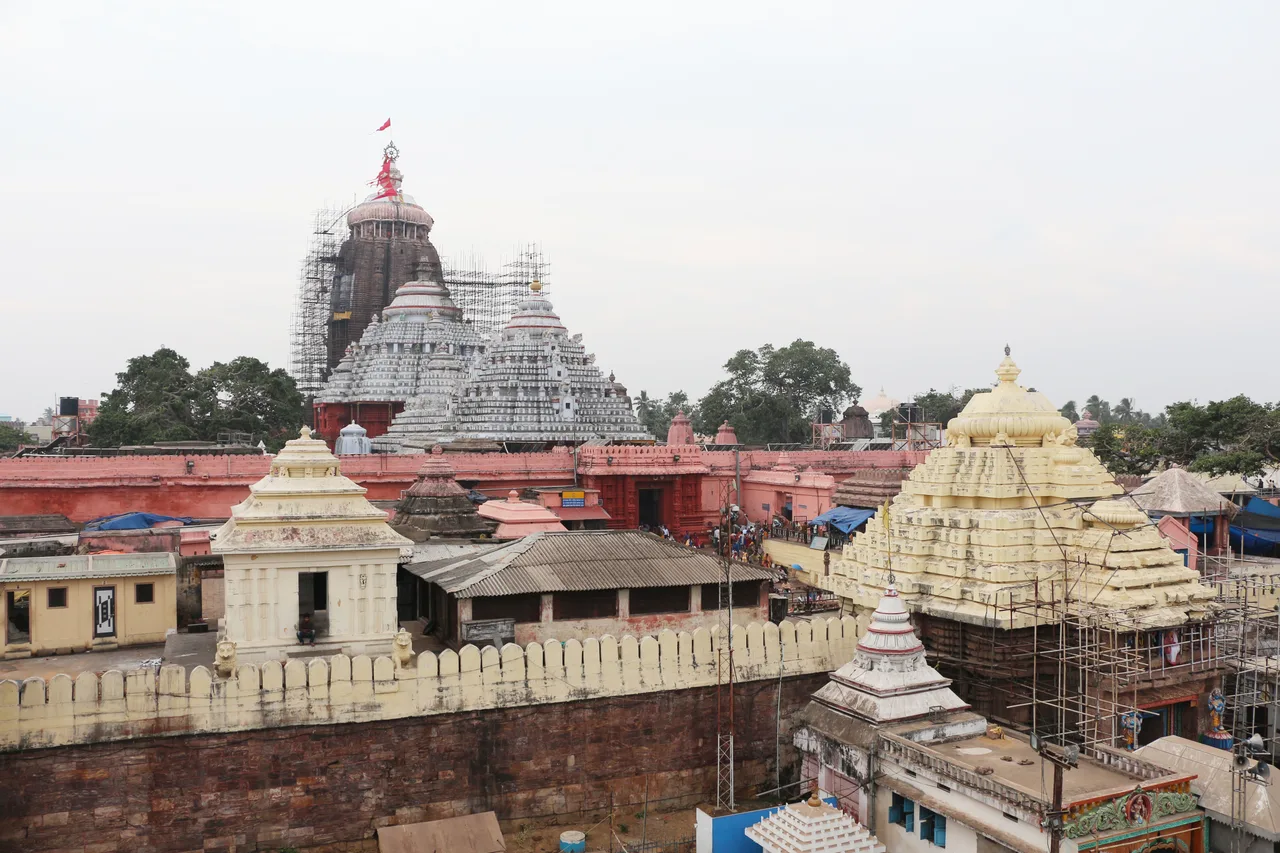
What can a visitor who cannot enter actually see? More than at most restricted shrines — and Odisha Tourism's temple tour describes the arrangement itself. Its Puri day runs: "Explore Old Library roof to witness Jagannath Temple. Stroll around the widespread road of Puri across several Ashrams where devotees reside." The library roof across the Grand Road is the established viewpoint — the temple's tower, gateway and the life of the road below all in frame — and the wide road itself, lined with ashrams, is the temple's public face, open to everyone.
Once a year the relationship between temple and street reverses. In the month of Ashadha, the annual Rath Yatra — the Car Festival — carries the deities out of the temple in procession along the Grand Road to the Gundicha temple, and the return procession brings them back — the district's most important festival, drawing immense crowds. Because the festival happens on the public road, the whole town — including every visitor who cannot enter the temple — shares the same view of the deities. No Gregorian date is printed for the next Rath Yatra: none is stated readably on the official pages read, and the date follows the temple calendar (see FAQ 3).
SECTION 03Konark Sun Temple: The Stone Chariot of the Sun God
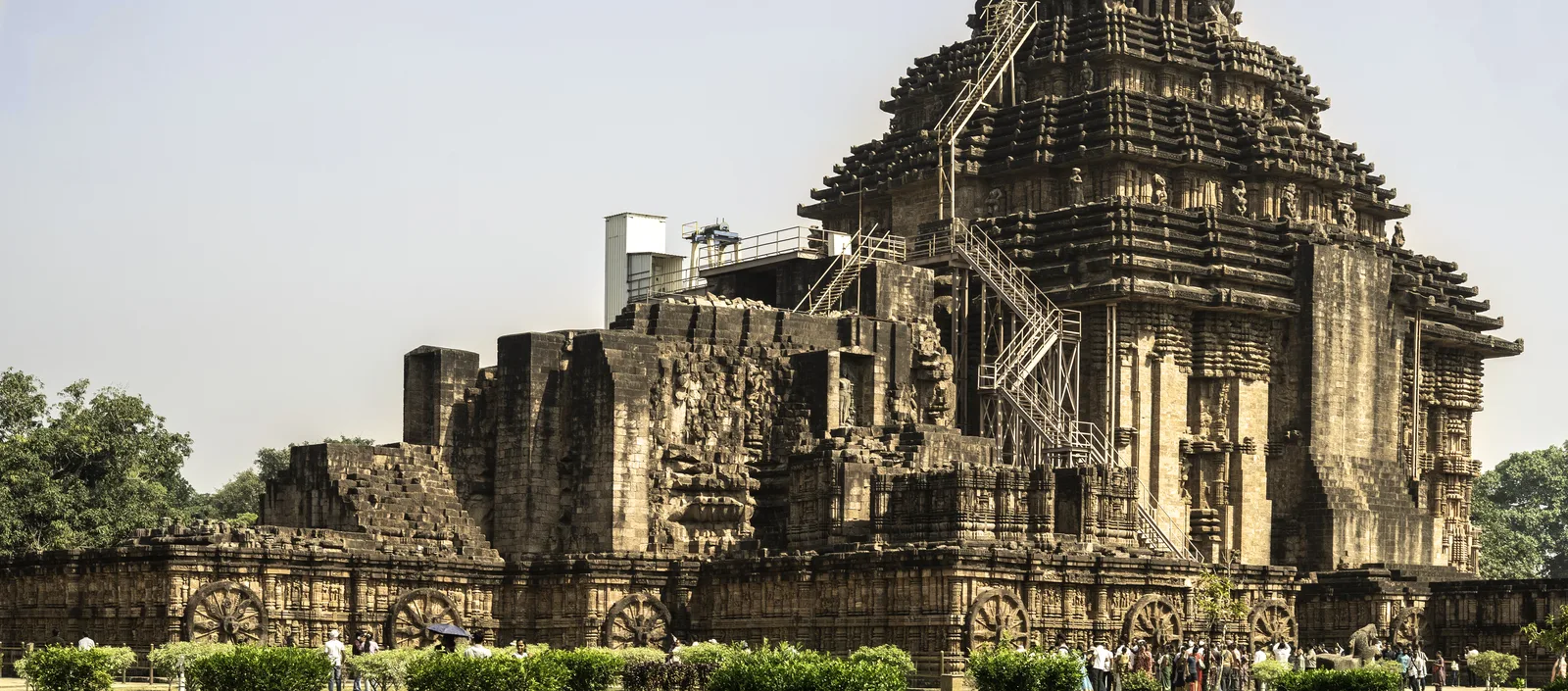
Konark is Puri's counterweight: where Srimandir is a living temple you approach on its own terms, the Sun Temple is a monument you walk around freely. The Archaeological Survey of India describes it as built in the thirteenth century and conceived as a gigantic solar chariot with twelve pairs of exquisitely ornamented wheels dragged by seven rearing horses. UNESCO, which inscribed it on the World Heritage List in 1984 under criteria (i), (iii) and (vi), calls it an outstanding testimony to the thirteenth-century kingdom of Orissa and the culmination of Kalingan temple architecture, raised under Narasimhadeva I (AD 1238–1264) of the Ganga dynasty. The district adds the name sailors gave it — the Black Pagoda — and its material, khandelite stone.
Read the ASI's description before you go, because it explains what you are looking at. The temple comprised a sanctum with a lofty sikhara — presumably over 68 m high — a jagamohana 30 m square and 30 m high, and a detached nata-mandira, the hall of dance. The sanctum and the nata-mandira have lost their roofs; what dominates the site today, as UNESCO puts it, is the jagamohana, the audience hall, with the unroofed dance hall on its high platform before it. The chariot's twenty-four carved wheels are each about 3 m in diameter, carved with seasonal and monthly motifs — walk a full circuit of the platform slowly, because the wheels are the monument's signature. The district notes that six of the seven horses still stand today, and that sculptures from the site are preserved in the Sun Temple Museum managed by the ASI. December brings the Konark Dance Festival, devoted to classical Indian dance, especially Odissi, with the temple as its backdrop.
SECTION 04Konark in Practice: Hours, Fees, and Chandrabhaga Beach
The ASI publishes the monument's visiting terms on its own Konarak page, and they are simple. Opening hours: open from sunrise to sunset. This guide prints no clock times for Konark, because the ASI states none — the "6 AM to 8 PM" quoted on unofficial sites appears in no ASI text read for this guide. A sunrise-to-sunset monument rewards an early start: the chariot faces the morning light, and the midday heat off the stone is real.
The entry fee, exactly as the ASI page publishes it: free entry for children below 15 years; visitors from the SAARC countries the page lists (Bangladesh, Nepal, Bhutan, Sri Lanka, Pakistan, Maldives and Afghanistan) and BIMSTEC countries (Bangladesh, Nepal, Bhutan, Sri Lanka, Thailand and Myanmar) pay ₹40 per head in cash, or ₹35 online; and other foreign visitors pay ₹600 per head in cash, or ₹550 online. One gap must be flagged honestly, because Indian readers will look for it first: the ASI's Konarak page, as published, does not state a separate rate for Indian citizens. This guide prints the page as it stands: confirm the current Indian rate at the ticket counter or on the ASI's ticketing portal. Konark is a protected monument open to visitors of every background — the entry restriction of Section 02 belongs to Puri's living temple, not here.
Complete the Konark half-day the way Odisha Tourism's Golden Triangle route completes it: after the Sun Temple, the itinerary continues to Chandrabhaga beach and to Ramchandi, where the district places the shrine of Goddess Ramachandi at the confluence of the Kushabhadra river and the Bay of Bengal — among the district's finest picnic destinations. Chandrabhaga is the quiet counterpart to Puri's busy town beach: the same coast, a short drive on, with the river meeting the sea.
SECTION 05Raghurajpur and Pipili: The Craft Villages
Between Puri and Bhubaneswar the official Golden Triangle route stops at "Pipili — the appliqué village", and the district administration describes what that means: Pipili is renowned for its vibrant appliqué work — umbrellas, wall hangings, purses, carpets and garments — with a strong market in India and abroad. The appliqué announces itself from the road, in saturated colour strung above the shops; it is a buy-from-the-maker stop on the way into or out of Puri.
The deeper stop is Raghurajpur, to which Odisha Tourism gives a full destination page. The department places it 14 km from Puri and records it as India's first heritage crafts village, famous above all for Pattachitra — painting of intricate detail, mythological themes and vibrant natural colours — in a village where almost every household is engaged in traditional art. The same page lists what else is made there: palm-leaf engraving (Tala Pattachitra), stone carving, wooden toys and masks, alongside the Gotipua dance tradition; the district adds papier-mâché, cow-dung toys and tussar paintings, and calls Raghurajpur a living museum where visitors can watch artists at work. Walls are painted with murals, visitors buy directly from the artists, and the village is the birthplace of Padma Vibhushan Kelucharan Mohapatra and Padma Shri Guru Maguni Charan Das. The department's practical details are complete enough to plan on: best time October to March; ideal duration two to three hours; timings 9:00 AM to 6:00 PM; no entry fee.
SECTION 06Puri Beach and Swargadwar: The Town's Other Face
Puri is a beach town as well as a temple town, and the official accounts keep the two together: the district pairs the temple with its long Golden Beach, and Odisha Tourism's Golden Triangle day in Puri ends with the evening at the golden beach — the pattern every visitor falls into, darshan by day and the shore at dusk. This guide prints no beach directory — bathing arrangements and lifeguard presence change, and were not stated in the official texts read — so swim only where others are swimming and local advice supports it, and let the evening stroll be the default plan.
At one stretch of that shore stands Swargadwar, and it should be understood before it is visited. Odisha Tourism's temple tour includes it in the Puri day without euphemism: visitors are driven to Swargdwaar, "where the final rituals of Hindus are done" — the cremation ground by the sea, a place of religious weight for the families who come to it. Many pilgrims visit to pay respects; it is not a spectacle. If you go, go quietly, keep distance from funeral parties, do not photograph, and keep the visit brief: in Puri the beach, the temple and the last rites of the dead share one shoreline, and none of them is scenery.
SECTION 07Getting There, the Marine Drive, Satapada, and a Two-Day Plan
The circuit has one gateway. Odisha Tourism's Raghurajpur page states the access facts for the whole Puri area: the nearest airport is Biju Patnaik International Airport, Bhubaneswar, and the nearest railway stations are Puri and Bhubaneswar. Puri has its own station, so rail travellers arrive in the town itself; air travellers land at Bhubaneswar and come down by road — the road the department's own routes take, past Konark and on to Puri on the Marine Drive. The Puri–Konark marine drive — with the district's Balighai, its casuarina groves and sand dunes, lying on it — is the scenic link. This guide prints no road distances or drive times for these legs: no official page read states them; the only distance printed is Odisha Tourism's own, Raghurajpur's 14 km from Puri.
The optional add-on is Satapada, on Chilika Lake — in the district administration's words, Asia's largest brackish water lagoon — known for Irrawaddy dolphins, migratory birds and boating. Odisha Tourism builds it into two of its routes: the Golden Triangle's third day cruises from Satapada to the sea mouth and Rajhans Island, looking for the rare Irrawaddy dolphins and local birds, and the Romantic Odisha route visits the sea mouth and the dolphins by motor boat. That is the officially stated shape of the trip, and where this guide stops: no boat fare, boat capacity, dolphin-watching rule or jetty timing is printed here, because no Odisha forest or wildlife authority text stating them could be read when checked. Arrange the boat on the day and follow the jetty's instructions.
A two-day plan that uses only the arrangements above. Day one — Puri: arrive by train at Puri or by road from Bhubaneswar; give the morning to the Jagannath Temple — darshan for Hindu visitors as the administration arranges it that day, and for everyone else the Old Library roof viewpoint and a walk down the Grand Road; take the afternoon for Raghurajpur (14 km, two to three hours, 9:00 AM–6:00 PM, no entry fee) with Pipili's appliqué on the same road; end with the evening on the golden beach, passing Swargadwar quietly if you go that way. Day two — Konark: take the marine drive early, inside the ASI's sunrise-to-sunset day, and give the Sun Temple the cool of the morning — the circuit of the platform and its twenty-four wheels, the jagamohana, the dance hall, and the ASI's Sun Temple Museum; continue to Chandrabhaga beach and Ramchandi as the official route does, and return to Puri by the same coast road. With a third day, add Satapada and the Chilika cruise. For season, the one official steer is Raghurajpur's: October to March — also the season of Konark's December dance festival.
FAQFrequently Asked Questions
Can non-Hindus enter the Jagannath Temple in Puri?
No. Odisha Tourism states the rule directly in its own tour text: a visit to the Jagannath temple comes with the note "non hindus are not allowed". Entry is for Hindu devotees, and the rule is applied at the gates. A visitor who cannot enter is not shut out of Puri: the department's temple tour directs visitors to the Old Library roof to witness the temple from across the Grand Road — and during the Ashadha Rath Yatra the procession is on the public road, the deities carried along the Grand Road to the Gundicha temple and back.
What does the Konark Sun Temple cost, and when is it open?
The ASI publishes both on its Konarak page. Opening hours: open from sunrise to sunset — the ASI states no clock times. Entry fee: free for children below 15 years; ₹40 per head in cash (₹35 online) for visitors from the SAARC countries the page lists (Bangladesh, Nepal, Bhutan, Sri Lanka, Pakistan, Maldives and Afghanistan) and BIMSTEC countries (Bangladesh, Nepal, Bhutan, Sri Lanka, Thailand and Myanmar); ₹600 per head in cash (₹550 online) for other foreign visitors. One honest gap: the page states no separate Indian-citizen rate; confirm it at the ticket counter.
When is the next Rath Yatra, and can I book Jagannath temple rooms online?
No date is printed here, deliberately: Rath Yatra is the annual Car Festival of the month of Ashadha, but no official page read (checked 3 November 2026) states the next Gregorian date readably, and the date follows the temple calendar.
Watch shreejagannatha.in and the district notices as the season approaches. On bookings, heed the administration's warning (Section 01): its only official websites are shreejagannatha.in and stayatpurijagannatha.in — book temple rooms only there.How do Puri and Konark fit together — and how do I get there?
As one coastal circuit. The nearest airport is Biju Patnaik International Airport, Bhubaneswar; the nearest railway stations are Puri and Bhubaneswar (Odisha Tourism). The department's own routes run from Bhubaneswar to Puri via Konark — a stop on the road, not a detour. Base in Puri, take Konark as a marine-drive day, and put Raghurajpur and Pipili into the other day.
What will a Satapada dolphin boat trip cost, and what are the rules?
None is printed, because none could be verified: no Odisha forest or wildlife authority text stating Chilika boat fares, capacities or dolphin-watching rules could be read when this guide was checked. What official sources establish is the trip's shape — Satapada sits on Chilika Lake, Asia's largest brackish water lagoon (district administration), and Odisha Tourism's routes cruise from Satapada to the sea mouth and Rajhans Island for the rare Irrawaddy dolphins, by motor boat. Arrange the boat on the day and follow the jetty's instructions.
Official references and checking status
Checked on 3 November 2026 against the official sources listed below; the accompanying sources file maps each claim to its page. Four limits are flagged honestly. First, the Temple Administration's site publishes notices — including its warning that its only official websites are shreejagannatha.in and stayatpurijagannatha.in — but no darshan timetable readable in text form, so no darshan clock-times are printed and conflicting unofficial times are not borrowed. Second, no official page read states the next Rath Yatra's Gregorian date readably, so the festival is described as the Ashadha Car Festival without a printed date; no Grand Road length is printed either. Third, the ASI's Konarak fee block lists free entry for children below 15, a ₹40/₹35 tier for the SAARC and BIMSTEC countries it names, and ₹600/₹550 for other foreign visitors, but no separate Indian-citizen rate; the tiers are printed exactly as published. Fourth, Satapada and Chilika rest on Odisha Tourism's and the district's text only — no boat fare or dolphin-watching rule is printed, because no Odisha forest or wildlife authority text stating them could be read; Bhubaneswar–Puri–Konark road distances are likewise unprinted. Confirm current prices and timings on the official sites before you travel.
- Shree Jagannatha Temple Administration (official) — notices: the fake-website warning and the only official websites
- Archaeological Survey of India (official) — Sun Temple, Konarak: description, hours and entry fees
- UNESCO — Sun Temple, Konârak: the World Heritage listing (1984)
- Odisha Tourism (official) — Golden Triangle II: the Bhubaneswar–Konark–Puri route, the entry note, Satapada
- Odisha Tourism (official) — Temple Tour: the Old Library roof viewpoint and Swargdwar
- Odisha Tourism (official) — Romantic Odisha: the Marine Drive, Satapada's dolphins
- Odisha Tourism (official) — Raghurajpur Craft Village: crafts, timings, entry and access
- Puri District Administration (official) — Places of Interest: Puri, Konark, Satapada, the craft villages
Photos: The Konark Sun Temple's great audience hall (jagamohana) and carved chariot wheels, by Joydeep Chakraborty, via Wikimedia Commons, licensed under CC BY-SA 4.0; the Jagannath Temple at Puri from across the Grand Road, by Bernard Gagnon, via Wikimedia Commons, licensed under CC BY-SA 3.0. Photographers keep their copyright; the licences require this credit.
General information only. This guide is based on official sources publicly available and checked on the date shown on this page. Visa rules change, and consular and USCIS officers decide every case on its own facts — nothing here is a confirmation or a guarantee for your individual case, and this is not legal advice. Always confirm the current requirement on the official page linked in this guide before you act, and consider a qualified immigration attorney for your specific situation.