
Researched & checked — 5 November 2026
Chandigarh: The Capitol Complex, the Rock Garden and the Sector Grid, Planned on Official Facts
NEW Published 5 November 2026
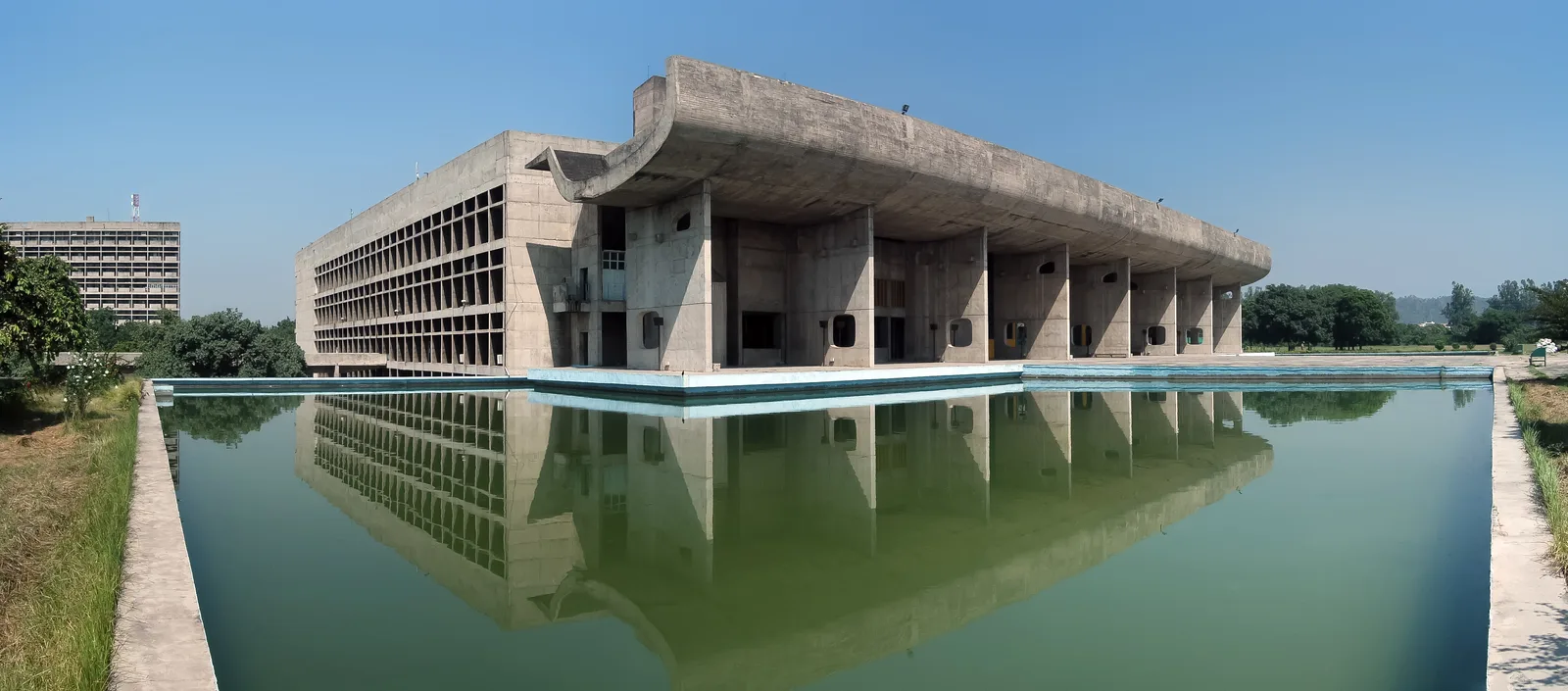
Chandigarh can be read like a document: a master plan drawn as a human body, a Capitol Complex UNESCO inscribed in 2016, a sculpture garden one man built in secret from the city's own waste, and a grid of self-sufficient sectors numbered from the hills downwards. Each claim here comes from UNESCO, Chandigarh Tourism or the Chandigarh Administration.
The Capitol Complex in Sector 1 — the Secretariat, the High Court and the Legislative Assembly, watched over by the Open Hand Monument — was inscribed by UNESCO in 2016 as part of The Architectural Work of Le Corbusier, seventeen sites in seven countries, under criteria (i), (ii) and (vi). You see it on Chandigarh Tourism's free guided tours at 10:00 a.m., 12:00 noon and 3:00 p.m., daily except gazetted holidays, ID proof required: interiors Monday to Friday, outside only on weekends. Beside it stand Nek Chand's Rock Garden, built from municipal waste, and Sukhna Lake (1958). The city is a grid of sectors, typically 800 m × 1,200 m each.
SECTION 01A Capital Drawn, Not Grown
Chandigarh exists because of Partition. The Administration's own history records that the city was conceived not only as the capital of East Punjab but also to resettle thousands of refugees uprooted from West Punjab. In March 1948 the Government of Punjab, with the Government of India, approved a tract of 114.59 sq km at the foothills of the Shivaliks — a site of about 59 villages, selected by Dr M. S. Randhawa, then Deputy Commissioner of Ambala. The foundation stone was laid in 1952.
The planner was Le Corbusier, and the Administration repeats his organising metaphor because the city still runs on it: the master plan was conceived as analogous to a human body — a clearly defined head (the Capitol Complex, Sector 1), heart (the City Centre, Sector 17), lungs (the Leisure Valley and sector greens), the intellect (the cultural and educational institutions), the circulatory system (the network of roads, the 7 Vs) and the viscera (the Industrial Area). Underneath it sit four functions: living, working, care of the body and spirit, and circulation.
The plan assumed a finite city of half a million people: thirty sectors in the first phase, Sectors 31 to 47 in the second, and a third phase from Sector 48. On the reorganisation of Punjab on 1 November 1966, Chandigarh became the capital of both Punjab and Haryana, while itself a Union Territory under the Central Government — two state governments, one shared capital, the arrangement every visitor's map quietly reflects.
SECTION 02The Sector Grid: How Chandigarh Addresses Work
Learn the sector and you can navigate without a map. The Administration's chapter is precise: each sector, or neighbourhood unit, is typically 800 metres by 1,200 metres, covering about 250 acres, and is likened to the traditional Indian mohalla. Each sector is meant to be self-sufficient, with shopping and community facilities within reasonable walking distance — which is why every sector has its own market, school and green, and why locals give addresses by sector first.
The edges are deliberate. Every sector is surrounded by V-2 or V-3 roads, and no building opens onto them; entry is at four controlled points, roughly at the middle of each side. Inside, a V-4 road running east–west (the sector's shopping street runs along its southern edge) and a V-5 running north–south divide the sector into four parts — A, B, C and D — and house numbers follow in blocks: 1–1000, 1001–2000, 2001–3000, 3001–4000, clockwise through the sub-sectors. So "House 2,340, Sector 22-C" decodes itself: the C quarter, two-thirds through its numbering. The earliest sectors, 1 to 6, have no sub-sectors.
Numbering runs from the northernmost edge downwards, and it skips one number. There is no Sector 13 — and the Administration's records give a plainer reason than the superstition usually blamed: Sectors 12 and 13 were first demarcated as a cultural zone in the lower halves of Sectors 10 and 11, then removed to avoid confusion; No. 12 was later reassigned to a residual area at the edge of Sector 11, but No. 13 was left out for want of an appropriate location. Around the sectors runs the 7 V hierarchy: V-1 highways to other cities, V-2 avenues (the Margs — Jan Marg, Madhya Marg, Dakshin Marg), V-3 fast corridors, V-4 shopping streets, V-5 inner lanes, V-6 lanes to the houses, and V-7 pedestrian paths through the greens — with cycle tracks, the V-8s, added later. The grid itself runs north-east/south-west against north-west/south-east, at right angles.
SECTION 03The Capitol Complex: A World Heritage Head
Sector 1 is the body's head, set — in Chandigarh Tourism's words — at the geographic and topographic "head" of the city against the Shivalik Hills. The department lists three concrete buildings, the pillars of democracy facing each other: the Legislative Assembly, the Secretariat and the High Court (which also holds the High Court Museum). The plan's fourth element was never built: the Museum of Knowledge, first drawn as a Governor's Palace, remains its famous absence — UNESCO's assessment notes the Capitol's authenticity could be affected if it ever were constructed.
Around the buildings stand four monuments. The Open Hand Monument carries the philosophy "open to give, open to receive": it is the official emblem of the city, symbolising peace and reconciliation. The Tower of Shadows studies the sun's influence on daily life in Chandigarh's demanding climate; the Geometric Hill bears Le Corbusier's diagram of the daily balance of light and darkness in concrete relief; and the Martyrs' Memorial commemorates the martyrs of Punjab's Partition.
In 2016, at its 40th session, UNESCO inscribed the Capitol Complex as one of the seventeen sites in seven countries that make up The Architectural Work of Le Corbusier, an Outstanding Contribution to the Modern Movement, under criteria (i), (ii) and (vi). UNESCO's synthesis gives it a particular role: it "had a considerable influence across the Indian subcontinent, where it symbolized India's accession to modernity", it promoted sculptural forms in architecture, and its concern for natural air-conditioning produced the sunscreens, double-skinned roofs and reflecting pools still working today. UNESCO calls it the focal point of Chandigarh's plan, and the most complete contribution to the Radiant City idea.
Because this is a working seat of two governments and a court, you do not wander it freely — you tour it, on the Tourism Department's published terms. Guided tours run at 10:00 a.m., 12:00 noon and 3:00 p.m.; reach 15 minutes before the start for registration. Entry is free of cost, with ID proof required. The complex is open daily except gazetted holidays, 10:00 a.m. to 5:00 p.m. — Monday to Friday you can visit inside the buildings; on Saturday and Sunday the tour views them from outside only. The department also takes bookings online through its website. Aim for a weekday tour if the interiors are the point of your visit.
SECTION 04The Rock Garden and Sukhna Lake: Sector 1's Other Half
A few minutes from the Capitol's concrete stands its opposite: a kingdom built from everything the new city threw away. The Rock Garden is the creation of Nek Chand, a road inspector in the city's engineering department, who — the Ministry of Tourism's account records — began in 1957 to gather discarded material and build, in secret, in a forest clearing near Sukhna Lake. He worked for eighteen years before the garden was discovered in 1975; rather than demolish it, the authorities gave him a team of fifty artisans, and it opened to the public in 1976. The Administration's summary is the best one-line review it will ever get: the garden is built with municipal waste, expressing "the fragility of the environment, the need for conservation of the earth's natural resources".
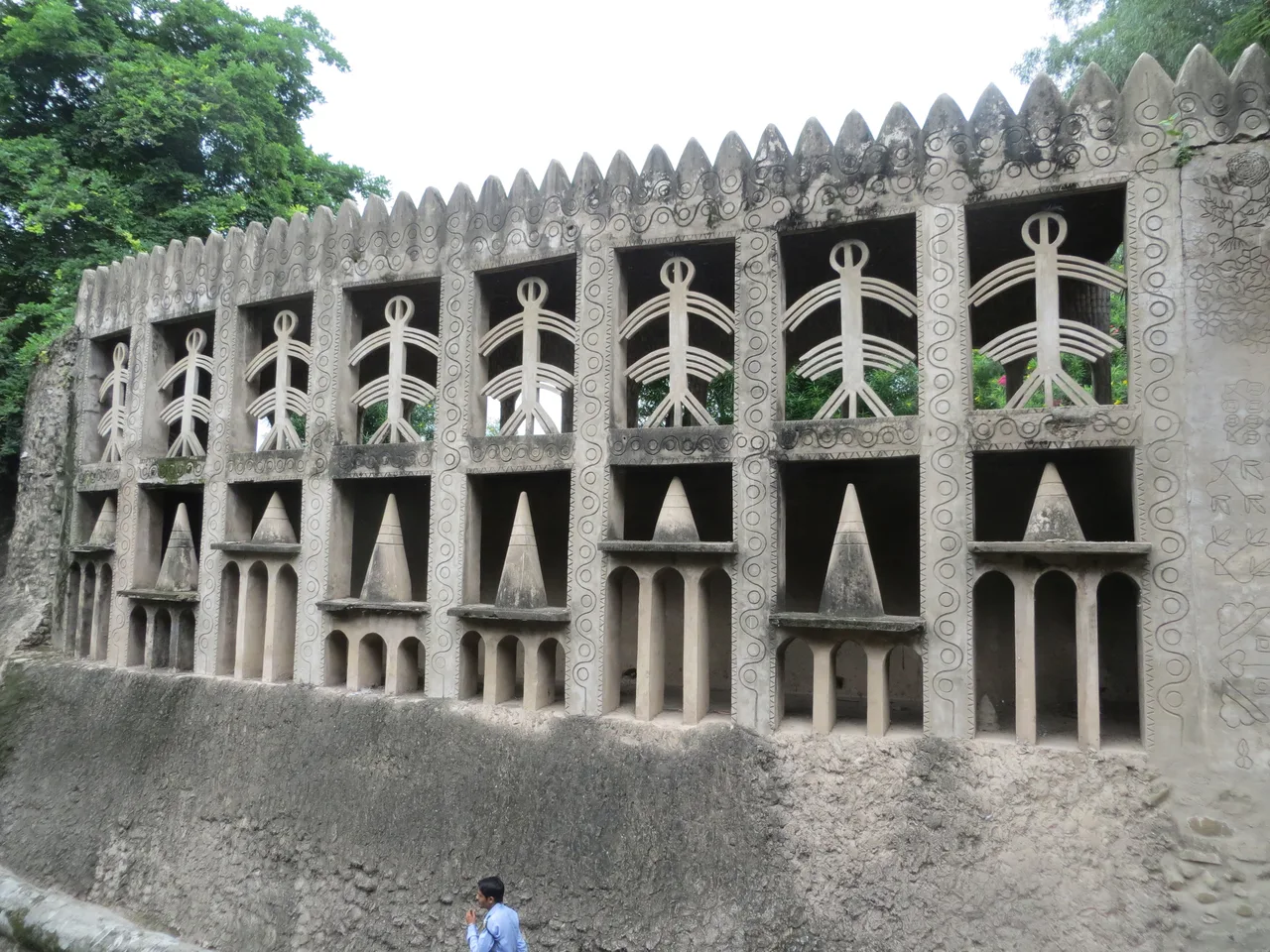
Inside, interlinked courtyards and walled paths unfold in three phases: chambers and niches set with terracotta pots, tiles, mirrors and broken bangles, man-made waterfalls, and crowds of figures — dancers, musicians, animals — modelled from broken ceramics, sinks, bottles, electrical waste and rubble. It is ticketed at the gate, and here this guide's rule applies: Chandigarh Tourism's published pages state no tariff that could be read and checked, and unofficial listings disagree on the fee and closing time — so no Rock Garden price or closing time is printed here. Carry some cash, and read the board at the entrance.
The garden's neighbour completes Sector 1. Sukhna Lake was constructed in 1958 across the Sukhna Choe, the seasonal stream that drains the Shivaliks, "and was planned as an integral part of master plan of the city", the Administration records. The reservoir lies in the shape of a bean seed behind a 12.8 m high rock-fill earthen dam at the Shivalik foothills; the promenade along the dam is the city's morning and evening walk, and boats can be hired on the shore (the operator's charges are not printed here, as no official tariff could be read). At the lake's far end, the Tourism Department's Garden of Silence — a seated Buddha amid concentric circular stairs, built for meditation — is open daily, 5:00 a.m. to 9:00 p.m., with no entry fee.
SECTION 05The Rose Garden and the Leisure Valley
The body's lungs are literal. The Leisure Valley is a green spine of more than 8 km running from Sector 1 through the city — a chain of sector greens and theme gardens. Its centrepiece sits in Sector 16: the Tourism Department's own newsletter describes the Zakir Hussain Rose Garden as Asia's largest rose garden: 30 acres, with 50,000 rose bushes of 1,600 species, established in 1967 under the patronage of Mohinder Singh Randhawa, Chandigarh's first Chief Commissioner, and named after Dr Zakir Hussain, the former President of India.
The garden is also a venue. The Rose Festival — a festival on the national calendar, organised by the Municipal Corporation during February–March each year — fills the Rose Garden and the Leisure Valley for three days over the last weekend of February, timed to the bloom; the department lists festival entry as free. If roses are your purpose, that weekend is the city's one unmissable date.
SECTION 06The Museums: The City Explaining Itself
Chandigarh's museums cluster where the plan put its intellect — in and around the Leisure Valley's cultural zone in Sector 10. First among them is the Government Museum and Art Gallery: "one of the most prominent museums of India that speaks about Indian history and partition", established in 1947 — and its building is itself an exhibit. The museum's own account notes that Le Corbusier designed it as one of his three "museums of unlimited growth", alongside Ahmedabad's Sanskar Kendra and Tokyo's National Museum of Western Art; it houses sculptures, miniature paintings, modern and contemporary art, textiles, decorative art, coins, manuscripts and pottery, and the Administration has declared the building Grade-I heritage.
Next door, the Chandigarh Architecture Museum was set up in 1997 to document, preserve and showcase the rare documents, drawings, sketches and archives of the making of Chandigarh. The Le Corbusier Centre is housed in the old Architects' Office — one of the earliest buildings constituted in Chandigarh, the workplace from which the city was designed. Pair it with Maison Jeanneret in Sector 5, where Pierre Jeanneret lived for eleven years in House No. 57. Families add the International Dolls Museum at Bal Bhavan in Sector 23, and weekday Capitol visitors can step into the High Court Museum (established 2006) inside the court building itself.
One honest limit: no museum entry fee or opening hour is printed in this guide. The Government Museum's own website could not be read when this guide was checked, and unofficial listings contradict each other on both price (₹10 in some, ₹30 in others) and closing time. Confirm the day's timings on the Tourism Department's site or at the door before you set out, rather than trusting any figure repeated here.
SECTION 07Sector 17 and the Tricity: The Heart and the Squeeze
Every planned body needs a heart, and Sector 17 is Chandigarh's — its central business district, in the Administration's description a vast shopping and business centre built around a main pedestrian piazza: four-storey concrete buildings with banks and offices above and showrooms and shops at ground level, and the Neelam piazza with its fountains at the centre. The plan even placed the Inter-State Bus Terminus at the heart (check which terminal your bus uses — services are split). This is where the grid relaxes into an evening out: dinner, a film, a stroll across the plaza.
Nor does the city end at its own borders. Chandigarh is the core of a tricity: Mohali (SAS Nagar) in Punjab spreads from its south-western edge and Panchkula in Haryana from its east — one continuous urban fabric under three administrations. You feel it most practically at the airport: Shaheed Bhagat Singh International Airport (IXC) stands not in the Union Territory at all but in Mohali, as the Airports Authority's own listing shows.
Arriving and leaving follow the plan's own geometry. By air, use IXC in Mohali. By rail, Chandigarh Junction is the city's main station, on the line running north to Kalka. By road, the two great avenues become the two great exits, exactly as the V-1 hierarchy intends: Dakshin Marg leads out towards Ambala — and so to Delhi — while Madhya Marg leads out towards Kalka, the toy-train railhead for Shimla. The same Kalka road carries you, just past Panchkula, to the excursion below.
SECTION 08The Day Trip: Pinjore Gardens
The classic half-day out of the planned city is to a garden three centuries older than it. At Pinjore, in Haryana's Panchkula district on the Kalka–Shimla highway, the Yadavindra Gardens — the Pinjore Gardens — are, in the words of the Environment Ministry's ENVIS record, "an example of the Mughal Gardens style", whose design was conceived by Nawab Fidai Khan, foster brother of the emperor Aurangzeb. He planned the garden on the classical charbagh pattern, a central waterway running down seven terraces — which, unusually, descend as you walk them — and supervised its three palaces: the Sheesh Mahal (palace of glass), the Rang Mahal (painted palace) and the Jal Mahal (palace of water).
After the Mughal centuries the garden decayed; it owes its survival and its present name to the Patiala royal house — restored under Maharaja Yadavindra Singh of Patiala, it is kept today by Haryana Tourism, which programmes its year around a spring Baisakhi festival in April and a Mango Festival in June–July. As at the Rock Garden, this guide prints no Pinjore entry fee or closing time: Haryana Tourism publishes no tariff page that could be read for this guide, and unofficial listings disagree (₹20 in some, ₹25 in others). The gardens are ticketed at the gate — carry cash, read the board, and give the terraces a slow hour.
FAQFrequently Asked Questions
How do I visit the Capitol Complex, and does it cost anything?
Entry is free, but only on Chandigarh Tourism's guided tours — this is a working seat of government and of the High Court. The department publishes the terms: tours at 10:00 a.m., 12:00 noon and 3:00 p.m., daily except gazetted holidays, 10:00 a.m.–5:00 p.m.; reach 15 minutes early for registration and carry ID proof. Monday to Friday the tour goes inside the buildings; on weekends it views them from outside only. Bookings are also taken online through the department's website.
Why is there no Sector 13 in Chandigarh?
Not superstition, according to the Administration's own record. Sectors 12 and 13 were originally demarcated as a cultural zone in the lower halves of Sectors 10 and 11, then removed to avoid confusion. No. 12 was later assigned to a residual area at the edge of Sector 11, but No. 13 was left out for want of an appropriate area — a gap left by the drawing office, not by fortune-tellers.
What does the Rock Garden cost, and when does it close?
This guide prints neither, deliberately. The garden is ticketed at its gate in Sector 1, but Chandigarh Tourism's published pages state no tariff that could be read and checked on 5 November 2026, and unofficial listings disagree on the entry fee and the closing time. Rather than repeat a number that might be wrong, the guide prints none — carry cash, and read the board at the entrance.
When is the best time to visit Chandigarh?
For the roses, aim for the Rose Festival: the Municipal Corporation holds it over the last weekend of February at the Rose Garden and the Leisure Valley, timed to the bloom, with free entry. For weather, the Administration's climate chapter divides the year into summer (mid-March to mid-June, May–June maxima around 45°C), the monsoon (July to September), a post-monsoon transition, and winter (mid-November to mid-March, January coldest) — so the comfortable sightseeing months run October to March.
How do I reach Chandigarh, and how do I go on to Shimla?
By air, fly to Shaheed Bhagat Singh International Airport (IXC) — in Mohali, next door, serving the whole tricity. By rail, Chandigarh Junction is the main station, on the line running north to Kalka. By road, the V-1 highways do what the plan intended: Dakshin Marg runs out towards Ambala for Delhi, and Madhya Marg towards Kalka. For Shimla, continue to Kalka and change onto the toy train; Pinjore Gardens make an easy stop on the same road.
Official references and checking status
Checked on 5 November 2026 against the official sources listed below; the accompanying sources file maps each claim to its page. Four limits are flagged honestly. First, no Rock Garden fee or closing time is printed: Chandigarh Tourism publishes no readable tariff, and unofficial listings conflict. Second, no museum fee or timing is printed: the Government Museum's own website could not be read in this pass and listings contradict each other. Third, no Pinjore fee or closing time is printed: Haryana Tourism publishes no tariff page that could be read, and listings conflict. Fourth, the Rose Garden's figures are the Tourism Department's current published ones; the Administration's older statistical abstract carries different figures, recorded in the sources file rather than silently blended. Confirm current prices and timings on the official sites before you travel.
- UNESCO — The Architectural Work of Le Corbusier: the listing, its criteria and the Capitol Complex's place in it
- Chandigarh Tourism (official) — Capitol Complex: buildings, monuments, tour times, entry terms and hours
- Chandigarh Administration (official) — Introduction and Master Plan: the body analogy, the sector grid, the 7 Vs, Sukhna Lake and the Rock Garden
- Chandigarh Tourism (official) — Museums: the Government Museum, Architecture Museum, Le Corbusier Centre, Maison Jeanneret and the Dolls Museum
- Chandigarh Tourism (official) — January 2025 newsletter: the Rose Garden's figures and the Rose Festival
- Incredible India, Ministry of Tourism (official) — Rock Garden: Nek Chand's story
- Chandigarh Tourism (official) — Garden of Silence, Sukhna Lake: timings and entry
- ENVIS Centre, Ministry of Environment & Forests (official) — Pinjore Gardens: Fidai Khan, the charbagh plan and the seven terraces
Photos: The Palace of Assembly and its reflecting pool in the Capitol Complex, by duncid, via Wikimedia Commons, licensed under CC BY-SA 2.0; a carved screen wall in the Rock Garden, by Antanana, via Wikimedia Commons, licensed under CC BY-SA 4.0. Photographers keep their copyright; the licences require this credit.
General information only. This guide is based on official sources publicly available and checked on the date shown on this page. Visa rules change, and consular and USCIS officers decide every case on its own facts — nothing here is a confirmation or a guarantee for your individual case, and this is not legal advice. Always confirm the current requirement on the official page linked in this guide before you act, and consider a qualified immigration attorney for your specific situation.