
Researched & checked — 31 Oct 2026
Shimla: The Ridge, Mall Road and the Kalka Toy Train, Planned on Official Facts
NEW Published 31 October 2026
Shimla runs on a short list of checkable facts: a World Heritage railway of 102 tunnels, a town centre the law keeps for walkers, a viceroy's lodge whose ticket prices and Monday closure are published by the institute itself, and a snow season that can be hoped for but never promised. Each is taken here from UNESCO, Himachal Tourism, the district administration and the bodies that run the places.
The Kalka–Shimla Railway — added to UNESCO's World Heritage List in 2008 as part of the Mountain Railways of India — climbs 96.6 km from Kalka to Shimla through 102 tunnels and over 864 bridges; its named trains include the Shivalik Deluxe and the Himalayan Queen. In town, the Ridge and Mall Road are for walking — the roads up from Cart Road are sealed and restricted, entry by official permit only. The Viceregal Lodge (Indian Institute of Advanced Study) receives tourists 9:30 AM–5:00 PM, closed Mondays and national holidays; guided-tour entry is ₹100 for Indian adults, ₹500 for foreign nationals. Above the town, Jakhoo Temple crowns Shimla at 2,445 m.
SECTION 01The Kalka–Shimla Railway: A World Heritage Line That Still Works
Begin with the status, because the heritage label understates the thing. In 2008 UNESCO extended its Mountain Railways of India listing to include the Kalka–Shimla Railway, inscribing it under criteria (ii) and (iv). UNESCO's reasoning: the line is an exceptional technical achievement for its length, altitude and terrain; it was designed under British rule because Shimla was the government's summer capital; and it remains a well-maintained living line, used for the same purposes as at its inception. All three lines remain fully operational — a working railway that is also a World Heritage Site.
The engineering, as the Himachal Pradesh government's heritage pages record it: the line is 96.6 km of single track on a narrow 762 mm gauge, built from 1898 and opened to traffic on 9 November 1903. It climbs from 656 m at Kalka to 2,076 m at Shimla — a rise of about 1,420 m — on a ruling gradient of 1 in 33, through 919 curves and over 864 bridges. Of 107 tunnels built, 102 remain in use; the longest, at Barog, runs 1.1 km, and UNESCO singles out the Kanoh bridge — the world's highest multi-arch gallery bridge. The state government declared the railway a heritage property in 2007, a year before UNESCO followed.
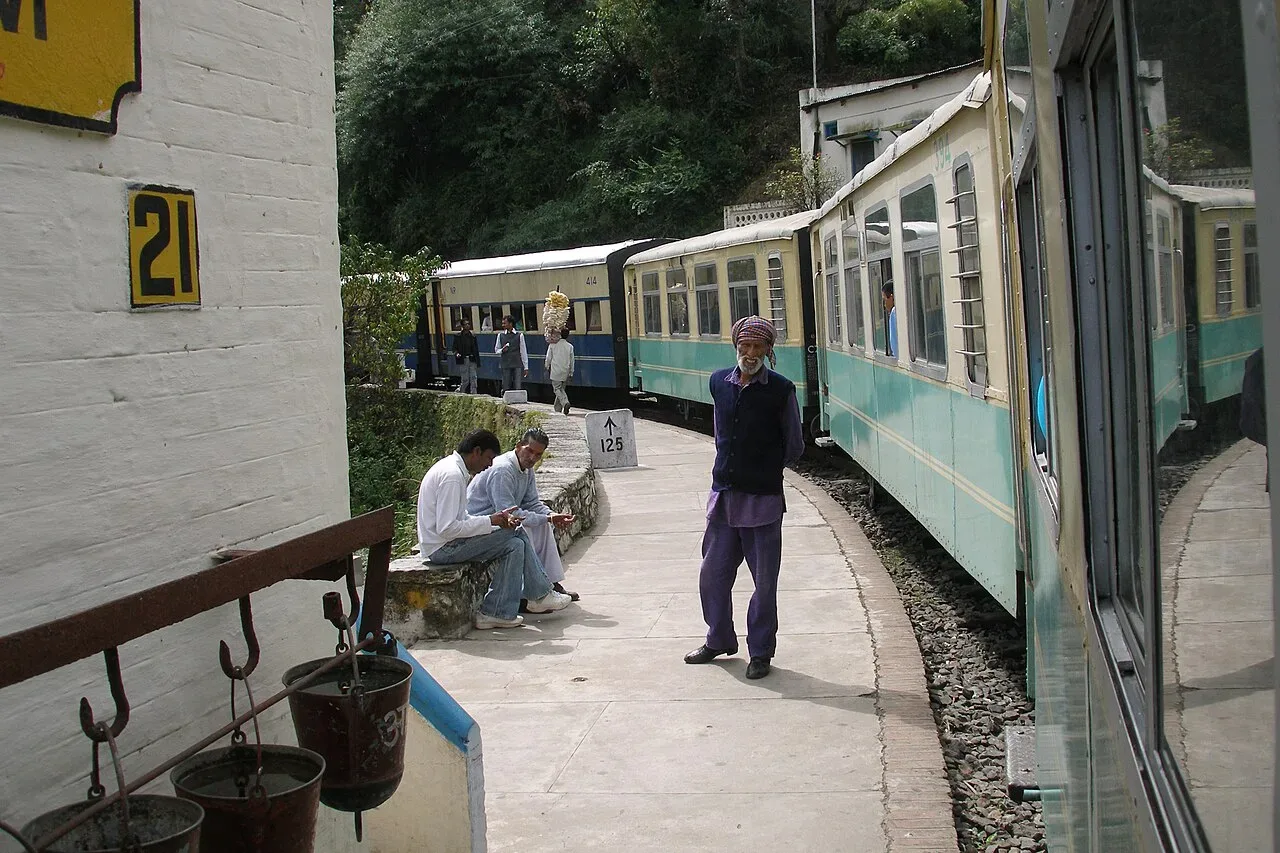
The state heritage page lists a small fleet with distinct characters. The Shivalik Deluxe Express is the premium working: chair cars with meal service. The Himalayan Queen connects at Kalka with the express and Shatabdi services to and from Delhi. The Kalka Shimla Express and Kalka Shimla Passenger carry first, second and unreserved classes; the single-coach Rail Motor is a glass-roofed first-class railbus; and luxury Shivalik Queen carriages, each holding up to eight people, are arranged through IRCTC. Trains run at about 22 km/h: the full climb occupies the better part of a morning — the ride is the day's main event, not a transfer.
On fares, this guide follows its rule: Indian Railways sells these trains through IRCTC and station counters, but publishes no fare table that could be read and checked, and the figures on unofficial pages trace back to railway brochures years out of date. So no toy-train fare is quoted here — check the live fare for your train and class on IRCTC, and book ahead in season. In the monsoon, also verify the train is running: UNESCO's assessment notes that monsoon rain, landslides and rock-falls regularly disturb the line.
SECTION 02The Ridge and Mall Road: A Centre That Belongs to Walkers
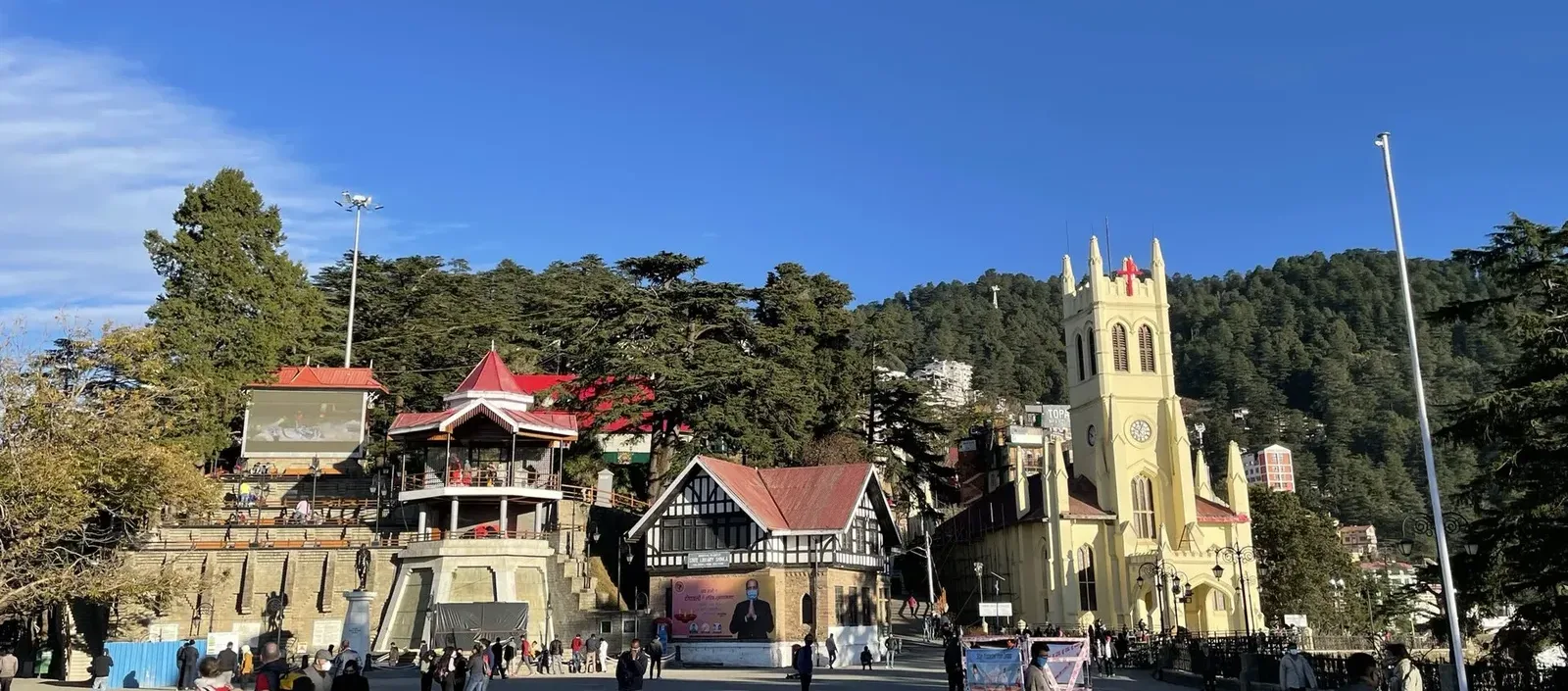
Himachal Tourism describes the centre's two levels precisely. The Ridge is the large open space that runs east to west alongside the Mall Road — the city's cultural hub, with snow-peak views to the north. Below it, the Mall is the town's main street: showrooms, department stores and restaurants along a shopping arcade, the Gaiety Theatre and Town Hall fronts, and the Himachal Emporium at its west end selling local handicrafts. The two levels meet at Scandal Point, where the Ridge and the Mall converge.
What makes this centre work is not nostalgia but law, and the district administration states it without decoration: all the roads leading from Cart Road to the Mall side are sealed and restricted roads. Entry on the prohibited roads is by permit only (Deputy Commissioner's office), parking on the sides of Cart Road is prohibited, and violations draw a heavy fine. For a visitor the consequence is liberating: nobody drives to the Mall or the Ridge. The Mall, the Ridge, Kali Bari and Lakkar Bazaar are reached on foot from the ring road — walking is the only mode of travel on the hill slopes — with one mechanical mercy: the Lift, run by Himachal Tourism, links Cart Road directly to the Mall. Arriving by car, use the listed parking (ISBT; near the Lift, about 800 vehicles; Old Bus Stand; Chhota Shimla; Sanjauli) and walk up.
One detail completes the Ridge's story: Himachal Tourism records that an underground reservoir built in the 1880s lies beneath the Ridge and is still one of the major stores for the city's everyday water needs — the promenade you cross for the view is the town's water tank with a parade ground on top.
SECTION 03Christ Church and the Landmarks Around the Ridge
At the Ridge's eastern end stands the building in every Shimla photograph. Himachal Tourism's description is the measured one this guide follows: the neo-Gothic, towering architecture of Christ Church, counted by the department among the town's colonial architectural heritage, with the Gaiety Theatre, Gorton Castle and Barnes Court. The state library and Gandhi's statue stand beside it. An honesty note: the church's familiar dates and titles — consecrated in 1857, second-oldest church in North India — are repeated by nearly every account of Shimla, but no official page read for this guide states them, so they are not asserted here. The official record needs no help: it is the landmark church of the former summer capital.
The Ridge's neighbours fill out the old town's circuit. A short walk below Scandal Point is the Kali Bari Temple, which Himachal Tourism records was built by a Bengali brahmin in 1845 and dedicated to the goddess Kali; the district history adds that Shimla began around Shyamala Devi's temple — the goddess the town is named for. The department's distance table puts the State Museum at 3 km and Summer Hill at 5 km — the latter itself a station on the toy-train line.
SECTION 04The Viceregal Lodge: Inside the Indian Institute of Advanced Study
About 4 km west of the Ridge stands Shimla's most consequential building. The Institute's own account and Himachal Tourism agree on the frame: the Viceregal Lodge was built between 1884 and 1888 under the Viceroy Lord Dufferin, designed by Henry Irwin in the manner of a Scottish castle, and was among the first buildings in India to be electrically lit. It was the seat of the imperial government from 1888 to 1947; the Shimla Conference of 1945 and the Cabinet Mission of 1946 met within it, and one room still keeps the table at which, Himachal Tourism notes, Pakistan's boundaries were drawn. After Independence it became the Presidential palace — Rashtrapati Niwas — and in 1965 the Ministry of Education established the Indian Institute of Advanced Study in it: today's occupant, which opens parts of it to visitors.
The visit is a guided operation, and the Institute publishes its terms in full. The building is open to tourists from 9:30 AM to 5:00 PM, closed on Mondays and national holidays. The interior is seen on guided tours of about 30 minutes, in Hindi and English, with up to 60 visitors per group. Tickets are issued first-come, first-served in slots — first tour usually about 10:30 AM, last at 4:30 PM, with a lunch break — and a missed slot is not adjusted and tickets are not refunded. Arrive with time in hand, especially in season.
The Institute's published entry fees are refreshingly complete. Guided-tour entry: Indian nationals ₹100; children aged 5–12 years ₹50; Indian senior citizens above 60 years ₹50; foreign nationals (above 5 years) ₹500; persons with disabilities ₹50. If you want only the grounds, the lawns and gardens ticket is ₹30 for Indian nationals and ₹50 for foreign nationals. Students of Himachal Pradesh government schools visiting in a group with the school's authority letter are exempt. Two rules shape the visit: photography is prohibited inside the building (the exterior is fair game), and the lawns are admired from the paths, because a rainwater-harvesting tank lies beneath the front lawn.
SECTION 05Jakhoo Temple: The Top of the Town
Every Shimla skyline ends at the same point. Himachal Tourism puts Jakhoo Hill at 2,445 m — the city's highest point, and home to Lord Hanuman, whose temple crowns it. The department's distance table gives 2.5 km from the Ridge on foot, or 6 km by the Circular Road, and calls the walk a daunting half-hour uphill climb from the Ridge. For those who would rather not climb, a ropeway service to the temple is also available.
Beside the temple stands the feature no visitor misses: a towering statue of Hanuman in orange, large enough to be picked out from the Ridge when the light is clear. This guide prints no height for it, deliberately — the figure quoted everywhere for it appears in no official publication that could be read for this guide. Practical advice: the temple's monkeys are bold and practised, so keep food, spectacles and phones firmly held on the climb and around the shrine.
SECTION 06Kufri: The Standard Day Trip, Described at Its Published Strength
Kufri is the excursion every Shimla itinerary adds. The state's tourism corporation describes it in its published destination material as a small hill station about 16 km from Shimla at about 2,510 m — noticeably higher than the town, which is the whole point. Its account promises famous hikes, wonderful snow for skiing in winters, and an enjoyable walk up to Mahasu Peak, the high point above the village. In winter it is where Shimla's visitors make first for snow.
The anchor sight is the Himalayan Nature Park, Kufri's high-altitude zoo, which the tourism corporation describes as having a good collection of the animals and birds found in the region — Himalayan species in a forest setting. Here the guide's rule bites: no entry fee or opening hours for the nature park are printed in this guide. The park's administering wildlife authorities publish visitor information that could not be read when this guide was checked, and the figures in unofficial listings disagree with each other on both price and the weekly closing day. So this guide prints none — the park is ticketed at the gate, so carry cash, read the board on arrival, or confirm through Himachal Tourism before you set out.
SECTION 07Getting There, and When to Come
Three routes converge on Shimla. By rail, the railhead is Kalka: Himachal Tourism notes that regular trains ply between Delhi and Kalka, from where you board the Kalka–Shimla train. By road, ordinary and luxury coaches regularly ply between Delhi, Chandigarh and Shimla, arriving at the ISBT at Tutikandi, 4 km from the main city (district administration). HRTC's published booking rules are genuinely useful: tickets can be booked online, through its app or at counters up to 60 days in advance; registration is not mandatory, as guest booking is allowed; e-tickets carry a 1.5% service charge while counter bookings carry none; children under 5 travel free without a seat and children aged 5 to 12 at half fare; and an e-ticket needs your ID proof but not a printout — the ticket on your phone suffices. By air, Himachal Tourism lists daily flights from Delhi to Shimla's airport at Jubbarhatti, 23 km from the city. Within town, local buses run 7 AM–9 PM on the Ring Road, and HPTDC's daily sightseeing buses are bookable at the Tourist Information Centre on the Mall.
Himachal Tourism describes Shimla as a year-round destination: April to June for the cool climate, March in spring, September to November in autumn — the district administration's own stated best times are October–November and April–June — with light woollens April–October and heavy woollens November–March. Winter is the snow season: the department notes that many visit from December to February to experience snowfall, and the open-air ice-skating season by the Ridge runs November to February. But no official source promises snow, because none can: snowfall is a possibility of the season, not a feature of the booking, and some winters deliver several falls while others barely deliver one. If snow is the purpose, aim for the deepest winter weeks, watch the forecast, and keep higher Kufri as a second chance. July–August monsoon mists also bring the landslip-prone roads and the railway disruptions noted in Section 01, so build slack into a monsoon itinerary.
FAQFrequently Asked Questions
How much does the Kalka–Shimla toy train cost, and how do I book it?
This guide prints no fare, deliberately: Indian Railways sells them through IRCTC and station counters, but publishes no fare table that could be read and checked on 31 October 2026; figures on unofficial pages descend from brochures years out of date. The named services are the Shivalik Deluxe Express (chair cars, meal service), the Himalayan Queen (connecting at Kalka with Delhi trains), the Kalka Shimla Express and Passenger (first, second and unreserved), the glass-roofed Rail Motor, and the Shivalik Queen luxury carriages arranged through IRCTC. Check the live fare for your train on IRCTC, and book ahead in season.
Can I drive my car onto Mall Road or the Ridge?
No. The Shimla district administration states that all roads leading from Cart Road to the Mall side are sealed and restricted roads: vehicle entry is by permit only (permits come from the Deputy Commissioner's office), parking on the sides of Cart Road is prohibited, and violations carry a heavy fine. Visitors use the listed parking (ISBT; near the Lift, about 800 vehicles; Old Bus Stand; Chhota Shimla; Sanjauli) and walk up. The Himachal Tourism Lift links Cart Road to the Mall.
What does the Viceregal Lodge cost, and when is it open?
The Indian Institute of Advanced Study publishes the terms itself: open to tourists 9:30 AM–5:00 PM, closed on Mondays and national holidays. Guided-tour entry (30-minute tours, Hindi and English, first-come first-served slots roughly 10:30 AM–4:30 PM) is ₹100 for Indian nationals, ₹50 for children aged 5–12, ₹50 for Indian senior citizens above 60, ₹500 for foreign nationals above 5 years and ₹50 for persons with disabilities. Lawns and gardens only: ₹30 (Indian) and ₹50 (foreign). A missed tour slot is not adjusted and tickets are not refunded; photography inside the building is prohibited.
Will I see snow in Shimla if I go in winter?
Possibly — and that is the most anyone honest can say. Himachal Tourism lists December to February as the months when visitors come to experience snowfall, and the town's open-air ice-skating season runs November to February; Kufri, about 16 km away and higher at about 2,510 m, is the standard second chance. But snowfall is weather, not a timetable: no official source guarantees it. If snow is your purpose, travel in the deepest winter weeks, watch the forecast, and treat snow as a prize rather than a plan.
Why are there no entry prices or timings for the Kufri nature park here?
Because no official figure could be verified. The Himalayan Nature Park at Kufri is ticketed at the gate, but its wildlife authorities' visitor information could not be read when checked (31 October 2026), and unofficial listings disagree with each other on the entry fee and on the weekly closing day (given variously as Monday and Tuesday). Rather than print a number that might be wrong, this guide prints none — carry cash, read the board at the gate, or confirm through Himachal Tourism before you go.
Official references and checking status
Checked on 31 October 2026 against the official sources listed below; the accompanying sources file maps each claim to its page. Four limits are flagged honestly. First, Indian Railways publishes no Kalka–Shimla fare table that could be read at passage level, so no fare is printed. Second, Kufri's description rests on the Himachal Pradesh Tourism Development Corporation's published destination text, read in this pass through a reproduction; the Himalayan Nature Park's administering authority publishes visitor information that could not be read directly, so its fees and hours are not printed, and the Jakhoo statue's often-quoted height is likewise not printed because no official figure could be read. Third, the district page's temporary-permit rate for restricted roads conflicts with more recent amendment reporting, so the permit mechanism is described without a figure. Fourth, Christ Church's widely repeated consecration date and "second oldest" title appear in no official text read for this guide and are not asserted. Confirm current prices and timings on the official sites before you travel.
- UNESCO — Mountain Railways of India: the listing and the Kalka–Shimla Railway's place in it
- UNESCO — Decision 32 COM 8B.28 (2008): the extension to the Kalka–Shimla Railway under criteria (ii) and (iv)
- Himachal Tourism (official) — Shimla: the Ridge, the Mall, the Lodge, Jakhoo, distances, access and weather
- Indian Institute of Advanced Study (official) — For Tourists: hours, tour arrangements, entry fees and rules
- HP government heritage portal (official) — Kalka–Shimla Railway: engineering, stations and trains
- Shimla District Administration (official) — Local Transportation and Parking: restricted roads, permits, the Lift, parking
- HRTC (official) — booking FAQ: the 60-day window, guest booking, charges and child fares
Photos: The Ridge and Christ Church in afternoon light, by Slyronit, via Wikimedia Commons, licensed under CC BY-SA 4.0; a Kalka–Shimla train at a wayside station, by Argenberg, via Wikimedia Commons, licensed under CC BY 4.0. Photographers keep their copyright; the licences require this credit.
General information only. This guide is based on official sources publicly available and checked on the date shown on this page. Visa rules change, and consular and USCIS officers decide every case on its own facts — nothing here is a confirmation or a guarantee for your individual case, and this is not legal advice. Always confirm the current requirement on the official page linked in this guide before you act, and consider a qualified immigration attorney for your specific situation.