
Researched & checked — 31 Oct 2026
Ahmedabad: The Heritage City, Sabarmati Ashram and the Old-City Pols, With Real Costs
NEW Published 31 October 2026
Ahmedabad's sights turn on a short list of checkable facts: a UNESCO listing that covers a living walled city rather than a single monument, a morning heritage walk with a published two-tier tariff, an ashram whose trust publishes its hours but no ticket, and a great textile museum you can only see on a timed tour. Every figure here comes from UNESCO, Gujarat Tourism or the bodies that run each place — and where no official figure could be read, this guide says so instead of inventing one.
Ahmedabad's walled city was inscribed on UNESCO's World Heritage List in July 2017, under criteria (ii) and (v) — the first Indian city on the List. The Ahmedabad Municipal Corporation's heritage walk runs daily from the Swaminarayan Temple, Kalupur at 7:45 AM, ending at the Jama Masjid at 10:30 AM; the walk's published tariff is ₹200 (Indian) / ₹300 (foreign) standard, ₹400 / ₹500 luxury. Sabarmati Ashram is open 10:00 AM–6:00 PM every day of the year by its Trust's own site, which publishes no admission charge. The Sidi Saiyyed mosque (1572–73) and the Jama Masjid are working mosques, not ticket counters. The Calico Museum is seen only on the Sarabhai Foundation's guided tours — Haveli Galleries 10:30 AM–12:30 PM, Chauk Galleries 2:30–4:30 PM, Tuesday to Sunday.
SECTION 01A World Heritage City, Not a Monument
Begin with what the listing actually is, because it shapes everything else. UNESCO's own description records that the walled city of Ahmadabad was founded by Sultan Ahmad Shah in 1411 AD on the eastern bank of the Sabarmati River and remained the capital of Gujarat for six centuries. It was inscribed on the World Heritage List in July 2017 under criteria (ii) and (v) — the first Indian city to be inscribed — covering a property of 535.7 hectares with a 395-hectare buffer zone. Criterion (ii) recognises the Sultanate-period architecture: mosques and tombs built by local craftsmen in a provincial idiom found nowhere else in India. Criterion (v) recognises the settlement itself — the hierarchy of neighbourhoods, streets that double as community space, and houses built as self-sufficient units around courtyards.
The protection numbers tell you how much of the city is in play. UNESCO records 28 monuments listed by the Archaeological Survey of India, one by the State Department of Archaeology, and 2,696 important buildings protected by the Heritage Department of the Ahmedabad Municipal Corporation. In other words, the heritage here is not a compound you enter; it is a working urban district of lanes, markets, shrines and homes, and "visiting" it mostly means walking it with your eyes open. There is no city-level entry ticket, and any operator who implies one is selling you something UNESCO never created.
SECTION 02The Pols: Neighbourhoods Behind a Single Gate
The unit of the old city is the pol, and UNESCO's criterion (v) text is the clearest short explanation of it anywhere: a self-sufficient gated street whose houses carry their own provisions for water, sanitation and climatic control, with the courtyard as the focus. Gujarat Tourism's heritage walk page describes the same fabric from ground level: pols are self-contained neighbourhoods sheltering large numbers of people, traversed by narrow streets, usually ending in a square with community wells and chabutaras — the carved bird-feeders that rise like small towers — with gates, cul-de-sacs and secret passages.
Layered over the pols is the domestic architecture UNESCO calls the city's most unique aspect: timber-based houses and havelis with carved wooden façades, their plans organised around a central courtyard in every community. The religious map is equally layered — UNESCO notes institutions of Hinduism, Islam, Jainism, Buddhism, Christianity, Zoroastrianism and Judaism within the same urban fabric — and you feel that on the ground, where a Jain temple, a mosque and a Hindu shrine can stand within a few lanes of each other. The pols are not a museum quarter: families live behind those carved doors, and the right way to see them is slowly, on foot, without treating people's doorsteps as exhibits.
SECTION 03The Heritage Walk: The One Organised Way In
If you take one organised product in Ahmedabad, this is it — and its facts are published by the state itself. Gujarat Tourism states the arrangement plainly: "Ahmedabad Municipal Corporation has arranged this Heritage Walk of Ahmedabad," and its published route runs from the Kalupur Swaminarayan Temple at 07:45 a.m. daily, terminating at the Jumma Masjid at 10:30 a.m. The walk's own official site — the one Gujarat Tourism links visitors to — fills in the working detail: reporting between 7:30 and 7:45 AM at the Swaminarayan Temple, Kalupur, off Relief Road; about 2 km and 2½ hours; 20 pause points on the morning route, temple to mosque, through the pols.
The same site publishes the tariff, in two tiers. Standard: ₹200 per Indian citizen, ₹300 per foreign citizen. Luxury: ₹400 and ₹500 respectively, taxes included. There is also a night heritage walk, starting from the Sidi Saiyyed Mosque with reporting at 8:30–8:45 PM, covering 16 points over about 2 km and 2½ hours, at ₹200 (Indian) / ₹300 (foreign). These are the only prices in the old city you can verify before you arrive — and the walk doubles as orientation: after 10:30 AM at the Jama Masjid, the pols you have just walked are yours to re-walk alone.
SECTION 04Sidi Saiyyed's Jali and the Jama Masjid
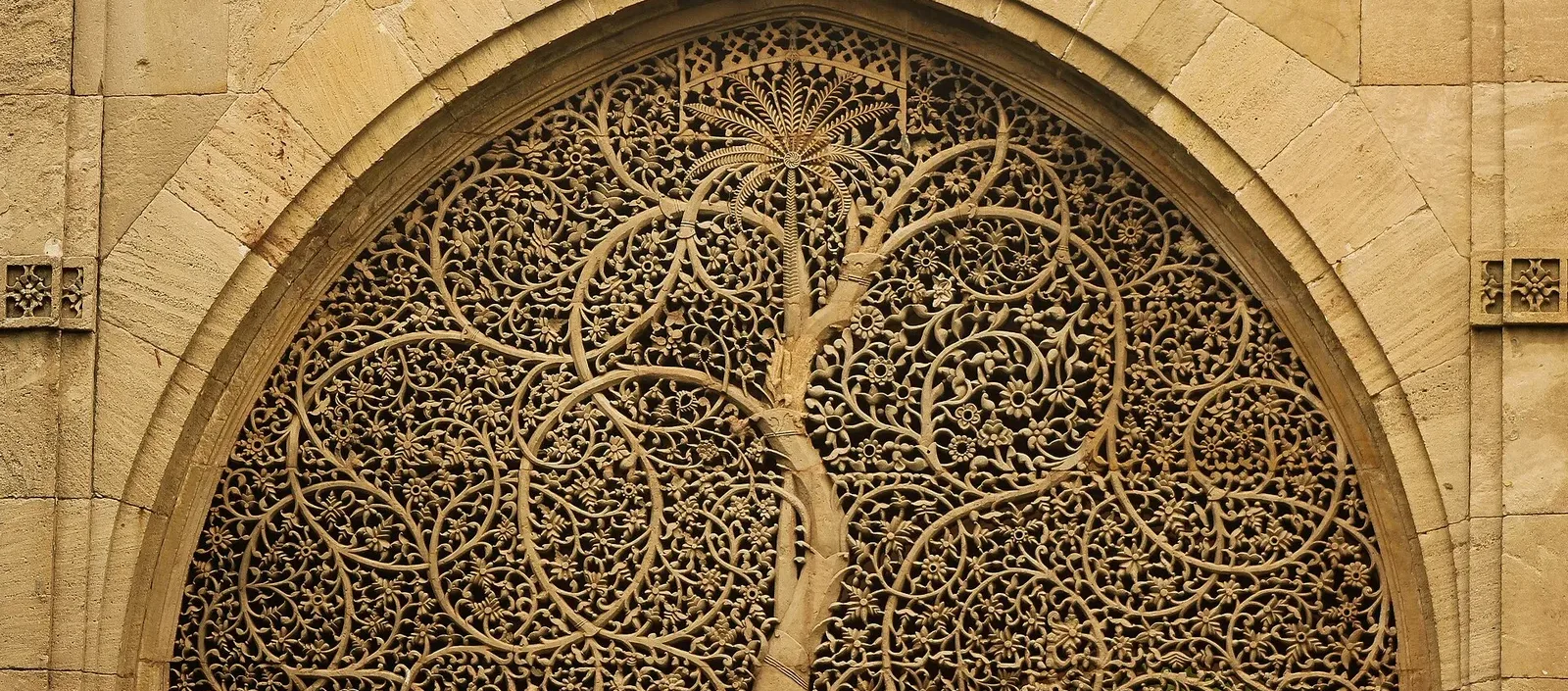
Two mosques carry the old city's fame, and they are opposites in scale. The Sidi Saiyyed Mosque is small, late and perfect. Gujarat Tourism's own history dates it to 1572–73 AD, built by Sidi Sayed, an Abyssinian who served in Ahmed Shah's army, in the very year the Mughals conquered Gujarat. It is famed, in Gujarat Tourism's words, for its exquisite jali windows "spider web fine," above all the one depicting the intertwining branches of the 'tree of life' — the carved stone screen that has become the city's emblem. Two of the portal's practical notes are worth carrying: the jali is best seen from the road that runs along the back of the mosque, and the central arch is deliberately plain, so your eye goes straight to the great screen behind it. And the essential etiquette fact: the mosque still functions as a place of prayer. Go in daylight, outside prayer times, dressed and behaving as a guest in a working mosque — because that is what you are.
The Jama Masjid is the founding generation's answer: UNESCO counts the fort, the three gates at the end of the Maidan-e-Shahi and the Jama Masjid among the very first acts of Sultan Ahmed Shah in establishing his city. It remains the old city's congregational mosque and the natural end-point of movement through it — the heritage walk terminates here at 10:30 AM, which is the right way to arrive, on foot out of the pols rather than by car to the gate. Ahmedabad's old-city monuments sit within the 28 ASI-listed monuments UNESCO records for the city, but protection is not ticketing: neither of these mosques is run as a ticketed monument, and this guide prints no ASI fee for them because ASI publishes none for these buildings — a point the checking note at the foot of this guide states in full.
SECTION 05Sabarmati Ashram: Gandhi's Headquarters
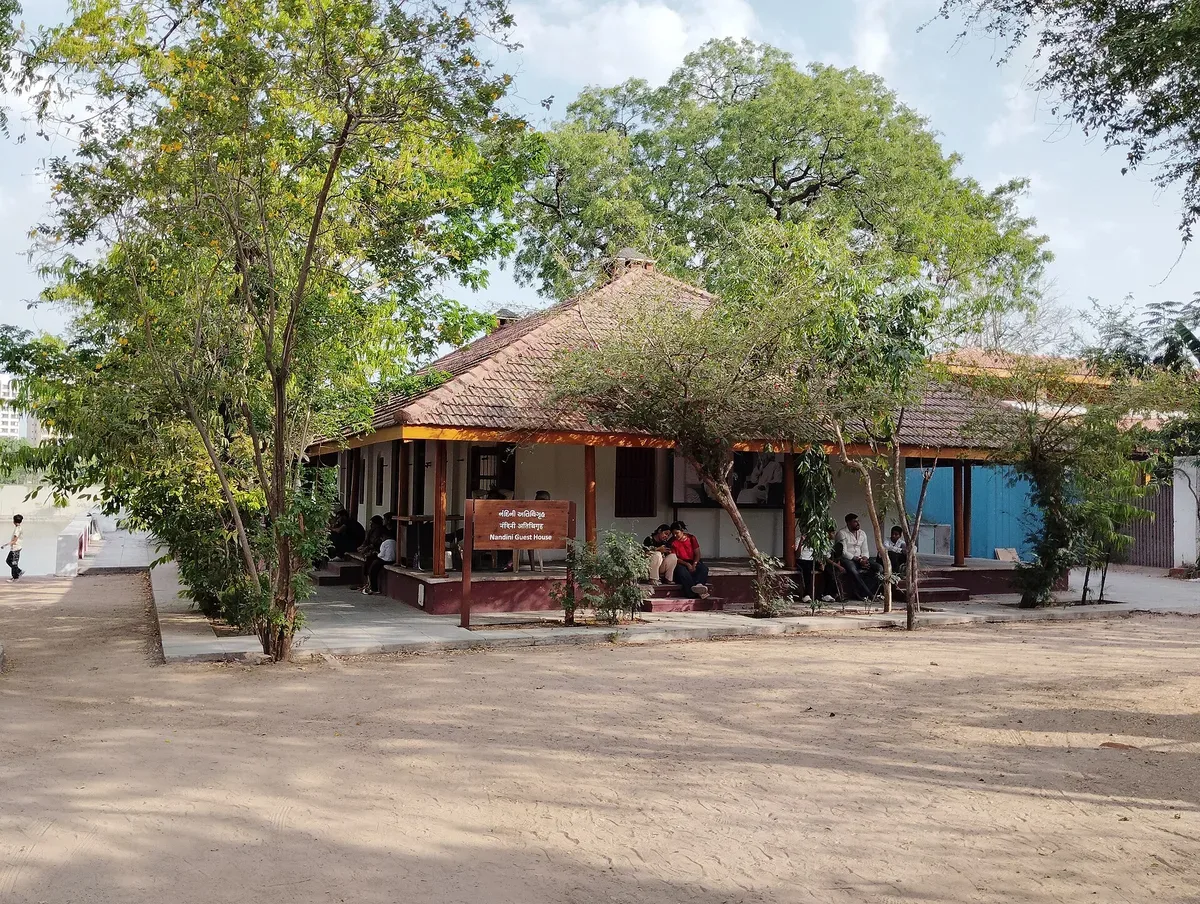
Across the river from the old city stands the other Ahmedabad. The Sabarmati Ashram — run by the Sabarmati Ashram Preservation and Memorial Trust — was Gandhi's home and the headquarters of the freedom movement, and its own Trust publishes the visiting facts: the Ashram is open from 10:00 AM to 6:00 PM, every day of the year. Gujarat Tourism's history fills in the arc: the ashram was founded in May 1915 at the Kocharab Bungalow as the Satyagraha Ashram and moved on 17 June 1917 to a 36-acre site on the banks of the Sabarmati — ground Gandhi chose, as Gujarat Tourism notes, between a prison and a cemetery, on the reasoning that a satyagrahi's life would end in one or the other. This is also the place from which Gandhi started the Dandi March.
What you walk through is a campus of modest buildings under trees: Hriday Kunj, Gandhi's own home, where the Trust records that he and Kasturba lived from 1918 to 1930; Magan Niwas, named for Maganlal Gandhi, whom Gandhi called the soul of the ashram; and the other cottages Gujarat Tourism names — Upasana Mandir, the prayer ground, Vinoba and Nandini among them. The museum, the Gandhi Smarak Sangrahalaya, holds the letters and photographs in a modern building conceived by architect Charles Correa. On cost, this guide follows its rule strictly: the Trust's published visitor information gives the hours and no admission charge, and Gujarat Tourism likewise publishes no entry fee for the ashram — so no price is printed here, because none is published by either body. Go in the morning if you can, when the river light and the quiet are at their best.
SECTION 06The Sabarmati Riverfront: The City's New Front Room
The same river has a second, newer face. Gujarat Tourism describes the Sabarmati Riverfront as a planned promenade of 22 km, of which a part is now complete, and lists its visiting hours simply as sunrise to sunset. The promenade is where the city now walks: fitness enthusiasts on daily rounds, boating stations and exhibition spaces along the path, and the two banks stitched together by eleven bridges — of which Ellis Bridge, first built in 1873, is the oldest. The riverfront's flower garden is planted on a civic scale: about 45,000 square metres holding more than 330 native and exotic flower species.
Plan the riverfront as the counterweight to the old city rather than a rival to it. The ashram overlooks this same water from its quieter northern stretch; the promenades below the old-city bridges give you the skyline view back at the walls you walked in the morning. Gujarat Tourism publishes no entry fee for the promenade, and this guide prints none — the riverfront works as public open space, best used early or at dusk, which in Ahmedabad's climate is when the city itself uses it.
SECTION 07The Calico Museum: By Timed Tour Only
The Calico Museum of Textiles, under the Sarabhai Foundation, is described on its own site as India's premier textile museum, its collection considered among the finest and most comprehensive in the world, housed — with the Foundation's South Indian bronzes, Jain art and miniature paintings — at The Retreat in Shahibaug. The visiting regime is the most restrictive in this guide, and it is the Foundation's own: the museum is seen on the Foundation's conducted tours of the galleries, not by wandering. The Haveli Galleries tour runs 10:30 AM to 12:30 PM, with entry between 10:15 and 10:30 AM; the Chauk Galleries tour runs 2:30 to 4:30 PM, with entry between 2:15 and 2:30 PM; both run Tuesday to Sunday, except Mondays and public holidays. A third, smaller window — the Udyana Garden — opens Thursday only, 3:30 to 5:00 PM.
The practical translation is blunt: you cannot improvise the Calico. Choose your gallery, be at the gate inside its fifteen-minute entry window, and build the rest of the day around it — a morning Haveli tour pairs with an afternoon in the old city, and the museum shop, which the Foundation opens in two daily windows, carries its academic publications. The Foundation's site publishes the tour structure and timings above and no admission price that this guide could read, so none is printed; check the museum's own site before you go, because a missed entry window is a missed museum.
SECTION 08Getting Around, and the Seasons
Ahmedabad's geography is a tale of two banks: the old city and the ashram face each other across the Sabarmati, and the metro now does the heavy lifting between them. The operator, Gujarat Metro Rail Corporation, records that Phase-I has two corridors — East–West from Thaltej Gam to Vastral Gam, and North–South from APMC to Motera Stadium — with commercial operations begun in March 2019 and the phase complete at 40.03 km and 31 operational stations. Under it, the city's Janmarg BRTS buses run their own corridors, and auto-rickshaws fill every gap — agree the fare or the meter before you set off. Inside the old city, forget wheels entirely: the pols were built for feet, and the heritage walk's 2 km is the correct speed.
The calendar matters as much as the map. The India Meteorological Department's Ahmedabad climatology is unambiguous about the rain: June to September is the rainy season, and July and August together contribute more than 70 per cent of the season's rainfall. Before the monsoon, the pre-monsoon summer is the city's fiercest season — sightseeing then is a dawn-and-dusk discipline, and the heritage walk's 7:45 AM start suddenly looks wise. The comfortable window is the post-monsoon and winter stretch, roughly October to February, when the walk, the ashram grounds and the riverfront can all be taken in daylight without negotiation. Whenever you come, Ahmedabad rewards the early riser: its best product runs at the hour when the light, the temperature and the lanes are all at their best.
FAQFrequently Asked Questions
What does sightseeing in Ahmedabad actually cost?
Less than most heritage cities, and the one fixed price is published: the municipal heritage walk costs ₹200 (Indian) / ₹300 (foreign) standard or ₹400 / ₹500 luxury on the walk's own site, and the night walk is ₹200 / ₹300. Beyond that, the walled city itself has no entry ticket, the Sidi Saiyyed and Jama Masjid are working mosques rather than ticketed monuments, and neither the Ashram's Trust nor Gujarat Tourism publishes an admission charge for the ashram — so this guide prints no figure for it rather than repeating one from unofficial listings.
How does the Ahmedabad heritage walk work?
It is arranged by the Ahmedabad Municipal Corporation, as Gujarat Tourism states, and runs daily: report at the Swaminarayan Temple, Kalupur, between 7:30 and 7:45 AM. The morning walk covers about 2 km and 20 pause points in roughly 2½ hours, ending at the Jama Masjid at 10:30 AM. A night walk runs from the Sidi Saiyyed Mosque, reporting 8:30–8:45 PM, over 16 points.
When is Sabarmati Ashram open, and is there an entry fee?
The Sabarmati Ashram Preservation and Memorial Trust's own site gives the hours as 10:00 AM to 6:00 PM, open every day of the year. On the fee, be precise: neither the Trust's published visitor information nor Gujarat Tourism states an admission charge for the ashram, so this guide prints none — unofficial sites state figures and free-entry claims the official sources do not.
What is the best season to visit Ahmedabad?
The post-monsoon and winter months, roughly October to February. The India Meteorological Department's Ahmedabad climatology puts the rainy season from June to September, with July and August alone contributing more than 70 per cent of the season's rain, and the pre-monsoon summer is severely hot. In the cool season the heritage walk, the ashram grounds and the riverfront promenade can all be done in comfort.
Can you just walk into the Calico Museum?
No. The Sarabhai Foundation's museum at The Retreat, Shahibaug, is seen only on its conducted gallery tours: the Haveli Galleries at 10:30 AM–12:30 PM (entry 10:15–10:30 AM) and the Chauk Galleries at 2:30–4:30 PM (entry 2:15–2:30 PM), Tuesday to Sunday except Mondays and public holidays, with the Udyana Garden open Thursday only, 3:30–5:00 PM. Miss the entry window and you miss the tour; the Foundation's site publishes these timings and no admission price this guide could read.
Official references and checking status
Every changeable fact in this guide was checked on 31 October 2026 against the official sources listed below. Three limits are stated plainly. First, Sabarmati Ashram's entry position: the Trust publishes its hours and no admission charge, and Gujarat Tourism publishes no entry fee either, so no figure — and no "free entry" claim — is printed as verified fact. Second, the ASI position: UNESCO records 28 ASI-listed monuments in the city, but no ASI-published entry fee for them could be read, so none is printed; the two great mosques are living places of worship, not ticketed sites. Third, the Ashram Trust's website carried spam-link contamination in its navigation when checked, and one of its visitor pages returned third-party spam instead of ashram information; only the Trust's clean homepage facts (its identity, address and hours) are used here. Gujarat Tourism's ashram page also contradicts itself on hours (10 AM–6 PM in its history text, 8 AM–6:30 PM in its visiting-hours field); this guide prints the Trust's own hours. Confirm current prices and timings on the official sites before you travel.
- UNESCO World Heritage Centre — Historic City of Ahmadabad: brief synthesis, criteria (ii) and (v), protection and management
- UNESCO World Heritage Centre — State of Conservation report: inscribed July 2017 under criteria (ii) and (v)
- Gujarat Tourism — Ahmedabad Heritage Walk: arranged by Ahmedabad Municipal Corporation; route and timings
- Ahmedabad Heritage Walk (official walk site, linked from Gujarat Tourism) — morning and night walk points, durations and published tariff
- Gujarat Tourism — Sabarmati Ashram: history, the 1915 founding, the 1917 move and the Dandi March
- Sabarmati Ashram Preservation and Memorial Trust — the Ashram's address and published hours, 10:00 AM–6:00 PM daily
- Gujarat Tourism — Sidi Saiyyed Mosque: the 1572–73 mosque, the tree-of-life jali, a functioning place of prayer
- Gujarat Tourism — Sabarmati Riverfront: the 22 km promenade, bridges, flower garden and visiting hours
- Calico Museum of Textiles (Sarabhai Foundation) — the collections and the conducted-tour timings
- Gujarat Metro Rail Corporation (official) — Ahmedabad Metro Phase-I corridors, operations from March 2019, 40.03 km and 31 stations
- India Meteorological Department, Meteorological Centre Ahmedabad — climatology of Ahmedabad: the June–September rainy season
Photos: the 'tree of life' jali of the Sidi Saiyyed Mosque in warm sandstone, by Snehrashmi, via Wikimedia Commons, licensed under CC BY-SA 4.0; Nandini, one of the cottages of Sabarmati Ashram, by Nizil Shah, via Wikimedia Commons, licensed under CC BY-SA 4.0. Photographers keep their copyright; the licences require this credit.
General information only. This guide is based on official sources publicly available and checked on the date shown on this page. Visa rules change, and consular and USCIS officers decide every case on its own facts — nothing here is a confirmation or a guarantee for your individual case, and this is not legal advice. Always confirm the current requirement on the official page linked in this guide before you act, and consider a qualified immigration attorney for your specific situation.