
Researched & checked — 3 Nov 2026
Somnath and Dwarka: Two Jyotirlingas and a Char Dham on One Saurashtra Circuit
NEW Published 3 November 2026
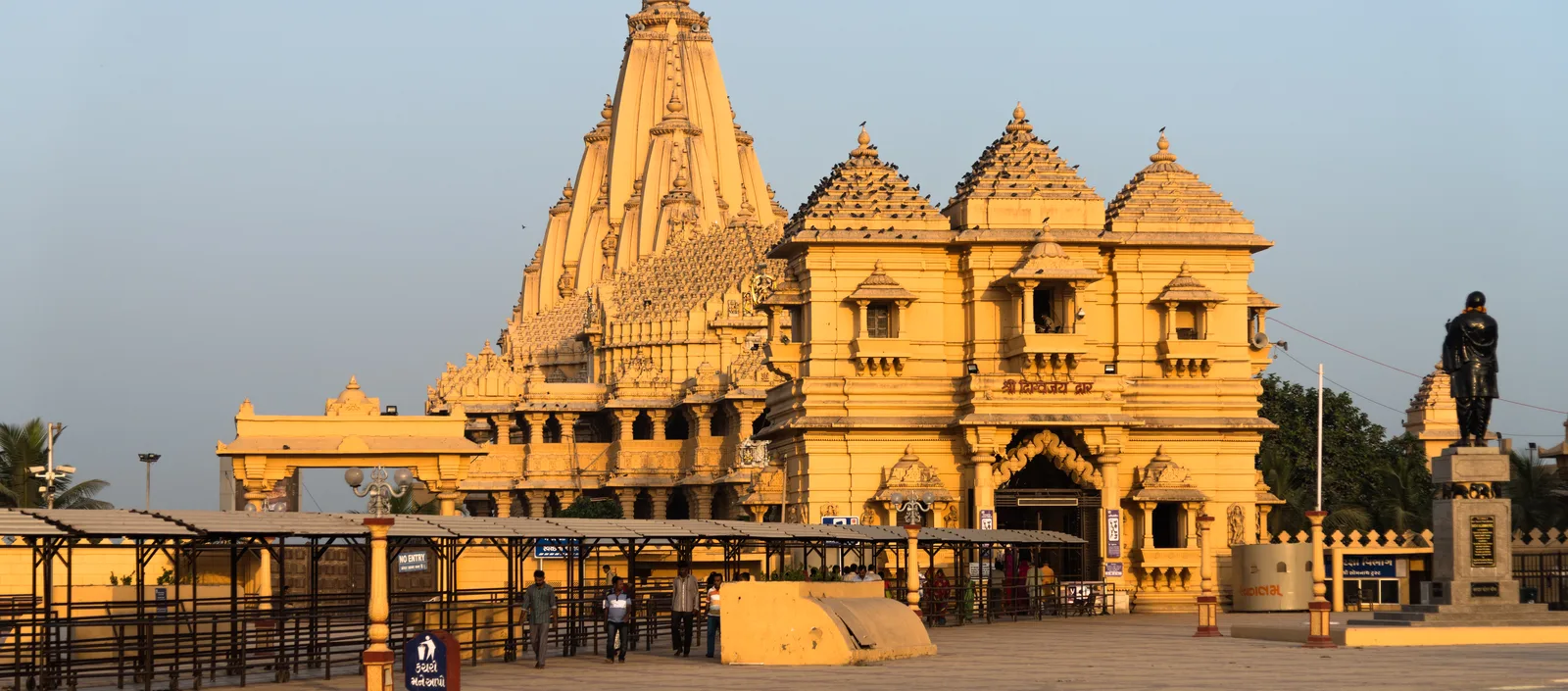
Gujarat's western coast holds a pilgrimage circuit that fits in two or three days: Somnath, where the first of the twelve jyotirlingas stands where three rivers meet the sea, and Dwarka, one of the four Char Dhams, with a second jyotirlinga at Nageshwar a short drive away. It is planned here on the trusts' and Gujarat Tourism's own published facts, and prints no fare or timing that could not be read on an official page.
Somnath — revered, in Gujarat Tourism's words, as the place where the first of the twelve jyotirlingas emerged — is open for darshan 6:00 AM–10:00 PM with aartis at 7:00 AM, 12:00 noon and 7:00 PM; entry is free, and all electronic devices are prohibited inside, with free cloak-room lockers at the gate. Dwarka, one of the four Char Dhams, lies 230 km away by the Trust's distance table; the Dwarkadhish Temple's published timetable runs 6:30 AM–1:00 PM and 5:00–9:30 PM. Add Bet Dwarka island and Nageshwar, another of the twelve jyotirlingas, and the circuit fills two to three days.
SECTION 01Why These Two Towns Belong on One Trip
The pairing is not a travel agent's invention; the temples' own publications make it. The Shree Somnath Trust's FAQ gives Dwarka at 230 km and names the Dwarka sights — the Dwarkadhish Temple, Beyt Dwarka and the Rukmini Temple. Gujarat Tourism's state-run Saurashtra itineraries run the two towns back to back — the Dwarka group first, then the drive down the coast through Porbandar to Somnath.
The religious geography explains the pull. Somnath holds the first of the twelve jyotirlingas, on Gujarat Tourism's account. Dwarka is one of the four Char Dhams — clubbed by Gujarat Tourism with Badrinath, Puri and Rameshwaram — and its temple honours Krishna as Dwarkadhish, the King of Dwarka. Just outside Dwarka stands Nageshwar, another of the twelve. Cover both towns in one journey and you stand before two jyotirlingas and one Char Dham — a density few Indian circuits of this length can match.
SECTION 02Somnath Temple: Darshan Hours, Free Entry and the No-Devices Rule
Gujarat Tourism's Somnath page sets the scene the Trust's rules then govern: the temple stands at the meeting of the Kapila, Hiran and Sarasvati rivers, where the Arabian Sea touches the shore. The temple pilgrims enter today is the post-Independence reconstruction — the present form was reconstructed in 1951, on a site the department traces to 649 BC.
The Trust's FAQ publishes the working day in full. Darshan runs from 6:00 AM to 10:00 PM; aarti is offered at 7:00 AM, 12:00 noon and 7:00 PM. The Light and Sound Show runs 8:00 PM–9:00 PM — except in the monsoon and rainy season, when it does not run; Gujarat Tourism gives a different start time, 7:45 PM, and this guide follows the Trust, which operates the show. Entry to the temple is free of cost; the Trust says so in as many words.
The rule that shapes every Somnath visit is the Trust's device ban: all electronic and electric equipment — mobile phones, cameras, smartwatches, laptops, tablets — is strictly prohibited inside the temple, and photography is strictly prohibited as well. This is a managed ban, not a trap: free lockers in the cloak room take your devices, and a free shoe house stands near it for footwear. Dress is policed at the same gate — mini skirts and disrespectful dress are not permitted — and smoking is not allowed in the temple vicinity.
Two Trust services deserve planning around: the Tirth Darshan Bus leaves from the main gate at 8:30 AM and 3:30 PM, covering the nearby temples at nominal charges; and wheelchairs and a golf cart are available at the main gate, with a lift inside the temple. One warning from the Trust's homepage protects real money: guest-house bookings, pooja registrations and donations are accepted only through somnath.org — never through any other medium, private phone numbers or UPI — and fraud has been reported. Book on the Trust's site or at its own booking offices, and nowhere else.
SECTION 03Around Somnath: Triveni Sangam, Dehotsarg and Bhalka Tirth
The temple does not stand alone; the Trust's own list of visiting places maps a small sacred landscape around Prabhas Patan, and three stops carry the story. The first is Triveni Ghat: a confluence of three holy rivers — Hiran, Kapila and Saraswati — meeting at the shore the temple overlooks. The Trust lists Prachi Tirth as its centre for rituals for the ancestors, likened in importance to Kashi.
On the bank of the Hiran, 1.5 km from the temple, stands Dehotsarg Tirth — the spot from which, the Trust records, Bhagvan Shree Krishna took his divine journey to Neejdham, in the Trust's telling from the Mahabharata and the Puranas. Beside it, the Geeta Mandir carries the teaching in stone: 18 pillars on which the 18 chapters of the Bhagavad Geeta are inscribed, with other shrines in the same cluster.
The third stop completes the Krishna story where it turned. Bhalka Tirth, 5 km from the temple on the Prabhas–Veraval highway, is where the Trust places the arrow of the poacher Jara, who mistook Krishna's foot for a deer as he rested in meditation under a pippal tree. All three are coverable in a single morning or afternoon, on the Trust's Tirth Darshan Bus or by local hire. The Trust adds that more than 20 historic and religious places stand in Prabhas Patan, the first 14 of them organised into a heritage walk route — among them the Ahilyabai Temple of 1783.
SECTION 04The Link: 230 Kilometres Between the Towns, and Each Town's Gateways
The circuit's one long leg is the drive between the towns, and the figure to plan on is the Trust's: Dwarka is 230 km from Somnath. Gujarat Tourism's own Saurashtra tours run this leg by road, sequencing the Dwarka group first and then driving via Porbandar to Somnath; and Gujarat Tourism notes that Somnath is well connected by GSRTC buses to other parts of Gujarat, and says the same of Dwarka's state-run buses. This guide prints no driving time — neither body publishes one — so treat the leg as a substantial half-day on the road and do not schedule a timed darshan against its end.
Rail serves both ends of the circuit rather than shuttling between them. At the Somnath end, the Trust's FAQ puts Somnath station 0.5 km from the temple and Veraval station 7 km away, and Gujarat Tourism confirms Somnath station is well connected to other major towns in Gujarat and India, and Dwarka likewise by rail. A rail-based circuit is therefore possible; check current services on Indian Railways' official channels, as this guide prints no timetable.
By air, each town has its own gateways. For Somnath, the Trust names Diu airport at 85 km as the nearest, then Rajkot at 200 km and Ahmedabad at 390 km. For Dwarka, Gujarat Tourism's trip planner names Porbandar (95 km) and Jamnagar (145 km) as the closest airports. Ahmedabad is the long-haul gateway behind both. Fly into one end's gateway and out of the other's, and the 230 km between the temples is driven once.
SECTION 05Dwarkadhish Temple: Planning Around the Darshan Timetable
Dwarka's temple — the Jagat Mandir — in Gujarat Tourism's telling: believed to have been established more than 2,500 years ago by Vajranabh, Lord Krishna's great-grandson, and standing on a small hill reached by more than 50 steps. Its 43 m spire is topped by a flag made from 52 yards of cloth, and entry and exit run through two doors, named swarg and moksh.
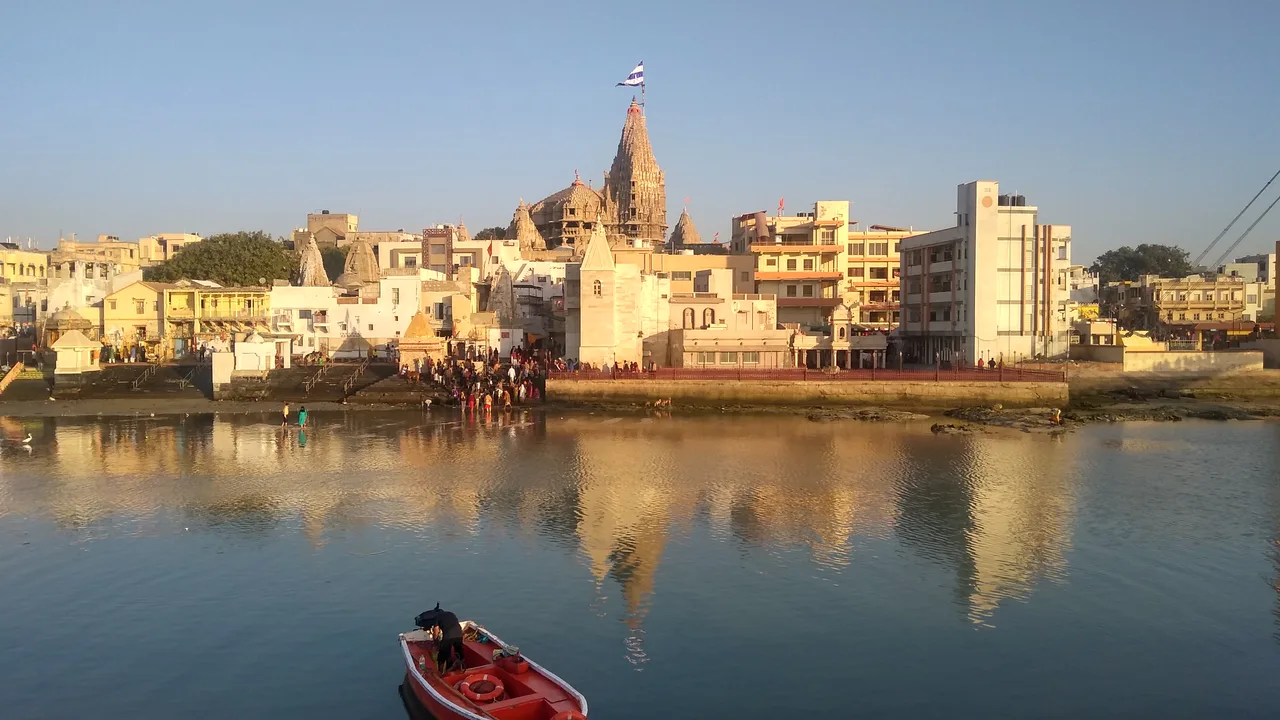
What the pilgrim actually plans around is the temple's own published timetable, and it is a rhythm, not a pair of opening hours. Morning darshan runs 6:30 AM–1:00 PM: Mangla Arti at 6:30, the doors close 8:00–9:00 for the Abhishek Pooja (the bathing rite), reopen for Shringar Darshan, and close briefly for each successive bhog, with the Shringar Arti at 10:30–10:45 AM the morning's set piece, before anosar, the afternoon closure, begins at 1:00 PM. Evening darshan runs 5:00–9:30 PM: the doors reopen with Uthappan at 5:00, the Sandhya Arti falls at 7:30–7:45 PM, the Shayan Arti at 8:30–8:35 PM, and darshan ends as the temple closes at 9:30 PM. The temple's own caveat: timings may change on special days and festivals. Gujarat Tourism's Dwarkadhish page summarises the hours differently — 7 AM–12:30 PM and 5–9 PM; this guide follows the temple's own timetable (see the checking note).
One contrast with Somnath: its Trust publishes device and dress rules in full, while the Dwarkadhish Temple's official pages read for this guide publish the timetable but no equivalent device list — so none is asserted here. Follow the instructions posted at the temple on the day.
The temple's geography is water on two sides — the temple stands, in Gujarat Tourism's phrase, at the cusp of the Gomti River and the Arabian Sea. At its base, a bridge called Sudama Setu crosses the Gomti creek towards the beach, open 7 AM–1 PM and 4–7:30 PM. Its hours frame when the ghats and far shore are reachable on foot — the morning window pairs with morning darshan; the evening window reopens an hour before evening darshan. Build the ghat into the day at those hours; the bridge does not keep temple time.
SECTION 06Bet Dwarka: The Island Temple, by Boat or by Bridge
Bet Dwarka — also called Shankhodhar — is the small island off the coast that Gujarat Tourism describes as accessed via Okha and as the residence of Lord Krishna when he ruled from Dwarka: the name comes from bet, a gift — Krishna is believed to have received one here from his friend Sudama; in the Mahabharata the island is Antardvipa, reached by boat. Its main temple's establishment is credited to Guru Vallabhacharya. Gujarat Tourism's listing gives the island temple's visiting hours as 7:30 AM–12:00 noon and 4:30–6:00 PM — narrower windows than the mainland temple's; build the island day around them.
The crossing itself changed in 2024. Until then, as the Prime Minister's Office records, pilgrims had to rely on boat transport to reach Beyt Dwarka. On 25 February 2024 the Sudarshan Setu was inaugurated, joining the Okha mainland to the island: at about 2.32 km it is the country's longest cable-stayed bridge, built at a cost of around ₹980 crore, its footpaths adorned with Bhagavad Gita verses and images of Krishna, and solar panels generating one megawatt of electricity. The island lies near Okha port, nearly 30 km from Dwarka town — a half-day from a Dwarka base: out to Okha, across by bridge or boat, darshan inside the temple's windows, and back.
On the boats, this guide follows its rule. The Okha crossing is a working pilgrim ferry route, but no fare for it could be read on a Gujarat Maritime Board or official operator page when this guide was checked, so no fare is printed — unofficial amounts disagree and trace to no official tariff. Carry cash and read the fare at the jetty. The choice itself is the point: boat, as pilgrims crossed for generations, or bridge, as India has crossed since February 2024.
SECTION 07Nageshwar and Rukmini: The Two Short Drives from Dwarka
Nageshwar is the circuit's second jyotirlinga, and Gujarat Tourism's account is compact: the revered site is home to one of the 12 jyotirlingas, a self-manifested shivalinga; the red building lies a short distance from the town, its main sanctum at the end of a large hall. Its founding legend, told as legend: the demon Daaruka imprisoned the Shiva devotee Supriya, whose chants of Om Namah Shivay brought Shiva to vanquish him, whereupon the linga appeared. The listing's visiting hours are given simply as dawn to dusk; Shivratri is celebrated here with great fervour.
The second short drive leads to the Rukmini Devi Temple on Dwarka's outskirts, commemorating Krishna's queen. Gujarat Tourism describes a temple said to be more than 2,500 years old, its present form belonging to the 12th century — much more modest than Dwarkadhish in structure, with carved naratharas (human figures) and gajatharas (elephants) in the panels at the base of the platform. The listing's visiting hours are 7:30 AM–8:00 PM, the longest day of any temple on this circuit. The department also tells why the queen's temple stands apart from her husband's: the sage Durvasa, thirsty on a chariot ride and not offered the water Rukmini drank, cursed her to live separately from Krishna — a separation the two addresses still enact.
SECTION 08The 2–3 Day Plan: Bases, Order and Season
Base in the temple towns themselves, within walking distance of the gates. At Somnath, the Trust runs the stay options closest to the temple: its FAQ names Sagar Darshan Atithi Gruh, Lilavati Atithi Bhavan and Maheshwari Atithi Bhavan, bookable online through the Trust's website — and only there, per the fraud warning in Section 02. At Dwarka, stay in the town: temple, ghat and Sudama Setu form one compact waterside cluster, and the drives to Okha, Nageshwar and Rukmini radiate from it.
A workable order follows the official hours. Day one, Somnath: the 7:00 AM aarti and morning darshan; Triveni Sangam, Dehotsarg and the Geeta Mandir, then Bhalka Tirth — or the Trust's Tirth Darshan Bus at 8:30 AM or 3:30 PM; the Light and Sound Show at 8:00 PM closes the day (monsoon excepted). Day two: the 230 km drive to Dwarka, arriving for evening darshan — Sandhya Arti at 7:30 PM — with the Sudama Setu evening window before it. Day three: Dwarkadhish morning darshan from 6:30 AM, then Nageshwar (dawn to dusk), Rukmini (open to 8:00 PM) and Bet Dwarka, inside its 7:30 AM–12 noon or 4:30–6:00 PM windows via Okha. With only two days, drive to Dwarka after Somnath's morning and give the island the second morning.
Season is the last variable, and the official guidance converges: Gujarat Tourism gives October to February as Somnath's best time and November to February for Dwarka, Bet Dwarka, Nageshwar and Rukmini alike. Festivals concentrate the crowds: Shravan month, Shivratri and the five-day Kartik Purnima Fair at Somnath (the Trust's list); Janmashtami, celebrated grandly, at Dwarka. A festival visit is richer and slower; choose knowingly.
FAQFrequently Asked Questions
Can Somnath and Dwarka really be covered in two or three days?
Yes. The towns are 230 km apart on the Shree Somnath Trust's own distance table, and Gujarat Tourism's state-run Saurashtra tours sequence them back to back. Give Somnath a day (temple, Triveni Sangam, Dehotsarg, Bhalka Tirth, the evening sound-and-light show), drive to Dwarka on the second day for the evening darshan window, and use the third day for Dwarkadhish's morning darshan plus Nageshwar, Rukmini and Bet Dwarka. No official driving time is published for the leg, so schedule it as a substantial half-day.
What does darshan at Somnath cost, and can I take my phone inside?
Entry is free — the Shree Somnath Trust's FAQ states "Entrance is Free Of Cost" in as many words. All electronic and electric equipment — mobile phones, cameras, smartwatches, laptops, tablets — is strictly prohibited inside, and photography is strictly prohibited too. Free cloak-room lockers hold your devices. Darshan runs 6:00 AM–10:00 PM, aarti at 7:00 AM, noon and 7:00 PM; and book Trust guest houses, poojas and donations only through somnath.org — never through other sites, private numbers or UPI.
How do I cross to Bet Dwarka — boat or bridge — and what does the boat cost?
Both crossings exist. Bet Dwarka island lies near Okha port, nearly 30 km from Dwarka town (Prime Minister's Office). Pilgrims relied on boats from Okha until the Sudarshan Setu bridge joined Okha to the island by road in February 2024. This guide prints no boat fare: none could be read on a Gujarat Maritime Board or official operator page when checked on 3 November 2026, and unofficial figures conflict. Pay the fare posted at the jetty. Gujarat Tourism lists the island temple's visiting hours as 7:30 AM–12:00 noon and 4:30–6:00 PM, so time the crossing to land inside a window.
When is the Dwarkadhish Temple closed during the day?
Often, briefly: the temple's timetable is a rhythm of darshan and bhog closures. Morning darshan runs 6:30 AM–1:00 PM but pauses for the Abhishek Pooja (8:00–9:00 AM) and for short bhog closures; the temple then closes for anosar from 1:00 PM, reopens at 5:00 PM, and evening darshan runs to 9:30 PM, again pausing for bhogs. Set pieces: Mangla Arti 6:30 AM, Shringar Arti 10:30–10:45 AM, Sandhya Arti 7:30–7:45 PM, Shayan Arti 8:30–8:35 PM. Timings may change on special days and festivals, the temple warns. Gujarat Tourism summarises the hours differently (7 AM–12:30 PM, 5–9 PM); this guide follows the temple's own timetable.
Which airport should I use for each town?
They differ by end of the circuit. For Somnath, the Trust's FAQ names Diu as the nearest airport at 85 km, then Rajkot at 200 km and Ahmedabad at 390 km; Somnath station is 0.5 km from the temple and Veraval station 7 km. For Dwarka, Gujarat Tourism names Porbandar (95 km) and Jamnagar (145 km) as the closest airports, with Dwarka well connected by road and rail.
Official references and checking status
Checked on 3 November 2026 against the official sources listed below; the accompanying sources file maps each claim to its page. The limits are stated where they occur. First, no fare is printed for the Okha–Bet Dwarka boats: no Gujarat Maritime Board pilgrim fare or official operator tariff could be read, and unofficial figures conflict. Second, no driving time is printed for the Somnath–Dwarka leg — no official source read publishes one; the 230 km distance is the Trust's own figure. Third, no device rule is asserted for the Dwarkadhish Temple: its official site publishes the timetable in full but no device rules on the pages read. Fourth, two disagreements between official sources are resolved in favour of the body that runs the thing: the sound-and-light show is printed at the Trust's 8:00–9:00 PM (Gujarat Tourism says 7:45 PM), and Dwarka's darshan windows follow the temple's own timetable (Gujarat Tourism summarises them as 7 AM–12:30 PM and 5–9 PM). Confirm current timings on the official sites before you travel.
- Shree Somnath Trust (official) — FAQ: darshan and aarti timings, free entry, device and dress rules, guest houses, distances; and the homepage's booking-fraud warning
- Shree Somnath Trust (official) — Nearest Places: Triveni Ghat, Dehotsarg, Geeta Mandir, Bhalka Tirth and the heritage walk
- Dwarkadhish Temple, Jagad Mandir (official) — the darshan time table, with the temple's own note that timings may change on special days and festivals
- Gujarat Tourism (official) — Somnath trip planner: the first jyotirlinga, the 1951 reconstruction, access and season
- Gujarat Tourism (official) — Dwarkadhish Temple: Vajranabh, the 43 m spire, the 52-yard flag, Sudama Setu, the Char Dham and Dwarka's closest airports
- Gujarat Tourism (official) — Beyt Dwarka: the island, the Vallabhacharya temple, visiting hours and the Sudarshan Setu
- Gujarat Tourism (official) — Nageshwar Jyotirlinga: the self-manifested linga and dawn-to-dusk hours
- Gujarat Tourism (official) — Rukmini Devi Temple: the 12th-century temple, its carvings, the Durvasa legend and visiting hours
- Prime Minister's Office (official) — Sudarshan Setu: inauguration, length, cost and the boat crossing it supplemented
Photos: The Shree Somnath temple in golden light, its shikhara and flag above the plaza, by Narendralohiya, via Wikimedia Commons, licensed under CC BY-SA 4.0; Dwarka across the Gomti at golden hour, the Dwarkadhish spire above the ghats, by Kridha20, via Wikimedia Commons, licensed under CC BY-SA 4.0. Photographers keep their copyright; the licences require this credit.
General information only. This guide is based on official sources publicly available and checked on the date shown on this page. Visa rules change, and consular and USCIS officers decide every case on its own facts — nothing here is a confirmation or a guarantee for your individual case, and this is not legal advice. Always confirm the current requirement on the official page linked in this guide before you act, and consider a qualified immigration attorney for your specific situation.