
Researched & checked — 5 November 2026
Kurukshetra: Brahma Sarovar, Jyotisar and the Land of the Gita, Planned on Official Facts
NEW Published 5 November 2026
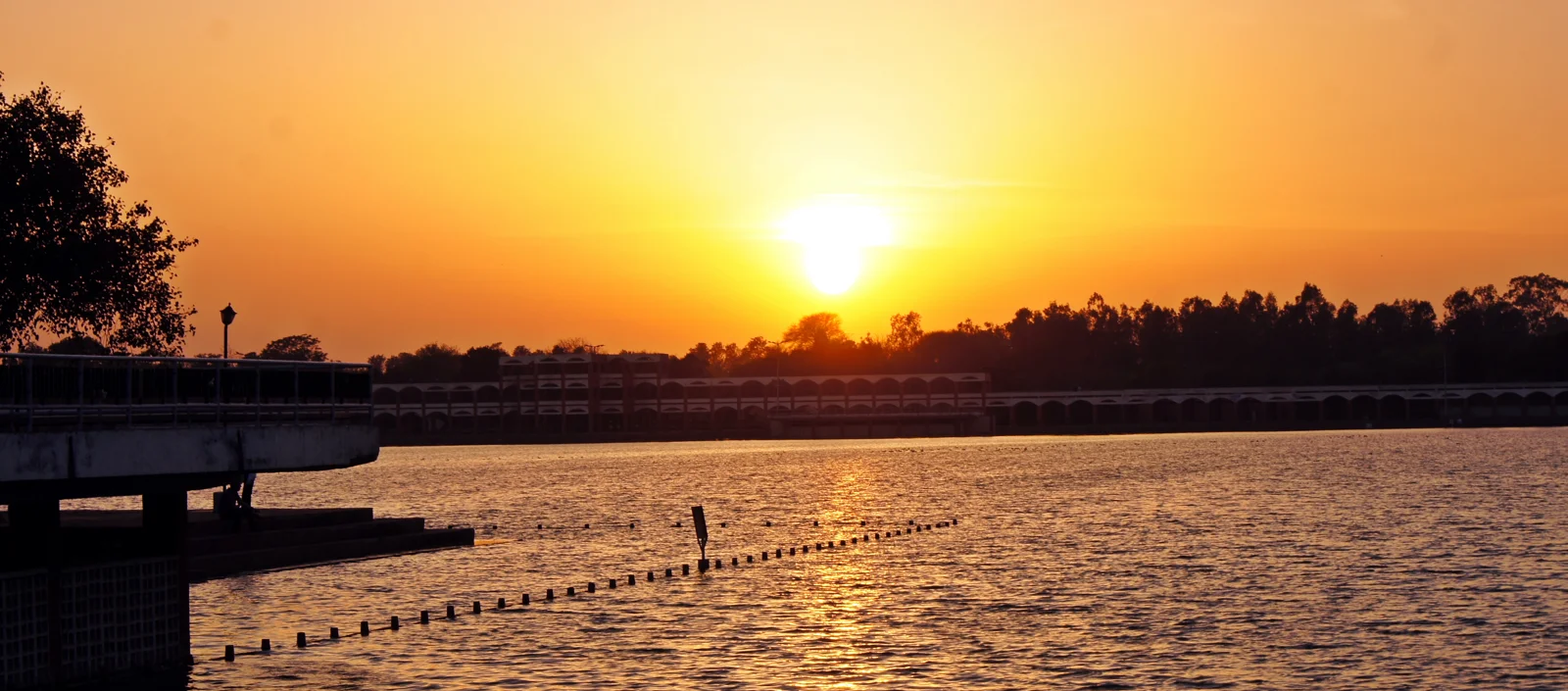
Kurukshetra is a pilgrimage landscape with a paperwork trail: a development board constituted in 1968 keeps its 182 documented tirthas, its biggest tank has a published perimeter of 3.5 km, and its museums print their real ticket prices — one down to the cost of a 3D show. This guide takes the sacred geography from the Kurukshetra Development Board, Haryana Tourism and the institutions themselves, and prints no fee or date it could not read on an official page.
Brahma Sarovar, the Board's centrepiece, is a man-made bathing tank of 3.5 km perimeter, among the largest in Asia, where a dip during a solar eclipse is held to equal thousands of Ashvamedha sacrifices. Jyotisar, west on the Pehowa road, is the tirtha where Krishna is believed to have spoken the Gita, marked by a holy banyan and a marble chariot installed in 1967. The Sri Krishna Museum (a Board unit) opens 10 AM–5 PM, closed Mondays, at ₹30 above 10 years, ₹10 for ages 5–10, free under 5; the neighbouring Panorama & Science Centre opens 9:30 AM–6 PM daily except Holi and Diwali, entry ₹50. Kurukshetra is an important rail junction and stands about 152 km from Delhi.
SECTION 01The 48 Kos and the Board That Keeps It
Start with the frame, because Kurukshetra is not a single shrine but a territory. Haryana Tourism states the shape of it plainly: the battle of Mahabharata was fought here, Krishna preached his philosophy of karma to Arjuna at Jyotisar, and the sacred land is spread over a circuit of about 48 kos holding a large number of holy places, temples and sacred tanks connected with the war and with the Kurus. The land is named after King Kuru, who, the department records, performed a supreme sacrifice to bring prosperity to it — and it is also, in the same official telling, the land where the sage Manu penned the Manusmriti and rishis compiled the Rig Veda and the Sama Veda.
The territory has a keeper. The Kurukshetra Development Board was constituted by the Haryana Government on 1 August 1968, under the chairmanship of Gulzari Lal Nanda, with objectives the Board itself lists: the comprehensive development of the Kurukshetra area, landscaping, renovation of historical buildings and tanks, amenities for pilgrims and tourists, and the upkeep of the tirthas. Its documented list now runs to 182 pilgrimage sites spread across five districts — Kaithal, Kurukshetra, Karnal, Jind and Panipat — the figure the state government used at the Board's governing-body meeting in October 2026. The district administration's attractions list reads like the Board's work made visible: both sarovars, Jyotisar, the museum row, Bhadrakali temple and Sheikh Chilli's Tomb among them.
The practical consequence is that Kurukshetra's core sights cluster tightly: the two sarovars, the museum row and the tomb sit in and around Thanesar town, and Jyotisar lies a short drive west. Everything in this guide fits one full day, in the order the geography suggests — tanks, Jyotisar, museums, tomb.
SECTION 02Brahma Sarovar: The Miniature Sea
The Board's own account of its centrepiece is the one this guide follows. Named after Lord Brahma, the creator, this huge water tank is believed to have been created over the land where Brahma performed his first sacrifice; according to local traditions it was first renovated by King Kuru, after whom the land is named. The Board calls it one of the most sacred tirthas of Kurukshetra and one of the largest man-made bathing tanks in Asia — a judgement a Mughal court reached independently: Akbar's court historian Abul Fazal called it a "Miniature Sea," and Haryana Tourism adds that it appears in the 11th-century traveller Al-Beruni's memoir, the Kitab-ul-Hind.
The Board publishes the tank's measure, and it is the only dimension this guide prints: a perimeter of 3.5 km. The tank is divided into two halves, and between them lies an island on which, it is said, Yudhishthira erected a vijayastambha — a tower of victory — after the battle. On that island a huge sculpture of the Gita Updesh has been installed in recent years; the Board gives its weight as around 35 tonnes. (The length-and-width figures quoted for the sarovar on unofficial pages could not be read on the Board's or the department's pages when this guide was checked, so they are not repeated here.)
The sarovar's calendar is written by the sky. The Board records that the merit of bathing in the tank during a solar eclipse has been equated with performing thousands of Ashvamedha yajnas, and that lakhs of pilgrims congregate here on an eclipse — the eclipse fair is the largest gathering of Kurukshetra's year. In quieter seasons the tank has other lives: Haryana Tourism notes that it comes to life in winter, when birds migrate from faraway places to its waters, and that it bears a shining look during the Deep Daan and aarti on Gita Jayanti, in late November and early December. The Birla Gita Mandir and Baba Nath's haveli stand nearby.
SECTION 03Sannihit Sarovar: Where All the Tirthas Assemble
A short distance away stands the older, quieter tank. The Board calls Sannihit Sarovar one of the most ancient water tanks of Kurukshetra and explains its name: Sannihit means congregation. It is believed that on every amavasya — the new-moon day — the waters of all the tirthas on earth assemble here, and that prayers and ablutions here lead one to salvation; a dip during a solar eclipse bears the sanctity of thousands of Ashvamedha yajnas. Haryana Tourism names the occasions on which the holy waters of all sacred rivers converge into Sannihit: Somvati Amavasya — an amavasya falling on a Monday — and solar eclipses; the Ministry of Tourism's portal describes the tank as the believed meeting point of seven sacred Saraswatis.
The tank also carries a visit from the epic's other side: the Board records that, according to the Srimad Bhagavata Purana, on one total solar eclipse Lord Krishna visited Kurukshetra with his relatives from the Dwarka and Mathura region — the eclipse pilgrimage here is one the texts place Krishna himself inside. Where Brahma Sarovar is the spectacle, Sannihit is the ritualist's tank; pilgrims commonly take both in one round.
SECTION 04Jyotisar: Under the Banyan
West of town on the Kurukshetra–Pehowa road — the district gazetteer puts the tirtha 5 km west of Thanesar, by the old bed of the Saraswati — lies the place the whole landscape exists to explain. Haryana Tourism calls Jyotisar the most venerated tirtha of Kurukshetra and the birthplace of the Gita: it is believed the Mahabharata battle began from here, where Arjuna received the Gita's eternal message from Krishna on the eve of the battle. What you see today is a tank, a temple platform, a marble chariot — and a tree.
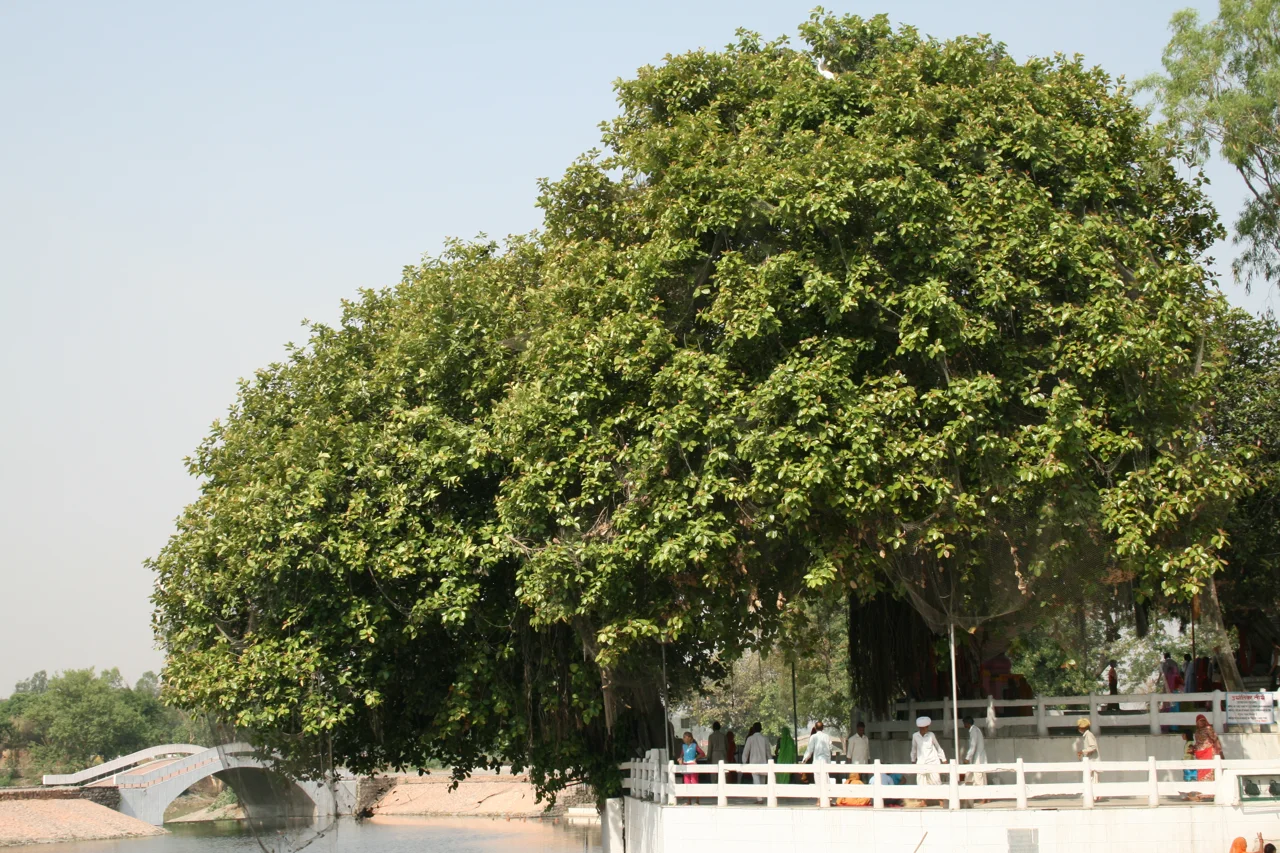
The site's documented history, as Haryana Tourism records it, is a chain of identifications and gifts. Adi Shankaracharya is said to have identified the place during his sojourn to the Himalaya in the 9th century. In 1850 the King of Kashmir built a Shiva temple here. In 1924 the King of Darbhanga raised a stone platform around the holy banyan tree — the tree which, according to devotees, is the evidence of the celestial song; tradition holds it to be an offshoot of the original banyan, and this guide prints no age for it, because the round figures quoted for its age appear in no official text read for this guide. In 1967 the Shankaracharya of Kanchi Kama Koti Peetha installed the chariot depicting the Gita Updesh on the platform, facing east; a carved piece of a 9th- or 10th-century temple sits on the main platform. The district list adds a Mahabharat Anubhav Kendra at Jyotisar, and Haryana Tourism runs a light and sound show here every evening, in Hindi and English. Come late in the day: the tirtha in afternoon light, then the show after dark.
SECTION 05Bhadrakali Temple: The Shaktipeetha
Kurukshetra's goddess shrine belongs to a different sacred geography from the epic's. The Board's account is complete and is followed here: this temple is one of the fifty-one Shaktipeethas spread over the length and breadth of the country. It is believed that the right ankle of Sati fell here, in the well known as Devikoop; to recall the event, a marble right ankle has been placed over the well in front of the present temple. The goddess of the peetha is called Savitri, and her associated Bhairava is Sthanu. Incredible India, the Ministry of Tourism's portal, counts the temple the same way — one of the 51 Shakti peeths dedicated to Kali.
The epic reaches here too, twice over. The Board records that the mundan — the tonsure sacrament — of Balarama and Krishna was accomplished here, and that before the battle, the Pandavas along with Lord Krishna worshipped the mother goddess here and received a boon of victory; after it, the victorious Pandavas returned and donated their best horses in her service. That gift set the temple's living custom: horses made of terracotta and metal are donated here after the fulfilment of one's wishes — the small horse figures at the shrine are Kurukshetra's most distinctive votive.
SECTION 06The Museum Row: Krishna, the Panorama and a Planetarium
On Pehowa Road in Thanesar, three institutions retell the epic three ways — as art, as spectacle and as science. The first is the Board's own. The Sri Krishna Museum, a unit of the Kurukshetra Development Board, is dedicated to the themes of Krishna, Kurukshetra and the Mahabharata. Its own history page fixes its growth: established in 1987, shifted to the present building in 1991, a new block added in 1995, and a Multimedia Mahabharata & Gita Gallery created in 2012. Its nine galleries run from regional crafts and an Archaeological Gallery holding Harappan, Painted Grey Ware and medieval material — and antiquities recovered from Dwarka — to miniatures, manuscripts, murals and three multimedia galleries ending in a huge circular Chakravyuha battle formation.
The museum publishes its visitor terms, printed here as published: open 10 AM to 5 PM throughout the year except Mondays, Deepawali and Holi. Entry: above 10 years ₹30 per person; children between 5 and 10 years ₹10; children below five free; concessional group tickets for students ₹10 per student against an authority letter from the head of the institution. The figures agree with the museum's own online ticket store, checked the same day.
Next door stands the second telling. The Kurukshetra Panorama and Science Centre is a unit of the National Council of Science Museums, Ministry of Culture, inaugurated on 6 March 2001 by the then Prime Minister, Atal Bihari Vajpayee. Its centrepiece is a lifelike panorama of the Mahabharata battle in a cylindrical auditorium: a 34-foot-high panoramic painting carrying episodes of the 18 days' war. Around it sit the science galleries — Indian scientific and technological heritage, fun science, astronomy, fun mirrors — and a park with a dinosaur enclave, butterfly park, herbal and cactus gardens.
The centre publishes the fullest price list of any sight in this guide: open 9:30 AM to 6 PM every day except Holi and Diwali. General entry ₹50; ₹20 for BPL card holders; free for persons with disabilities, defence and paramilitary personnel in uniform with ID, ICOM members with card, and children up to 3.4 feet in height; organised school groups ₹10 per student. Shows are ticketed separately: 3D film ₹40, Taramandal (planetarium) show ₹20, science demonstration lecture ₹20, Knowledge on Sphere ₹30, Fantasy Ride ₹80, VR theatre ₹100, 7D theatre ₹100, with lower student-group rates on several. Parking: ₹50 per four-wheeler, ₹20 per two-wheeler, bicycles free. One caution from the centre's own pages: its ticket-rates and opening-hours pages give the counter's closing as 5:30 PM and 5:15 PM respectively — buy tickets well before either.
The third institution stands on the same road, near Jyotisar. The Kalpana Chawla Memorial Planetarium was set up by the Haryana State Council for Science & Technology in collaboration with the National Council of Science Museums, in memory of Kalpana Chawla, and was established on 24 July 2007. Its astronomy shows run about thirty minutes, usually in Hindi, with English shows arranged on demand for groups, and a gallery section is devoted to Chawla's life from school to NASA. Haryana Tourism's published visitor information gives its hours as 10 AM to 4:30 PM, closed Mondays. Its ticket price, however, is not printed in this guide: no rate could be read on an official page when this guide was checked, and unofficial listings disagree — ₹30, ₹50 and ₹60 all circulate. It is a small, ticketed amount; carry cash and read the board at the counter.
SECTION 07Sheikh Chilli's Tomb: Thanesar's Mughal Layer
Thanesar's second civilisation stands on a mound near the museum row. The complex of Sheikh Chilli's Tomb — two tombs, a madrasa, a mosque and Mughal gardens — is the town's Mughal-era monument, kept by the Archaeological Survey of India. The ASI's account, followed here, is precise about both the man and the law: the tomb and attached madrasa are associated with the Sufi saint Abd-ur-Rahim, alias Abd-ul-Karim, alias Abd-ur-Razak, popularly known as Sheikh Chehli, believed to have been the spiritual teacher of the Mughal prince Dara Shikoh; and the monument was protected and declared to be of national importance under the Ancient Monuments and Archaeological Sites and Remains Act, by a notification dated 27 March 1919. An ASI Archaeological Museum within the complex displays what excavations around Thanesar produced — seals, terracotta figurines, ornaments and swords from the Kurukshetra region and Bhagwanpura, of the Kushana, Gupta and Vardhana periods; excavation at the site revealed continuous habitation from about the 1st century CE to the late Mughal period.
The ASI publishes the monument's visiting terms, printed here as published: open 9 AM to 5 PM, closed only on Fridays; entry ₹25 per head for citizens of India and visitors from SAARC and BIMSTEC countries, and ₹100 for other foreign visitors. The buff-sandstone tomb with its white dome, raised over the madrasa courtyard, is routinely called the Taj of Haryana in popular writing; the ASI's plainer record needs no nickname. It is the essential counterweight stop on a Kurukshetra day.
SECTION 08Gita Jayanti and the International Gita Mahotsav
Kurukshetra's year peaks in late November and December, when the town celebrates the birth of its text. Haryana Tourism describes the International Gita Mahotsav as a weeklong festival whose major attractions are shloka recitation, dance performances, Bhagavad Katha readings, bhajans, dramas, book exhibitions and free medical check-up camps, organised by the Kurukshetra Development Board, Haryana Tourism, the District Administration, the North Zone Cultural Centre, Patiala, and the state's Information and Public Relations Department. One ritual is observed by everyone, the department notes: a bath in the holy waters of Sannihit Sarovar and Brahma Sarovar. The festival's official site records its growth: Gita Jayanti celebrations began in Kurukshetra in 1989 under the Board, and since 2016 the festival has been celebrated in international form, with events now held abroad as well.
For 2026, the state government announced at the Board's governing-body meeting in October that the celebrations would run in Kurukshetra from 5 to 25 December, with an awareness campaign across the 182 tirthas from 2 December and a procession from Pipli on 4 December. One caution: when checked on 5 November 2026, the festival's official website still carried the previous year's dates (15 November–5 December 2025), so treat 5–25 December as the announced plan and confirm the final programme on the official site before booking around specific days. The season itself does not move: Haryana Tourism dates the Deep Daan and aarti at Brahma Sarovar to Gita Jayanti in late November and early December, and Gita Jayanti — the eleventh day of the bright half of Margashirsha — is the festival's fixed point.
SECTION 09Getting There, and When to Come
Haryana Tourism's own directions are the reliable skeleton. By rail, Kurukshetra is an important railway junction on the Delhi–Ambala–Kalka line, and the department names the trains passing through: the Shatabdi Express, Amritsar Express, Jhelum Express, Kalka Mail and Himalayan Queen; railway enquiries are on 139. By road, the town is reached by the linking road from the national highway — the old NH-1, today's NH-44 — through Pipli; the department's hotel listings put Kurukshetra at about 152 km from Delhi, and Pehowa at 110 km from Chandigarh. Haryana Roadways and other state corporation buses connect Kurukshetra with Delhi, Chandigarh and other important places in Haryana, Punjab and Himachal Pradesh, including Volvo services (bus enquiry: 01744-220468). By air, the nearest airport is Chandigarh. The department's own places in town — the Parakeet and the Neelkanthi Krishna Dham Yatri Niwas — are bookable through Haryana Tourism.
The department gives the climate in four numbers: altitude 260 m; winter 7°C to 22°C; summer 35°C to 42°C; monsoon June to September — and then declares the best season to be all seasons. Translated into advice: the comfortable months are October to March, and they hold the year's great occasions, the Gita Jayanti programme and any solar-eclipse fair. Summer visits are possible, but the sarovar ghats at noon in May, at the top of that 42-degree range, are a penance rather than a pleasure. Eclipse days are a category of their own: lakhs converge on the tanks, so arrive the night before and follow the district administration's advisories.
FAQFrequently Asked Questions
When is the International Gita Mahotsav, and when should I visit Kurukshetra?
The festival is held around Gita Jayanti in the November–December season. Haryana Tourism describes a weeklong Samaroh — shloka recitation, dance, Bhagavad Katha, bhajans, dramas and book exhibitions, organised by the Kurukshetra Development Board with Haryana Tourism and other state bodies — with ritual bathing at the two sarovars at its heart. For 2026 the state government announced celebrations from 5 to 25 December, though the festival's official website still carried the 2025 dates (15 November–5 December) when checked on 5 November 2026 — confirm the final programme there before travelling for specific days. Outside the festival, October to March is the comfortable season: winter runs 7–22°C against summer's 35–42°C.
What do the Sri Krishna Museum and the Panorama & Science Centre cost, and when are they open?
Both publish their terms. The Sri Krishna Museum (Kurukshetra Development Board) opens 10 AM–5 PM except Mondays, Deepawali and Holi; entry ₹30 above 10 years, ₹10 for ages 5–10, free below five, ₹10 per student for concessional groups with an authority letter. The Panorama and Science Centre (National Council of Science Museums) opens 9:30 AM–6 PM except Holi and Diwali; general entry ₹50 (₹20 for BPL card holders; free for persons with disabilities, uniformed defence and paramilitary personnel with ID, ICOM members, and children up to 3.4 ft; ₹10 per student for organised school groups). Its shows cost extra — 3D film ₹40, Taramandal ₹20, science demonstration lecture ₹20, Knowledge on Sphere ₹30, Fantasy Ride ₹80, VR and 7D theatres ₹100 each.
Why is there no ticket price for the Kalpana Chawla Planetarium in this guide?
Because no official figure could be verified. The planetarium — set up near Jyotisar by the Haryana State Council for Science & Technology with the National Council of Science Museums and established on 24 July 2007 — publishes no ticket rate on an official page that could be read when checked (5 November 2026), and unofficial listings disagree, quoting ₹30, ₹50 and ₹60. Rather than repeat a number that might be wrong, this guide prints none: the amount is small and ticketed, so carry cash and read the board at the counter. Haryana Tourism's visitor information gives its hours as 10 AM–4:30 PM, closed Mondays; shows run about thirty minutes, usually in Hindi.
Is Sheikh Chilli's Tomb ticketed, and what will I see there?
Yes — it is an ASI protected monument (declared of national importance by a notification dated 27 March 1919). The ASI's published terms: open 9 AM–5 PM, closed only on Fridays; entry ₹25 per head for citizens of India and visitors from SAARC and BIMSTEC countries, ₹100 for other foreign visitors. The complex holds the tomb of the Sufi saint Abd-ur-Rahim — Sheikh Chehli — believed to have been Dara Shikoh's spiritual teacher, a second tomb, a madrasa and mosque, Mughal gardens, and an ASI Archaeological Museum displaying seals, terracotta figurines, ornaments and swords excavated around Thanesar and Bhagwanpura.
How do I reach Kurukshetra from Delhi or Chandigarh?
By train, Kurukshetra is an important junction on the Delhi–Ambala line; Haryana Tourism names the Shatabdi Express, Amritsar Express, Jhelum Express, Kalka Mail and Himalayan Queen among its trains (enquiries: 139). By road, the town lies just off the Delhi–Chandigarh highway (the old NH-1, now NH-44) via Pipli — about 152 km from Delhi by the department's listings — and Haryana Roadways and other state buses, including Volvos, connect it with Delhi, Chandigarh and other towns (bus enquiry: 01744-220468). The nearest airport is Chandigarh. Jyotisar lies about 5 km west of Thanesar on the Pehowa road.
Official references and checking status
Checked on 5 November 2026 against the official sources listed below; the accompanying sources file maps each claim to its page. Five limits are flagged honestly. First, the Kalpana Chawla Planetarium publishes no ticket rate on an official page that could be read, and unofficial figures conflict (₹30, ₹50, ₹60), so no planetarium price is printed; its hours rest on Haryana Tourism's published visitor information. Second, Brahma Sarovar's dimensions are printed only as the Board's 3.5 km perimeter — the length, width and depth figures in wide circulation could not be read on an official page in this pass. Third, no age is asserted for the Jyotisar banyan: official texts record devotees' belief that it is an offshoot of the original tree, and nothing more precise. Fourth, the 2026 Mahotsav window (5–25 December) is the state government's October 2026 announcement, reported from the Board's governing-body meeting; the festival's official website still carried its 2025 dates when checked, so reconfirm there. Fifth, the Sheikh Chilli's Tomb terms and the Jyotisar site history rest on ASI and Haryana Tourism texts read in this pass partly through verbatim reproductions of those official pages, as the sources file records. Confirm current prices and timings before you travel.
- Kurukshetra Development Board (official) — Brahma Sarovar: perimeter, island, eclipse bathing
- Kurukshetra Development Board (official) — Sannihit Sarovar: the congregation of tirthas
- Kurukshetra Development Board (official) — Maa Bhadrakali Shaktipitha: Devikoop, Savitri, horse offerings
- Haryana Tourism (official) — Kurukshetra: the 48 kos, access, climate and hotels
- Haryana Tourism (official) — Brahma Sarovar: Kitab-ul-Hind, Deep Daan, winter birds
- Haryana Tourism (official) — International Gita Mahotsav: the weeklong Samaroh
- International Gita Mahotsav (official festival site) — since 1989, international since 2016
- Sri Krishna Museum (official, KDB) — galleries, timings and entry fees
- Kurukshetra Panorama and Science Centre (official, NCSM) — Ticket Rates
- Kurukshetra Panorama and Science Centre (official, NCSM) — Opening Hours
- District Kurukshetra, Government of Haryana (official) — Tourist Attractions
- Incredible India, Ministry of Tourism (official) — Kurukshetra
Photos: Sunset over Brahma Sarovar and its arched arcade, by Cordavida, via Wikimedia Commons, licensed under CC BY-SA 3.0; the holy banyan at Jyotisar, by Ravinder M A, via Wikimedia Commons, licensed under CC BY 2.0. Photographers keep their copyright; the licences require this credit.
General information only. This guide is based on official sources publicly available and checked on the date shown on this page. Visa rules change, and consular and USCIS officers decide every case on its own facts — nothing here is a confirmation or a guarantee for your individual case, and this is not legal advice. Always confirm the current requirement on the official page linked in this guide before you act, and consider a qualified immigration attorney for your specific situation.