
Researched & checked — 5 November 2026
Ranchi and Its Waterfalls: Hundru, Jonha, Dassam and Panch Gagh, Planned on Official Facts
NEW Published 5 November 2026
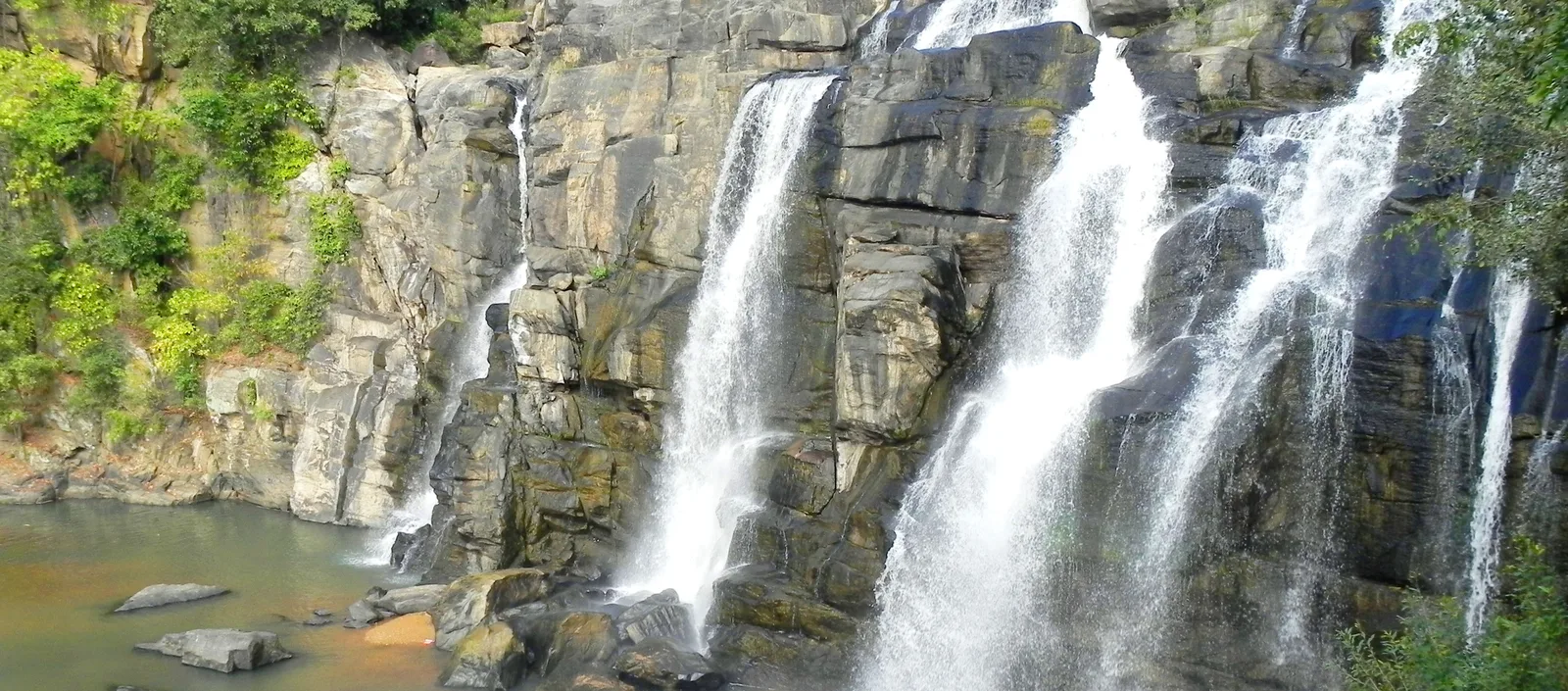
Ranchi's waterfalls are plateau-edge falls, and the official record is unusually candid: a tourism department that publishes the season and hours for its tallest fall, and a tourism corporation whose own site assessments call one fall's pool dangerous, another's steps very steep, and two of the four among the safest in the state. This guide plans the circuit on those documents — and prints no entry fee anywhere, because no official fee schedule could be read.
Four falls ring the plateau city. Hundru Falls, about 45 km east on the Ranchi–Purulia road, is where the Subarnarekha River drops 320 feet (about 98 metres) — the tallest of the circuit; Jharkhand Tourism publishes a visiting window of August to March, 8:00 AM–5:00 PM. Jonha Falls (Gautamdhara), about 40 km on the same road, is a hanging-valley fall reached down 722 steps, with a Buddha temple beside it and its own railway station 1.5 km away. Dassam Falls, about 40 km south-east near Taimara, spreads the Kanchi River over a 144-foot drop — dramatic, and, on the tourism corporation's own assessment, a place to watch from the decks, not to enter. Panch Gagh, about 55 km beyond Khunti, is the gentle one: the Banai River split into five low streams, rated among the safest falls in Jharkhand. In the city: the Rock Garden and Kanke Dam, Tagore Hill, the 468 steps of Pahari Mandir and the 1691 Jagannath Temple; and Patratu Valley, about 40 km north.
SECTION 01Four Falls, Four Tempers: The Circuit at a Glance
Ranchi stands on the Chota Nagpur Plateau, and its waterfalls are what happens where the plateau's rivers step off its edge. The tourism corporation's memorandum gives the mechanism a name: a nick point, or knick point — a break in a river's profile caused by rejuvenation — and notes the whole fall family shares that origin. That geology explains the circuit's variety: one river goes over in a single tall leap, one hangs over its master stream, one spreads wide, and one arrives already split into five.
The departments' own figures, gathered in one place: Hundru, 320 feet, 45 km from Ranchi; Jonha, 40 km (the department publishes no height for it); Dassam, 144 feet (44 metres), about 40 km; Panch Gagh, about 55 km, its height deliberately unboasted — the corporation stresses that its water "does not fall from great heights." The falls point in different directions, which decides how a trip is built: Hundru and Jonha share the Ranchi–Purulia road east; Dassam is south-east on the Jamshedpur highway; Panch Gagh is south-west, past Khunti.
SECTION 02Hundru Falls: The Tall One, With a Published Season
Hundru is the fall Ranchi is known by. Jharkhand Tourism's account is compact: about 45 km from Ranchi town, on the Ranchi–Purulia Highway, the River Swarnarekha (Subarnarekha) takes a spectacular leap from a height of 320 feet; at the base the water gathers into a frothy pool. The district page adds that the falling water has eroded the rock into different formations and calls the fall the highest in the state; the corporation's memorandum notes the approach runs about 21 km off the main road, with a shorter four-lane alternative via Ormanjhi and Sikidiri of about 39 km.
What sets Hundru apart in this guide is that the department publishes its terms. Its Best Visit Timing table gives August to March, 8:00 AM to 5:00 PM (with the relaxed note that you can also visit at other times). Season changes the fall's character completely, and both official texts say so: in the monsoon, the tourism page warns, Hundru's wrath is at its peak, its waters "unbridled and unchallenged, lash against the rocks", while the corporation calls its rainy-season form intimidating and its dry-season form an exciting picnic spot. The descent deserves the same respect: the corporation counts almost 745 steps down, "very steep and hence difficult to descend." In high water, let the flow, not the itinerary, decide how close you go.
SECTION 03Jonha Falls (Gautamdhara): The Hanging Valley and Its 722 Steps
Jonha, about 40 km from Ranchi on the Ranchi–Purulia road, is the contemplative fall of the four. The corporation's memorandum classifies it precisely: a hanging valley fall, where the Gunga River hangs over its master stream, the Raru River, and forms the falls. It takes its other name, Gautamdhara, from the Buddha temple in its vicinity: the department records a tourist rest house enclosing a Buddhist shrine, and a temple and ashram atop Gautam Pahar built by the sons of Raja Baldevdas Birla. A fair is held at Jonha every Tuesday and Saturday.
The visit is a staircase. The corporation counts 722 steps down to a proper view of the falls, past rest sheds and local stalls selling woodwork handicrafts. Its site assessment then delivers the most reassuring verdict in the document: Jonha is one of the safest waterfalls of Ranchi, because it has no deep plunge pool beneath the fall — the bottom is filled with sand and shingle, and one can bathe just beneath the falling water. That is a 2017 assessment, not a promise about any given day's flow. Uniquely among the four, Jonha can be reached by train as well as road: the department notes Jonha station is 1.5 km from the fall; by road, 32 km of the Purulia road, then about 4.8 km off it.
SECTION 04Dassam Falls: The Wide One, Watched From the Decks
Dassam is the circuit's spectacle of width. The department's page: about 40 km from Ranchi, en route to Jamshedpur, a motorable road branches off NH 33 towards Taimara village, where the Kanchi River — a wild tributary of the Swarnarekha — tumbles down from a height of 144 feet. The corporation fills in the name: Dassam derives from the Mundari 'Da-song', the act of pouring water, which local people still call it. The department names October to January as the ideal time to visit, and its station table puts Ranchi Railway Station 42 km and about an hour away.
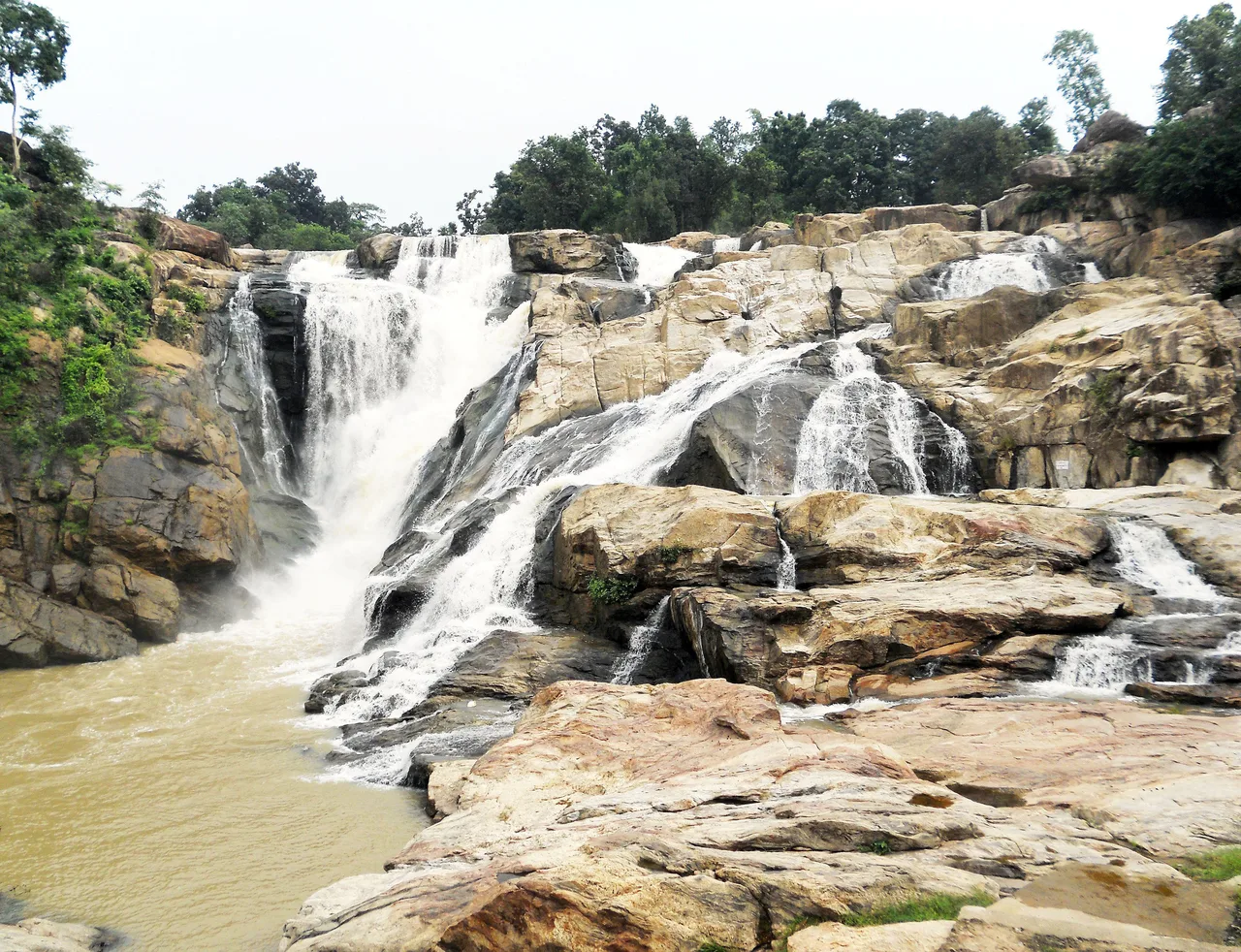
Dassam is also where this guide's safety note matters most, and it comes from the corporation itself. Its assessment records two well-constructed viewing decks overlooking the falls, reached by two flights of steps from the parking area — and then states plainly that with the beauty comes danger: the pool's bottom is deep, undulating and slippery, with sharp rocks, and the site has historically witnessed many deaths. Visit Dassam the way the site is built: from the decks, camera in hand. Save the paddling for Panch Gagh and Jonha, where the same corporation's assessments run the other way.
SECTION 05Panch Gagh: Five Streams, and the Safest Reputation of the Four
Panch Gagh is the family fall. The corporation's description is almost musical: finding its way through hard, jagged terrain, the Banai River branches into five different streams, generating singing rivulets through the cluster of rocks; the water does not fall from a great height, yet its reverberation is audible on arrival. The falls are also called Panchdhara, and the department's destination text places them on the Ranchi–Chaibasa road towards Simdega, an ideal picnic spot amid lush greenery; the memorandum fixes the geography — 5 km from Khunti on the Simdega road, about 55 km from Ranchi.
Its safety verdict is the mirror of Dassam's. The corporation calls Panch Gagh one of the safest falls in Jharkhand, because of its low height and rocky terrain: the rock terrain slopes gradually to a rectangular pond, offering safe spots to dawdle between the trickling water, and its open rocky spaces make it the natural picnic ground of the circuit. Read that as a statement about the site's character, not about any particular monsoon afternoon — but if the day includes children and a picnic basket, the assessments point here, or to Jonha, first.
SECTION 06The City Day: Rock Garden, Tagore Hill, Pahari Mandir and the Jagannath Temple
Between falls, Ranchi's own sights fill an easy day. The Rock Garden, about 4 km from Albert Ekka Chowk on the Kanke Road, was built out of the rocks of Gonda Hill; the tourism department describes artificial gardens and waterfalls developed among naturally occurring large boulders by artistes from Kolkata, the district page adds the garden's signature — an iron jhula (swing) bridge carried on just two poles — and both agree it overlooks the water of Kanke Dam, which the department's destination list puts 12 km from Ranchi.
Tagore Hill, in Morabadi, is the city's quiet hill: the district administration records that before it became a viewpoint it was the ashram of Rabindranath Tagore's elder brother, Jyotindra Nath, and earlier still a rest house; the Ramakrishna Mission Ashram stands at its base. The district recommends the sunrise and sunset views from the top. Pahari Mandir is the strenuous one: the temple of Lord Shankara (Shiva) in the heart of the city, atop the 2,140-foot Ranchi hill (also called Richi Buru), reached by a flight of 468 steps, 8 km from the railway station, with a bird's-eye view of the city as the reward; the Ministry of Tourism adds that Shiva is worshipped here in linga form as Pahari Baba, and that Ranchi Lake lies at the hill's foot. The department's published account adds the hill's older name, Phansi Tongri, from the colonial-era hangings there.
The Jagannath Temple at Jagannathpur, Dhurwa, is the city's piece of the seventeenth century. The department's text: the temple, dedicated to Lord Jagannath, nestles on a small hillock near HEC, about 11 km from the railway station and 6 km from the airport, and was built by the king of Barkagarh, Jagannathpur Thakur Ani Nath Shahdeo, in 1691; the state portal's version adds that it stands about 100 feet tall. Its style is reminiscent of its counterpart at Puri, and its great occasion is the Rath Yatra, when a huge procession and fair gather around the gigantic Rath.
SECTION 07Patratu Valley: The Drive Is the Destination
North of the city, Patratu Valley lies about 40 km from Ranchi, and the department is frank that the journey rivals the place: the trip is almost as beautiful as the valley, with meandering roads through lush greenery and misty mountains, at an elevation of more than 1,300 feet. It names winter, October to March, as the fantastic time to visit, and publishes a year-round visiting window of 10:00 AM to 8:00 PM. Patratu is also a working landscape — home to the famous Patratu Thermal Power Station — and its dam, built to store the water of the Nalkari River and supply the power station, is the valley's second sight: the department records that boating has operated on the dam since 14 January 2010, and that the road to it via Pithoria, about 35 km from Ranchi, is picturesque in itself. It takes its own half-day.
SECTION 08Seasons, Safety and Building the Falls Days
The season question has a genuine trade-off, and both sides of it are in the official texts. The falls are rain-fed plateau rivers, so the fullest water follows the monsoon: Hundru's published visiting window opens in August, while the falls are still near their powerful best, and runs to March. The Ministry of Tourism names October to March as Ranchi's ideal season overall; Dassam's page names October to January. Against that, the same pages warn that monsoon Hundru is a wrathful, intimidating sight, its 745 steps very steep; post-monsoon and winter are the balanced choice. High summer is the lean season, when Hundru thins to streams on a vast rock face.
Safety, stated once and plainly, from the official assessments: Dassam — watch from the viewing decks; the corporation records a deep, slippery, sharp-rocked bottom and many historical deaths. Hundru — respect the steep steps and the monsoon flow; the department's own language for its peak is "unbridled." Jonha and Panch Gagh — assessed by the corporation as among the safest falls in the state, with shallow, sandy or gently sloping bottoms, and described as bathing and paddling places; conditions still change with the flow, so follow the signage and local direction on the day. Those contrasts decide which falls get the picnic and which gets the camera.
The circuit builds itself by corridors. Day one, east: Hundru and Jonha, both on the Ranchi–Purulia road, share a hire car comfortably, with Hundru's 8:00 AM opening arguing for the earlier start. Day two, south-east: Dassam, a half-day on the Jamshedpur highway that leaves room for the city sights in the afternoon. Day three, south-west: Panch Gagh via Khunti, the picnic day — or north to Patratu if drives appeal more than falls. A hired car for the day is the standard instrument throughout; only Jonha offers a rail alternative.
SECTION 09Getting to Ranchi
By air, Birsa Munda Airport (IXR): the Airports Authority of India gives its IATA code as IXR and places it in the Hinoo locality, approximately 7 km from the centre of the city; the Ministry of Tourism notes regular flights to and from major cities such as Delhi, Kolkata and Mumbai. By rail, Ranchi Railway Station is, in the Ministry's words, another primary gateway, with trains linking the city to other major destinations — and waterfall visitors have one extra option, the local line out to Jonha station, 1.5 km from Jonha Falls. By road, Ranchi is linked by national and state highways with regular bus services; the falls are then a hired-car exercise (Section 08).
FAQFrequently Asked Questions
How much does it cost to enter Hundru, Jonha, Dassam or Panch Gagh falls?
This guide prints no entry fee for any of the four, deliberately. The Jharkhand Tourism pages publish descriptions, distances and — for Hundru — a visiting season and hours, but no fee schedule that could be read and checked on 5 November 2026, and the figures quoted on unofficial pages disagree with each other. The same applies to the Rock Garden and Patratu. Carry small cash for whatever is charged at the gate, and treat any exact figure quoted online as unverified until you read it on an official board.
When are the waterfalls at their best?
At their most powerful, in and just after the monsoon — with the warning the department itself attaches: monsoon Hundru's waters are "unbridled and unchallenged," and its steps are very steep. The published windows point to the balanced season: Jharkhand Tourism gives Hundru's best visiting months as August to March (8:00 AM–5:00 PM), Dassam's ideal time as October to January, Patratu's as October to March, and the Ministry of Tourism names October to March as Ranchi's ideal season overall. Post-monsoon and winter bring strong flow without the monsoon's force; high summer is the lean season.
Can you swim or bathe at the falls?
It differs by fall, on the tourism corporation's own site assessments. At Jonha, the assessment describes bathing just beneath the falling water, over a bottom of sand and shingle, and calls it one of the safest waterfalls of Ranchi because it has no deep plunge pool. At Panch Gagh, it describes safe spots to dawdle between the trickling water on a gradual rocky slope. At Dassam, it warns the opposite way: a deep, slippery bottom with sharp rocks, and many deaths historically — Dassam is for the viewing decks. At Hundru, the department describes the base pool as a bathing and picnic place in calm seasons — and its monsoon word for the fall is wrath. Everywhere: the day's flow and local signage outrank any guide.
Can all four falls be seen in one day?
Not sensibly. The falls leave Ranchi in three different directions: Hundru and Jonha share the Ranchi–Purulia road east (about 45 km and 40 km out), Dassam is about 40 km south-east on the Jamshedpur highway, and Panch Gagh is about 55 km south-west beyond Khunti — and Jonha and Hundru between them ask for roughly 1,450 steps of climbing. Pair Hundru with Jonha in one hired-car day, give Dassam its own half-day, and keep Panch Gagh for the picnic day. Patratu Valley, 40 km north, is a separate half-day again.
How do I reach Ranchi, and can I do the falls without a car?
Fly to Birsa Munda Airport (IXR), about 7 km from the city centre, with regular flights from cities such as Delhi, Kolkata and Mumbai (Ministry of Tourism); or take a train to Ranchi Railway Station, the city's main rail gateway. Within the city, the Rock Garden is reached by hired taxis, auto rickshaws and local public transport. For the falls, road is the rule (Dassam's page specifies cars or private vehicles), and a hired car for the day is the standard pattern. The one rail exception is Jonha: its own station stands 1.5 km from the fall.
Official references and checking status
Checked on 5 November 2026 against the official sources listed below; the accompanying sources file maps each claim to its page. Four limits are flagged honestly. First, no entry fee is printed for the falls, the Rock Garden or Patratu: the pages publish descriptions, distances and, in places, visiting windows, but no fee schedule that could be read at passage level, and unofficial figures conflict. Second, Jharkhand Tourism publishes no height for Jonha Falls, so none is printed. Third, the official pages disagree on some distances: Panch Gagh appears as 40 km in the destination list, about 50 km on its destination page and 55 km in the memorandum (this guide follows the memorandum, and its 5 km from Khunti); Jonha's page headline says about 45 km while its how-to-reach block and the memorandum say 40 km (the guide prints 40 km); Dassam's page text says about 45 km while the memorandum, the list and the page's station table support about 40–42 km (the guide prints about 40 km); and Hundru's height appears as 320 feet on the department and district pages and as 98 m (322 ft) in the memorandum — the guide prints "320 feet (about 98 metres)," which both support. Fourth, two details rest on single official publications: the Phansi Tongri history of Pahari Mandir's hill, and Patratu dam's boating start date. The corporation's safety assessments date from its 2017 memorandum; they are quoted as character assessments, not guarantees for any given day. Confirm current prices and timings before you travel.
- Jharkhand Tourism (official) — Hundru Fall: the 320-foot leap and the August–March, 8:00 AM–5:00 PM visiting window
- Jharkhand Tourism (official) — Water Fall & Dam destination list: distances from Ranchi for the falls, Patratu Dam and Kanke Dam
- Jharkhand Tourism (official) — Dassam Falls: the 144-foot drop at Taimara and the October–January ideal time
- Jharkhand Tourism (official) — Patratu Valley: about 40 km from Ranchi and the 10:00 AM–8:00 PM window
- Jharkhand Tourism Development Corporation (official) — Project Information Memorandum: site backgrounds, steps, rivers and safety assessments for the four falls
- Ranchi District Administration (official) — Hundru Waterfall: the 320-foot drop and access distances
- Ranchi District Administration (official) — Tagore Hill: Jyotindra Nath's ashram and access distances
- Ranchi District Administration (official) — Rock Garden: Gonda Hill's rocks and the two-pole iron jhula
- Ranchi District Administration (official) — Pahari Mandir: the Shiva temple on the 2,140-foot hill, 468 steps
- Government of Jharkhand portal (official) — Jagannath Mandir, Dhurwa: built in 1691, 100 feet tall
- Incredible India, Ministry of Tourism (official) — Ranchi: the October–March ideal season and the airport
- Airports Authority of India (official) — Birsa Munda Airport brief: IATA code IXR, in Hinoo
Photos: Jonha Falls in full flow over dark, layered rock, by Smeet Chowdhury, via Wikimedia Commons, licensed under CC BY 2.0; Dassam Falls spread over pale terraced rock, by Sreyabanerjee, via Wikimedia Commons, licensed under CC BY-SA 4.0.
General information only. This guide is based on official sources publicly available and checked on the date shown on this page. Visa rules change, and consular and USCIS officers decide every case on its own facts — nothing here is a confirmation or a guarantee for your individual case, and this is not legal advice. Always confirm the current requirement on the official page linked in this guide before you act, and consider a qualified immigration attorney for your specific situation.