
Researched & checked — 31 Oct 2026
Darjeeling: The Toy Train, Tiger Hill and Tea Gardens, Planned on Official Facts
NEW Published 31 October 2026
Darjeeling runs on three sights — a World Heritage toy train, a sunrise hill that catches Kanchenjunga before anywhere else, and tea gardens protected by law — plus one very well-published zoo. This guide takes the railway from UNESCO, the zoo from its own tariff and the views from the district administration, and says plainly where no official figure could be read, starting with the toy train's fares.
The Darjeeling Himalayan Railway is a UNESCO World Heritage line: 88.48 km of two-foot gauge from New Jalpaiguri to Darjeeling, inscribed in 1999 and still fully operational, climbing through six zigzag reverses and three loops to Ghoom, at 2,258 metres. Most visitors ride the short Darjeeling–Ghoom joy rides; this guide prints no toy train fare, because none could be read from an official page. Tiger Hill (2,590 m, 13 km from town) is the sunrise viewpoint for Kanchenjunga — and, on a clear day, Everest. The Padmaja Naidu Himalayan Zoological Park is open 8:30 AM–4:30 PM in summer and to 4:00 PM in winter, closed every Thursday; entry is ₹110 for Indian and SAARC adults, ₹180 for other foreigners, free below 6 years, camera ₹10, and the Himalayan Mountaineering Institute stands in the same compound. Reach it via Bagdogra airport (90 km) or New Jalpaiguri station.
SECTION 01The Toy Train: A World Heritage Line You Can Still Ride
Start with the listing. The Darjeeling Himalayan Railway was the first of India's three mountain railways to be inscribed on the World Heritage List, in 1999, under criteria (ii) and (iv); the Nilgiri and Kalka–Shimla lines were added by extensions in 2005 and 2008, and the property took its present name, the Mountain Railways of India. It had opened in 1881 — built between 1879 and 1881 up from Siliguri — and UNESCO's point is that it never stopped: all three railways, the listing states, are still fully functional and operational, living engineering rather than museum pieces.
The numbers UNESCO publishes are the ones worth carrying. The property covers 5.34 hectares and consists of 88.48 kilometres of two-foot (0.610 metre) gauge track connecting New Jalpaiguri with Darjeeling, passing through Ghoom at an altitude of 2,258 metres. The climb uses no tunnels: the design includes six zigzag reverses and three loops, on a ruling gradient of 1 in 31. The property's owner, UNESCO records, is the Ministry of Railways, and the line operates today under the Northeast Frontier Railway. UNESCO also notes that the famous B-class steam locomotives are among the original engines still maintained, with original carriages in use alongside newer stock — and, with a frankness that matters for Section 08, that the line's history is regularly disturbed by monsoon rain, landslides and rock-falls.
SECTION 02Riding It: Joy Rides, the Full Line, and the Fare This Guide Won't Print
There are three ways travellers actually use the railway, and West Bengal Tourism's Darjeeling page confirms the pattern at the top of the hill: diesel locomotives handle tourist trains from Darjeeling to Ghum — India's highest railway station — and a steam-hauled Red Panda service runs from Darjeeling to Kurseong. The short joy rides between Darjeeling and Ghum are the ride most visitors take: a round trip of roughly two hours pausing at the Batasia Loop and at Ghum, whose station — 7,407 feet, matching UNESCO's 2,258 metres — has a railway museum beside it. The full line is the second way: ordinary passenger trains work the whole 88 km between New Jalpaiguri and Darjeeling, a slow full-day climb. The third is the railway's seasonal extras — for the October 2026 festive season, the Northeast Frontier Railway announced additional special joy rides. The joy rides' stopping pattern is given as the railway's established pattern rather than quoted from a current timetable, for the reason set out next.
Now the fares, and the problem. This guide prints no toy train fare, deliberately. The railway's own heritage website, dhr.in.net, was unreachable when checked, and its DHR portal on Indian Railways' site publishes the line's history but no readable fare table. IRCTC's booking pages do not render as readable text, so no current official figure could be verified. Unofficial listings disagree across seasons — the Darjeeling–Ghum joy ride appears at widely different figures depending on the site and the year — and the October 2026 festival specials were announced with proposed fares: an announcement, not a tariff. The mechanism, which the railway's own service descriptions have long published, is this: tickets are sold through Indian Railways' normal reservation channels — online through IRCTC and at computerised reservation counters — and the fare quoted there, for the train and class you choose, is the official one.
SECTION 03Tiger Hill: The Sunrise Everyone Sets an Alarm For
Tiger Hill is the reason Darjeeling's jeeps all leave in the dark. West Bengal Tourism places it at an altitude of 2,590 metres and 13 km from Darjeeling town: at sunrise the peaks of Kanchenjunga are lit up before the sunlight is seen anywhere else in the town. The district administration's page adds the geometry: Mount Everest (8,848 m) is just visible from Tiger Hill, yet Kanchenjunga (8,598 m) looks higher than Everest — owing, the district explains, to the curvature of the Earth and to Kanchenjunga being much closer. The straight-line distance from Tiger Hill to Everest is 107 miles (172 km). On a clear day the same page looks the other way: Kurseong to the south, and the Teesta, Mahananda, Balason and Mechi rivers meandering down to the plains.
The mechanics are simple, and their pricing is entirely unofficial, so this guide describes them without figures. You go up in the small hours by hired or shared jeep from town and watch from the summit area as the light arrives. Unofficial listings put various small charges on the hill and its viewing tower, at conflicting figures, and no tariff published by the district administration, the territorial administration or the forest department could be read. So no entry figure for Tiger Hill is quoted here: carry small cash for whatever is charged on the day. The one certainty is the timing: a sunrise appointment, with crowds building from well before dawn in season.
SECTION 04The Kanchenjunga Viewpoints: Batasia, the Mall and the Ridge Itself
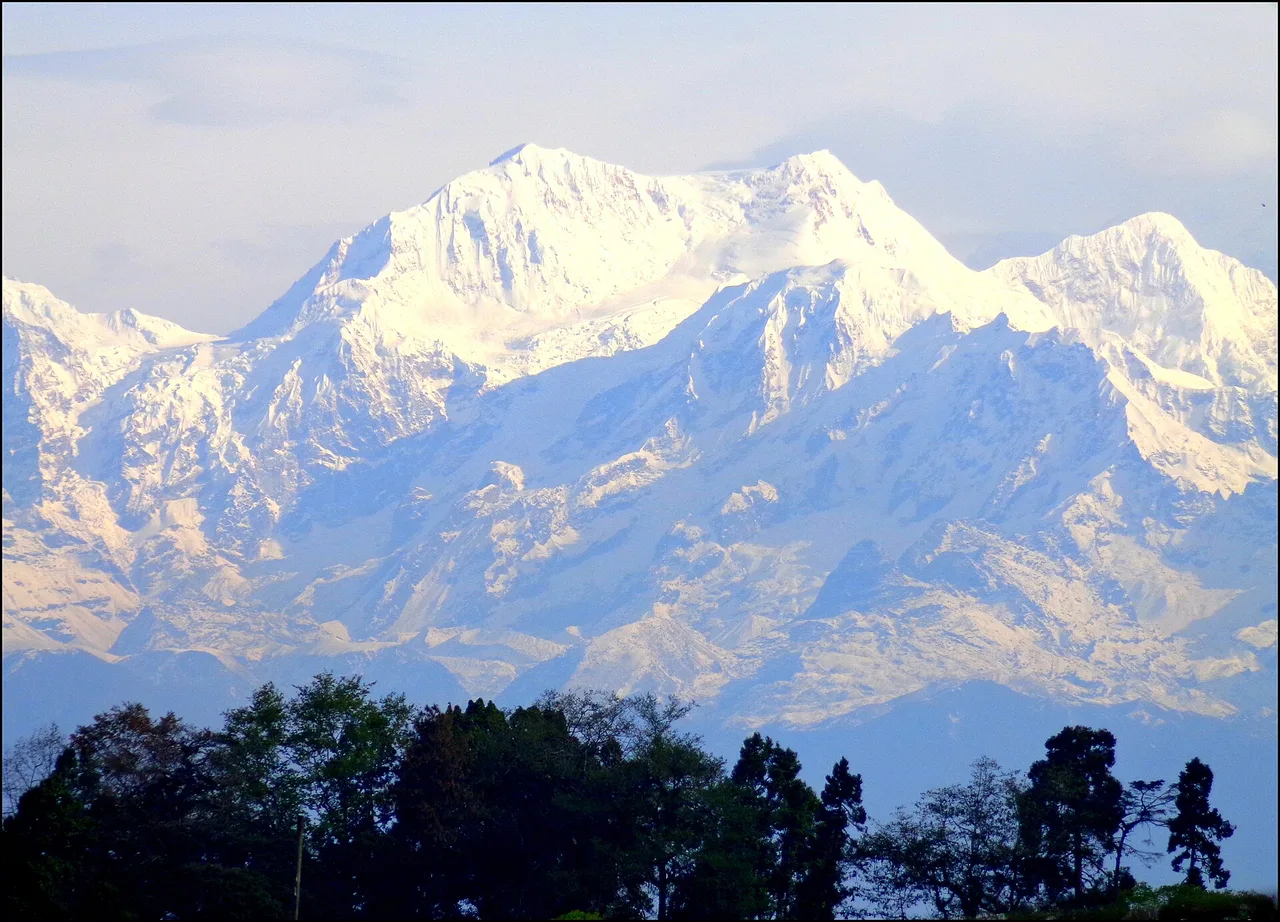
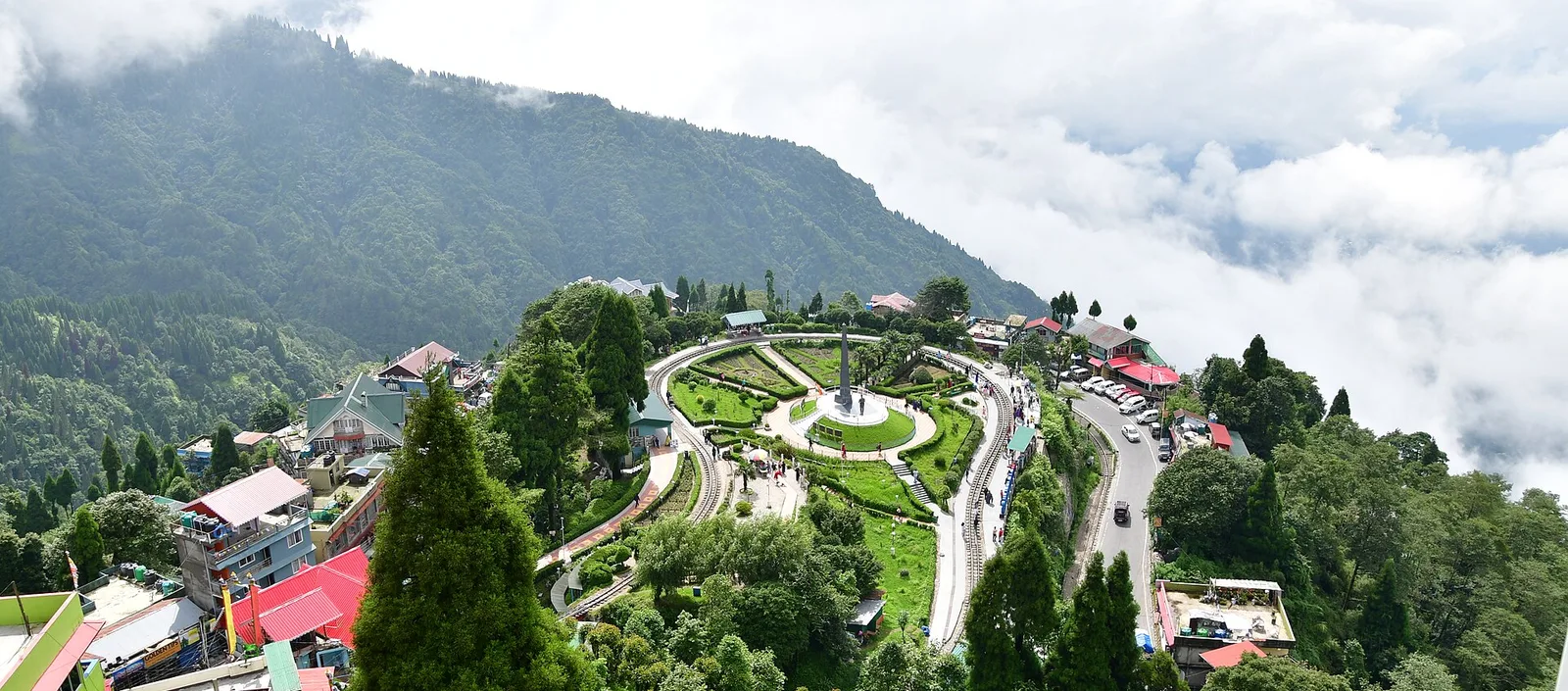
Tiger Hill is the expedition; the other viewpoints are woven into the town's day. The best of them is on the railway itself. The Batasia Loop, below Ghum on the run down to Darjeeling, is one of the loops by which the line loses height — a spiral of track around a landscaped garden. At the garden's centre stands the war memorial to the Gorkha soldiers of the Darjeeling hills who died in India's wars after independence. The joy ride pauses here, and the pause is the point: Darjeeling spread below, the track curling through its own garden, and Kanchenjunga filling the northern sky on a clear morning.
In town, the viewing platform is the ridge itself. The Mall — Chowrasta — is the heart of Darjeeling, in West Bengal Tourism's words: the level promenade at the top of the town that livens up in the evening with strollers, stalls and pony rides. The honest framing for all of Darjeeling's viewpoints is the one the official pages use: Everest is just visible; Kanchenjunga appears on a clear day.
SECTION 05The Tea Gardens: A Working Landscape You Visit by Arrangement
Darjeeling's third sight is not a monument but an industry in a landscape. The Tea Board of India's own account of the region — its chairman's presentation to a WIPO symposium — puts the gardens on the hills of Darjeeling district at altitudes of 700 to 2,000 metres, in an agro-climatic combination the Board credits for the tea's distinctive muscatel flavour, and dates cultivation in the gardens to a century and a half. The legal protection is the part visitors rarely hear: the Tea Board has protected the word and logo "Darjeeling" as certification trade marks, and runs the certification system that decides which tea may lawfully be sold under the name.
What a garden visit is, in practice, needs the same honesty as the toy train fares. The estates are working farms under private management, not public attractions with published tariffs: no tourism department or Tea Board page publishes an official programme of estate tours, timings or entry prices, and this guide prints none. The visit travellers most commonly make is to Happy Valley Tea Estate, the garden closest to town, below Hill Cart Road a short distance north of it, where walks and factory visits are arranged by the estate itself and through local hotels and operators; other gardens receive visitors the same way, by arrangement. Timings and charges are the estate's to set — plucking follows the flush seasons — so confirm on the day rather than trusting any printed figure. Go for the landscape as much as the leaf.
SECTION 06The Zoo and the Mountaineering Institute: One Hillside, One Ticket
On Jawahar Parbat, a short way out of town, two of Darjeeling's institutions share one wooded compound. The Padmaja Naidu Himalayan Zoological Park spreads over 67.57 acres, of which about ten acres are on display and the rest zoo forest and conservation breeding centre. The West Bengal Zoo Authority, which runs the park's official pages, calls it a pioneer of conservation breeding of endangered Eastern Himalayan species in India, with its captive-breeding work running since 1983; its named special attractions are the animals of this altitude — red panda, snow leopard, Tibetan wolf, blue sheep, Himalayan tahr and the Himalayan salamander — among 108 species.
The zoo's hours and tariff, as published by the Zoo Authority: open 8:30 AM to 4:30 PM in the summer season and 8:30 AM to 4:00 PM in winter, closed every Thursday. Entry is ₹110 for Indian and SAARC adults, ₹180 for foreigners, free for children below 6 years, and ₹10 for a camera. Inside the same compound stands the Himalayan Mountaineering Institute: its official site records that it was founded on 4 November 1954 by Pandit Jawaharlal Nehru, to commemorate the first successful ascent of Everest by Tenzing Norgay and Sir Edmund Hillary, and it remains a working mountaineering school — basic, advanced, adventure and search-and-rescue courses. You reach the Institute through the zoo's grounds, so plan the two as one visit: a Thursday closes both, and the zoo's ticket is the one you buy at the gate.
SECTION 07Getting There: Bagdogra, New Jalpaiguri and the Hill Roads
Darjeeling has two gateways, and the district administration's page gives both distances. By air: Bagdogra, 90 km away via NH 110, is the nearest airport, with flights from Kolkata, Delhi and Guwahati. Bagdogra (IATA code IXB) is a civil enclave at an Air Force station, administered with the Airports Authority of India, about 11 km south-west of Siliguri — so every airport journey goes to Siliguri first, then up. By rail: beyond the toy train's own station, 88 km from New Jalpaiguri, the district names Siliguri and New Jalpaiguri as the two closest mainline stations.
From Siliguri, everything goes up the same corridor. The major road access to Darjeeling is via Siliguri, 77 km away via NH 55, and the district lists four routes from Siliguri, the first of them the Tindharia–Kurseong route that the toy train also climbs. Buses and shared jeeps leave from Siliguri through the day for Darjeeling and the other hill towns; in season and after heavy rain, seats and road both need a margin, because the monsoon tests this corridor first. Allow half a day from Bagdogra or NJP to a Darjeeling hotel whatever the map says — and the toy train, for those with a full day, remains the slowest and most memorable way up.
SECTION 08Seasons, the Monsoon, and a Careful Word on Permits
Darjeeling's calendar divides by cloud. The Zoo Authority's best months — March to June and September to January — double as the town's: spring and the post-monsoon autumn into winter are when the range shows itself. The monsoon months between are the honest difficulty: UNESCO's listing says it of the railway — its history has been regularly disturbed by monsoon rain, landslides and rock-falls — and what is true of the line is true of the hill roads that share its slopes: in heavy rain, expect toy train sections and road journeys alike to be suspended, diverted or slow, and build a monsoon itinerary loosely.
Permits need care, because Darjeeling's position is genuinely two-layered, and this guide states only what the official publications support. On the current official lists — the Government of India's consular guidance on Protected and Restricted Areas, reflecting the Immigration and Foreigners Order, 2025 — the areas requiring a Protected Area Permit or Restricted Area Permit are named, and Darjeeling district is not among them: ordinary foreign tourists visit Darjeeling on their normal Indian visa, with no RAP or PAP. The caution is that an older instrument still circulates in print: the Foreigners (Restricted Areas) Order, 1963, as amended in the 1960s, names Darjeeling district among restricted areas — one reason this subject generates confusion. The operating position is the current lists'. Where the regime unquestionably does bite is the onward journey: Sikkim, next door, is partly Protected and partly Restricted, and foreign nationals need a Restricted Area Permit for it — issued free of charge, per Sikkim Tourism's entry formalities, including by the District Magistrate's office in Darjeeling itself. If Gangtok follows Darjeeling, arrange that permit before you cross, not at the border.
FAQFrequently Asked Questions
How much does the Darjeeling toy train cost?
No fare is printed here, because no current official figure could be read: the railway's heritage website is offline, its DHR portal publishes no readable fare table, and IRCTC's booking pages do not render as text — while unofficial listings disagree widely, and the October 2026 festival specials were announced at proposed fares, not a tariff. The official price of any seat is the one Indian Railways' reservation system quotes for that train and class — check on IRCTC or at a reservation counter.
What are the Darjeeling zoo's ticket prices, and when is it closed?
The published tariff is ₹110 for Indian and SAARC adults, ₹180 for other foreigners, free for children below 6 years, and ₹10 for a camera. The park is open 8:30 AM–4:30 PM in summer and 8:30 AM–4:00 PM in winter, and closed every Thursday — which also closes the Himalayan Mountaineering Institute in the same compound.
Can you really see Mount Everest from Darjeeling?
From Tiger Hill, yes — just. The district administration's own page says Everest (8,848 m) is just visible from Tiger Hill, 107 miles (172 km) away, and explains why it looks smaller than Kanchenjunga (8,598 m): Kanchenjunga is much closer, and the Earth's curvature does the rest. Tiger Hill is 2,590 m and 13 km from town per West Bengal Tourism. All of it is conditional on a clear morning — the official pages say "on a clear day".
Do foreign visitors need a permit for Darjeeling?
On the current official lists, no. The Government of India's consular guidance on Protected and Restricted Areas — reflecting the Immigration and Foreigners Order, 2025 — names the areas requiring a PAP or RAP, and Darjeeling district is not among them; foreign tourists visit on their ordinary Indian visa. Confusion arises because the Foreigners (Restricted Areas) Order, 1963, as amended in the 1960s, still names Darjeeling in its printed schedule. Neighbouring Sikkim is different: foreign nationals do need a Restricted Area Permit for it, issued free — including in Darjeeling itself. Confirm the current position before travel, as these rules are revised.
When is the best time to visit Darjeeling, and what happens in the monsoon?
The Zoo Authority's best-time advice — March to June and September to January — matches the town's pattern for clear Kanchenjunga views. In the monsoon, plan for disruption: UNESCO records the heritage line's long history of disturbance by monsoon rain, landslides and rock-falls, and the hill roads share its slopes. Journeys can be suspended in heavy rain, so build a monsoon itinerary loosely.
Official references and checking status
Checked on 31 October 2026 against the official sources below; the accompanying sources file records which page supports which claim. Four limits are flagged where they occur in the text: toy train fares are not printed — no official fare table could be read; the joy-ride pattern is given as the railway's established pattern; Tiger Hill's entry charges are not printed, because no official tariff could be read and unofficial figures conflict; and the permit position is stated from the current lists, the 1963 Order's contrary naming disclosed. West Bengal Tourism counts five loops on the line where UNESCO's listing counts three; this guide follows UNESCO.
- UNESCO World Heritage Centre — Mountain Railways of India: area, length, gauge, loops, reverses, gradient, Ghoom altitude, criteria, operational status, monsoon disturbance
- UNESCO World Heritage Centre — the Darjeeling line first inscribed (1999), extended 2005 and 2008, opened 1881
- West Bengal Tourism (official) — Darjeeling: Tiger Hill, the DHR summary, Ghum and its museum, reaching Darjeeling
- Darjeeling District Administration (official) — Tiger Hill: Everest and Kanchenjunga visibility, and the Bagdogra, NJP and Siliguri access figures
- West Bengal Zoo Authority — the zoo's hours, Thursday closure and tariff
- West Bengal Zoo Authority — the zoo's area, species and conservation breeding
- Himalayan Mountaineering Institute (official) — founding, 4 November 1954, and courses
- Airports Authority of India — Bagdogra Airport (IXB/VEBD) data
- Tea Board of India — protecting Darjeeling tea: garden altitudes, muscatel character, certification marks (WIPO symposium presentation)
- Government of India (Consulate General of India) — Protected & Restricted Areas: the current PAP/RAP lists
Photos: The Batasia Loop from above, its spiral track around the garden and war memorial below Ghum, by DEB ANUTOSH, via Wikimedia Commons, licensed under CC BY 2.0; the Kanchenjunga massif in clear morning light, seen from Darjeeling, by Maitreyee12, via Wikimedia Commons, licensed under CC BY-SA 4.0. Photographers keep their copyright; the licences require this credit.
General information only. This guide is based on official sources publicly available and checked on the date shown on this page. Visa rules change, and consular and USCIS officers decide every case on its own facts — nothing here is a confirmation or a guarantee for your individual case, and this is not legal advice. Always confirm the current requirement on the official page linked in this guide before you act, and consider a qualified immigration attorney for your specific situation.