
Researched & checked — 30 Oct 2026
Gangtok: MG Marg, Rumtek and the Nathula Permits, Explained From Official Sources
NEW Published 30 October 2026
Sikkim's capital needs no permit for Indian visitors and one free permit for foreign visitors — but its famous day trips run on a second permit system entirely. This guide explains both, from the Tourism and Civil Aviation Department's own published pages: who may go to Tsomgo Lake, who may not go to Nathula, plus the ropeway's printed fares and Rumtek.
Indian visitors need no permit for Gangtok or Sikkim's ordinary towns — but a Protected Area Permit (PAP) is required for Tsomgo Lake, Baba Mandir and Nathula, arranged through a registered travel agency. Foreign visitors first need a Restricted Area Permit (RAP) — issued free of cost at Sikkim Tourism offices and check posts such as Rangpo and Melli — valid up to 30 days, with registration within 24 hours of arrival. On the east circuit, foreigners are allowed only as far as Tsomgo Lake; Nathula Pass is for Indian nationals — the department's documents table states foreigners are "Not allowed" — and for the Indian permit, Aadhaar is not accepted: carry a voter ID or driving licence and two passport photographs. In town, MG Marg is a free public promenade and the ropeway's published round trip is ₹266 for an adult and ₹139 for a child, taxes included.
SECTION 01Two Permits, Two Different Jobs
Keep the two documents apart and the rules become simple. The Restricted Area Permit (RAP) — previously known as the Inner Line Permit — is the foreign visitor's permission to enter and stay in Sikkim at all; it exists because the state sits in a restricted-area regime along sensitive borders. It is not an Indian citizen's document: Indians enter freely, with ordinary photo ID. The Protected Area Permit (PAP) is a second, separate layer for specific protected areas inside the state, applying to Indians and foreigners alike — the high valleys of North Sikkim, the western treks, and, most relevant to a Gangtok stay, the east circuit to Tsomgo Lake, Baba Mandir and Nathula Pass.
The pattern to hold in mind: Gangtok, Rumtek and Sikkim's ordinary sightseeing need no PAP at all. The paperwork begins only where the border roads begin. Taxis in Sikkim likewise run on government-notified fares published by the Tourism Department — for local travel as for permits, there is an official sheet to ask for.
SECTION 02Foreign Visitors: The Restricted Area Permit (RAP)
Every foreigner — the department's page excepts only visitors of Bhutanese origin — who wishes to enter and stay in Sikkim must hold a RAP, applied for on the prescribed form with copies of the required documents (passport and Indian visa, with photographs). Three features deserve emphasis, because they are the opposite of what visitors expect. It is issued free of cost. It is available on arrival at a long list of offices, so it need not be arranged weeks ahead. And it carries a registration duty: all foreigners must register within 24 hours of arrival.
The department's list of issuing offices is long; the ones a traveller will actually use are these. Before you reach Sikkim: the Ministry of Home Affairs in New Delhi, all Indian missions abroad, all Foreigners Registration Offices, and the immigration offices at the Mumbai, Kolkata, Chennai and New Delhi airports. On the approaches: the Sikkim Tourism office at the SNT Complex in Siliguri, the Tourist Information Centre at Bagdogra, the Sikkim Tourism offices at Sikkim House, New Delhi and in Kolkata. At the border itself: the Assistant Director's offices at Rangpo and Melli — the page notes ILP issuing hours of 8 am to 8 pm every day at Melli — and the Tourist Information Centre at Pakyong. One caution from the same page: nationals of Pakistan, Afghanistan and China (including Hong Kong and Macau) and certain other categories need prior clearance from the Ministry of Home Affairs, so those applications are not an on-arrival formality.
What the RAP opens: on its issue, a foreigner may visit, for tourism, a named list of places — in the east, Gangtok, Rumtek, Pakyong, Rongli and Aritar; in the west, Gyalshing, Pemayangtse, Khecheopalri and Yuksom; in the south, Namchi and Ravangla; in the north, Phodong and Mangan up to Toong. Anything beyond that list — Tsomgo Lake, the North Sikkim valleys — needs the PAP of the next section on top. Validity: a foreigner may stay a maximum of 30 days on the permit. An extension application must be made at least two days before expiry, and extensions are given by the Foreigners Registration Office at Gangtok and the Superintendents of Police at Namchi, Mangan and Gyalshing — with the total stay in no case to exceed 60 days.
SECTION 03The Protected Area Permit and the East Circuit: Tsomgo, Baba Mandir, Nathula
The day trip east from Gangtok — Tsomgo (Changu) Lake, the Baba Mandir shrine and, at the top of the road, Nathula Pass — is Sikkim's most wanted excursion, and it runs entirely on PAP rules. For Tsomgo–Baba Mandir: permits for domestic tourists are issued by the Police Check Post; foreign tourists are allowed till Tsomgo Lake only, their permit issued by the Tourism & Civil Aviation Department with the vehicle permit from the Police Check Post, applied through a registered travel agency. For Nathula Pass: the permit is issued by the Tourism Department and the vehicle permit by the Police Check Post, for domestic tourists, through a registered travel agency. In practice, you do not walk up to a window alone — a registered agency assembles the permit with your documents, normally the day before, and the vehicle is permitted with you. The foreign Tsomgo PAP is for a day excursion; there is no foreign Nathula option at any price.
Nathula is Indian-nationals only. The department's PAP page makes this structural: its documents table for Nathula lists what Indians must bring and enters, against foreigners, simply "Not allowed". The same table settles the document question that trips up Indian visitors. For the Nathula permit, Indians need a voter ID or driving licence and two passport-size photographs; children below 18 need a birth certificate or a parent's voter ID or passport; and the page states in terms: "Adhar card is not accepted." Carry the right ID — the wrong card, however official it looks, ends the trip at a desk in Gangtok. The department's Nathula information adds the pass's rhythm: open to Indian visitors Wednesday to Sunday — closed Monday and Tuesday — with photography at the pass strictly prohibited. Riders should note one more PAP rule from the same page: two-wheelers and motorbikes need an engine capacity of 150 cc or higher in PAP areas.
Two honest limits. First, no PAP fee is printed: the department's pages describe who issues each permit and how, but publish no fee schedule — the permit reaches you bundled in the agency's arrangement for the day's vehicle; ask the agency to separate the permit from the car when you compare quotes. Second, permits do not override the mountain: the Nathula road is an army-controlled border road, and weather or the army's requirements can close it on a permitted day. Build the east circuit early in a stay, not on the last morning.
SECTION 04In Town: MG Marg and the Deorali Ropeway
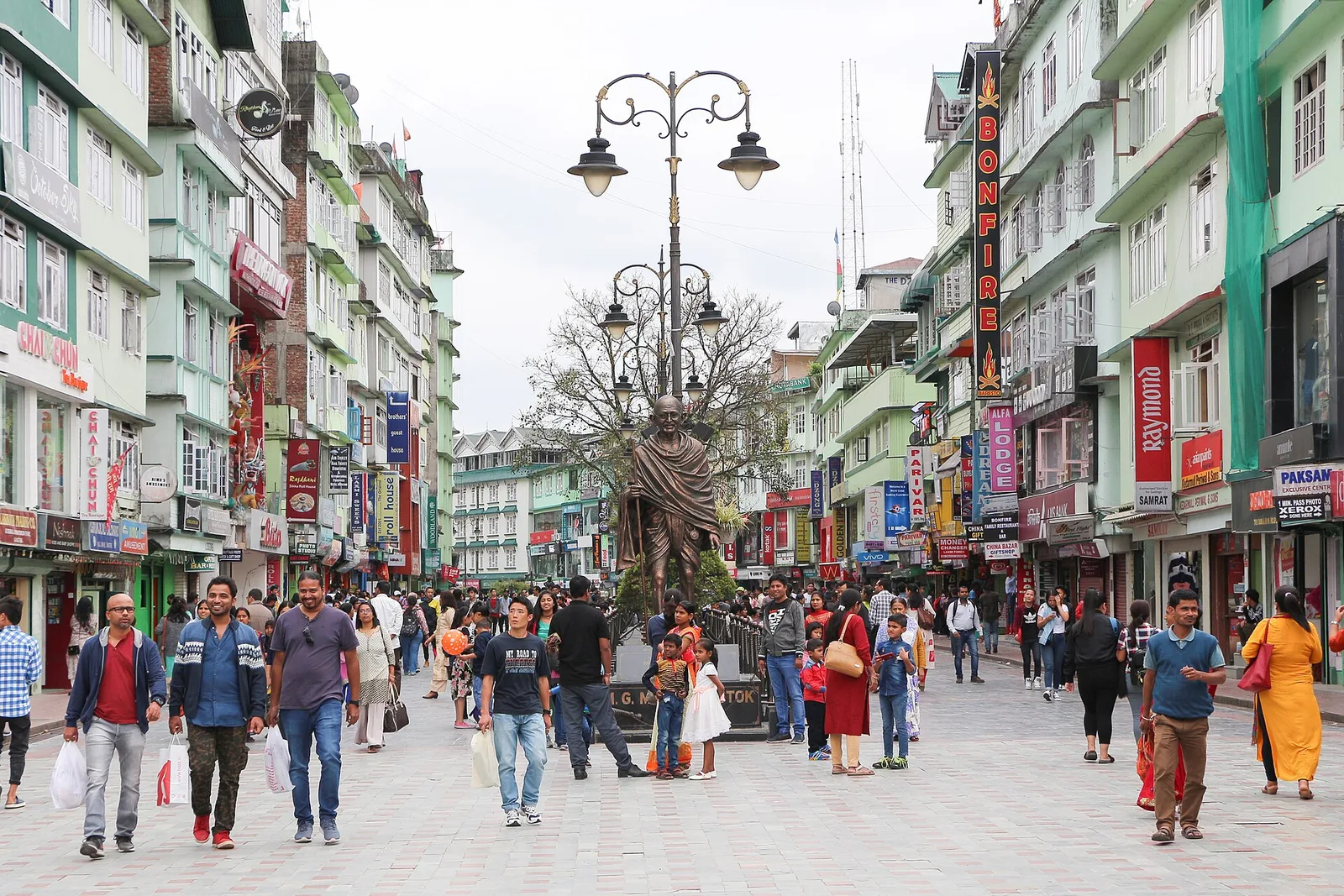
Gangtok's centre needs no permit, no ticket and no plan more complicated than a walk. MG Marg — Mahatma Gandhi Marg — is the town's pedestrianised main street: a broad, vehicle-free promenade of benches, lamps and shopfronts along the ridge, with the Gandhi statue at its heart and cafés, bakeries and handicraft shops on both sides. It is a public street, free to stroll at any hour; evenings are its natural time, when the day-trip cars have left and the whole town seems to be out walking. It is also Gangtok's practical anchor — hotels cluster on and behind it, and the registered agencies who arrange PAP excursions keep their offices in and around it. Do your permit business here, in person, the day before you travel.
For the town's best cheap panorama, ride the ropeway. The Gangtok ropeway, built in 2003 and run by Damodar Ropeways & Infra Ltd, runs from Deorali Bazar up to the Sikkim Legislative Assembly at Namnang, near MG Marg — a short aerial traverse over the town's rooftops, in a cabin rated at 24 passengers plus an attendant. Unusually for this guide, the operator publishes its prices, so they can be printed as checked: a round trip costs ₹266 for an adult and ₹139 for a child, inclusive of taxes, with one-way tickets also sold. Services run from 9:00 in the morning into the early evening, adjusted for sunlight and weather, and online tickets are valid only up to 4:30 pm on the date of journey — buy for the day you will ride. Deorali, at the bottom, is also where the town's bus and taxi stands are, so the ropeway doubles as local transport between the lower town and the MG Marg level.
SECTION 05Rumtek Monastery: The Seat Across the Valley
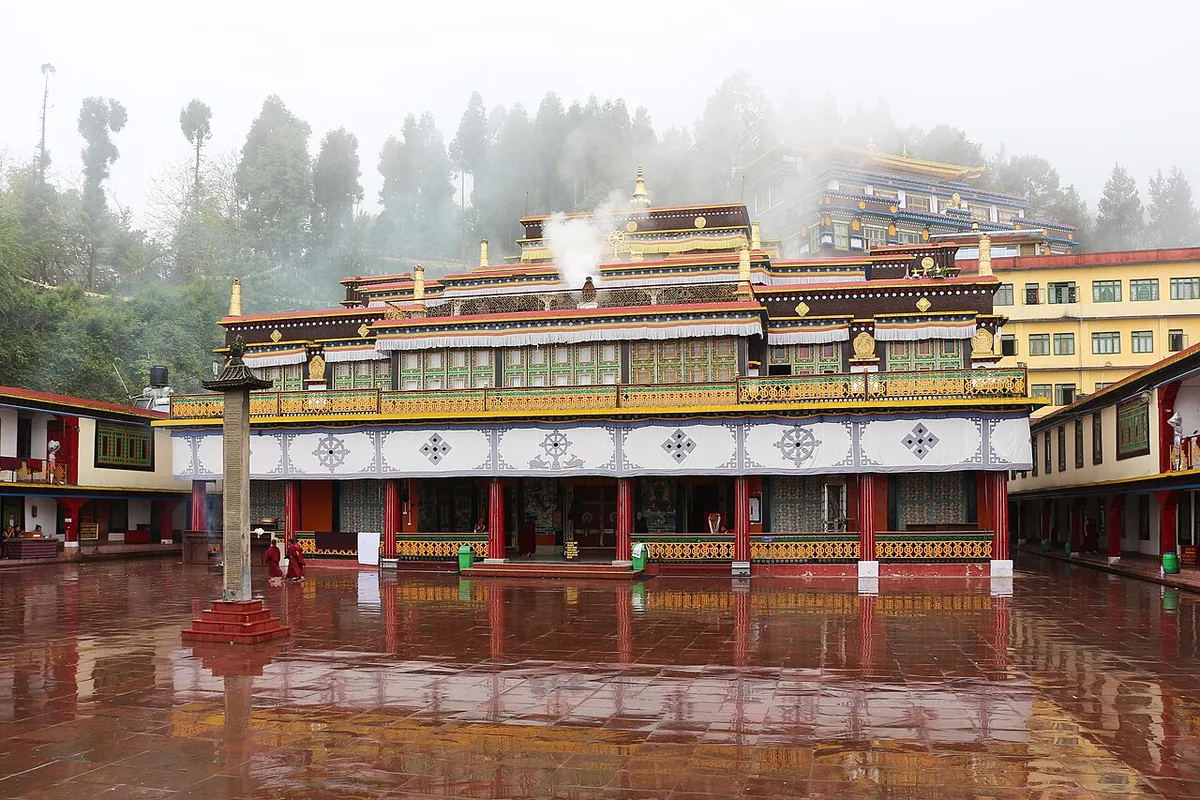
The monastery in every Gangtok photograph is not in Gangtok at all — it faces the town from the opposite hill. Rumtek Monastery, the Dharma Chakra Centre, describes itself on its own site as the largest monastery in Sikkim, set into a hill at 5,500 feet, facing Gangtok: a four-storey main temple crowned by a golden ghanzira, with monks' quarters around a stone courtyard that hosts the ritual lama dances of the Tibetan Buddhist calendar. It is a working monastery, not a museum — dress and behave accordingly, keep voices down in the temple, and follow the monastery's own directions on photography inside.
For permits, Rumtek is the easy case, and the official lists prove it twice over. For foreign visitors, Rumtek appears by name on the department's RAP list of places visitable on the entry permit alone — no PAP is involved. For Indians, it is an ordinary sightseeing trip by taxi. On entry charges, this guide prints no figure: the monastery publishes no visitor tariff on its official pages that could be checked, and monasteries' gate arrangements are their own — treat any charge as the monastery's current one, checked on the day. Allow half a day for the return trip; the road down from Gangtok and up to Rumtek is half the pleasure.
SECTION 06Getting There: Siliguri, Bagdogra and the Hill Road
Gangtok's gateways are in West Bengal, and every route funnels through Siliguri. By air, Bagdogra is the working airport for Sikkim (whose Tourist Information Centre is also an RAP-issuing office); by rail, New Jalpaiguri (NJP), beside Siliguri, is the main station. From Siliguri, the road climbs along the Teesta river to Gangtok — roughly four to five hours depending on traffic; treat that as an approximation, since landslides and roadworks rewrite it seasonally.
The state runs its own buses on the route: Sikkim Nationalised Transport (SNT), the Government of Sikkim's transport undertaking, operates from the SNT complex at Siliguri up to Gangtok. This guide prints no SNT fare: the undertaking's published schedule could not be read in a form that fixes the current Siliguri–Gangtok fare when checked, and third-party figures disagree, so check at the SNT counter rather than budgeting from a blog. Alongside the buses, shared jeeps and hired taxis run the route all day; Sikkim's taxi fares are government-notified and published by the Tourism Department, so there is an official rate to ask about. Come up in daylight if you can.
FAQFrequently Asked Questions
Do Indian citizens need a permit to visit Gangtok?
No. Indian citizens enter Sikkim freely with ordinary photo ID, and Gangtok, Rumtek and the ordinary towns need no permit. A Protected Area Permit (PAP) is needed only for the protected areas — from Gangtok, the east circuit to Tsomgo Lake, Baba Mandir and Nathula Pass, and the North Sikkim valleys — arranged through a registered travel agency, usually the day before.
Can foreign tourists visit Nathula Pass?
No. On the Sikkim Tourism Department's Protected Area Permit page, the documents table for Nathula enters "Not allowed" against foreigners; the Nathula permit machinery described there — Tourism Department permit plus Police Check Post vehicle permit, through a registered travel agency — is for domestic tourists. Foreign visitors on the same road are allowed as far as Tsomgo Lake, on a PAP for a day excursion through a registered travel agency — with their RAP already in hand.
Is the Restricted Area Permit really free, and where do I get it?
Yes — the department's RAP page states the permit is issued free of cost. Its issuing offices include all Indian missions abroad, Foreigners Registration Offices, the immigration offices at the Mumbai, Kolkata, Chennai and New Delhi airports, the Sikkim Tourism offices at Sikkim House (New Delhi), Kolkata and the SNT Complex at Siliguri, the Tourist Information Centre at Bagdogra, and the offices at the Rangpo and Melli entry points. You must also register within 24 hours of arrival. The permit allows a stay of up to 30 days, extendable on application to a maximum total of 60 days.
Is Aadhaar accepted for the Nathula permit?
No. The Tourism Department's PAP page states in terms, of the Nathula documents, "Adhar card is not accepted." Indian applicants need a voter ID or driving licence and two passport-size photographs; children below 18 need a birth certificate or a parent's voter ID or passport. Carry the specified documents — the wrong ID card is the commonest reason the trip fails.
How much does the Gangtok ropeway cost, and when does it run?
On the operator Damodar Ropeways' own published page, checked 30 October 2026: a round trip is ₹266 for an adult and ₹139 for a child, inclusive of taxes, between Deorali Bazar and Namnang (near MG Marg); one-way tickets are also sold. Services run from 9:00 am into the early evening, adjusted for sunlight and weather, and online tickets are valid only up to 4:30 pm on the date of journey — book for the day itself.
Official references and checking status
The permit rules in this guide were checked on 30 October 2026 against the Tourism and Civil Aviation Department's own published permit pages listed below — the RAP page for who must hold one, where it is issued, its free issue, the 24-hour registration duty and the 30-day validity with extension to 60; the PAP page for the east circuit's issuing machinery, the foreigners-at-Tsomgo limit, the documents tables including the refusal of Aadhaar, and the 150 cc rule — and the accompanying sources file records the claim-by-claim mapping. The ropeway fares are the operator's own published figures; the monastery description is the monastery's own. Two honest limits: the department's pages publish no PAP fee schedule and no Nathula-season calendar, so this guide prints neither — permits are costed by the registered agency arranging your vehicle day, and the border road can close for weather or army requirements on any permitted day. Confirm current arrangements before you travel.
- Sikkim Tourism (official) — Restricted Area Permits: issuing offices, free issue, validity and extensions
- Sikkim Tourism (official) — Protected Area Permits: Tsomgo, Baba Mandir and Nathula rules and documents
- Rumtek Dharma Chakra Centre (official) — the monastery, its temple and courtyard
- Damodar Ropeways & Infra Ltd (operator) — Gangtok ropeway: route, timings and published ticket prices
Photos: MG Marg, Gangtok's pedestrianised main street, with the Gandhi statue, by Bernard Gagnon, via Wikimedia Commons, licensed under CC BY-SA 4.0; the main temple of Rumtek Monastery across its courtyard, by Bernard Gagnon, via Wikimedia Commons, licensed under CC BY-SA 4.0. Photographers keep their copyright; the licences require this credit.
General information only. This guide is based on official sources publicly available and checked on the date shown on this page. Visa rules change, and consular and USCIS officers decide every case on its own facts — nothing here is a confirmation or a guarantee for your individual case, and this is not legal advice. Always confirm the current requirement on the official page linked in this guide before you act, and consider a qualified immigration attorney for your specific situation.