
Researched & checked — 31 Oct 2026
Munnar: Eravikulam, the Tea Gardens and How Booking Really Works
NEW Published 31 October 2026
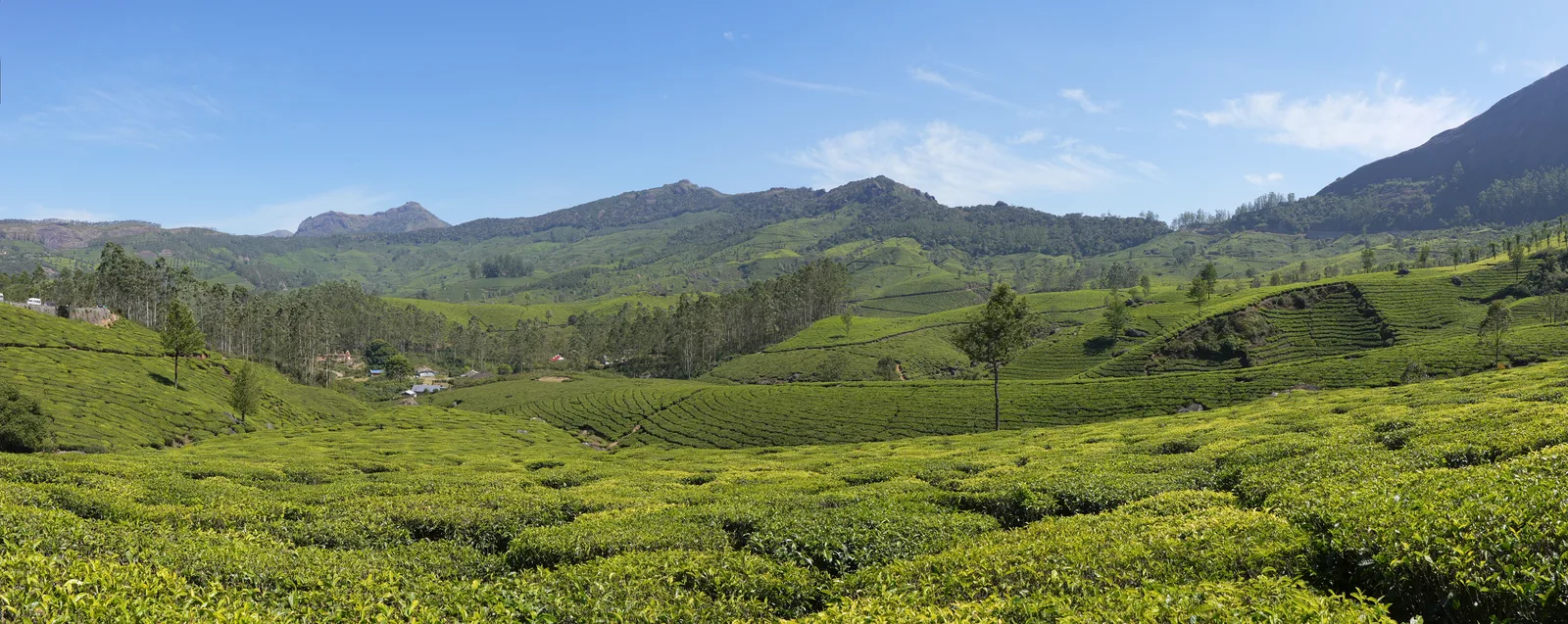
A hill town wrapped in working tea plantations, guarded by a national park that closes each year so an endangered goat-antelope can calve in peace. Eravikulam's official entry fees, entry window and booking system explained step by step — plus an honest account of the tea gardens and the prices no official source publishes.
Eravikulam National Park's official entry fees are ₹200 for Indian adults and ₹500 for foreign nationals, with an ordinary camera at ₹50 and a video camera at ₹350, through the park's own booking site; entry runs 8:00 am to 2:00 pm, and the park closes for the tahr calving season — listed as February to March — every year. International visitors cannot pay through the site's international gateway and are directed by the park to book by email instead. The famous tea gardens are private plantation land — enjoy them from public roads and viewpoints — while the one ticketed way inside the tea story is the KDHP Tea Museum, whose company publishes no ticket price or hours on its official page, so none is printed here.
SECTION 01One Town, Three Landscapes
Everything in Munnar organises itself around the town. The park's own directions put Munnar as the nearest town to Eravikulam, 13 kilometres away. The park covers about 97 square kilometres of high-altitude grassland and shola forest, and inside it stands Anamudi, at 2,695 metres the highest peak in South India. Visitors do not climb Anamudi; the public experience is the Rajamala tourism zone at the park's southern edge: open grassland, cliffs, and tahr herds grazing within sight of the paths.
The second landscape needs no ticket, because it is the view itself: the tea estates folding over every hill, planted since the 19th century and still harvested by hand. The third is the day-loop east of town — Mattupetty's reservoir and the Top Station road (Section 06).
SECTION 02Eravikulam: The Fees, the Entry Window and the Park Bus
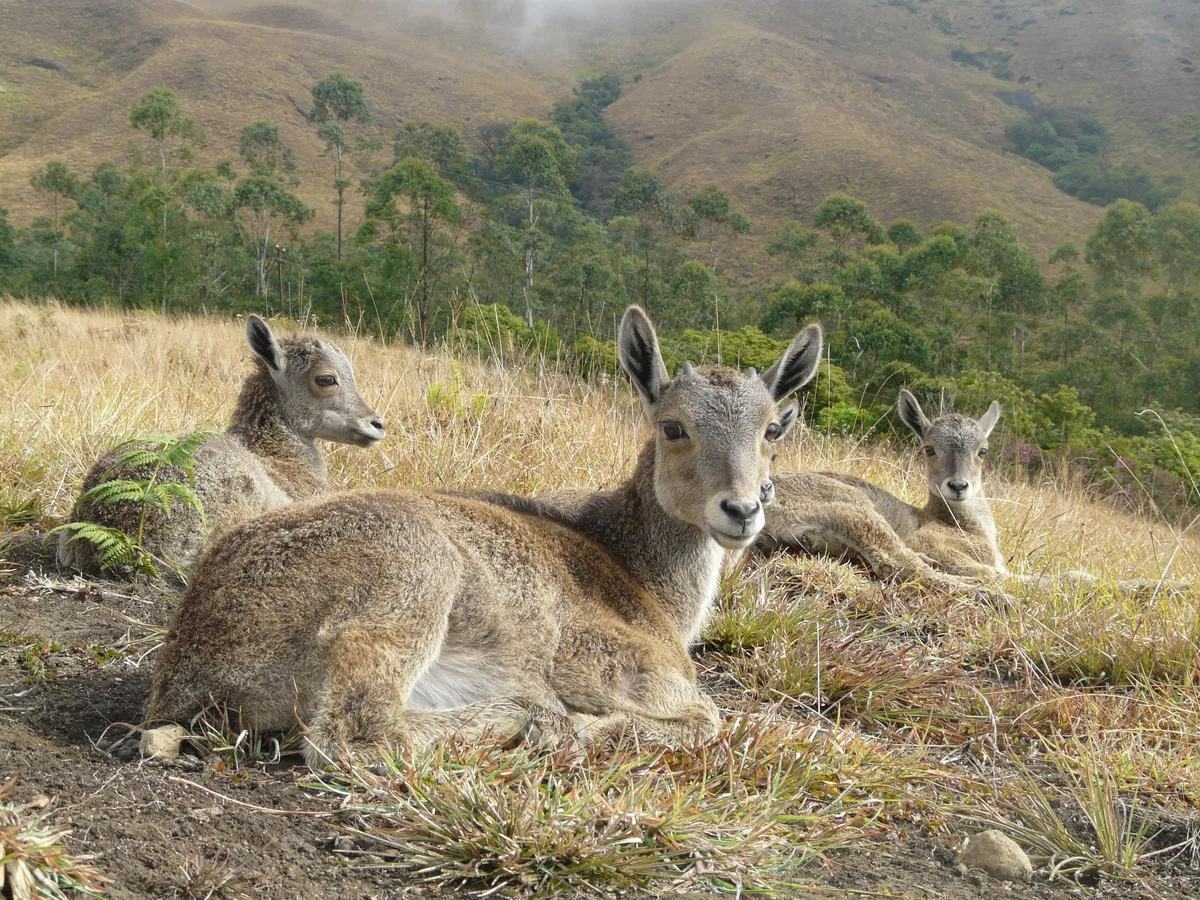
Eravikulam exists for one animal. The park's official guidance states it plainly: the park "was declared for the protection of the Nilgiri Tahr, an endangered species" — a stocky, sure-footed goat-antelope found only in these southern high ranges. The same guidance is equally plain that "sighting of wildlife is absolutely based on chance; not certain". In practice the Rajamala herds are habituated and sightings are the norm — but the park sells you entry to a protected home, not a sighting, and that shapes everything from the entry window to the rules in Section 04.
The fee block published on the park's official booking system is short and complete:
- Indian adults: ₹200
- Foreign nationals: ₹500
- Ordinary camera: ₹50
- Video camera: ₹350
Two things are worth noticing. The official list names Indian adults and foreign nationals only — no separate children's fee appears in it, whatever older blogs may quote. And there is a reservation fee of ₹50, attached to the park's reservation counter at the Information Centre in Munnar, open 9 am to 3 pm. Entry itself runs in a morning window: the booking system states "Entry time: 8:00 am – 2.00 pm". Take the earliest slot you can; the grasslands are clearest and the tahr most active before the mist and crowds build.
Inside the gate, your own vehicle goes no further. The department's published description explains that the motorable road runs through the southern extremity, inside the tourism and awareness zone at Rajamala, and that all other movement inside the park is on foot along trails and footpaths. In practice, visitors leave private vehicles at the entrance and are ferried into the Rajamala zone in the park's own buses, then walk the designated paths.
SECTION 03How Booking Really Works — Including for Foreign Visitors
The booking system is a website with a paper-era personality, and knowing its actual steps removes most of the friction. As the park's "How to Book" instructions set it out: you log in with a username or mobile number, a password and a security code; choose your date and the number of persons; choose a timeslot; then enter the number of "packs" for each item — entry, cameras — which auto-calculates the total, adding the basic details of each visiting person and your vehicle details. A ticket preview follows; then payment; then the ticket, which you can print immediately or retrieve later through the "view ticket" option. Registration asks for an ID proof from a published list: Aadhaar card, driving licence, passport, election ID, school ID or PAN card. Carry the same ID to the gate. One warning from the site itself: it notes RuPay card issues with its SBIePay gateway and advises using another card if yours fails.
Foreign visitors get a different door, and it is an email inbox. The booking system states that its international payment gateway "is not ready from SBIePay", and directs international customers to the park's official email — eravikulamnationalparkmunnar@gmail.com — where the process runs on an offline booking form: you send the form with your payment details under the subject line "International Ticket Reservation Eravikulam National Park", and the confirmation is notified back to you by email. The park's published contacts, for either route, are the Anaimudi Forest Development Agency at Rajamala, Munnar (phone 04865-231587 and 04865-208255).
Finally, the refund ladder, because plans change: cancellations must be made before 48 hours of the visit day to claim anything; a cancellation before 15 days earns a 50% refund, and one between 15 days and 48 hours earns 25%. Camera charges cannot be refunded at all, an entrance-fee deduction applies regardless of timing, and refunds are credited within 8 to 15 days, after administrator approval, against the bank details you supply on the tickets page. Read that ladder before booking a just-in-case second date: holding two dates and cancelling one is a 50%-at-best strategy.
SECTION 04The Calving Closure, and the Park's Rules
Eravikulam's calendar has a hard edge. The booking site carries a closure notice headed "Closure Period — Eravikulam National Park: February to March", and elsewhere on its own pages states the reason and a wider window: "Park would be closed from February 1 to April 1 to ensure a safe calving season." Those two official formulations do not perfectly agree, and this guide will not pretend they do. The safe reading is the one the park itself gives you: the park closes in late winter for tahr calving, roughly February into March and possibly to the start of April, and if your trip falls near those months, confirm the exact dates for your year with the park before building Munnar around it.
The same grasslands have a second, rarer calendar: roughly once in twelve years the neelakurinji shrubs flower together and turn whole slopes blue-purple, most recently in the great bloom of 2018.
The park's published do's and don'ts are the contract for the days it is open, and several are stricter than visitors expect. Carrying food and beverages into the park is prohibited. The park is a plastic-free zone — "do not carry plastic materials inside". Smoking, alcohol and contrabands are prohibited; feeding, teasing or disturbing wildlife is strictly prohibited; visitors must stay in the designated areas, with unauthorised trekking and picnicking punishable; and music, honking and loud speech are all on the list. Breaches are fined or penalised under the Wildlife (Protection) Act, 1972. It is how a small, famous park keeps an endangered species calm within metres of a public path.
SECTION 05The Tea Gardens, Honestly — and the Tea Museum
Here is the thing the postcards skip: Munnar's tea gardens are working private plantations, not a public park with hedges. The estates belong to plantation companies, the bushes are a crop, the paths between them are farm tracks, and there is no general right to wander into a garden because it photographs well. What visitors legitimately get is almost as good: the public roads wind through the estates for mile after mile, with viewpoints and pull-offs where the green runs to the horizon. Treat any walk between the rows as needing the estate's own arrangement — a booked estate visit — not an assumed welcome.
The one place the tea story opens its doors to everyone is in Munnar town: the Tea Museum run by the Kanan Devan Hills Plantations Company (KDHP), which the company describes as the first of its kind in the country. Its official page says the museum showcases the history of tea cultivation in Munnar since 1876, when tea was first planted in this district, through rare artefacts, curios and period photographs — and, best of all, it has a miniature tea factory attached, where visitors are walked through tea cultivation and processing and finish with tea tasting. It is the stop that turns scenery into understanding.
And here this guide must be straight with you: KDHP does not publish the museum's ticket price or opening hours on its official page — the figures floating around review sites come from visitors, some of them years old, not from the company. So no price and no hours are printed here, because a number we cannot verify is worse than none. The museum is an established, inexpensive walk-in attraction; go during the ordinary sightseeing day, pay what the counter asks, and if the exact price matters to your budget, KDHP's published contact number will confirm it faster than any blog.
SECTION 06Mattupetty and Top Station: The Viewpoint Loop
The standard half-day loop out of Munnar runs through Mattupetty, where a dam backs a long reservoir into the hills, and climbs on to Top Station, the high viewpoint on the ridge towards Tamil Nadu. The pleasures are simple: water and reflected hills at Mattupetty, and at the top, on a clear morning, a panorama that drops away into the plains far below.
The mechanics deserve one honest paragraph. Boating on the reservoir and the small attractions along this road are run by local operators and counters, not by a single authority publishing a tariff — so this guide prints no boat fare, ride price or fixed timings for the loop, because none could be verified from an official source. What can be said: these are pay-at-the-counter activities at ordinary local rates, they cluster in the standard sightseeing hours, and they thin out in heavy rain, when the Top Station view can close to mist within minutes. Go early for the view.
SECTION 07Getting to Munnar
The park's own "How to reach" gives the skeleton, and it is refreshingly specific. The park — and with it Munnar — is accessible from Kochi airport at about 148 kilometres and Coimbatore airport at about 175 kilometres. The nearest railway stations are Alwaye (Aluva) at 120 kilometres and Coimbatore at 160 kilometres; from any of these, the last stretch is a mountain road, and it is the slow, winding part of the journey whatever the kilometre count suggests. Most visitors route through Kochi and Aluva, on Kerala's side; Coimbatore serves those arriving from Tamil Nadu.
State buses are the budget spine of that last stretch: KSRTC, Kerala's state transport corporation, runs the services connecting Munnar with Aluva, Kochi and the towns below the hills. No official Munnar fare table was published in a form this guide could verify, so — as with the boats — no fare is printed: check the day's services and prices at the KSRTC stand or its official channels when you travel. For the park day itself, remember that your vehicle stops at Eravikulam's entrance; the park's buses do the last part, as Section 02 described.
FAQFrequently Asked Questions
How much does Eravikulam entry cost, all in?
On the park's official booking system, checked 31 October 2026: ₹200 for an Indian adult or ₹500 for a foreign national, plus ₹50 for an ordinary camera or ₹350 for a video camera. So an Indian adult with a camera pays ₹250 in park charges; a foreign national with a camera pays ₹550. Counter reservations at the Munnar Information Centre carry a ₹50 reservation fee. The official fee list names no separate children's rate.
Is Eravikulam open in February and March?
Generally, no. The park closes each year for the Nilgiri tahr calving season: its booking site heads the closure "February to March" and elsewhere states the park "would be closed from February 1 to April 1 to ensure a safe calving season". Those official wordings differ slightly, so if you travel anywhere near late winter or early spring, confirm the exact closure and reopening dates for your year with the park first.
How do foreign visitors book Eravikulam tickets?
Not through the website's payment page: the park states its international payment gateway is not ready, and directs international customers to book by email at eravikulamnationalparkmunnar@gmail.com, using an offline booking form with payment details under the subject "International Ticket Reservation Eravikulam National Park"; confirmation comes back by email. Indian visitors book online normally — log in, choose date, persons and timeslot, add entry and camera "packs", preview, pay, and print or later retrieve the ticket.
What does the Munnar Tea Museum charge, and when is it open?
This guide cannot tell you, and distrust any page that answers too confidently: the museum's operator, KDHP, describes the museum on its official site — Munnar tea history since 1876, artefacts, photographs, a miniature factory and tea tasting — but publishes no ticket price and no opening hours there. The museum is a long-established walk-in attraction in Munnar town; pay at the counter, or confirm the day's price and hours through KDHP's published contact before you go.
Can I walk inside the tea gardens?
Not as of right. Munnar's tea gardens are private, working plantations; the rows of bushes are a crop, not a public garden. Public roads and viewpoints run through the estates for miles anyway, and the ticketed way into the tea story itself is the KDHP Tea Museum. For walking between the rows, you need an estate-arranged visit, not an assumption.
Official references and checking status
Every changeable fact in this guide was checked on 31 October 2026 against the official sources listed below; the accompanying sources file records which page supports which claim. Three honest limits. The park's own pages give its calving closure two slightly different formulations — a "February to March" closure heading and a "February 1 to April 1" closure sentence — and both are reported here rather than reconciled. The Tea Museum's operator publishes no ticket price or hours, so none is printed. And no operator- or authority-published source could be verified for reservoir boating tariffs or a Munnar bus fare table, so those mechanisms are described without figures. One more record: the older eravikulam.org domain no longer carries the park's official content and was refused as a source; everything here rests on the park's booking system at eravikulamnationalpark.in. Confirm current prices and dates before you travel.
- Eravikulam National Park (official booking system, Anaimudi Forest Development Agency) — entry fees, entry time, closure period, reservation counter and contacts
- Eravikulam National Park — booking instructions: how to book, international customers, refund policy and do's and don'ts
- Kanan Devan Hills Plantations Company — the Tea Museum, Munnar: what the museum contains (no ticket price or hours published)
Photos: the Lockhart tea plantation below Munnar, its planted rows folding over the hills, by Ingo Mehling, via Wikimedia Commons, licensed under CC BY-SA 4.0; three young Nilgiri tahr resting in Eravikulam's grassland, by A. J. T. Johnsingh, WWF-India and NCF, via Wikimedia Commons, licensed under CC BY-SA 4.0. Photographers keep their copyright; the licences require this credit.
General information only. This guide is based on official sources publicly available and checked on the date shown on this page. Visa rules change, and consular and USCIS officers decide every case on its own facts — nothing here is a confirmation or a guarantee for your individual case, and this is not legal advice. Always confirm the current requirement on the official page linked in this guide before you act, and consider a qualified immigration attorney for your specific situation.