
Researched & checked — 31 Oct 2026
Ajanta and Ellora: The Caves, the Closed Days and What Entry Really Costs
NEW Published 31 October 2026
Two rock-cut masterpieces, one base city — and a pair of weekly closures that can quietly wreck a trip. What ASI itself publishes on entry fees, opening hours and closed days for Ajanta and Ellora, and how to plan the days so neither gate is locked when you arrive.
Ajanta is closed on Mondays; Ellora is closed on Tuesdays — never plan either site on its closed day. Ajanta's entry, from ASI's official monument page, is ₹40 cash or ₹35 online for Indian, SAARC and BIMSTEC visitors, and ₹600 cash or ₹550 online for other foreign visitors, with children below 15 free; it opens 9 am to 5 pm. Ellora carries the same listed rates — ₹40/₹35 and ₹600/₹550, children below 15 free — though ASI publishes Ellora's rate through its ticket system rather than on its monument page, so treat them as currently listed and confirm at booking. Base yourself in Chhatrapati Sambhajinagar (formerly Aurangabad), give Ajanta a full day of its own, and keep Ellora's Kailasa temple (Cave 16) for the centre of its day.
SECTION 01Two Sites, One Base City — and Two Different Days
The base for both sites is the city Maharashtra now officially calls Chhatrapati Sambhajinagar, renamed from Aurangabad — you will still see the old name on railway boards, older maps and ASI's own pages, which use Aurangabad as the district headquarters. It is the same city; only the name on the sign has changed.
From that base, the two sites pull in different directions. ASI places Ajanta 107 kilometres north of the city, in a horseshoe-shaped gorge, and Ellora about 30 kilometres north-northwest of it, on the road towards Chalisgaon. In practice that makes Ajanta a full-day expedition — the drive, the gorge, thirty caves — and Ellora a large half-day or a full day that can still share its afternoon with the city's other sights. Give each site its own day, and the closed-day pattern decides which day gets which cave.
SECTION 02Ajanta: Thirty Caves of Painting Above a River Gorge
Ajanta is a single, deliberate composition: thirty rock-cut excavations — one unfinished — cut into a scarp about 76 metres high curving in a horseshoe above the Waghora stream. ASI divides them into five chaityagrihas, or prayer halls — caves 9, 10, 19, 26 and 29 — and a majority of viharas, the monasteries where monks lived. They were made in two great phases. The earlier, Hinayana phase includes caves 9 and 10 — Cave 10 is the earliest of all, dating to the 2nd century BC — along with caves 8, 12, 13 and 15A. The later Vakataka phase, roughly mid-5th to mid-6th century AD, produced the caves the world now travels for: Cave 16 was dedicated by Varahadeva, a minister of the Vakataka king Harishena (reigned about 475–500 AD), and Cave 17 was the gift of a feudatory prince.
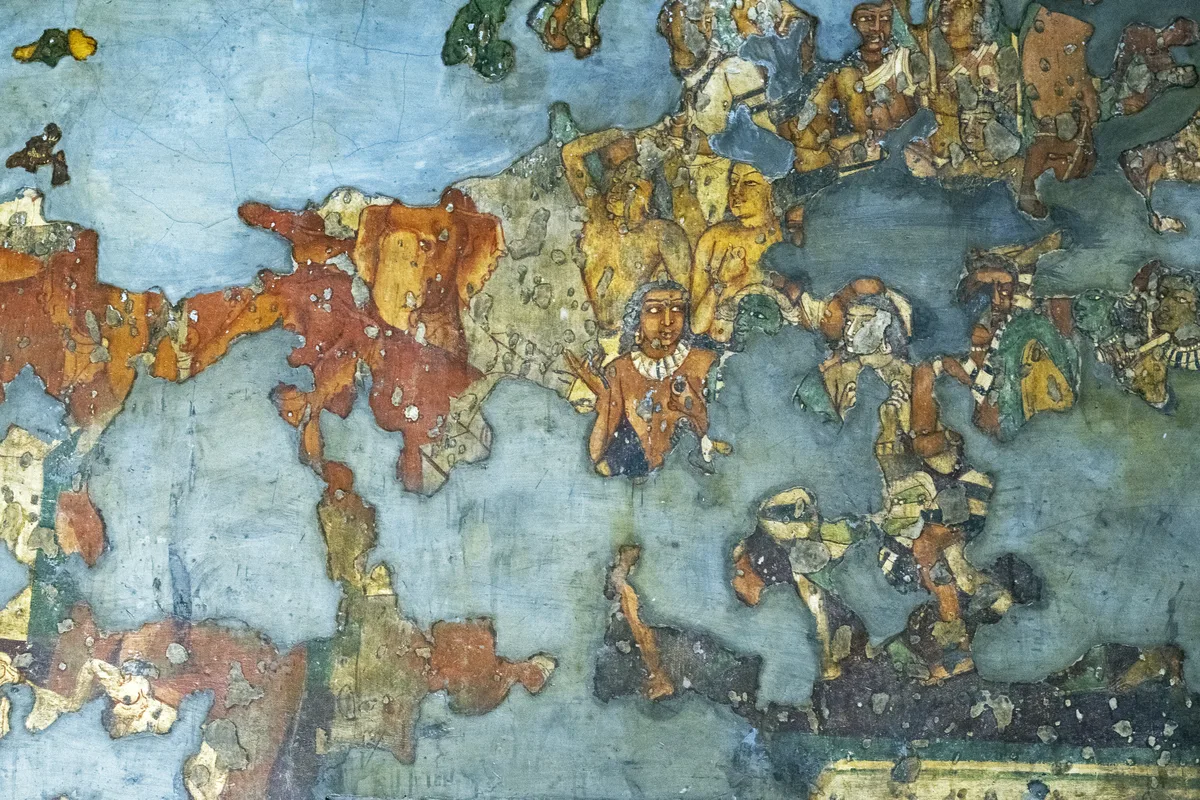
What survives on those walls is the reason Ajanta was inscribed on UNESCO's World Heritage List in 1983. ASI locates the finest paintings in caves 1, 2, 16 and 17, and makes two points worth knowing before you stand in front of them. First, despite the universal shorthand, these are not frescoes: the pigments — a palette that includes lapis lazuli carried from far beyond the Deccan — were bound with glue and applied in a tempera technique onto prepared plaster, which is part of why they are so fragile. Second, the site was lost for over a thousand years, hidden by jungle after the monasteries were abandoned, until 1819, when a British Army officer stumbled on it. The great caves are dim by design, to protect the pigment, and reward slow looking rather than a circuit at walking pace.
SECTION 03Ajanta: Hours, the Monday Closure and the Ticket
Ajanta's practical frame comes from ASI's official page for the caves, and it is unusually complete. The caves are open from 9 am to 5 pm and closed on Mondays — that Monday closure is the fact most likely to break a western-India itinerary. Build the trip the other way round: Ellora first if your free days fall awkwardly, or Ajanta on any day that is not Monday.
The entry fee, as ASI prints it, has two prices inside each tier, and the difference is worth taking:
- Indian, SAARC and BIMSTEC visitors: ₹40 per head paying cash, ₹35 paying online
- Other foreign visitors: ₹600 per head paying cash, ₹550 paying online
- Children below 15 years: free entry
The online discount is small in rupees and large in minutes, and booking ahead skips the counter queue. One more official facility is worth knowing — ASI provides an audio guide at the site in English, French, Spanish, German, Italian, Hindi and Bangla, arranged near the ticket booking counter. For caves whose stories are told in paint rather than labels, it is the difference between looking and understanding.
One part of the Ajanta journey this guide deliberately prices no further than this: your vehicle stops at the parking plaza below the gorge, and a shuttle bus runs the last stretch of road up to the caves. ASI publishes no fare for that shuttle, and the figures quoted by drivers, blogs and tour desks do not agree with each other — so rather than print a number we cannot stand over, the honest version is this: it is a small separate charge, collected at the plaza; carry small notes for it. The caves' entry prices above are the official ones; the bus is a mechanism, not a tariff.
SECTION 04Ellora: Three Faiths in One Cliff, and the Kailasa at Its Heart
Ellora — known locally as Verul Leni — is a different kind of wonder: not one monastery but a whole sacred mountain range in miniature, which ASI describes as one of the largest rock-hewn monastic-temple complexes in the entire world. Nearly a hundred caves were cut into the hill; 34 are the famous, visited ones, dividing by faith along the cliff: caves 1 to 12 are Buddhist, caves 13 to 29 are Brahmanical (Hindu), and caves 30 to 34 are Jaina. ASI dates the work broadly from the 6th–7th to the 11th–12th century AD, along a basalt scarp running about two kilometres, north to south. Where Ajanta is a gallery, Ellora is an argument in stone: three religions carving side by side.
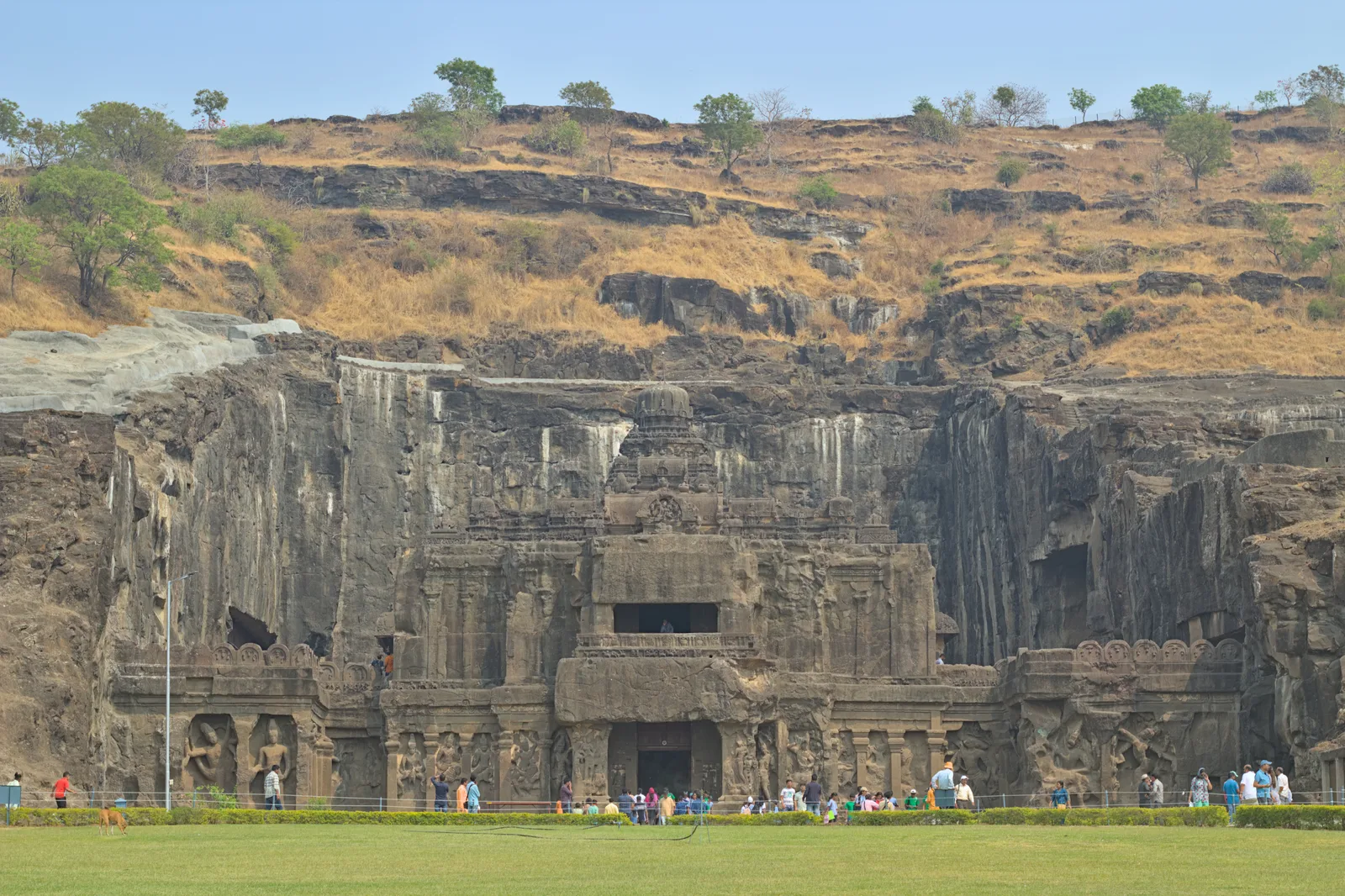
At the centre of the Brahmanical group stands the reason Ellora is on every list of the world's great buildings: the Kailasa temple, Cave 16, which ASI calls the largest single monolithic excavation in the world. It is not a building assembled from stone but a mountain subtracted into one — a full temple complex, all carved downwards out of a single rock mass and attributed to the Rashtrakuta king Krishna I, around 757–83 AD. Everything else at Ellora is a cave; Kailasa is a sculpture the size of a temple, and it deserves the middle of your day, when you are fresh enough to walk its courtyard slowly.
ASI itself suggests how to ration your time, and its shortlists are the best planning tool on this page. With three to four hours, ASI points you to caves 10 (the Visvakarma chaitya), 16 (Kailasa), 21 (Ramesvara), and 32 and 34 in the Jaina group. With a full day, it adds the Buddhist caves 2, 5, 10 and 12, the Brahmanical caves 14, 15, 16, 21 and 29, and the Jaina caves 32 to 34 — a route through all three faiths in the order they were carved along the cliff. ASI also notes that a visit here "is enjoyed maximum during monsoon", when the scarp runs with seasonal waterfalls.
SECTION 05Ellora: The Tuesday Closure and What Entry Is Listed At
Ellora's closed day is Tuesday — the mirror image of Ajanta's Monday, and the hinge on which a two-day cave trip turns. Arrive in the city on a Monday and the order writes itself: Ellora on the Monday (Ajanta is shut anyway), Ajanta on the Tuesday (Ellora is shut anyway). Arrive on a Tuesday and reverse it. The only genuinely bad pattern is a trip so short that a site's day is its own closed day — a planning error, not bad luck.
On fees, a small piece of honesty about how ASI publishes its prices. For Ajanta, the Survey prints the full fee block on the monument's own page. For Ellora, ASI's monument page describes the caves in detail but carries no fee or hours block of its own — the rates are published through ASI's ticket system and at the gate instead. Those currently listed rates for Ellora match the standard ASI World Heritage tariff exactly:
- Indian, SAARC and BIMSTEC visitors: ₹40 per head paying cash, ₹35 paying online
- Other foreign visitors: ₹600 per head paying cash, ₹550 paying online
- Children below 15 years: free entry
Because those figures reach print through the ticket system rather than a monument page, treat them as currently listed: the number that matters is the one the booking page or the gate shows on your day, and if ASI revises its standard tariff, Ellora will move with it. What can be said without qualification is that Ellora is charged on the same system, in the same tiers, as Ajanta.
Hours need the same care. Sources disagree about Ellora's exact opening and closing clock times, and ASI's page does not settle it — so this guide prints no clock pair it cannot verify. The workable truth is that Ellora is a daylight-hours site: arrive early, both for the light on the scarp and because a full-day route through 34 caves cannot start at noon, and let the gate's posted times on the day govern.
SECTION 06Putting the Two Days Together
A workable two-day pattern, built only from the facts above, looks like this. Day one — Ellora. Leave the city after an early breakfast for the 30-kilometre run, walk ASI's shortlist in faith order (Buddhist caves in the south, Kailasa and the Brahmanical group at the centre, the Jaina caves last), and be back by mid or late afternoon. Day two — Ajanta. This is the long day: 107 kilometres each way, plus a gorge of thirty caves whose best paintings sit in caves 1, 2, 16 and 17. Start early, take the audio guide at the counter, and keep that evening's plans loose enough to absorb a late return.
Two more stops belong in the Ellora day's margins, mentioned here with a deliberate absence of prices. The Grishneshwar temple, one of the twelve Jyotirlingas, stands close to the Ellora caves — ASI's Aurangabad Circle lists it among its monuments — and pairs naturally for pilgrims; it is a living temple, so its darshan arrangements are the temple's own. In the city itself, the Bibi ka Maqbara, the Mughal-era tomb often called the Deccan's Taj, fills the Ellora afternoon gracefully. No ASI-published visitor figures for either reached this guide in verifiable form, so we print none: both are inexpensive, established stops whose counters will tell you the day's price. We will not borrow a figure from a blog and dress it as a fact.
Finally, the seasonal note. ASI's remark that Ellora is at its best in the monsoon applies to the whole district: from roughly June to September the gorges run green and the Waghora at Ajanta is a living stream rather than a dry bed. Winter — November to February — brings the kindest walking weather. Either way, the closed days do not move: Monday and Tuesday, all year.
FAQFrequently Asked Questions
Which days are Ajanta and Ellora closed?
Ajanta is closed on Mondays — ASI's official page for the caves states its hours as 9 am to 5 pm, closed on Monday. Ellora is closed on Tuesdays. Plan each site for any day except its own closed day.
How much does entry to both cave sites cost?
On the figures checked 31 October 2026: Ajanta charges ₹40 (cash) or ₹35 (online) for Indian, SAARC and BIMSTEC visitors and ₹600 (cash) or ₹550 (online) for other foreign visitors, children below 15 free — printed on ASI's official Ajanta page. Ellora is currently listed at the same rates through ASI's ticket system, though ASI prints no fee block on its Ellora monument page, so confirm Ellora's figure when you book. A foreign visitor doing both sites should budget ₹1,200 cash or ₹1,100 online in entry fees; an Indian visitor, ₹80 or ₹70.
Can Ajanta and Ellora be done in one day?
Not properly. ASI places Ajanta 107 km from Chhatrapati Sambhajinagar and Ellora about 30 km from it, in a different direction; Ajanta alone fills a day once the drive, the gorge and thirty caves are counted, and ASI's own full-day shortlist shows Ellora can fill one too. Compressing both into a day means seeing each site's car park better than its caves. Give them a day each.
What are Ellora's opening hours?
ASI's Ellora page does not publish a clock-time pair, and secondary sources disagree with each other, so this guide prints none rather than guess. Ellora works in daylight hours: arrive early in the morning, allow three to four hours at minimum (a full day for ASI's complete shortlist), and let the times posted at the gate on your day govern. Ajanta's hours, by contrast, are published by ASI: 9 am to 5 pm, closed Mondays.
How much is the shuttle bus at Ajanta?
There is no officially published fare to quote. Vehicles stop at the parking plaza below the gorge and a shuttle bus covers the last stretch to the caves, but ASI publishes no shuttle tariff and the figures quoted elsewhere conflict — so this guide describes the arrangement without inventing a price. It is a small charge collected at the plaza; carry small notes and pay what the counter asks on the day.
Official references and checking status
Every changeable fact in this guide was checked on 31 October 2026 against the official sources listed below; the accompanying sources file records which page supports which claim. Two honest limits. Ellora's entry rates are listed through ASI's ticket system and agree with the standard fee block ASI prints on its Ajanta and Elephanta pages, but ASI's Ellora monument page itself carries no fee or hours block, so Ellora's figures are presented as currently listed and its exact clock times are not printed, because published sources conflict. And no fare is printed for the Ajanta shuttle, because ASI publishes none and unofficial figures disagree. Confirm current prices and timings through ASI before you travel.
- Archaeological Survey of India — Ajanta Caves: opening hours, Monday closure, entry fees and audio-guide facility
- Archaeological Survey of India — Ellora Caves: the 34 caves, Kailasa (Cave 16) and ASI's suggested cave shortlists
- Archaeological Survey of India — Elephanta Caves: the standard World Heritage fee block Ellora's listed rates match
- Archaeological Survey of India, Aurangabad Circle — monument pages for the Ajanta and Ellora sub-circles, including Grishneshwar Temple
Photos: the Kailasa temple (Cave 16) at Ellora, carved from a single rock and seen across its front court, by Shishirdasika, via Wikimedia Commons, licensed under CC BY-SA 4.0; a surviving fragment of mural painting in Cave 1 at Ajanta, by Biswas Dibyendu, via Wikimedia Commons, released under CC0 1.0. Photographers keep their copyright where the licence reserves it; the licences require this credit.
General information only. This guide is based on official sources publicly available and checked on the date shown on this page. Visa rules change, and consular and USCIS officers decide every case on its own facts — nothing here is a confirmation or a guarantee for your individual case, and this is not legal advice. Always confirm the current requirement on the official page linked in this guide before you act, and consider a qualified immigration attorney for your specific situation.