
Researched & checked — 3 Nov 2026
Leh and Ladakh: Pangong, Nubra and the Permit Rules, Planned on Official Facts
NEW Published 3 November 2026
Ladakh runs on a short list of checkable facts: a district health advisory giving every arrival in Leh 48 hours before any high-altitude journey, a permit portal run by the Hill Council and the district administration, and a royal palace the Archaeological Survey of India has protected since 1982.
Arrive in Leh and stop: the district health advisory requires at least 48 hours of acclimatisation before any journey to higher areas, with no active physical exertion on the first two days. Permits are handled online on the LAHDC Leh permit portal (lahdclehpermit.in): Indian tourists pay the environmental fee there — the Deputy Commissioner's notice of 14 October 2021 fixes the green fee at ₹400 per person. The inner line permit applies only to foreign tourists, who need Protected Area Permits for areas such as Pangong and Nubra. Then go in the classic order: Thiksey and Hemis, Khardung La (17,582 ft, per the Border Roads Organisation) to Nubra, and Pangong Tso.
SECTION 01Leh Town: The Palace, the Stupa and the Main Market
Leh's old town climbs a hill, and the building at its top explains the town. The ASI's information board at the palace records that Leh Palace was completed in a short span of only three years during the reign of Senge Namgyal (c. 1590–1635). Built of stones, sun-dried mud bricks, poplar, juniper and willow, it comprises nine levels with over a hundred rooms: staff and storage below, the royal apartment on the seventh level, a shrine on the ninth; entry is through the wooden gate called Singe-sgo, the Lion Gate, at the second level. The palace was occupied until the Dogra invasion of 1834–40; the ASI declared it a Monument of National Importance in 1982 and has restored it in phases since.
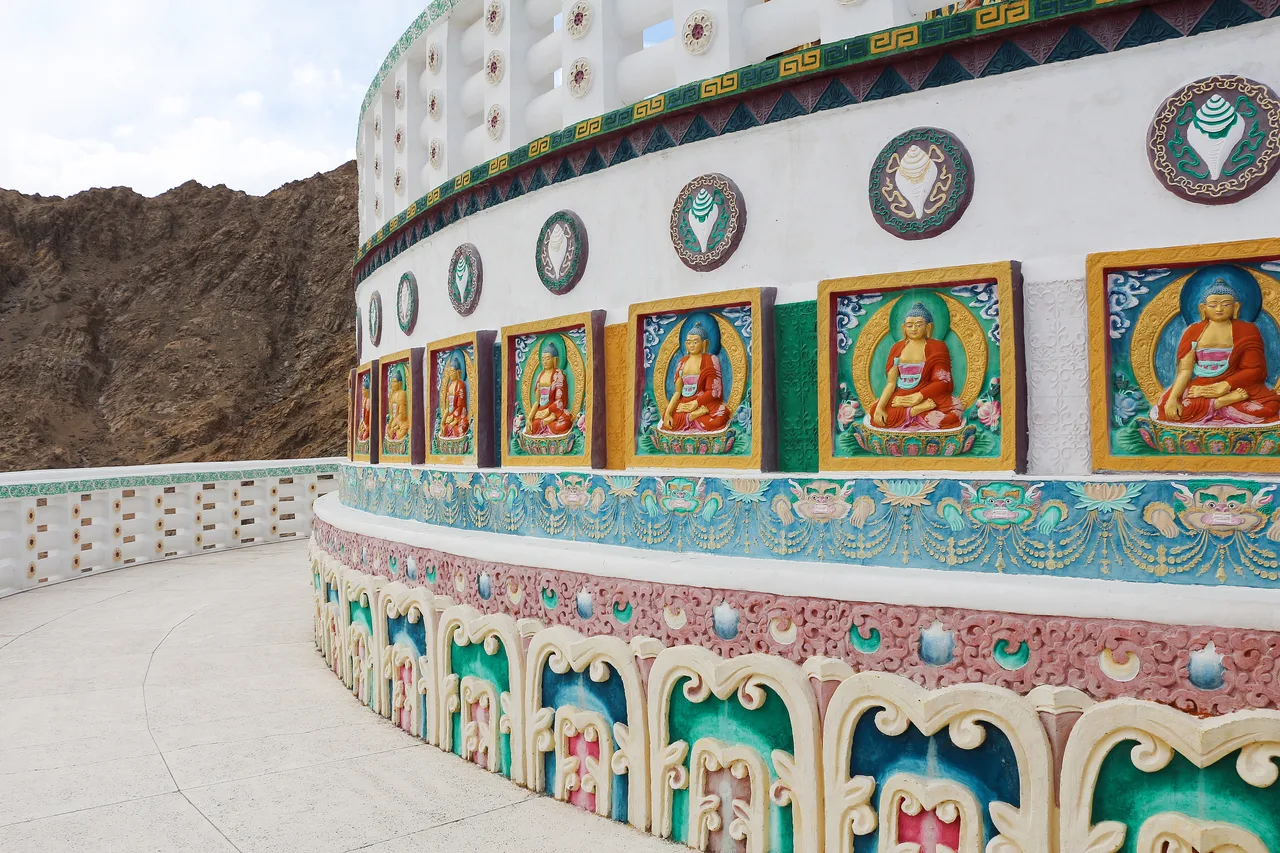
Across the valley, on the hill above Changspa, stands the town's answering landmark: the white Shanti Stupa. Palace and stupa face each other over the rooftops, and the standard Leh evening — once your rest days allow it — is the climb to watch the light leave the palace hill. An honesty note: the stupa's familiar construction story is repeated by nearly every account of Leh, but the district's official pages could not be read for this guide, so no building history is asserted here. It is, in practice, Leh's sunset balcony.
Below the palace, the main market is the town's commercial spine and, usefully, its acclimatisation ground: the first two days go here — cafés, bakeries, bookshops and outfitters at walking pace, because walking pace is all the health advisory allows. It is also the ceremonial route: the tourism department's listing for the Ladakh Festival (September 26–28) describes a procession of cultural troupes through Leh Market. A district-administration visitor poster sets the etiquette: get the required permits, respect local communities, do not litter, do not waste water.
SECTION 02Altitude First: The District's 48-Hour Rule
The district administration publishes Ladakh's most important rule as a formal health advisory on the permit portal. Its instruction is unambiguous: "All tourist/visitors arriving in Leh must undergo at least 48 hrs of acclimatization before initiating their journey to high altitude areas." It spells out what those days mean: complete rest for the first 24–36 hours, and "there should be no active physical exertion on the first two days of arrival in Leh." It closes the road travellers' loophole too: "Road travel does not help at all in acclimatization" — even arriving by road, you halt at Leh and begin onward journeys only after the 48 hours.
The scale of the jump explains the rule. The Airports Authority of India puts Leh's airport at 3,256 m (10,682 ft) above mean sea level — higher than most travellers have ever slept, reached within hours of leaving Delhi. The advisory's regimen is specific: drink 2–3 litres of water a day; avoid alcohol, smoking and sedatives; eat lightly on the first day and do not overeat; sleep early. Its precautions also list Diamox-250mg, twice a day from at least two days before the journey to Leh until two days after arriving — a prescription medicine, so treat the mention as a prompt to discuss it with your own doctor before travelling.
Its danger signs include headache, nausea, breathlessness, disturbed sleep, coughing, irregular heartbeat, dizziness and loss of appetite, and it warns that the symptoms of HAPE and HACE — the pulmonary and cerebral forms of altitude sickness — "can be life threatening and fatal." Save the advisory's Leh emergency numbers before you land: Chief Medical Officer, Leh: 01982-252012; Medical Superintendent, SNM Hospital, Leh: 01982-252014; Casualty, SNM Hospital, Leh: 01982-053629. Build the itinerary backwards: valley monasteries during the rest days, nothing higher until the 48 hours are done.
SECTION 03The Permit System, End to End: One Portal, Two Rules
Every permit question in Leh district runs through one official site: lahdclehpermit.in, the district permit system of the Ladakh Autonomous Hill Development Council (LAHDC), Leh, and the District Administration, Leh. A press release from the CEO's office, LAHDC Leh, posted on the portal, confirms that the existing fee structure continues in effect — the fee includes the environmental fee (green fee), the Red Cross Fund and the wildlife fee — payable online, with no need to visit the DC office or any other government office physically.
For Indian tourists the system is a payment, not a permission. A notice issued by the Deputy Commissioner, Leh on 14 October 2021 records the environmental fee (green fee) of ₹400 per person, payable through the portal. The portal's domestic registration page removes the old paperwork step: after paying online there is no further need to verify the payment contribution slip at the DM office; you proceed directly to the areas on your circuit, and the slip — on your phone or printed — will be checked only at the respective check posts. And keep your boarding pass: "It is mandatory to show your Leh arrival boarding pass along with the permit."
Two honesty limits apply to the money: the only component amount in an official document this guide could read is the ₹400 green fee — no official figure for the wildlife fee or Red Cross Fund, and no official statement of the permit's validity in days, could be read — so no "typical total" and no validity period is printed; the portal shows what you owe when you pay. And pay there yourself: a Deputy Commissioner's notice of 21 September 2023 records complaints of fake fee slips issued by private agencies, and warns of strict action, including cancellation of licences.
For foreign tourists the regime is different; the portal's FAQ states the dividing line in one sentence: "The inner line permit is applicable only to foreign tourists." The FAQ grounds the system in the Foreigners (Protected Areas) Order, 1958: the protected and restricted areas are those "like Pangong, Nobra, Khardongla, Tsomoriri, etc.". Two categories face a higher door: citizens of Pakistan, Afghanistan and China require their PAP from the Ministry of Home Affairs, and holders of diplomatic, UN, international-organisation, official and journalist passports or visas require clearance from the Ministry of External Affairs. Agency-repeated mechanics — group sizes, processing days, agent requirements — are not printed: the portal's detailed foreigner entries sit in expandable FAQ answers that could not all be read for this guide.
Travel follows published tourist circuits: Nubra via Khardong, Khalsar, Diskit, Hunder, Turtuk, Pachathang and Tyakshi; Pangong via Kharu, Changla, Durbuk and Tangtse to Lukung; one circuit is "Only Leh City"; and the full list also reaches Tso Moriri, Hanle, Umlingla and Demchok. Your payment or permit follows your circuit, and the check posts enforce it.
SECTION 04Thiksey and Hemis: The Indus Valley Monasteries
The monasteries are the right ambition for the acclimatisation days: both stand in the Indus valley south-east of Leh, and combine into the standard half-day loop. The UT tourism department's descriptions are the ones this guide follows. Of Thiksey: "A stunning 12-storey hilltop gompa resembling the Potala Palace, with panoramic Indus Valley views." The resemblance is the experience — shrines and courtyards stacked up one hill, the green Indus plain below the top terrace. Of Hemis, further up the valley: "The largest and wealthiest monastery in Ladakh, famous for the annual Hemis Festival" — the date travellers plan whole trips around, on the department's own billing.
The department's third monastery name points the other way, down the Indus towards Kargil: Alchi, "a 1000-year-old monastery complex housing rare Kashmiri-style Buddhist murals and art." It belongs to a longer day, so most first trips keep it for a second visit. In all three, the district's visitor etiquette applies: respect the community, stay on designated paths, carry litter out, do not waste water.
SECTION 05Over Khardung La to Nubra: Diskit and the Hunder Dunes
North of Leh the road climbs to the pass that gates the Nubra valley. The Border Roads Organisation's figure, in the Press Information Bureau release of 4 August 2021, is the one to quote: "The Khardung La Pass in Leh is at an altitude of 17,582 ft." Khardung La was long billed as the world's highest motorable pass; the same release records the record has moved on, to the BRO's road over Umling La. But the pass remains a serious altitude — the reason this excursion waits until after the 48 hours.
Diskit is the valley's main settlement on the circuit, its monastery set above the village. Hunder, a little further on, holds the sight nobody expects in the trans-Himalaya: the tourism department describes "the surreal cold desert sand dunes of Hunder in Nubra Valley, home to double-humped Bactrian camels" — dunes rolling down to the river flats, and shaggy two-humped camels, the surviving signature of the old caravan trade. The circuit continues to Turtuk and Tyakshi, the last listed villages. Most travellers give Nubra a night rather than a day: the pass is crossed twice either way, and the valley repays it. Section 03's mechanics apply: the Nubra names must be on your circuit, and the slip is checked at the posts.
SECTION 06Pangong Tso: A Day Trip, or a Night on the Shore?
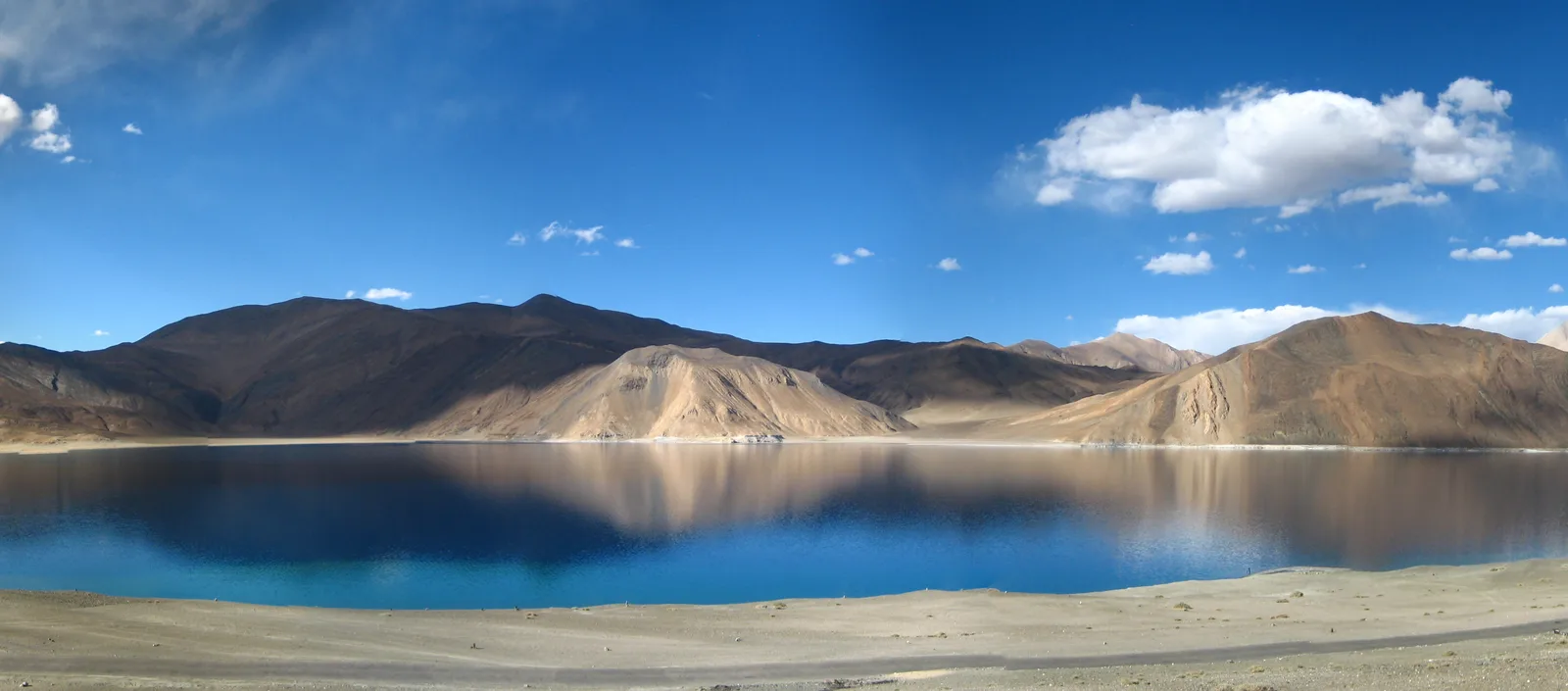
The tourism department's line for the lake: "A shimmering high-altitude lake stretching across India and China, famed for its ever-changing blue hues." The portal's circuits fix the route: Leh to Kharu, over the Chang La pass, then Durbuk and Tangtse to Lukung, the first village on the shore; lakeside Maan village lies further along the same shore. Two figures this guide deliberately does not print: the lake's length and precise altitude appear in no official text read for it. The one official altitude attached to the lake is the district administration's, given for a winter event: in February 2023 it reported the world's highest frozen lake half-marathon — a 21-km run registered by Guinness World Records — held on the frozen lake at 13,862 feet, the 700-square-kilometre saltwater lake frozen at temperatures of minus 30 degrees Celsius. A lake that can be run on in February is a different place from the blue mirror of summer.
So: day trip or overnight? The day trip is commoner and more punishing — Chang La twice, the lake compressed into the middle hours. The overnight, at Lukung, Maan or Tangtse, buys the lake at sunset and sunrise and spreads the road over two easier days — but means sleeping at roughly the lake's altitude, far above Leh, so it belongs late in a trip, never inside the acclimatisation window. The deciding rule is Section 02: the 48 hours come first, whichever you choose, and travellers who feel the advisory's danger signs at the lake should descend, not endure.
SECTION 07Getting to Leh, and Picking Your Season
By air is the standard arrival. The Airports Authority of India's press release No. 6/20-21 (11 September 2020) describes Kushok Bakula Rinpoche Airport at Leh, situated at 3,256 m (10,682 ft) above mean sea level, handling more than nine lakh passengers a year, with a new terminal building — foundation stone laid by the Prime Minister on 3 February 2019 — designed for 20 lakh passengers annually. That release is a 2020 project document, so nothing is asserted here about the project's present status. Its timeless fact is the elevation — why the 48-hour rule, not the taxi queue, shapes your first two days.
By road, two highways reach Leh — from Srinagar over Zoji La, and from Manali over a staircase of high passes — both snowbound winter roads kept by the Border Roads Organisation. Here the guide's rule bites again: no official calendar of opening and closing dates exists on the sources read. Both highways close through the winter and reopen after snow clearance, each season's dates announced year by year; a blog's fixed "opens in May, closes in October" summarises past seasons, it does not promise yours. Check the BRO's and district announcements for your year — and remember: the road journey does not acclimatise you, and the 48 hours are owed either way.
When to come is best anchored to the department's own dates. Its calendar lists the Apricot Blossom Festival — "Chuli Mentok" — on April 8–16, 2026; the Ladakh Festival on September 26–28 in Leh; and the Ladakh Marathon, billed by the department as the world's highest AIMS-certified marathon, run between 11,500 and 17,618 ft. Between those anchors sits the practical main season — late spring to early autumn, when both highways are open and the lake shows its blues. Winter belongs to specialists: a frozen Pangong at minus 30 degrees is a serious expedition, not a quieter summer trip.
FAQFrequently Asked Questions
Do Indian tourists need an Inner Line Permit for Pangong or Nubra?
No. The portal's FAQ states it directly: "The inner line permit is applicable only to foreign tourists." Indian tourists register as domestic tourists on lahdclehpermit.in, pay the environmental fee online, and need no DM-office verification of the slip. Carry the slip — on your phone or printed — for the check posts, and keep your Leh arrival boarding pass: the portal makes showing it along with the permit mandatory.
How much does the Ladakh permit cost?
The one component amount published in an official document is the environmental (green) fee: the Deputy Commissioner, Leh's notice of 14 October 2021 fixes it at ₹400 per person, payable through the portal. The LAHDC's press release states that the fee also includes the Red Cross Fund and the wildlife fee — but no official figure for those two components, and no official statement of the permit's validity in days, could be read when this guide was checked (3 November 2026), so none is printed here. The portal shows what you owe when you pay.
Why must I spend 48 hours in Leh before going to Pangong or Nubra?
Because the district administration's health advisory requires it, in terms: at least 48 hours of acclimatisation before any journey to high-altitude areas, complete rest for the first 24–36 hours, no active physical exertion on the first two days. You land at an airport the AAI places at 3,256 m (10,682 ft); every headline sight is far higher again. The advisory lists the danger signs (headache, nausea, breathlessness, disturbed sleep, dizziness among them) and warns that HAPE and HACE can be life threatening and fatal. Its Leh emergency numbers: CMO office 01982-252012; SNM Hospital 01982-252014 and 01982-053629 (Casualty).
Pangong Tso: should I do it as a day trip or stay overnight?
Either works; they are different trips. The portal's circuit runs Leh–Kharu–Chang La–Durbuk–Tangtse–Lukung, so a day trip crosses the Chang La twice and compresses the lake into midday. A night on the shore — Lukung, Maan, or Tangtse — gives you sunset and sunrise and splits the road across two days, but you sleep at high altitude: after full acclimatisation only, never inside the first 48 hours. If the advisory's danger signs appear at the lake, descend and seek help rather than keeping the booking.
I am a foreign national. What permit do I need for Pangong and Nubra?
A Protected Area Permit (or Restricted Area Permit, as the area requires). The portal's FAQ explains that the inner line permit is applicable only to foreign tourists, under the Foreigners (Protected Areas) Order, 1958: the protected and restricted areas are those "like Pangong, Nobra, Khardongla, Tsomoriri, etc." Citizens of Pakistan, Afghanistan and China must obtain the PAP from the Ministry of Home Affairs; holders of diplomatic, UN, international-organisation, official and journalist passports or visas need clearance from the Ministry of External Affairs. Register through the portal's overseas pages; carry your boarding pass with the permit. No group-size or processing-time figures are printed — the portal's detailed foreigner entries could not all be read when checked.
Official references and checking status
Checked on 3 November 2026 against the sources below; the accompanying sources file maps each claim to its page. Five limits are flagged honestly. First, the only permit component amount in readable official text is the ₹400 green fee (notice of 14 October 2021): the wildlife fee and Red Cross Fund amounts and the permit's validity in days appear in no readable official text, so none are printed, and unofficial "total" figures are not used. Second, Pangong's length and precise altitude are not printed — no official page read states them; the only official altitude attached to the lake is the district administration's 13,862 ft for the February 2023 frozen-lake marathon, reported via PTI. Third, no road distances, drive times or highway opening dates are printed: no official table could be read, and no standing official calendar exists — openings are announced season by season. Fourth, Leh Palace's history rests on the ASI's information board at the palace, read through a verbatim reproduction; the ASI list confirms its protected status, and Shanti Stupa's construction history is not asserted because leh.nic.in could not be read directly. Fifth, BRO's marvels site gives Umling La as 19,024 ft where the PIB release gives 19,300 ft, so no Umling La figure is printed. Confirm current prices and rules before you travel.
- LAHDC Leh / District Administration, Leh — the official permit portal: fee press release, FAQ, circuits, domestic registration, health advisory, and the Deputy Commissioner's notices of 14 October 2021 and 21 September 2023
- Tourism Department, Union Territory of Ladakh (official) — Pangong, Hunder, Thiksey, Hemis and Alchi descriptions, and the festival calendar
- Press Information Bureau (Ministry of Defence / Border Roads Organisation), 4 August 2021 — the Umling La road and Khardung La at 17,582 ft
- Airports Authority of India — press release No. 6/20-21 (11 September 2020): Leh airport at 3,256 m (10,682 ft) and the new terminal building project
- Archaeological Survey of India — List of Centrally Protected Monuments/Sites: Ladakh's 15 monuments (Leh Mini-Circle), Leh Palace among them
Photos: Pangong Tso's blue water mirroring the barren ranges (guide header), by Gopal Vijayaraghavan, via Wikimedia Commons, licensed under CC BY 2.0; the painted Buddha reliefs at the base of Shanti Stupa, by Bernard Gagnon, via Wikimedia Commons, licensed under CC BY-SA 4.0. Photographers keep their copyright; the licences require this credit.
General information only. This guide is based on official sources publicly available and checked on the date shown on this page. Visa rules change, and consular and USCIS officers decide every case on its own facts — nothing here is a confirmation or a guarantee for your individual case, and this is not legal advice. Always confirm the current requirement on the official page linked in this guide before you act, and consider a qualified immigration attorney for your specific situation.