
Researched & checked — 5 November 2026
Lakshadweep: The Entry Permit, the Islands Open to You and the Ships and Flights from Kochi, Planned on Official Facts
NEW Published 5 November 2026
Lakshadweep is planned on a permit before it is planned on beaches: every visitor who is not a native of the islands — Indian citizens included — needs an entry permit under rules made in 1967, applied for on the Administration's e-Permit portal and verified level by level before it is issued. Around that gate sit the journey's other facts: the islands open to tourists, the SPORTS packages, the seven passenger ships and the one airstrip at Agatti, and a fair season from October to May — each from the Administration, the portal and its official manual, and SPORTS.
Every non-native visitor needs an entry permit under the 1967 Rules — the portal exempts only government officials and armed forces members and their families. Apply on the Administration's e-Permit portal (linked from lakshadweep.gov.in; the current system is at lak.e-permit.utl.gov.in): register, choose the Tourist/Tourism purpose, upload documents, and pay — the portal's published fees are a ₹50 application fee per applicant plus a heritage fee of ₹200 per adult (₹100 for ages 12–18). Applications are verified in levels — ADM Office, then Senior ADM, with the SHO Police and BDO verifying Indian applications; foreign nationals need a tourist visa and end with the Collector. Tourists are received on Agatti, Bangaram, Thinnakara, Kadmat, Kavaratti, Kalpeni and Minicoy; Kochi is the gateway — flights land at Agatti (about 1½ hours) and seven passenger ships make the 14–18 hour passage. Best season, per SPORTS: October to mid-May.
SECTION 01The Permit: A 1967 Rule That Still Gates the Islands
Begin with the law, in the e-Permit portal's own words: "According to the Laccadive, Minicoy and Amindivi Islands (Restriction on Entry and Residence) Rules, 1967, every person, who is not a native of these islands, shall have to obtain a permit in the Prescribed Form from the Competent authority, for entering into and residing in these islands." The Administration's homepage says it more briefly: the entry to Lakshadweep islands is restricted, and one requires an entry permit issued by the Lakshadweep Administration. No category of visitor stands outside this rule. The permit names its holder, its islands and its dates, and the portal's public Verify Permit page exists so that, in the manual's words, port authorities, airport security and accommodation hosts can check whether a permit is valid. Expect it to be asked for.
The exemptions are narrow and the portal states them in one sentence: "Only the Government Officials and Armed Force members working or visiting these islands and their family members are exempted from this." Everyone else applies. The machinery sits with the Revenue Department, whose page lists the processing and issuance of entry permits among its services; it is headquartered at Kavaratti and headed by the Additional District Magistrate — the ADM whose office reappears inside the portal as the first verifying authority. The 1967 Rules add the holder's duties: report to the Registration Officer on arrival, and surrender the permit on leaving the islands. Contravening the Rules is an offence, punishable with imprisonment of up to one month, or a fine of up to one thousand rupees, or both. The permit is granted routinely to genuine tourists — but it is granted, not assumed.
SECTION 02Applying on the e-Permit Portal, Step by Step
The application lives on one official system. The Administration's pages link the e-Permit portal at epermit.utl.gov.in, and the portal's official user manual names the current system address as lak.e-permit.utl.gov.in — reach it through the Administration's own links rather than any look-alike address. The manual describes it as the official online system for obtaining an entry permit to the Union Territory of Lakshadweep: visitors apply online, upload documents, pay through a gateway and receive the approved permit by email, while officials verify each application online, level by level. Registration comes first — name, mobile, email, nationality, date of birth and a password — confirmed by a six-digit emailed code; every later sign-in needs a fresh code too.
The application itself has six steps: Nationality, Purpose & Travel, Applicants, Family, Review and Payment. At Purpose & Travel, an Indian applicant chooses from purposes that include Tourist/Tourism; selects the islands to visit — more than one can be chosen — and enters the from and to dates, with the maximum number of days allowed shown beside the date field for the chosen purpose. That maximum is set purpose-wise, and no official page read publishes a single tourist validity figure, so none is printed here. The purpose's documents are uploaded at the same step — PDF, JPG or PNG up to 2 MB each, clear and readable or the application may be rejected. At Applicants, the main traveller's details go in — name, parent's or spouse's name, nationality, date of birth, gender, mobile, email, permanent address, address in island and an emergency contact — with a passport-size photograph and ID proof for each person. Family members are added next, a step that cannot be skipped; a single application can include a maximum of six persons. Review shows everything with the fee summary and a truth declaration; Payment is by card, net banking, UPI or wallet. One trap: if a permit already exists for the same dates, another cannot be applied for those dates again.
What happens after payment is the part first-time applicants least expect: the application is verified in levels inside the portal. The manual's user roles name the chain — the ADM Office is the first-level verifier, forwarding, returning or rejecting; the Senior ADM is the next level and, for many purposes, the final approval; and the SHO Police and BDO act as verifiers for Indian applicants, purpose-wise. The police verification that older accounts describe as a certificate you fetched yourself now sits inside the workflow: you upload your photograph and identity proof, and the officers examine the application online. Statuses run Draft; Submitted / Review at the named level; Returned – Action Required (sent back with remarks to correct and resubmit); Approved, when the permit can be downloaded or is sent to your email; and Rejected, with the reason emailed. Anyone can track an application from its ID without logging in, and an approved permit can later be extended — the extension passes through verification again.
SECTION 03What the Permit Costs: The Portal's Own Fee Table
On the fee, this guide prints what the portal itself publishes. The portal carries a public Fee's Structure page, and its official user manual transcribes the standard fees from it: an application fee of ₹50 for each applicant, and a heritage fee of ₹100 for children aged 12 to 18 and ₹200 for individuals above 18. An adult tourist's permit therefore totals ₹250, and a traveller aged 12 to 18 pays ₹150. Two qualifications travel with the figures, both the portal's own: fees depend on the purpose of visit, and some purposes are free of charge; and the exact amount payable is always shown on the payment page before you pay. That is the whole of the government's charge for the permit itself — tickets and packages are separate costs. Pay inside the portal's payment step and nowhere else: no agent's markup changes what the verifying officers see.
SECTION 04Foreign Nationals: A Separate Lane Through the Same Gate
Foreign visitors apply on the same portal, but three official statements frame their lane first. The Administration's tourism pages carry the position as a banner: "Foreign nationals, only with 'tourist visa' will be permitted to Lakshadweep islands." The portal's homepage adds: "Foreign Tourists need to have a valid passport and visa for visiting India." And the manual records that a foreign applicant's account is the same as an Indian one, with three purposes of visit and additional documents — passport and stamped visa. The approval chain is longer too: the Collector is the final approving authority for foreign national applications only. Build the extra level into your timeline.
The 1967 Rules add one older, still-instructive definition. Under them, a "bonafide tourist" is a foreign national tourist having a valid passport and visa and having confirmed booking for accommodation at the tourist accommodation of islands notified for the purpose — and the Administrator's permission is contemplated in particular for staying on Kadmat and Agatti and the notified uninhabited islands. The practical reading, which the modern portal echoes by asking for your address in island, is that a foreign visitor's accommodation should be confirmed, not improvised. Which islands may a foreign national stay on? Official text read answers only in part: SPORTS states of Kadmat that non-Indians are also permitted to visit this island, and the Rules single out Kadmat, Agatti and the notified uninhabited islands (Bangaram and Thinnakara are the uninhabited resort islands). A fuller list circulates on unofficial pages, but no official page read prints it as a list, so this guide does not either: treat those four as the officially supported ground, and confirm any wider plan with the Administration before booking.
SECTION 05The Package Route: SPORTS and the Confirmed Stay
There is a second way through the gate, and for many visitors the natural one: let the Administration's own tourism society organise the trip. The Society for Promotion of Nature Tourism and Sports — SPORTS — is, in its own account, a society formed by the Lakshadweep Administration in 1982, acting as the nodal agency of the Lakshadweep Administration for promotion of tourism in the islands and as its hospitality wing. SPORTS operates tourist resorts at Bangaram, Thinnakara, Kadmat, Minicoy and Kavaratti and conducts ship package tours covering three islands. A package does not abolish the permit — nobody is exempt — but it aligns the three things the system wants together: a confirmed stay, a known ship or flight, and known dates.
The named packages, from the Administration's tourism pages: Lakshadweep Samudram, a five-day cruise by M.V. Kavaratti visiting Kavaratti, Kalpeni and Minicoy, island tours by day and nights on board — bookings are taken online through the Samudram portal the Administration links. Swaying Palm is a six- or seven-day tour to Minicoy in beachfront cottages. The Marine Wealth Awareness Programme goes to Kadmat by flight via Agatti — four to seven days, swimming, snorkelling and kayaking included. Taratashi is a four- or five-day stay on Kavaratti, also by flight via Agatti. SPORTS also offers tents on Thinnakara and cottages on Bangaram. One notice on SPORTS' homepage corrects a common assumption: there is at present no Government permitted resort at Agatti Island — Agatti is the gateway and the airstrip, not where the Administration puts you up. Package tariffs are not printed here; current prices sit on the booking pages.
SECTION 06The Islands Open to Tourists
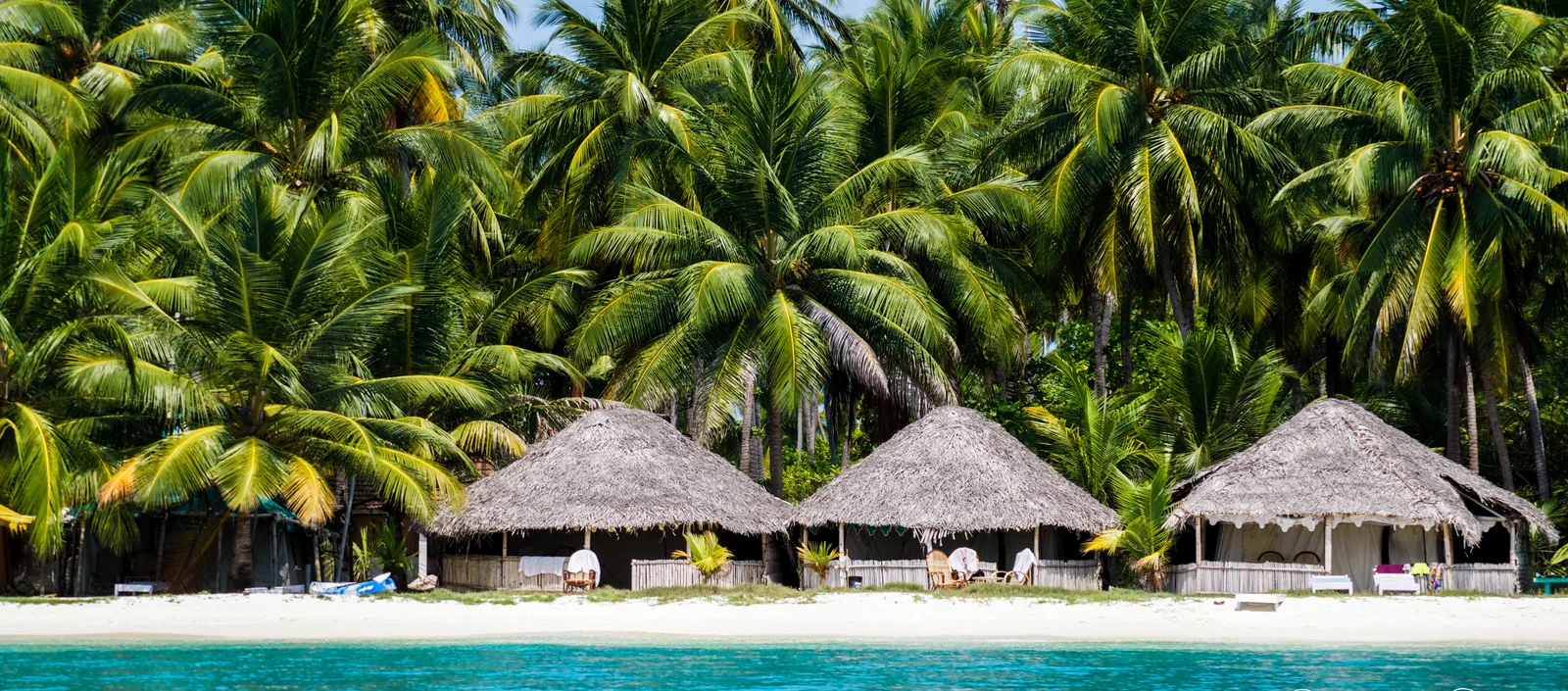
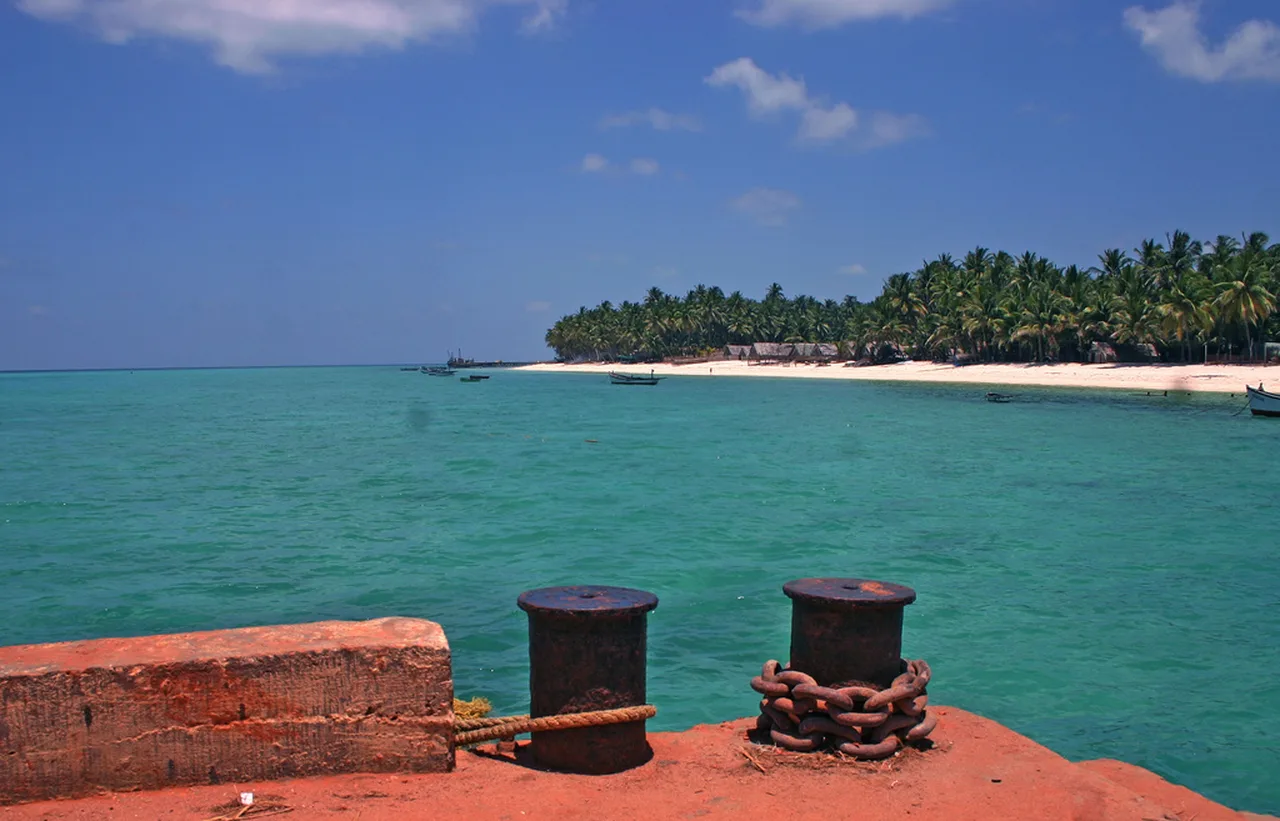
Seven names recur across the Administration's and SPORTS' pages as the tourist map. Agatti is the gateway: SPORTS calls its lagoon one of the most beautiful in Lakshadweep and the island the virtual gateway — the airport is built on this island. A short boat ride away lies Bangaram: a tiny teardrop-shaped island close to Agatti and Kavaratti, uninhabited, whose resort SPORTS calls the only uninhabited island resort in Lakshadweep; Thinnakara and Parali lie close by in the same lagoon — 8 km northeast of Agatti, with tents, kayaks and glass-bottomed boats. Guests reach Bangaram by boat or helicopter from Agatti.
Kadmat is the divers' island: 8 km long and only 550 metres wide, a shallow western lagoon made for water sports, long sandy beaches and sand banks at the southern tip. A Water Sports Institute functions on the island, and SPORTS records clear water with 20–50 metre visibility — and, noted in Section 04, that non-Indians are also permitted to visit. Kavaratti, headquarters of the Administration and the most developed island, carries 52 mosques — the Ujra mosque the most beautiful — a marine aquarium, glass-bottomed boats and the Dolphin Dive Centre. Kalpeni, visited on the Samudram and Coral Reef packages, forms one atoll with Tilakkam, Pitti and uninhabited Cheriyam; its peculiar feature is the huge storm bank of coral debris along its eastern shores, thrown up, it is believed, by a violent storm in 1847, and its vast lagoon suits swimming, snorkelling and reef-walking. Minicoy stands apart, about 200 km south: 10.6 km long, the second largest island after Andrott, culturally distinct — Mahl is the spoken language, the Lava its traditional dance, its race boats called Jahadhoni — with a tuna-canning factory and a 300-foot lighthouse built in 1885. Ten of the 36 islands are inhabited; the permit names the islands you may visit, and these seven are the ones the Administration's tourism machinery is built to receive you on.
SECTION 07Ships, Flights and Seasons: Reaching a Permit-Only Archipelago
Every route starts at one city. The Administration's How to Reach page is categorical: Lakshadweep can be reached by ships and flights operated from Kochi, and for all tourist purposes Kochi is the gateway to Lakshadweep. By air, the airstrip is at Agatti and nowhere else — the flight from Cochin to Agatti takes approximately one hour and thirty minutes. From Agatti, boats are available to Kavaratti and Kadmat during the fair season, October to May; a helicopter transfer is available from Agatti to Kavaratti during the monsoon, subject to availability; and high-speed vessels run between the islands in the fair season. By sea, the Administration names its fleet: seven passenger ships — M.V. Kavaratti, M.V. Arabian Sea, M.V. Lakshadweep Sea, M.V. Lagoon, M.V. Corals, M.V. Amindivi and M.V. Minicoy — operate between Cochin and the islands, and the passage takes 14 to 18 hours depending on the island, in A/C first-class two-berth cabins, A/C second-class four-berth cabins and push-back or bunk class, with a doctor on call. Ship tickets are sold through the Lakshadweep IRCTC site the Administration links, and sailings are published voyage by voyage. No timetable and no fare table is printed here, deliberately: both belong to the booking portal on the day you travel.
The seasons govern all of it, and SPORTS frames them officially: the best time to visit Lakshadweep is from October to mid-May; from mid-May to September it is rainy. Resorts and flights operate throughout the year — but reaching the islands by ship is difficult during the monsoon, and in that season the ships operate for local passengers only and are not available for tourist transport. Agatti and Bangaram remain pleasant in the monsoon and reachable by flight, though Agatti to Bangaram is then only by helicopter; Kadmat, Minicoy and Kavaratti are difficult to reach. The planning consequence matches the permit's own logic: a fair-season trip — permit applied for with confirmed dates, a flight to Agatti or a bunk on a named ship, boats running between the islands — is the journey the system is designed around. Travel in the islands' own spirit while there: SPORTS describes its packages as drawn up to protect the environment and not upset the delicate balance between man and nature — the reef and lagoon are the sights themselves, so walk the reef flat with care and take nothing from it.
FAQFrequently Asked Questions
Do Indian citizens really need a permit to visit Lakshadweep?
Yes. The e-Permit portal states the rule in terms of the 1967 Rules: every person who is not a native of the islands must obtain a permit from the competent authority for entering into and residing in them. The only exemptions named are government officials and armed forces members working or visiting the islands, and their families. Indian tourists apply on the portal under the Tourist/Tourism purpose, exactly as foreign nationals apply under theirs.
How much does the entry permit cost?
The portal's published fee structure — transcribed in its official user manual — is an application fee of ₹50 for each applicant, plus a heritage fee of ₹200 for individuals above 18 and ₹100 for children aged 12 to 18. An adult tourist's permit therefore costs ₹250 in total, and a 12-to-18-year-old's ₹150. Fees depend on the purpose of visit and some purposes are free; the exact amount payable is shown on the payment page before you pay. Tickets, accommodation and package tariffs are separate costs.
Do I need to get a police clearance certificate before applying?
Not as a document you fetch yourself, on the portal's design. What you upload is your passport-size photograph and ID proof (plus any documents listed for your purpose — files up to 2 MB, clear and readable). Verification happens inside the system after you apply: the ADM Office at the first level, the Senior ADM at the next, and the SHO Police and BDO as verifiers for Indian applicants purpose-wise. If a verifier needs more, the application comes back with remarks — Returned – Action Required — for you to correct and resubmit.
Can foreign nationals visit Lakshadweep?
Yes, through the same portal but a stricter lane. Foreign nationals will be permitted only with a tourist visa, and the portal adds that foreign tourists need a valid passport and visa for visiting India. Foreign applicants upload their passport and stamped visa, and their applications are finally approved by the Collector — a level Indian applications do not go through. Under the 1967 Rules a "bonafide tourist" has a valid passport and visa and a confirmed accommodation booking, so confirm your stay before applying; SPORTS states expressly that non-Indians are permitted to visit Kadmat.
When should I go, and how do I actually get there?
SPORTS' official season runs from October to mid-May; from mid-May to September it is rainy, ships are difficult and in monsoon they carry local passengers only, not tourists. All routes start from Kochi. Flights land at Agatti — the only airstrip, about an hour and a half from Cochin — with boats onward to Kavaratti and Kadmat in the fair season and a helicopter transfer to Kavaratti in the monsoon, subject to availability. Seven Administration ships sail from Cochin, taking 14 to 18 hours depending on the island; tickets are sold through the Lakshadweep IRCTC portal the Administration links, with sailings published voyage by voyage.
Official references and checking status
Checked on 5 November 2026 against the official sources listed below; the accompanying sources file maps each claim to its page. Four limits are flagged honestly. First, the permit fee IS printed — from the portal's own published Fee's Structure as transcribed in its official user manual; the live application is a sign-in system, and its fee page is reproduced in the manual for exactly this purpose. Second, no maximum stay in days is printed: the manual records that the portal displays the maximum days beside the date field per purpose, and no official page read publishes the figure. Third, the 1967 Rules are published as a scanned gazette document whose text layer interleaves its two columns; they are relied on only for their structure — the permit requirement, the bonafide-tourist definition, the holder's duties — with the portal's clean restatement preferred wherever the two overlap. Fourth, ship fares, timetables and package tariffs are not printed: the Administration publishes them voyage by voyage on its booking portals. Confirm current prices and timings on the official sites before you travel.
- Lakshadweep e-Permit Portal (official) — the permit rule, the exemptions and the foreign-tourist passport and visa position
- Lakshadweep e-Permit Portal, User Manual (official) — the application steps, verification levels, statuses and the Fee's Structure
- Lakshadweep Administration (official) — Entry Permit: the Rules, the issuing authorities and the portal link
- Lakshadweep Administration (official) — Department of Revenue: processing and issuance of entry permits
- Lakshadweep Administration (official) — How to Reach: Kochi the gateway, the Agatti airstrip, the seven ships, the 14–18 hour passage
- Lakshadweep Administration (official) — Tourist Packages: Samudram, Swaying Palm, Marine Wealth Awareness, Taratashi, Thinnakara and Bangaram
- SPORTS (official) — the society, its resorts and the Agatti resort notice
- SPORTS (official) — the focal islands: Kavaratti, Kalpeni, Minicoy, Kadmat, Agatti and Bangaram
- SPORTS (official) — Tourist Season: October to mid-May, and the monsoon position
Photos: thatched cottages under the palms on Bangaram's white sand, the lagoon in front, by The.chhayachitrakar, via Wikimedia Commons, licensed under CC BY-SA 4.0; from Agatti's jetty, the lagoon and the island's palm-lined shore across the water, by icultist, via Wikimedia Commons, licensed under CC BY 2.0. Photographers keep their copyright; the licences require this credit.
General information only. This guide is based on official sources publicly available and checked on the date shown on this page. Visa rules change, and consular and USCIS officers decide every case on its own facts — nothing here is a confirmation or a guarantee for your individual case, and this is not legal advice. Always confirm the current requirement on the official page linked in this guide before you act, and consider a qualified immigration attorney for your specific situation.