
Researched & checked — 31 Oct 2026
Khajuraho: The Temple Groups, Entry Fees and How to Plan the Visit
NEW Published 31 October 2026
Khajuraho turns on a small set of official facts: one ticketed enclosure holding the greatest temples, an ASI tariff of ₹40 and ₹600, a museum that shuts on Fridays, and an evening show whose clock changes with the season. Everything here comes from UNESCO, the ASI and MP Tourism.
The Western Group is Khajuraho's ticketed core, open sunrise to sunset on ASI's published hours; entry is ₹40 per head for Indian visitors and ₹600 for other foreign visitors, with children below 15 free. The Eastern Group holds the great Jain temples — Parsvanatha, Adinatha, Santinatha — plus the Hindu Vamana, Javari and Brahma temples; the Southern Group is the quiet pair of Duladeo and Chaturbhuj. The ASI Archaeological Museum is open 9 AM–5 PM, closed Fridays, at ₹30 (Indian, SAARC and BIMSTEC citizens) and ₹500 (other citizens). The sound-and-light show at the Western Group runs in English then Hindi — 6:30 PM and 7:25 PM from October to February, 7:30 PM and 8:25 PM from March to September — at ₹300/₹150 Indian adults/children and ₹800/₹400 foreign adults/children.
SECTION 01What Khajuraho Is: The UNESCO Listing
Khajuraho, in the Chhatarpur district of Madhya Pradesh, was the principal seat of the Chandella rulers, and the temple city they adorned is now a World Heritage property. UNESCO inscribed the Khajuraho Group of Monuments in 1986, under two criteria. Criterion (i) recognises the complex as a unique artistic creation, for its highly original architecture and the quality of its sculpted decoration. Criterion (iii) recognises the temples as exceptional testimony to the Chandella culture, which flourished in central India before the establishment of the Delhi Sultanate at the beginning of the 13th century.
UNESCO's statement describes a group testifying to the culmination of northern Indian temple art and architecture under the Chandella dynasty, who ruled the region in the 10th to 11th centuries CE. It counts 23 temples, including one partly excavated structure, distributed over about 6 square kilometres in the western, eastern and southern clusters — rare surviving examples of the originality and high quality of Nagara-style temple architecture. The Indian accounts give the fuller arc: ASI records that local tradition lists eighty-five temples, of which only twenty-five stand today in various stages of preservation, and MP Tourism tells the same story. The counts differ by definition rather than by dispute: UNESCO counts the inscribed property; ASI and the state count every standing survival.
The form UNESCO singles out is worth learning before you arrive, because you will read it on every temple. Each is built in sandstone and raised on a highly ornate terraced platform, the jagati. The visitor passes through an entrance porch (ardhamandapa) into the main hall (mandapa), then a vestibule (antarala), before reaching the sanctum (garbhagriha); above the sanctum rises the shikhara, its thrust accentuated by miniature spires that UNESCO reads as symbolising Mount Kailasa, abode of the gods. Larger temples add subsidiary shrines at the platform's four corners. Almost all is in fine-grained sandstone — buff, pink or pale yellow, in ASI's description; the granite exceptions are the Chausath-Yogini, Brahma and Mahadeva temples.
SECTION 02The Western Group: The Ticketed Core, Its Temples and Its Price
The Western Group is the Khajuraho of the postcards: a walled, landscaped enclosure holding the largest and most richly carved temples, and the one part of the site where the visit is formally organised. ASI's Khajuraho page publishes the opening hours as sunrise to sunset — a rhythm that rewards the early start, when the sandstone takes the morning light and the enclosure is quietest. Its published entry fee is ₹40 per head, and ₹600 per head for other foreign visitors, with free entry for children below 15 years. One honest gap: ASI's Khajuraho page names no separate rate for citizens of SAARC and BIMSTEC countries, and secondary listings disagree about one, so this guide prints no SAARC figure for the temples — the ticket counter works from ASI's published table. (The museum nearby, below, does publish a SAARC rate; the two tariffs are separate.)
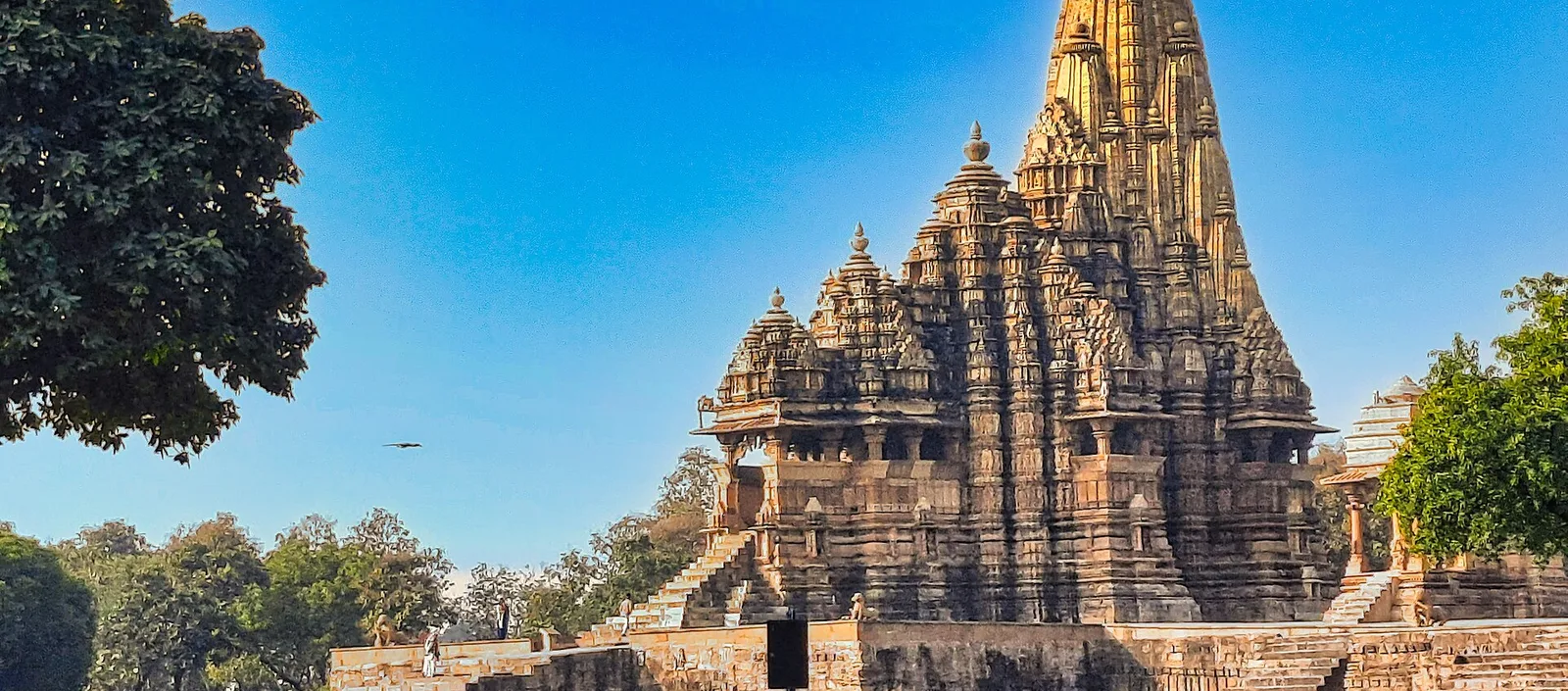
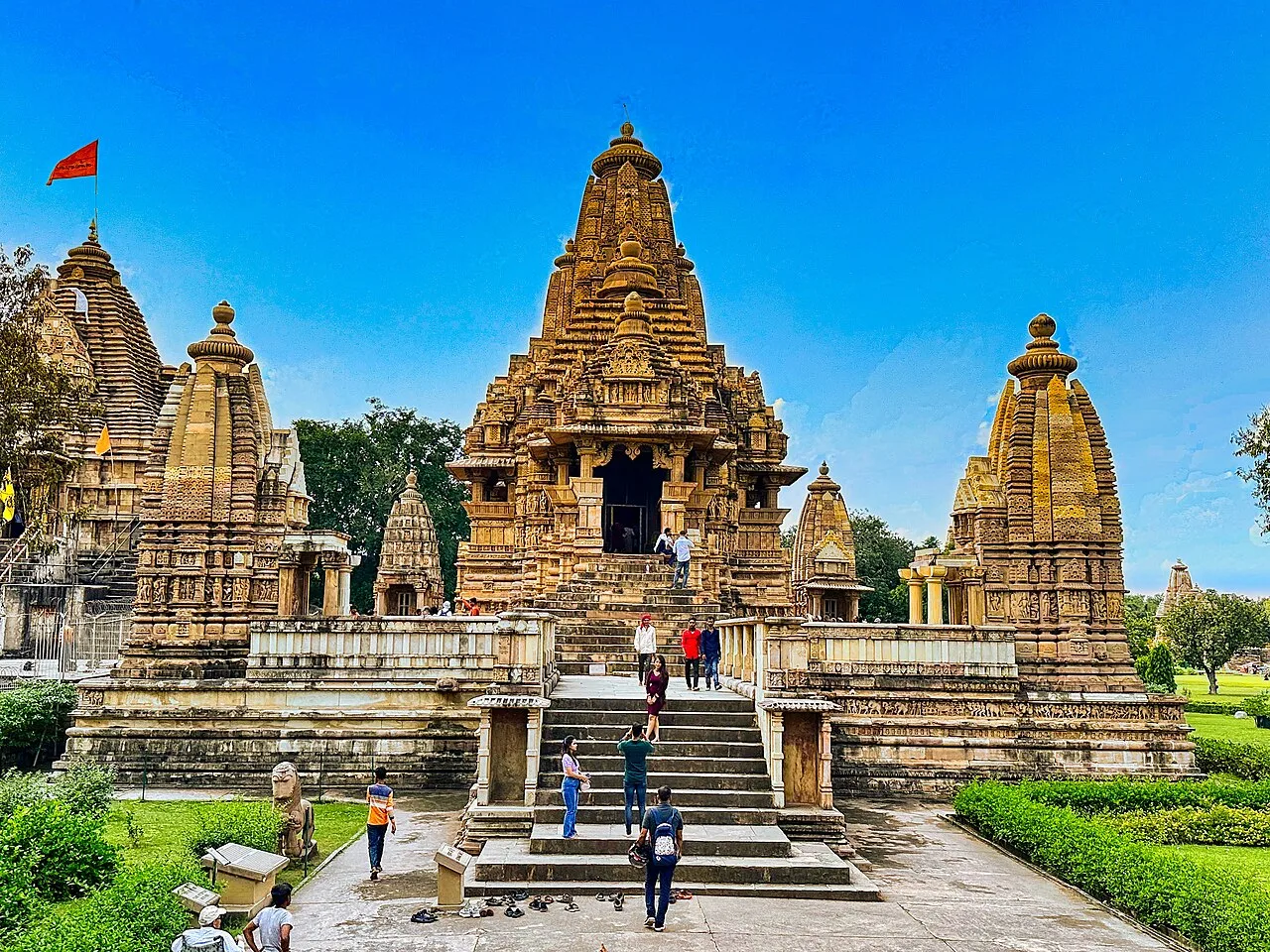
Inside, two temples organise the visit. The Kandariya Mahadeva is, in ASI's words, the largest and grandest temple of Khajuraho, attributed to king Ganda (AD 1017–29); MP Tourism dates its building to 1025–1050 and describes it rising in successive towers like a range of hills — the most complete statement of the Nagara form, dedicated to Shiva. Before it stands the Lakshmana Temple: ASI records that Yasovarman built this temple of Vishnu in AD 954, proclaiming the prestige of the Chandellas. Around them the group holds Visvanatha and the Jagadambi and Chitragupta temples, which ASI names as noteworthy among the western royal temples — Chitragupta is the group's temple to Surya, the sun god — together with the Varaha and Parvati shrines and the Nandi pavilion that MP Tourism's listing adds, and the granite Chausath-Yogini at the enclosure's edge. Just outside the ticketed boundary stands Matangeshwara, which MP Tourism's Khajuraho writing describes as still in active worship — the one living temple among monuments.
Allow the Western Group the largest share of your time — two to three unhurried hours is a realistic floor, and the enclosure repays a second circuit, because the carving reads differently as the light moves. The eastern and southern temples are spread across the old village, and the southern pair is a separate excursion within the town.
SECTION 03The Carving — and the Famous Sculptures in Proportion
UNESCO's own summary of the sculpture is the right frame. The temples, it says, are known for the harmonious integration of sculpture with architecture; all surfaces are profusely carved with motifs depicting sacred and secular themes — acts of worship, clan and minor deities, and couples in union reflect the sacred belief system, while other themes mirror social life through domestic scenes, teachers and disciples, dancers and musicians, and amorous couples. ASI's account runs the same way: cult images and attendant deities, the dikpalas, and the apsaras and sura-sundaris, the celestial women.
So the famous erotic sculptures, factually and briefly: they are the "couples in union" and "amorous couples" of UNESCO's description — one named strand in a programme whose other strands are worship, mythology, teaching, music, dance and daily life. Neither UNESCO's statement nor ASI's Khajuraho page assigns them a share of the whole, and the percentage repeated by guidebooks could not be read in any official text checked for this guide, so no percentage is printed here. What the official record supports is proportion of a different kind: the erotic panels are a small, deliberate part of a sculptural scheme covering nearly every surface of temples like Kandariya and Lakshmana, most of it devoted to gods, celestial figures and the ordinary business of living. MP Tourism makes the complementary point from the other end: the Southern Group's Chaturbhuj is, it notes, the only temple in Khajuraho without a single erotic sculpture — a distinction that only makes sense against carving this varied.
SECTION 04The Eastern and Southern Groups: Jain Splendour and the Quiet South
The Eastern Group, spread through and beyond the old village, is where Khajuraho's second religion speaks. Its glory is the Jain cluster — UNESCO's component list names its members: the Parsvanatha, Adinatha and Santinatha temples, with the Ghantai remains. MP Tourism dates Parsvanatha to 950–970, built of honey-coloured sandstone, a Jain temple that also holds Vaishnava images — a small carved record of the two faiths' coexistence; ASI places it, with Visvanatha and Vaidyanatha, in the time of king Dhanga. The Hindu temples complete the group: Vamana, Vishnu's dwarf incarnation, dated by MP Tourism to 1050–75, and Javari, dated 1075–1100, on a high plinth with a delicately carved makara-torana arch; the Brahma temple, one of ASI's granite exceptions, and the colossal Hanuman complete UNESCO's eastern list.
The Southern Group is the smallest and the latest: two temples standing apart to the south, usually visited by vehicle and usually quiet. Duladeo, a Shiva temple also called Kunwar Math, is dated by MP Tourism to 1100–1150 — among the last of the Chandella temples — and praised for the flying celestials on its shikhara and the carved jewellery of its female figures. Chaturbhuj holds the group's great single image: a large Vishnu that MP Tourism describes as seeming about to step out and bless the devotee — and, as noted above, the one temple here with no erotic sculpture at all. ASI names both among the later, smaller but elaborately designed temples that followed Kandariya. Together they take under an hour; with the east, they turn a Western-Group morning into a complete Khajuraho day.
SECTION 05The Archaeological Museum: The Loose Sculpture, Gathered
Close to the Western Group stands the other half of the Khajuraho story. ASI's Archaeological Museum holds the sculptures and antiquities that came loose from the temples — its primary collection, in the ASI museum service's description, consists of sculptures and antiquities from the Chandela period, when Khajuraho was the capital, displayed across five galleries. The same official page tells the collection's history: the temples were brought to wider notice by T. S. Burt in 1838 and researched by Alexander Cunningham from 1852 to 1885; the loose sculptures were gathered under W. E. Jardine, political agent of Bundelkhand, into the Jardine Museum of 1910, which ASI took over in 1952.
The museum's practical facts are published and precise. It is open 9 AM to 5 PM, and closed on Fridays and on public holidays. Entry is ₹30 for Indian nationals and for SAARC and BIMSTEC citizens, ₹500 for other citizens, and free for children below 15. The ASI museum service allows an average visit of one to two hours. The planning consequence is the easiest mistake in Khajuraho to make: do not leave the museum for a Friday. Pair it with the Western Group on any other day — it is the natural shelter from the midday heat, and its galleries explain carving you have just seen on the walls.
SECTION 06After Dark: The Sound-and-Light Show
The Western Group has a second life after sunset. MP Tourism stages a sound-and-light show at the Western Group complex, in which the illuminated temples carry the story of the Chandela rulers who made Khajuraho a centre of art, spirituality, architecture and culture. It runs in two languages nightly, and MP Tourism publishes both the seasonal clock and the tariff.
From March to September, the English show runs 7:30–8:05 PM and the Hindi show 8:25–9:00 PM. From October to February, both move earlier: English 6:30–7:05 PM, Hindi 7:25–8:00 PM. Tickets are ₹300 for Indian adults and ₹150 for Indian children; ₹800 for foreign adults and ₹400 for foreign children. The show is a separate ticket from the day's ASI entry, and the winter timings mean the peak-season evening organises itself: temples until sunset, a short break, then the English show at half past six.
SECTION 07The Side Trip: Panna National Park and the Falls
Khajuraho pairs naturally with wild country. In the Vindhya ranges, spanning the northern districts of Panna and Chhatarpur, lies Panna National Park — MP Tourism presents it as the standard excursion from the temples: a park of canyons and dense teak forest in the Ken river country, home to tigers and other wild cats, deer and antelopes, and a wide range of bird species, visited by safari jeep. MP Tourism's Khajuraho page measures the park at 96 kilometres from Khajuraho — a figure that reads as the full journey to the park's far side rather than its nearest safari gate, so treat Panna as a committed day or an overnight, and book the safari through the park's official forest-department channels before you travel; this guide prints no safari tariff, because none is published in the official tourism material it relies on.
Two waterfalls sit on the same roads. Raneh Falls, about 21 kilometres from Khajuraho on MP Tourism's measure, drops through a canyon of coloured rock close to the Panna reserve; Pandav Falls, about 34 kilometres out on the Khajuraho–Panna road, falls some 30 metres from the Ken into a pool at whose base, legend says, lie caves of the Pandavas, and MP Tourism notes falls and park are usually covered the same day. Both are at their best with water in the river — after the monsoon and through winter.
SECTION 08Getting There, Seasons and the Shape of the Visit
Khajuraho is remote but not hard to reach, and MP Tourism publishes the three routes plainly. By air, Khajuraho has its own domestic airport about two kilometres from the temple sites, with flights it lists to Delhi, Mumbai, Bhopal and Varanasi among others. By rail, Khajuraho's own station stands about five kilometres from the main town; the closest major railhead is Mahoba, around 78 kilometres away, with regular trains from Mathura, Varanasi, Mumbai, Kolkata, Prayagraj, Jabalpur and Gwalior — the route most long-distance rail travellers use, finishing by road. By road, Khajuraho is well linked to the national and state highways, with buses to nearby cities such as Jhansi and cabs for hire. Build the remoteness in: whichever route you choose, arrival the evening before a sunrise start beats arrival on the day.
The seasons follow from the site's own published rhythms. The visit is an outdoor one, governed by ASI's sunrise-to-sunset hours, on exposed sandstone terraces; the comfortable pattern is the one the state's calendar assumes — the light show moves to its early, winter timings from October to February, and February brings the Khajuraho Dance Festival, which MP Tourism invites visitors to plan around, when classical dancers from across India perform against the temple backdrop. Summer in Bundelkhand is fiercely hot at midday on open stone — the editorial advice of this guide, offered as advice, is to give the Western Group the early morning in any season and keep the museum for midday. The shape that follows: day one, the Western Group from sunrise, the museum late morning (never a Friday), the Eastern Group in the afternoon, the show after dark; day two, the Southern Group at leisure and Panna or the falls.
FAQFrequently Asked Questions
How much is entry to the Khajuraho temples, and when are they open?
ASI's published hours for the Khajuraho monuments are sunrise to sunset. Its published entry fee is ₹40 per head for Indian visitors and ₹600 per head for other foreign visitors, with free entry for children below 15 years. ASI's Khajuraho page publishes no separate SAARC or BIMSTEC rate for the temples, so this guide prints none — the museum publishes its own, separate tariff (₹30 including SAARC and BIMSTEC citizens).
Which temples are in each of Khajuraho's three groups?
The Western Group holds Kandariya Mahadeva, Lakshmana, Visvanatha, Jagadambi, Chitragupta, Varaha, Parvati and the Nandi pavilion, with Chausath-Yogini at its edge and the living Matangeshwara temple just outside the ticketed boundary. The Eastern Group holds the Jain Parsvanatha, Adinatha and Santinatha temples with the Ghantai remains, plus the Hindu Vamana, Javari and Brahma temples and the colossal Hanuman. The Southern Group is Duladeo and Chaturbhuj.
How much of Khajuraho's carving is erotic?
No official source checked for this guide puts a figure on it, and this guide prints none. UNESCO describes the sculpture as depicting sacred and secular themes — worship, deities and couples in union; domestic scenes, teachers and disciples, dancers, musicians and amorous couples. The erotic panels are one strand of that whole; MP Tourism notes Chaturbhuj has no erotic sculpture at all.
When is the sound-and-light show, and what does it cost?
At the Western Group complex, nightly in English then Hindi. From October to February: English 6:30–7:05 PM, Hindi 7:25–8:00 PM. From March to September: English 7:30–8:05 PM, Hindi 8:25–9:00 PM. Madhya Pradesh Tourism's published prices are ₹300 (Indian adult) and ₹150 (Indian child); ₹800 (foreign adult) and ₹400 (foreign child). The show is ticketed separately from ASI's daytime entry.
When is the ASI museum closed, and can Panna be combined with Khajuraho?
The Archaeological Museum is open 9 AM–5 PM and closed on Fridays and public holidays; entry is ₹30 for Indian, SAARC and BIMSTEC citizens, ₹500 for other citizens and free below 15. Yes — Panna National Park, in the Vindhya ranges across the Panna and Chhatarpur districts, is the standard side trip for its tigers and other wildlife, usually given its own day and combined with Raneh or Pandav Falls on the same road. Book safaris through the park's official forest-department channels; no official safari tariff is printed here.
Official references and checking status
Every changeable fact in this guide was checked on 31 October 2026 against the official sources listed below; the accompanying sources file records which page supports which claim. Two limits are flagged where they occur in the text: ASI's Khajuraho page publishes no separate SAARC or BIMSTEC temple rate, so none is printed; and no official text read assigns a percentage to the erotic sculpture, so none is printed. UNESCO counts 23 temples in the inscribed property, while ASI and MP Tourism count 25 standing survivors of a traditional 85 — the guide reports both counts with their attributions. Confirm current prices and timings before you travel.
- UNESCO World Heritage Centre — Khajuraho Group of Monuments: inscription (1986), criteria (i) and (iii), and the adopted statement of Outstanding Universal Value
- Archaeological Survey of India — Group of Temples, Khajuraho: the temples and their builders, opening hours (sunrise to sunset) and the entry fee (₹40 / ₹600, children below 15 free)
- ASI museum service (Museums of India) — Archaeological Museum, Khajuraho: collection and history, hours 9 AM–5 PM, Friday closure, entry ₹30 / ₹500
- Madhya Pradesh Tourism — Khajuraho: the three groups and their temples, Panna National Park and the falls, and how to reach Khajuraho by air, rail and road
- Madhya Pradesh Tourism — Sound & Light Shows in Madhya Pradesh: the Khajuraho show's venue, seasonal timings and ticket prices
Photos: the Kandariya Mahadeva Temple rising above its jagati in morning light, and the Lakshmana Temple with its corner shrines, both by Ms Sarah Welch, via Wikimedia Commons, released under CC0 1.0.
General information only. This guide is based on official sources publicly available and checked on the date shown on this page. Visa rules change, and consular and USCIS officers decide every case on its own facts — nothing here is a confirmation or a guarantee for your individual case, and this is not legal advice. Always confirm the current requirement on the official page linked in this guide before you act, and consider a qualified immigration attorney for your specific situation.