
Researched & checked — 5 November 2026
Imphal and Loktak Lake: The Floating National Park, the Women's Market and the Inner Line Permit, Planned on Official Facts
NEW Published 5 November 2026
Manipur is planned on a permit before it is planned on sights: an Inner Line Permit that the state's own portal prices at ₹100 for a 30-day tourist stay, a lake 48 km from Imphal where whole meadows float and fishermen live on them, the world's only floating national park holding the last wild Sangai deer, and a capital whose sacred fort, twin-domed temple and all-women's market stand a short walk from its war cemeteries. Each is taken here from Manipur Tourism, the state ILP portal, the Forest Department and the War Graves Commission.
Indian visitors from outside Manipur need an Inner Line Permit (ILP): the tourist's Temporary Permit costs ₹100, runs 30 days (non-renewable) and needs no sponsor — apply on the state portal or at kiosks at Imphal Airport, Mao Gate and Jiribam. Foreign nationals need a Protected Area Permit (PAP), granted only through the e-FRRO portal. Loktak Lake, 48 km from Imphal, is the Northeast's largest freshwater lake; on it floats Keibul Lamjao, the world's only floating national park and last natural home of the Sangai deer. In Imphal: Ima Keithel, run by 3,000 or more women; Kangla, the old seat of power; and Moirang, where the INA flag was first unfurled on 14 April 1944.
SECTION 01Loktak Lake: The Lake That Grows Islands
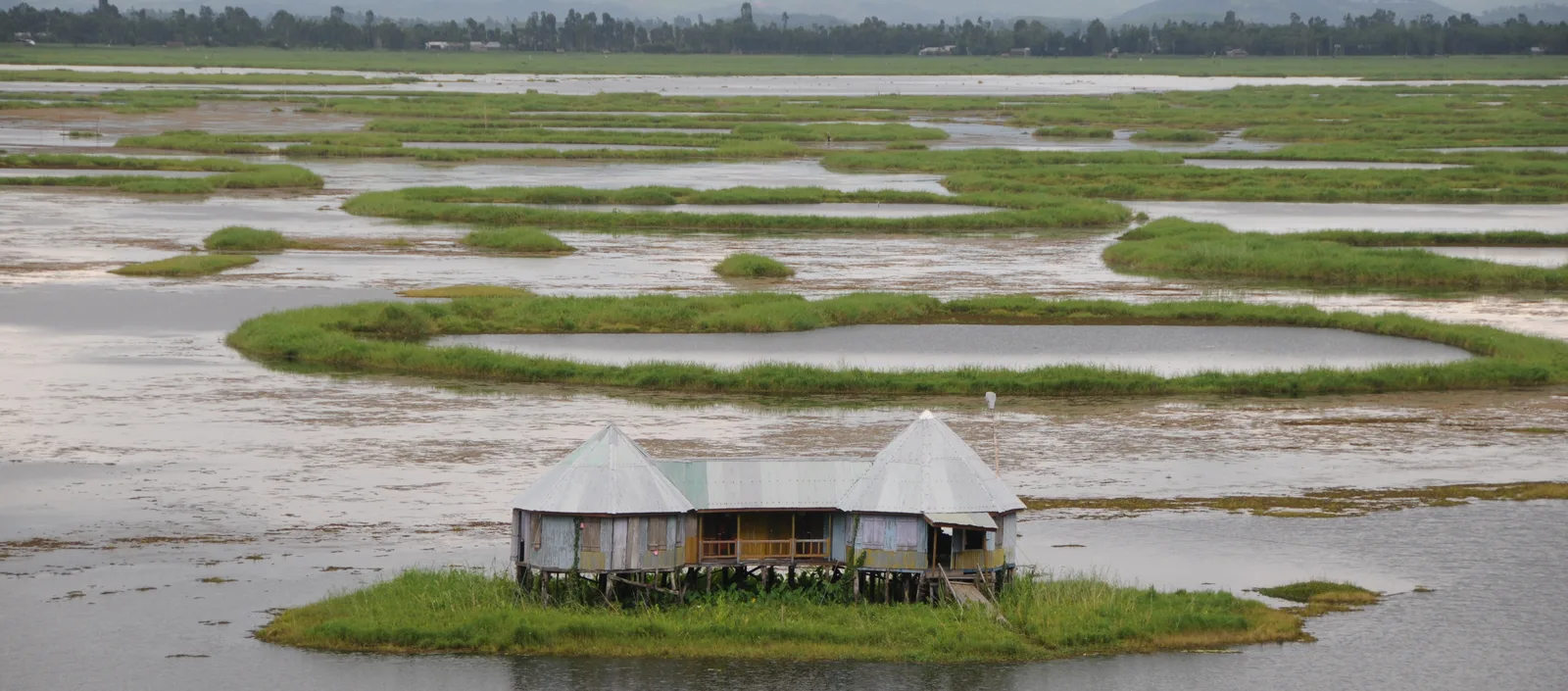
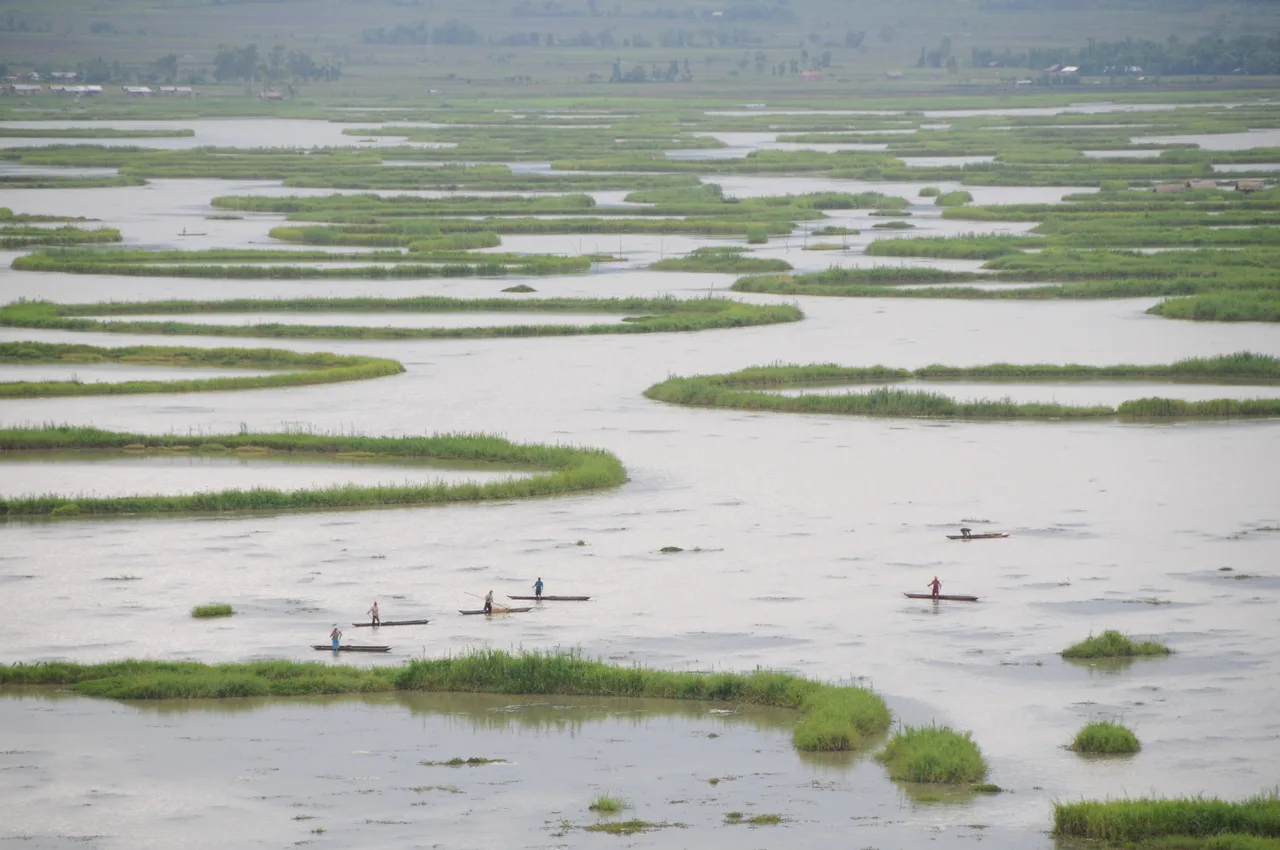
Begin with the department's own summary. Manipur Tourism calls Loktak, 48 km from Imphal, the largest fresh water lake in the North East Region — the Forest Department says the largest natural freshwater lake in North-East India — and describes a surface that behaves like no other lake in the country: the small islands in view from the shore are actually floating weeds on which the lake-dwellers live, among labyrinthine boat routes and colourful water plants. The state's nature pages name the phenomenon plainly: the lake is famed for its unique floating swamps, known as Phumdis. The Forest Department gives the phumdi its working definition — the unique floating biomass of vegetations, which forms meadows — a mat of vegetation and organic matter thickened until it can carry weight. The Environment Ministry records Loktak as a Ramsar site since 23 March 1990.
People live on the water, not just beside it. The National Informatics Centre's Imphal pages describe fishermen living in floating islands called phumdis in floating huts known as phumsangs, and the working lake is the sight as much as the scenery. The classic vantage is the one the department names first — from the Tourist Bungalow set atop Sendra Island, visitors get a bird's eye view of life on the Lake, with the Sendra Tourist Home and its cafeteria as the base on the lake's northern side; boating and other water sports are organised here in Takmu Water Sports Complex. Go onto the lake, not just up to it: a boat among the phumdis first, the Sendra viewpoint after, the national park on the same southern run.
SECTION 02Keibul Lamjao: A National Park That Floats, and the Deer That Dances on It
At the lake's south-eastern end, the phumdi thickens into the strangest protected area in India. Manipur Tourism's description is the one this guide follows: the only floating National Park in the world, on the Loktak Lake, 50–55 km from Imphal, which is the last natural habitat of the Sangai (Rucervus eldii eldii) the dancing deer of Manipur. The Forest Department, which manages the park, places it in the South-Eastern part of the Loktak Lake and explains why a deer can live on water at all: the phumdi meadows are the crucial habitat of Sangai. The supporting cast, from the tourism pages: hog deer, otter and a host of water fowls and migratory birds, sighted during November to March, with the Forest Department maintaining watch towers and two rest houses within the park — the towers are where a patient visitor waits for the deer.
The Sangai's official biography is a rescue told in four numbers. The deer — one of the endangered deer species in the world, now available only in Keibul Lamjao National Park, also called the Manipur Dancing Deer — was declared extinct in 1951 and then re-discovered at Keibul Lamjao in 1953. The first census of Sangai conducted in 1975 counted 14 heads only; the department took the initiative the same year and notified Keibul Lamjao National Park in 1977; and as per the 2016 ground census, the population of Sangai has reached 260. Two honest limits: no official page read publishes the park's entry fee or visiting hours, so neither is printed here; confirm both locally. If the wild deer stay hidden, the fallback stands in the city — the Manipur Zoological Garden at Iroisemba, 6 km from the centre, which also keeps the brow-antlered deer.
SECTION 03Moirang and Sendra: Where the INA Flag Rose
The lake's shore town carries the heaviest date in this guide. Moirang, 45 km from Imphal and situated near the Loktak lake, is in the department's telling one of the main centres of early Meitei folk culture, with the ancient temple of the pre-hindu deity, Lord Thangjing, and the Moirang Lai Haraoba, a ritual dance festival held every year in the month of May. Then the department changes register: it was at Moirang that the flag of the Indian National Army was first unfurled on April 14, 1944. The memorial is a state institution, not a plaque: the Department of Art & Culture records that the INA Martyrs' Memorial complex at Moirang was established in 1985 for Netaji Subhas Chandra Bose and the INA personnel who hoisted the tricolour there, that the INA Museum and Library are the two main components of the Memorial, and that the INA Museum displays more than 1000 museum objects and documents relating to the 2nd World War and Indian National Army movement — letters, photographs, badges of ranks and other memorabilia. Moirang, Sendra's viewpoint and Keibul Lamjao lie on the same southern run, with Bishnupur, 27 km out on the Tiddim Road — its 15th century Vishnu Temple and famous stoneware — as the stop back. One timing fact: the department's own report lists the I.N.A. War Museum at Moirang among the institutions that close every Monday and on general holidays, while remaining open on Sundays.
SECTION 04The Inner Line Permit: ₹100, Thirty Days, and the Paper That Opens the State
The state's own portal defines the document. The Manipur Inner Line Permit (ILP) is an official travel document authorized by the state government to regulate and permit the inward movement and stay of Indian citizens within Manipur for a specified duration, under Sections 2 and 4 of the Bengal Eastern Frontier Regulation, 1873, extended to the State of Manipur via the President of India's Order No. S.O. 4433(E) dated 11/12/2019. If you are an Indian citizen from outside the state, the permit is not optional, whichever gate you arrive at.
The tourist's version is the Temporary Permit, and here Manipur's portal — unlike Arunachal's, which defeated the Tawang guide in this series — prints its price list in the open: the Temporary Permit is for tourists, business visitors and short-term travelers; validity 30 days (non-renewable); fee ₹100; no sponsor required, and its application page adds that the permit requires a valid Government-issued Photo Identity Card, with an instant Aadhaar route using OTP verification. Apply online before you travel, or use the self-service ILP kiosks at Imphal Airport, Mao Gate and Jiribam Entry Point, where visitors can verify details, pay digitally and receive the ILP on their phones. One conflict, flagged rather than smoothed over: the portal's older how-to-apply document gives the Temporary Permit 15 days, where its current pages say 30 — this guide prints the live portal's 30 days. The longer permits exist for other lives — a sponsored Regular Permit at ₹500 for 3 months, a Special Category Permit at ₹5,000 (renewal ₹10,000) for 3 years — but the tourist needs only the ₹100 line.
Foreign nationals travel under a different document entirely, printed at the strength of the official text read. The Bureau of Immigration's current guidance lists the entire area of the state of Manipur as a Protected Area, and the Home Ministry's instructions, as restated on Indian missions' official pages, are that every foreigner, except a citizen of Bhutan, who desires to enter and stay in a Protected or Restricted Area is required to obtain a Special Permit — the Protected Area Permit — and that all PAP/RAP will be granted only on the e-FRRO portal; no physical permits will be issued. Lead times: approvals at least 30 days in advance for those applying with a visa, or through the jurisdictional FRRO at least 15 days in advance if already in India. The state information department announced in December 2024 that the Home Ministry had reimposed this regime after a long relaxation — treat the PAP as a before-you-book task.
SECTION 05Kangla and the Govindajee Temple: The Sacred Centre of Imphal
Imphal arranges itself around a walled green emptiness. Kangla was, in the tourism department's words, the centre of Manipur's power till 1891 — the historical embodiment of Manipur's rulers and its people — and what the visitor walks today is a sacred landscape rather than a ruin field: the department lists the Govindajee temple, outer and inner moat and other relics inside it. Its modern administration is a matter of statute: the Department of Art & Culture records that the Kangla Fort Board was constituted by the Government of Manipur to oversee the administration and development of the Kangla Fort under the Kangla Fort Act, headed by the Chief Minister as President. The department's working-hours note carries the one timing that matters: Kangla closes on every Monday and general holidays and is open on Sundays — do not leave it for a Monday. Nearby stands 1891's other memorial: the Shaheed Minar at Bir Tikendrajit Park, commemorating the patriotic Meitei and tribal martyrs who sacrificed their lives while fighting the British in 1891.
The living temple stands across the city at the palace it served. The tourism department describes Shree Shree Govindajee Temple as a historic Vaishnavite centre, adjoining Manipur's former Maharajas' Royal Palace, and gives its architecture in one clean inventory: twin domes, a paved courtyard, and a large raised congregation hall, with the shrines of Lord Krishna and Balaram and Jagannath flanking the two sides of the presiding deity. Its counsel for timing is devotional rather than administrative: the early hours prayer (aarti) is the moment it singles out. Pair the two sites in one morning: Kangla's moated quiet first, then the temple at its first aarti.
SECTION 06Ima Keithel and the War Cemeteries: The Mothers' Market, the Soldiers' Gardens
Imphal's market has no counterpart in India, and the tourism department's entry is the definitive short account. At Khwairamband Bazar — the Ima Market — it records a unique all women's market, having 3,000 or more "Imas" or mothers who run the stalls, split into two sections on either side of a road: vegetables, fruits, fishes and household groceries on one side, and exquisite handlooms and household tools on the other. Go in the morning, when the produce side is at full voice and the handloom halls are opening.
A few minutes away, the register changes. The tourism department notes the city's War Cemeteries, commemorating the British and Indian soldiers who died during the World War II, managed by the Commonwealth War Graves Commission, with little stone markers and bronze plaques recording the sacrifice. The Commission's own account gives the scale: Imphal War Cemetery contains 1,600 Commonwealth burials of the Second World War — begun with some 950 graves, then gathered in after the war when the Army Graves Service brought in graves from two smaller cemeteries and from isolated positions in the surrounding region — and it is open every day, 09:00–16:30 from March to September and 09:00–16:00 from October to February. Beside it stands the second ground: at the Imphal Indian Army War Cemetery, almost 1,700 Commonwealth service personnel are buried or commemorated; the Muslim dead were laid to rest there, while the Hindu and Sikh dead were cremated according to their faith and are commemorated by name on the Imphal Cremation Memorial at its heart.
SECTION 07Getting There, and When to Go
Fly, unless the road itself is the point. Imphal's airport is the Bir Tikendrajit International Airport at Tulihal; Manipur University's official account records air services available daily from Delhi, Kolkata and Guwahati, and the airport doubles as a permit gate — its arrivals hall is one of the ILP system's named channels, though the surer course is still the online permit bought before you board. There is, in the university's flat phrase, no direct train service in the state of Manipur: the nearest railway junction is Dimapur in Nagaland, approx 210 km from Imphal, and the road from there climbs through Kohima to enter Manipur at Mao Gate — allow the day for it, check the permit position for the Nagaland stretch as well, and note Guwahati at 479 km by road. Within the state: Loktak and Moirang make one southern day trip, Keibul Lamjao a longer one.
The seasons, as the official pages frame them, turn on the birds and the festivals. The migratory birds and waterfowl at Keibul Lamjao are a November to March sighting, in the lake's clear, cool season. May brings Moirang's Lai Haraoba; March–April is the blooming peak the department gives for the Khonghampat Orchidarium, 10 km from Imphal with over 110 rare varieties of orchids. One caution belongs here rather than in a footnote: Manipur's recent years have been unsettled, and conditions on its roads can change — check your government's current travel advice and the local position before you travel.
FAQFrequently Asked Questions
Do Indian citizens need a permit to visit Manipur, and what does it cost?
Yes. Every Indian citizen from outside Manipur needs an Inner Line Permit. The tourist's Temporary Permit is printed on the state's official ILP portal at ₹100, valid 30 days and non-renewable, with no sponsor required; you need a valid government-issued photo ID. Apply online at manipurilponline.mn.gov.in before you travel, or at the kiosks at Imphal Airport, Mao Gate and Jiribam. The portal's older how-to-apply document still shows a 15-day duration; its current pages state 30 days, which is what this guide prints.
Can foreign nationals visit Manipur?
Yes, on a different document. Foreign nationals do not use the ILP; the Bureau of Immigration lists the whole of Manipur as a Protected Area, so a Protected Area Permit (PAP) is required. Under the Home Ministry's instructions the PAP is granted only through the e-FRRO portal — no physical permits are issued — and approvals should be obtained at least 30 days in advance (15 days through the FRRO if you are already in India). The regime was reimposed in December 2024, per the state information department's announcement, so arrange it before booking.
When is the best time to see the Sangai deer and the floating park?
The deer live at Keibul Lamjao year-round, but the park's wider show is seasonal: Manipur Tourism places the waterfowl and migratory birds from November to March. Sightings of the shy Sangai are a matter of patience at the Forest Department's watch towers, not a guarantee — go early, wait quietly, and treat the department's own fallback as a genuine second chance: the Manipur Zoological Garden at Iroisemba, 6 km from central Imphal, also keeps Sangai. No official page read publishes the park's entry fee or hours, so confirm both locally before the drive.
Is Kangla open every day?
No. The Department of Art & Culture's own working-hours note lists Kangla among the institutions that close every Monday and on general holidays, while remaining open on Sundays. The same Monday closure applies to the Manipur State Museum and the I.N.A. War Museum at Moirang. Plan both for any day but Monday; the war cemeteries are open every day.
How many days does an Imphal and Loktak trip need?
Three full days is the honest minimum. One for Imphal itself — Kangla, the Govindajee Temple at its early aarti, Ima Keithel in the morning and the war cemeteries. One for the southern run: Bishnupur's Vishnu temple, Moirang and the INA Museum, and Sendra's viewpoint over Loktak. One for Keibul Lamjao, 50–55 km away, with boat time on the lake itself. Fly in and out, unless the Dimapur–Kohima road journey is itself the point.
Official references and checking status
Checked on 5 November 2026 against the official sources listed below. Four limits are flagged honestly. First, the ILP fee IS printed — ₹100 for the Temporary Permit — because the state portal publishes its fee schedule openly; but the portal's older how-to-apply document gives the Temporary Permit 15 days against the current pages' 30, so the guide prints the live portal's figure. Second, no entry fee or opening hours are printed for Keibul Lamjao or Kangla: no official page read publishes either; Kangla's Monday closure, by contrast, IS printed, from the Department of Art & Culture's own administrative report. Third, the foreign-visitor position rests on the Bureau of Immigration's current listing of the whole of Manipur as a Protected Area and the Home Ministry's instructions (e-FRRO only, no physical permits); the December 2024 reimposition is carried as the state information department's announcement. Fourth, the Sangai's numbers are the Forest Department's published line (extinct 1951, rediscovered 1953, 14 counted in 1975, 260 in the 2016 census); later counts in the press are not printed.
- Manipur Tourism (official) — Places to See: Loktak, Keibul Lamjao, Moirang, Ima Keithel, Kangla, the Govindajee Temple
- Manipur Tourism (official) — Nature and Wildlife: the phumdis, Keibul Lamjao at 50–55 km
- Government of Manipur (official) — the Inner Line Permit portal: the ₹100 Temporary Permit, 30-day validity, kiosks, legal basis
- Government of Manipur (official) — the Temporary Inner Line Permit: photo ID and the instant Aadhaar route
- Forest Department, Government of Manipur (official) — the Sangai and Keibul Lamjao: the 1951–2016 census story
- Department of Art & Culture, Manipur (official) — the INA Martyrs' Memorial, Moirang
- Department of Art & Culture, Manipur (official) — Manipur State Archaeology: the Kangla Board
- Commonwealth War Graves Commission (official) — Imphal War Cemetery: 1,600 burials and the visiting hours
- High Commission of India (official) — Protected/Restricted Area Permits: Manipur, e-FRRO only, the lead times
- Manipur University (official) — How to reach Imphal: flights, the Dimapur railhead, the Guwahati road
Photos: Loktak Lake — a stilt house on its own phumdi, the ringed floating meadows behind it, by Sharada Prasad CS, via Wikimedia Commons, licensed under CC BY 2.0; fishermen in narrow canoes among the phumdi strips near Moirang, by Sharada Prasad CS, via Wikimedia Commons, licensed under CC BY 2.0. Photographers keep their copyright; the licences require this credit.
General information only. This guide is based on official sources publicly available and checked on the date shown on this page. Visa rules change, and consular and USCIS officers decide every case on its own facts — nothing here is a confirmation or a guarantee for your individual case, and this is not legal advice. Always confirm the current requirement on the official page linked in this guide before you act, and consider a qualified immigration attorney for your specific situation.