
Researched & checked — 3 Nov 2026
Kohima and the Hornbill Festival: Kisama, the War Cemetery and the Permit, Planned on Official Facts
NEW Published 3 November 2026
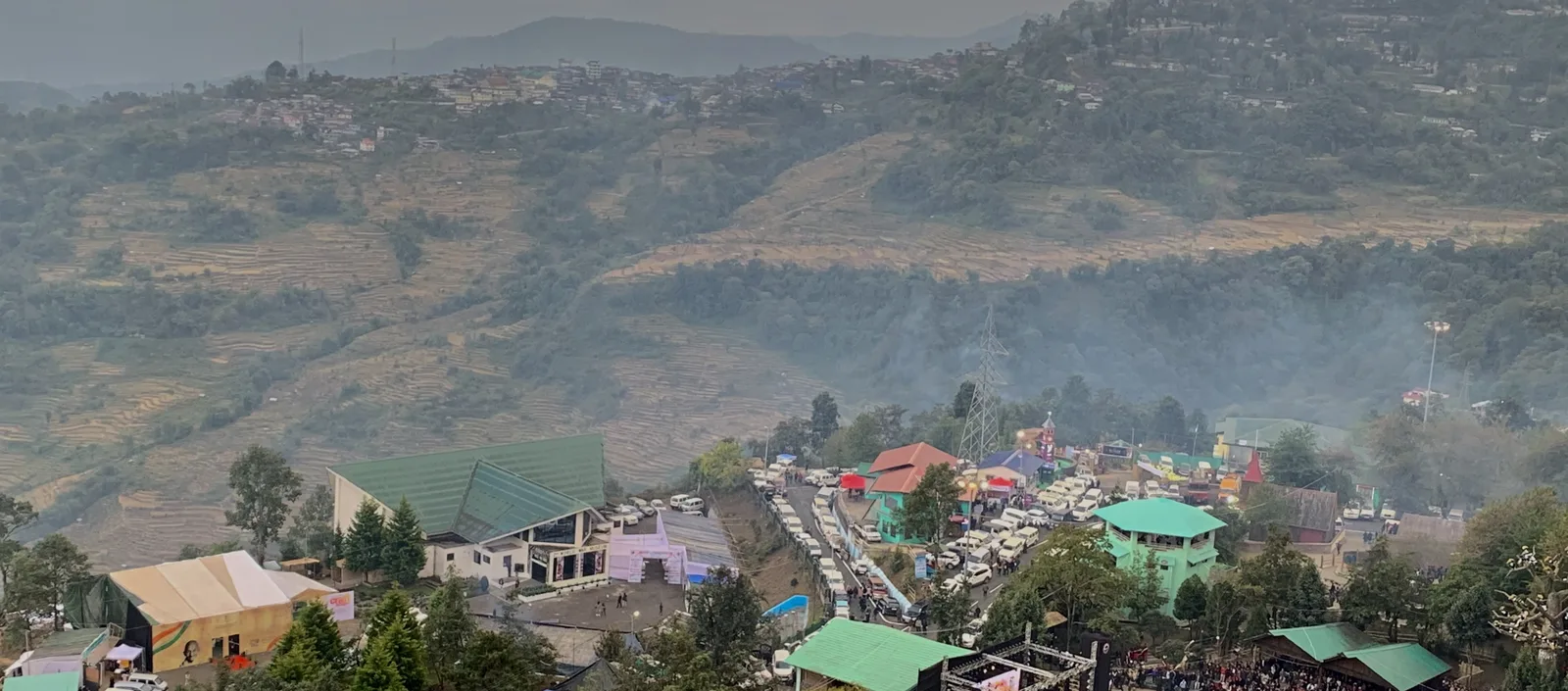
Kohima asks one piece of paperwork before it offers anything else: an Inner Line Permit that the state's own portal prices, times and explains. Beyond that gate stands a ten-day festival of seventeen tribal morungs at Kisama, a war cemetery whose two lines of verse are known around the world, and a museum holding the heritage of sixteen tribes. Each fact here comes from Nagaland's Tourism Department, the state ILP portal, the CWGC and the Ministry of Tourism.
Every non-indigenous visitor to Nagaland needs an Inner Line Permit (ILP): apply online at the state's ILP portal; a domestic tourist permit costs ₹200 per person and lasts 30 days (foreign tourists ₹500, also 30 days), tourists need no guarantor, and approval applied for in working hours may come within 4 hours. The Hornbill Festival runs at the Naga Heritage Village, Kisama, about 12 km from Kohima — the Tourism Department's announced next edition is 1–10 December 2026. In town, the Kohima War Cemetery holds 1,420 Commonwealth burials and the famous epitaph (open 9:00 AM–4:00 PM); the Nagaland State Museum is open 10:00 AM–4:00 PM, closed Sundays and public holidays.
SECTION 01The Hornbill Festival at Kisama: Ten Days, Seventeen Morungs
Start with the dates, because everything else in a Kohima December arranges itself around them. Nagaland's Tourism Department — the state body that organises the festival — currently lists its next event plainly: the Hornbill Festival, 1–10 December 2026. The department describes a ten-day annual tourism promotional event, conceptualised in 2000 and organised by the State Government to showcase Nagaland's rich cultural heritage. The numbering confirms the rhythm: December 2024 was billed as the 25th edition, and the state's Information and Public Relations department recorded the 26th opening on 1 December 2025 at the same venue. This festival keeps a fixed place in the calendar.
The venue is half the experience. The festival is held at the Naga Heritage Village at Kisama, about 12 km from Kohima, a purpose-built complex whose centrepiece, in the Tourism Department's description, is a cluster of seventeen indigenously designed houses — called morungs, meaning youth dormitories — each representing a different Naga tribe. A morung was traditionally where a village's young men were housed and taught; at Kisama the seventeen stand in one complex, so a visitor can walk from one tribe's architecture, carving and kitchen to the next in minutes. The complex also holds a World War II Museum, carrying Kohima's other story into the festival ground.
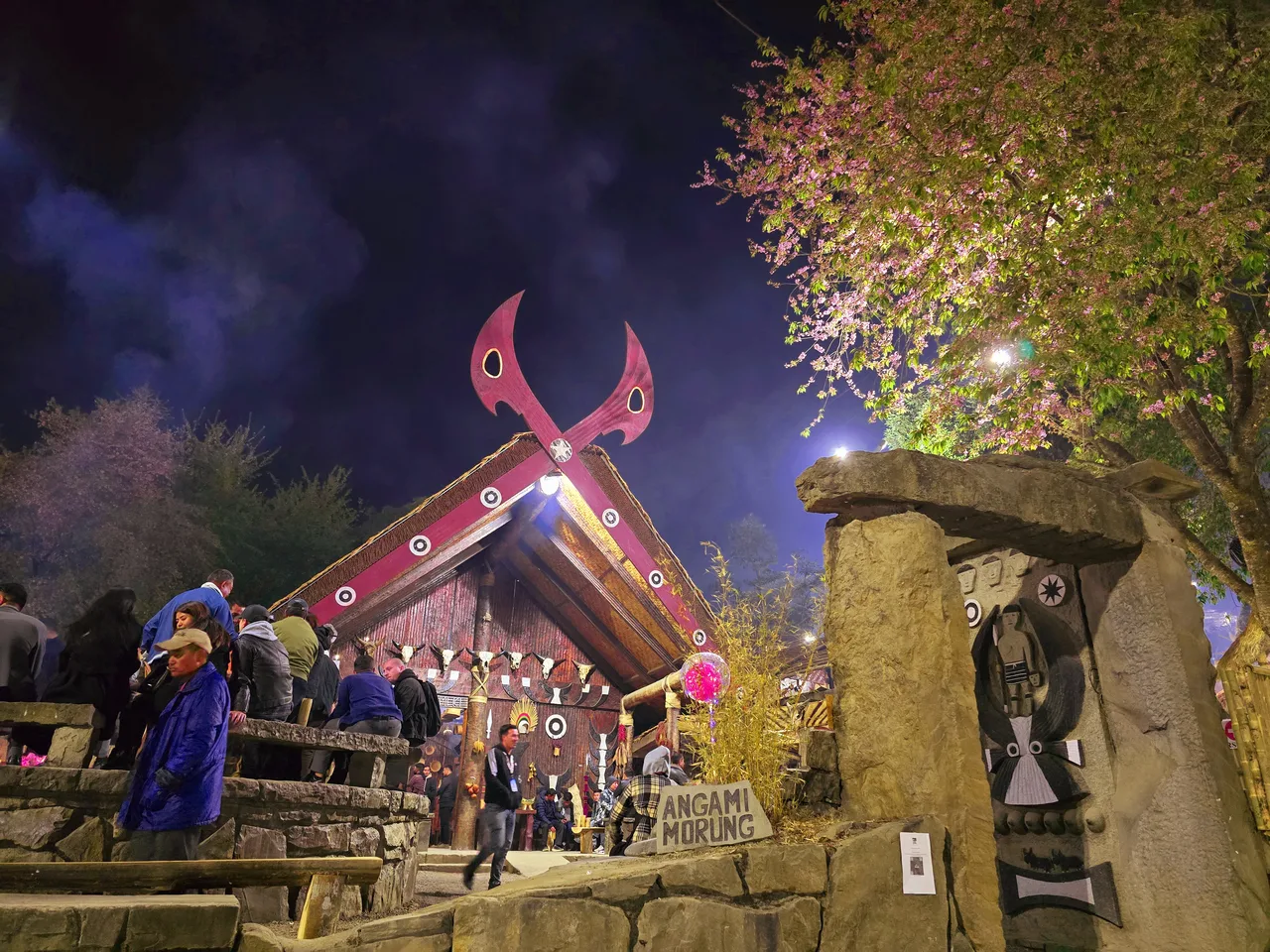
The festival's nickname, on the department's events page, is the "Festival of Festivals" — earned by accumulation rather than one headline act. There is no single stage show to plan around; there are ten days of parallel events, and Section 02 lays out what the department itself lists.
SECTION 02What the Festival Actually Contains
The Tourism Department's events page lists sixteen strands. The core is ten days of cultural performances by the different Naga tribes — dance, song and ceremony in traditional dress in the heritage village's arena. Around it: handlooms and handicrafts, flora and vegetation displays, indigenous games and sports, a local cuisine and food festival, village walks and treks, a cultural exchange programme, arts and crafts, and an exhibition-cum-sale of tourism products. Food is a strand in its own right: the morungs serve their own tribes' cooking, and the Naga King Chilly and Pineapple Eating Competitions are on the official list.
The named fixtures give a week its landmarks. The Hornbill Music Festival runs alongside, with handshake concerts and rock contests. There is a World War II Rally, tying the festival to the 1944 battle up the hill; an International Loin Loom event for the backstrap weaving tradition; the International Hornbill Naga Wrestling championship; a Bamboo Carnival and Night Carnival; and adventure activities including mountain biking and Dzukou Valley day hikes — the valley of Section 06, offered as an organised excursion from the festival.
One cost question must be answered honestly: this guide prints no entry fee for the Hornbill Festival or for Kisama, because no official page read states one. The documented paperwork cost is the Inner Line Permit of Section 03; for the festival itself, carry cash and check the Tourism Department's site near the dates. Officialdom does record how visitors moved in a recent edition: for 2024 the department ran daily city bus shuttles from three Kohima points — ISBT at ₹80, NST Station at ₹70 and PR Hill Junction at ₹50 — first bus 8:00 AM, last return 9:00 PM, plus a free bus from Kigwema parking. Those are 2024's arrangements, a precedent rather than a promise: confirm the current edition's terms first.
SECTION 03The Inner Line Permit: The Paperwork That Comes First
Nagaland's permit is not a tourism formality invented for festivals; it is one of India's oldest entry controls. The state's ILP portal explains the basis itself: under the Bengal Eastern Frontier Regulation of 1873 — in force in the Naga Hills since 1873 — any person, Indian or foreign, who is not an indigenous inhabitant of the area must obtain an Inner Line Permit to enter the state for a limited period. That includes Indian citizens from every other state, with no festival exemption. The permit is checked: the state's revised guidelines state that ILP checking is done only by authorised government agencies, and that hotels, guest houses and homestays must inform the police about guests from outside the state.
The online route is the one the state pushes, and the portal's FAQ walks through it. Go to the Nagaland online ILP portal (ilp.nagaland.gov.in), open ILP services and choose Apply new ILP. Select your category — the portal lists Tourist, Businessman, Trader, Labourer, Teachers, Student and Priest — enter your phone number, verify it with the OTP sent to it, fill the form and submit. Two points matter to tourists. First, tourists do not need a guarantor — a holiday application stands on its own. Second, a local contact is required: have your hotel's or a Nagaland contact's details ready first.
The portal also publishes how long approval takes, which is rarer than it should be in Indian paperwork. A tourist ILP applied for during working hours may be approved within 4 hours; applied for outside working hours, within the first 3 hours of the next working day. Other categories take a few hours to two or three working days; approval comes by SMS. The fees are published just as plainly: a Tourist (Domestic) ILP costs ₹200 per person, valid 30 days; a Tourist (Foreigner) ILP costs ₹500 per person, also 30 days; payment-gateway charges are extra. Thirty days of validity means one permit covers a festival trip with excursions — no need to time the application to the day. The manual route remains: ILPs are also issued through the Nagaland Houses in other cities and the district Deputy Commissioner's office.
Two recent changes belong in the record. The portal's notifications include consolidated ILP guidelines dated 20 September 2024 and the implementation of ILP for Chümoukedima and Niuland districts dated 14 August 2025 — the permit net has been extended, not loosened. The state's Information and Public Relations department records that the Deputy Commissioner of Dimapur's revised guidelines, covering Dimapur including Chümoukedima and Niuland, took effect following a Cabinet decision dated 7 August 2025, with the same tourist terms: ₹200 domestic, ₹500 foreign, 30 days each. For foreign visitors the guidelines add that the foreign tourist ILP is subject to valid Protected Area Permit (PAP) and visa requirements — the ILP sits alongside India's protected-area rules, not instead of them. In a system being actively revised, the portal is the authority: read its guidelines before applying.
SECTION 04The Kohima War Cemetery: The Tennis Court and the Epitaph
Kohima's other claim on the world's attention is a hillside of graves in the middle of town. The cemetery stands on Garrison Hill, overlooking the city, and the Commonwealth War Graves Commission — which cares for it — tells the ground's story itself. The first burials were made during the fighting, in 1944; in August 1948 the cemetery passed into the care of the War Graves Commission. Its architect, Colin St Clair Oakes, designed the terraced ground around two survivals of the battle: the tennis court of the Deputy Commissioner's residence, and the only cherry tree to survive the battle.
The battle those features belonged to is summarised by the Commission starkly. On 3 April 1944 a Japanese force of some 15,000 attacked Kohima; the garrison numbered about 2,500, only half of them combat troops. After two weeks the defenders held only 350 square metres around the tennis court; relief arrived at dawn on 18 April. The tennis court is no curiosity in the layout — it is the centre of the ground the battle was fought over, and the terraces of graves step down the hill around it.
The numbers, from the Ministry of Tourism's listing: 1,420 Commonwealth burials of the Second World War lie here, plus one non-war burial; the Kohima Cremation Memorial commemorates 917 Hindu and Sikh soldiers — the Commission's account gives the scale as more than 1,400 buried and more than 900 commemorated. And on the 2nd Division Memorial stands the epitaph that has made this hillside famous far beyond military history, quoted exactly as the Commission records it: "When you go home, tell them of us and say, for your tomorrow, we gave our today." The listing gives the timings as opening 9:00 AM, closing 4:00 PM — plan a morning or early-afternoon visit, and give it unhurried time. Nearby stands the Cathedral Church, a striking blend of Gothic and Naga styles, with stained glass.
SECTION 05Around Kohima Town: The Museum and the Cathedral
If the festival shows Nagaland performing its heritage, the Nagaland State Museum is where the state keeps it. The Ministry of Tourism's listing places it on Bayavu Hill, one of two museums maintained by the Directorate of Art and Culture, Nagaland, open to the public since 1970. Its galleries hold the heritage of Nagaland's sixteen tribes: clan motifs, necklaces and precious stones, traditional costumes and inscriptions, models of the morung — the traditional Naga hut — that stands full-size at Kisama, and instruments crafted from bamboo and buffalo horns, with an art gallery alongside. For a festival visitor it is the ideal primer: an hour here explains what the seventeen morungs mean. The published timings are 10:00 AM–4:00 PM, closed on Sundays and public holidays — note the Sunday closure when sequencing a short trip.
The town's other landmark is the Catholic Cathedral on Aradura Hill, whose stained-glass windows the museum listing itself points visitors towards. Between the cathedral, the cemetery on Garrison Hill and the museum on Bayavu Hill, Kohima's in-town circuit needs nothing more than a taxi by the hour and a sensible order: cemetery in the morning, museum before its 4:00 PM close, cathedral as the day ends. In festival week these sights are the counterweight to Kisama, most visitable on the ten days' quieter mornings.
SECTION 06Dzukou Valley: The Add-On Trek, at Official Strength
The excursion that completes a Kohima trip crosses into the valley on Nagaland's southern edge. The Ministry of Tourism's page for Dzukou Valley describes a trek of approximately nine kilometres, about five to six hours, with two routes up from the Nagaland side: the established Viswema route, which offers a vehicle ride to the trek's starting point, and the newer, shorter Jakhama route. Its practical instruction is unambiguous: it is important to have a local guide with you. Even the name is landscape commentary — one recorded account derives Dzukou from a word shared by the Angami and Mao languages, translated as "cold water", after the stream through the valley.
The festival itself points here: Dzukou Valley day hikes appear in the Tourism Department's own list of Hornbill's adventure activities, so in December the trek can be taken as an organised outing from Kisama. Outside festival week, arrange the guide and transfer through your Kohima hotel. On fees, this guide's rule applies in full: no Dzukou entry fee is printed here, because no official tariff could be read — unofficial figures seen while researching ranged from ₹30 to ₹300, so printing any would be a guess. The documented permit for the trip is the state ILP of Section 03; if the trailhead levies a locally set charge on the day, it is payable there — carry cash, and treat any website's confident figure as unverified.
SECTION 07Getting There, and Festival Week Versus the Rest of the Year
Kohima has no airport or railway station of its own; the official listings name the same gateway twice. Both the cemetery and museum pages give the nearest airport as Dimapur Airport (DMU) and the nearest railway station as Dimapur (DMV). The journey has two stages: reach Dimapur — by air, or by rail on the main line through Assam — then take the hill road up to Kohima by taxi or bus. Treat that road leg with patience rather than a timetable: hill roads keep their own schedule, and in festival week every vehicle in Dimapur seems to be climbing the same road. Arriving the day before the festival opens beats arriving on its morning.
The season argues for December beyond the festival. The Ministry of Tourism's climate figures give December days between 3.2 °C and 20.9 °C and November between 6.4 °C and 25.4 °C — cold nights, clear cool days, cherry blossom around the cemetery terraces. Pack for the night temperature, not the noon one, especially for Kisama's evening programme. Festival week is Kohima at its fullest: rooms and taxis are scarcest, and the ILP and the booking should both be done well ahead — the permit's 30-day validity removes any reason to leave it late. The rest of the year inverts everything: the cemetery, museum and cathedral keep their published hours, Dzukou is walked in its greener seasons, and Kohima is a quiet hill capital. Come in December for the morungs lit at night; come in another month for Garrison Hill at walking pace.
FAQFrequently Asked Questions
I am an Indian citizen. Do I really need a permit to visit Nagaland?
Yes. The state's ILP portal states that under the Bengal Eastern Frontier Regulation of 1873, in force in the Naga Hills since 1873, anyone who is not an indigenous inhabitant — Indian citizens included — must hold an Inner Line Permit to enter Nagaland. Apply online at ilp.nagaland.gov.in (ILP services → Apply new ILP → Tourist category → phone number and OTP → submit). A domestic tourist ILP costs ₹200 per person, valid 30 days; tourists need no guarantor but must give a local contact; approval in working hours may come within 4 hours, confirmed by SMS. Manual issue is available through Nagaland Houses and Deputy Commissioners' offices.
When and where is the Hornbill Festival held?
At the Naga Heritage Village, Kisama, about 12 km from Kohima. The Nagaland Tourism Department — the festival's organiser — describes a ten-day annual event, conceptualised in 2000, and currently lists the next edition as 1–10 December 2026. The complex holds seventeen indigenously designed houses (morungs, or youth dormitories), one for each tribe represented, plus a World War II Museum. December 2024 was billed as the 25th edition and the 26th opened on 1 December 2025, so the early-December window is a fixture: plan rooms, taxis and the ILP ahead.
What does the Hornbill Festival cost to enter?
This guide prints no entry fee, deliberately: no official page read states a ticket price for the festival or for Kisama. The documented paperwork cost is the Inner Line Permit — ₹200 per person for a domestic tourist, valid 30 days. For festival-week movement, the published precedent is the Tourism Department's 2024 shuttle arrangement: daily buses from ISBT (₹80), NST Station (₹70) and PR Hill Junction (₹50), first bus 8:00 AM, last return from Kisama 9:00 PM, plus a free bus from Kigwema parking. Those are 2024's fares, not the coming edition's — carry cash and check tourism.nagaland.gov.in near the dates.
What is the famous Kohima epitaph, and how many are buried in the War Cemetery?
The Ministry of Tourism's listing counts 1,420 Commonwealth burials of the Second World War (plus one non-war burial), with the Kohima Cremation Memorial commemorating 917 Hindu and Sikh soldiers; the Commonwealth War Graves Commission, which has cared for the cemetery since August 1948, describes more than 1,400 buried and more than 900 on the memorial. Architect Colin St Clair Oakes built the terraces around the Deputy Commissioner's tennis court — centre of the garrison's last 350 square metres in April 1944 — and the battle's only surviving cherry tree. The epitaph on the 2nd Division Memorial reads: "When you go home, tell them of us and say, for your tomorrow, we gave our today." Open 9:00 AM–4:00 PM.
Can I add the Dzukou Valley trek to a Kohima trip?
Yes — the Tourism Department itself lists Dzukou Valley day hikes among the Hornbill Festival's adventure activities. The Ministry of Tourism's page describes a trek of approximately nine kilometres taking about five to six hours, by the established Viswema route (with a vehicle ride to the starting point) or the newer, shorter Jakhama route, and stresses that a local guide is important. No entry fee is printed here: no official tariff could be read, and unofficial figures conflict wildly (₹30–₹300 seen). The permit the trip documents is the state ILP; carry cash for any locally set trailhead charge.
Official references and checking status
Checked on 3 November 2026 against the official sources listed below; the accompanying sources file maps each claim to its page. Four limits are flagged honestly. First, no entry fee for the Hornbill Festival or Kisama is printed, because no official page read states one. Second, no Dzukou Valley fee is printed: no official tariff could be read, and unofficial figures ranged from ₹30 to ₹300. Third, the shuttle fares quoted are the Tourism Department's 2024 arrangements, labelled as a precedent. Fourth, hornbillfestival.com presents itself as the festival's own site, but every load-bearing claim here rests on the Tourism Department's own domain (tourism.nagaland.gov.in) and the ILP portal. Confirm prices, dates and permit rules on the official sites before you travel.
- Nagaland online ILP portal (official) — FAQ: who needs an ILP, the flow, fees and validity
- Nagaland DIPR (official) — DC Dimapur's revised ILP guidelines: coverage, fees, the PAP condition
- Nagaland Tourism Department (official) — the Hornbill Festival's announced dates
- Nagaland Tourism Department (official) — Hornbill Festival events page: the sixteen strands
- Nagaland Tourism Department (official) — Kisama Heritage Village: seventeen morungs, about 12 km from Kohima
- Incredible India, Ministry of Tourism (official) — Kohima War Cemetery: burials, architect, timings, access
- Incredible India, Ministry of Tourism (official) — Nagaland State Museum: Bayavu Hill, timings, closures
- Incredible India, Ministry of Tourism (official) — Dzukou Valley: trek length, routes, guide advice
Photos: The Kisama festival arena at dusk during the Hornbill Festival, by Aravind Manickam, via Wikimedia Commons, licensed under CC BY-SA 4.0; the Angami morung at Kisama lit up at night, by JyotiPN, via Wikimedia Commons, licensed under CC BY-SA 4.0. Photographers keep their copyright; the licences require this credit.
General information only. This guide is based on official sources publicly available and checked on the date shown on this page. Visa rules change, and consular and USCIS officers decide every case on its own facts — nothing here is a confirmation or a guarantee for your individual case, and this is not legal advice. Always confirm the current requirement on the official page linked in this guide before you act, and consider a qualified immigration attorney for your specific situation.