
Researched & checked — 31 Oct 2026
Jodhpur and Jaisalmer: Mehrangarh, the Living Fort and the Desert, Planned Properly
NEW Published 31 October 2026
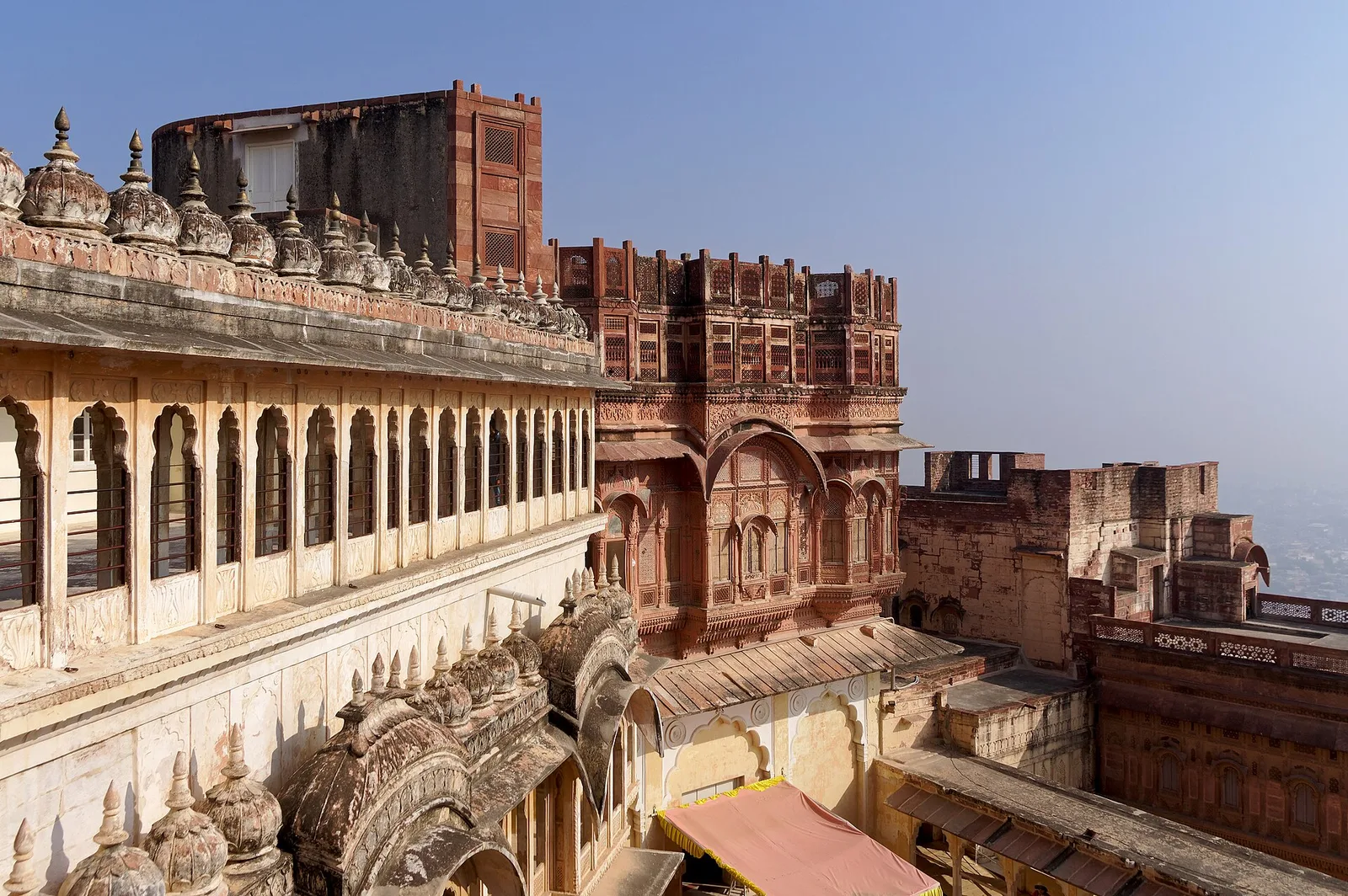
Western Rajasthan pairs India's best-run fort museum with its most improbable town. Mehrangarh's trust publishes every charge it makes — entry, elevator, audio guide, guide bands — and this guide prints them all. Jaisalmer's golden fort, still lived in, charges nothing at its gates; what its palace museum charges could not be read from an official page, so this guide says that instead of guessing, and explains the desert's price-free-for-all honestly.
At Mehrangarh, on the Museum Trust's published table: international visitors pay ₹800 — with the audio guide included — and domestic visitors ₹200; students pay ₹500 and ₹100 respectively, senior citizens ₹100 on the domestic side, and the elevator costs ₹50 one way. The fort museum keeps 9 am to 5 pm, open all days. Jaswant Thada, down the hill, is ₹100 / ₹50 on the same Trust's table. Jaisalmer Fort charges nothing to enter — it is a living town — while its palace museum is ticketed at its own counter at a figure this guide does not print, because no official tariff for it could be read (Section 05 explains). At the Sam dunes there is no official price for a camel or a jeep: agree the whole quote, in writing where you can, before you leave town.
SECTION 01Mehrangarh: The Full Published Tariff
Mehrangarh, the Rathore citadel on its cliff above Jodhpur's blue old city, is run as a museum by the Mehrangarh Museum Trust — and the Trust does the single most useful thing a ticketed monument in India can do: it publishes the whole tariff on its official site. Read at that page, the charges are:
- International visitor: ₹800 — and the Trust notes that the audio guide is included in the international admission fee
- International visitor, student concession: ₹500
- Domestic visitor: ₹200
- Domestic visitor, student and senior-citizen concession: ₹100
- Elevator, one way: ₹50
- Audio guide (for those whose ticket does not include it): ₹180; student and senior-citizen concession ₹120
- Guides, paid directly to the guide: ₹500 for 1–4 visitors, ₹600 for 5–15, ₹800 for 16–30, ₹1,000 for 31–50, taxes included
The frame around the figures matters as much. The museum keeps timings of 9:00 to 17:00 and is open all days, and the Trust notes that ticket sales close at 17:00 — this is a museum that runs to its clock, so the last entry is a mid-afternoon habit rather than a sunset one. One date is worth knowing before you fix an itinerary: on Jodhpur Foundation Day, 12 May, entry is free for all guests, with only the elevator charges applying. And one omission is deliberate: the Trust's published table lists no camera or video charge, so this guide prints none — if a camera fee is asked at the counter, it is the counter's current practice, not a published tariff.
SECTION 02Inside the Fort, and Jaswant Thada Below
What the ticket buys is the best-kept palace museum in Rajasthan: a sequence of courtyard apartments — the palanquins and howdahs, the armoury, the miniature paintings and textiles the Trust's collection pages describe — climbed through gate after battle-marked gate, with the cannons on the ramparts and the whole blue city laid out below the walls. Give it half a day and take the audio guide seriously: for international visitors it is already in the price, and for domestic visitors at ₹180 it is the cheapest expertise in the fort. The elevator, at ₹50 one way, exists for the climb between the entrance level and the palace courts; the sloping stone ramps are otherwise the route, and they are part of the fortress's argument — this place was built to be hard to enter.
Down the same hill road, in the Trust's care as well, Jaswant Thada is the marble counterweight: the cenotaph built by Maharaja Sardar Singhji in memory of Maharaja Jaswant Singh II, completed in 1906 and often described — the Trust repeats the phrase — as the "Taj Mahal of Marwar". Its published tickets are ₹100 for international visitors and ₹50 for domestic visitors, with guides charged by group size and paid directly (₹150 for a group of one to four), and it keeps the same 9:00 to 17:00, open all days. Do it on the way down from the fort, in the late-afternoon light the marble was made for, and the two sites read as one composition: the fortress of war above, the memorial of peace below.
SECTION 03The Desert Rock Park and the Blue Streets
The fort's Trust runs one more Jodhpur site, and it is the city's quiet bargain. The Rao Jodha Desert Rock Park, created in 2006 to restore the rocky wasteland ecology at the fort's feet, spreads across 70 hectares of volcanic rock and desert planting, entered from a visitors' centre 800 metres from the main fort gate. The Trust's page prices it simply: tickets ₹100, with a naturalist hired for a guided walk at ₹200. Its hours are seasonal — 7:00 to 18:30 from April to September, 8:00 to 17:30 from October to March — which makes it the early-morning walk of a Jodhpur stay, best before the fort's 9 am opening or after its close. Below, the old city's lanes — the blue-washed Brahmin houses under the cliff, the Clock Tower and Sardar Market at their centre — are ordinary public streets: no ticket, no gate, and the correct price for wandering them is the price of a cup of tea.
SECTION 04The Road West: Jodhpur to Jaisalmer
Between the two cities lies the journey that organises the whole trip: the better part of 300 kilometres of desert highway, or the railway that crosses the same Thar more slowly. Both exist in ordinary, bookable forms — Rajasthan's state road transport and private buses run the road through the day, and direct trains link the two stations — but this guide prints no fare and no timetable for either, because neither could be read from an official table in this pass, and desert services are revised too often for a printed figure to stay honest. Treat the crossing as half a day, not a transfer: leave Jodhpur after the fort, arrive in Jaisalmer by evening, and give the golden fort a full day of its own rather than a same-day raid. Confirm trains on Indian Railways' official channels and buses with the state transport corporation when you book; the mechanism is reliable even where this page will not quote its price.
SECTION 05Jaisalmer: A Fort You Do Not Buy a Ticket For
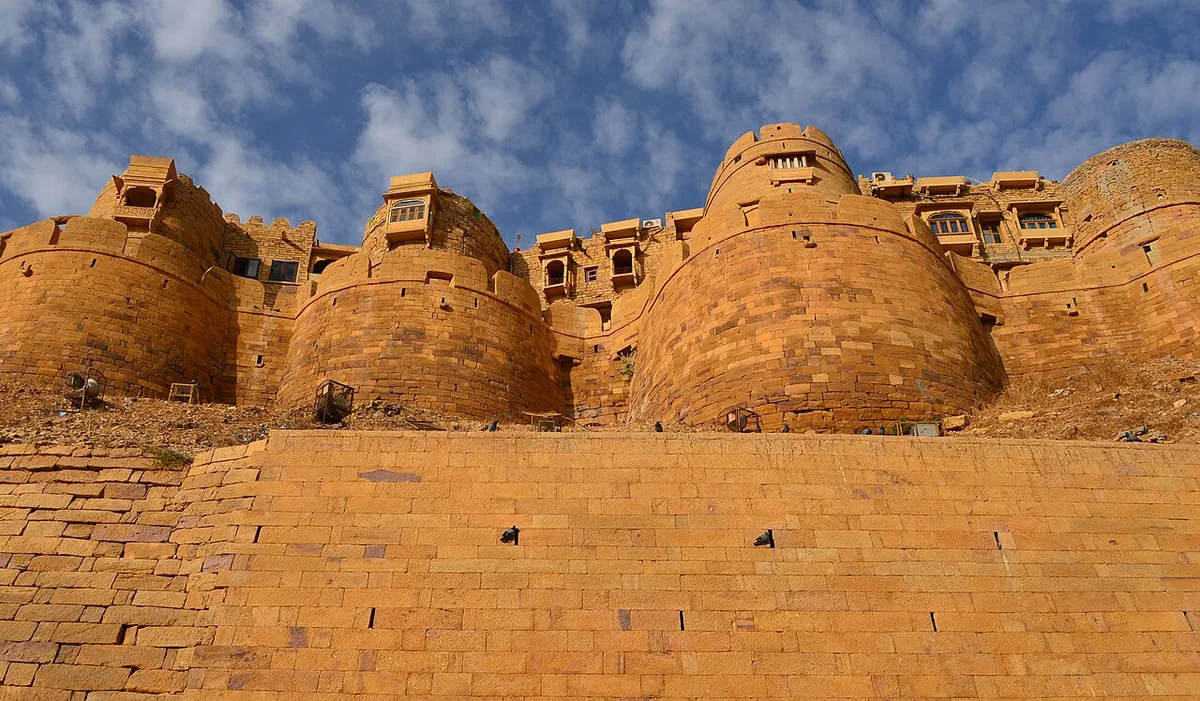
Jaisalmer Fort breaks the rule every other Indian fort teaches. Founded in 1156 on Trikuta Hill, it is one of the world's few living forts: Rajasthan Tourism's own description records that nearly one fourth of the old city's population still resides within the fort — families in houses centuries old, shops in the lanes, temples in use. A town cannot sell you a ticket to itself, and none is sold: there is no gate ticket for Jaisalmer Fort. You walk up through its gates — Akhai Pol, Suraj Pol, Ganesh Pol, Hawa Pol — into streets that are public because they are lived in, and the ramparts and lanes are yours for the walking at any hour the town is awake.
What is ticketed inside are the institutions, each at its own counter. The Fort Palace Museum — the former Maharawals' palace rising over Dussehra Chowk, its galleries holding the coronation throne, armoury and royal apartments — sells its own ticket, as do the Jain temples nearby. This guide prints neither figure, and the reason is the same discipline applied elsewhere in Rajasthan: no official page publishing the palace museum's tariff could be read for this guide — the state's archaeology and tourism sites were unreachable throughout checking, as they were for earlier guides in this series — and the figures published elsewhere do not agree with one another, differing by multiples rather than rupees. A number chosen from that disagreement would be a guess wearing a citation. So: budget for a modest museum ticket, read it at the counter in Dussehra Chowk, and know that the fort around it — the thing you came for — costs nothing.
The same rule governs Patwon ki Haveli, the five-mansion cluster of the brocade merchants in the lanes below the fort. Parts of the complex are state-run — the state archaeology department is even housed in it — and parts are a private family museum; each section tickets at its own door. For the state sections, the Rajasthan pattern of this whole series applies: the department's prices are not published in any readable official place, and secondary figures conflict, so no figure is printed here. The haveli's carved façade, one of the great street walls of India, is free from the lane in any case; go in the morning, when the lane's light rakes across the stonework, and decide at each door whether that section's counter price buys your next half hour.
SECTION 06Sam: The Dunes and the Unpriced Desert
Forty kilometres west of Jaisalmer the road gives out into the Sam dunes, and every visitor's last evening arranges itself the same way: out before sunset, a camel or a jeep into the sand, the light going down over the Thar, and back to town — or on to a desert camp for dinner, music and a night under a very large sky. What must be understood before you price any of it is that there is no official tariff for the Sam desert: no government rate card fixes a camel ride, a jeep circuit or a camp night. The sellers are private operators and camps, the prices are negotiated, and they move with season, crowd and your own patience. Any page that quotes you an exact official camel price is inventing its authority.
So buy the desert the way locals sell anything unpriced: by specifying it. A complete quote names the vehicle or the camel, how many people it covers, how far into the dunes it goes and for how long, whether sunset is watched from the crowded main dune or a quieter one, and what the camp adds — dinner, cultural programme, overnight stay — because the spread between a bare sunset ride and a full camp night is the whole negotiation. Book through your hotel or a town agency if you want one throat to choke, or at Sam itself if you are comfortable bargaining at the dune edge; either way, fix the total before anyone moves, and keep small notes for the camel handler. Then let the evening be what it is: the one part of this whole journey that no trust has ticketed, timed or tabulated — and none the worse for it.
FAQFrequently Asked Questions
What does a full Mehrangarh visit cost a foreign visitor?
On the Mehrangarh Museum Trust's published table, checked 31 October 2026: entry is ₹800 and includes the audio guide. Add ₹50 if you take the elevator one way, and ₹100 for Jaswant Thada down the hill — ₹950 covers both sites with the lift. Domestic visitors pay ₹200 entry (₹100 for students and senior citizens), with the lift and Jaswant Thada at ₹50 each — ₹300 covers both sites with the lift. Guides at the fort are paid directly, from ₹500 for a group of one to four. On Jodhpur Foundation Day, 12 May, fort entry is free for everyone, with only elevator charges applying.
Is entry to Jaisalmer Fort really free?
Yes. Jaisalmer Fort is a living town — Rajasthan Tourism records that nearly a fourth of the old city's population still resides inside it — and there is no gate ticket for its streets, gates or ramparts. What costs money inside are the individual institutions at their own counters, principally the Fort Palace Museum above Dussehra Chowk and the Jain temples. Anyone selling you a "fort entry ticket" at the gate is selling you something that does not exist.
Why is the Jaisalmer palace museum's price not printed here?
Because it could not be read from an official source. The museum tickets at its own counter; the Rajasthan state archaeology and tourism websites that might publish its tariff were unreachable throughout checking (the same failure met in earlier guides in this series), and the prices published elsewhere conflict — differing by multiples, not rupees. The honest figure is the one on the counter in Dussehra Chowk on the day; expect a modest museum ticket by Indian standards.
What should a camel ride at Sam cost?
There is no official answer to print: the Sam desert runs on private operators and camps, no government tariff fixes camel or jeep prices, and quotes move with season and demand. Protect yourself by specifying the whole product before you agree — transport mode, people covered, distance and duration, which dune for sunset, and exactly what any camp adds (dinner, programme, overnight) — and fix the total before you set out.
How long does Mehrangarh need, and when is it open?
The museum keeps 9:00 to 17:00, open all days, with ticket sales closing at 17:00 — so arrive by early afternoon at the latest. The palace courts, galleries and ramparts reward half a day; pair Jaswant Thada (same hours, ₹100 / ₹50) on the way down, and the Rao Jodha Desert Rock Park (₹100) fills an early morning, opening at 7:00 in the summer half of the year and 8:00 in the winter half.
Official references and checking status
Every changeable fact in the Jodhpur half of this guide was checked on 31 October 2026 against the Mehrangarh Museum Trust's own pages listed below — its museum tariff (including the audio guide's inclusion in the international ticket), Jaswant Thada's tickets and hours, and the Desert Rock Park's ticket and seasonal hours — and the accompanying sources file records the claim-by-claim mapping. The Jaisalmer half is deliberately thinner in figures, for stated reasons: the fort's streets carry no ticket because the fort is a living town (Rajasthan Tourism's description), and its palace museum, the state-run haveli sections, and the Sam desert have no tariff that could be read from an official page in this pass — the Rajasthan archaeology and tourism sites returned no response throughout checking, as in earlier rounds of this series. Confirm current prices and timings before you travel.
- Mehrangarh Museum Trust (official) — Mehrangarh Museum: ticket table, elevator, guides, audio guide, timings and the Foundation Day note
- Mehrangarh Museum Trust (official) — Jaswant Thada: tickets, guides and timings
- Mehrangarh Museum Trust (official) — Rao Jodha Desert Rock Park: ticket, naturalist walks and seasonal timings
- Mehrangarh Museum Trust (official) — Visit: timings for the museum, Jaswant Thada and the Rock Park
- Rajasthan Tourism (official) — Jaisalmer: the fort as a living fort, with a quarter of the old city's population resident inside
Photos: Mehrangarh Fort's palace wings and ramparts above Jodhpur, by Jakub Hałun, via Wikimedia Commons, licensed under CC BY-SA 4.0; the golden bastions of Jaisalmer Fort from below, by Clément Bardot, via Wikimedia Commons, licensed under CC BY-SA 4.0. Photographers keep their copyright; the licences require this credit.
General information only. This guide is based on official sources publicly available and checked on the date shown on this page. Visa rules change, and consular and USCIS officers decide every case on its own facts — nothing here is a confirmation or a guarantee for your individual case, and this is not legal advice. Always confirm the current requirement on the official page linked in this guide before you act, and consider a qualified immigration attorney for your specific situation.