
Researched & checked — 5 November 2026
Agartala: Ujjayanta Palace, the Water Palace of Neermahal and the Carvings of Unakoti, Planned on Official Facts
NEW Published 5 November 2026
Tripura is the Northeast's quiet exception: a former princely kingdom wrapped on three sides by Bangladesh, with a white palace in its capital, a second palace standing in a lake, a sanctuary built around the clouded leopard, and a hillside of carved gods in the north — and, as the state's own tourism corporation states in print, no Inner Line Permit or Restricted Area Permit formalities for visiting it.
Start at the Ujjayanta Palace in the heart of Agartala — built by Maharaja Radha Kishore Manikya in 1901, named by Rabindranath Tagore, home to the State Museum since the Assembly moved out in 2011. South of the city, Neermahal stands in Rudrasagar Lake (about 5.3 sq km) at Melaghar, 53 km away, and pairs in one day with the Sepahijala Wildlife Sanctuary, 28 km from Agartala, whose Clouded Leopard National Park (5.08 sq km, established 2007) sits inside its 18.53 sq km. The Tripura Sundari Temple at Udaipur, 57 km away, is counted one of the 51 Peethas. Unakoti's rock carvings, 178 km north, reward an overnight at Kailashahar rather than a same-day dash. And the formalities are simple: TTDCL states that there is no need of entry formalities like Restricted Area Permit (RAP) or Inner Line Permit (ILP) to visit Tripura.
SECTION 01Ujjayanta Palace and the State Museum: The Kingdom in One Building
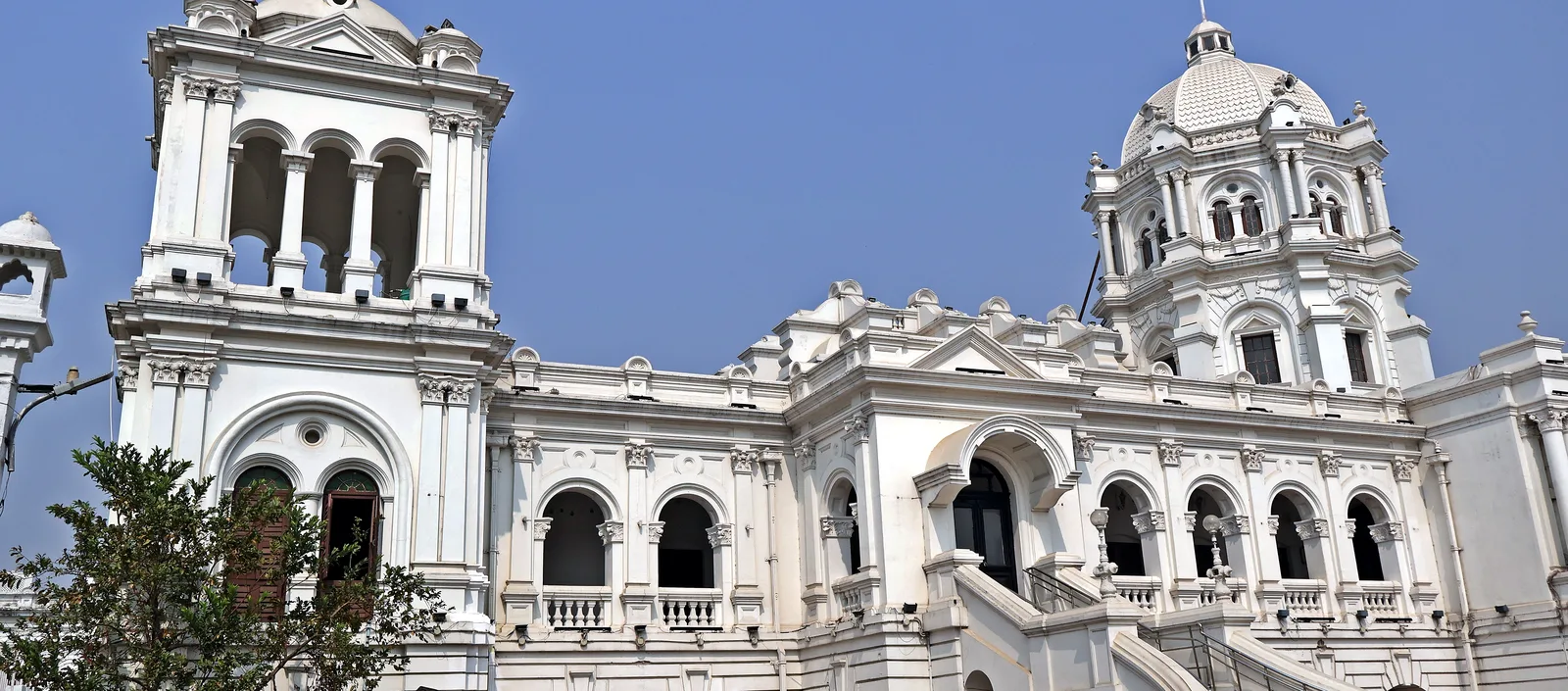
Tripura Tourism's description is the measured one this guide follows. The gleaming white Ujjayanta Palace in the capital evokes the age of Tripura's Maharajas; its name was given by Nobel Laureate Rabindranath Tagore. The palace was built by Maharaja Radha Kishore Manikya in 1901 AD: an Indo-Saracenic building set in large Mughal-style gardens on a lake front, with three domes each 86 feet high, tiled floors, curved wooden ceilings and crafted door decor, and many temples set around the palace. Floodlighting in the evening enhances the edifice — the department's word, and accurate.
The building's second life is as documented as its first. It housed the State Legislative Assembly up to 2011; today the palace houses the State Museum, with a collection of royal and cultural artefacts. The visit is two things at once: the architecture of a princely court, and inside it the state's own account of itself — the natural first stop of any Tripura trip, placed by the department, plainly, "in the heart of the city".
One honest limit. Tripura Tourism's palace page publishes no visiting hours and no entry fee, and the figures and timings in unofficial listings disagree with each other — Indian entry is quoted anywhere from ₹10 to ₹50, and closing days are given variously. So this guide prints no museum fee and no museum hours: carry cash for the ticket counter, or confirm through Tripura Tourism (0381 232 5930, the number the department prints on its palace page). The department's own package circuits pair the palace with the Heritage Park and the Akhaura Integrated Check Post on Agartala's standard sightseeing day — Heritage Park is a fixture of the official circuit, but its own page could not be read for this guide, so nothing more is claimed for it here.
SECTION 02Neermahal: A Palace Standing in a Lake
South of Agartala the kingdom built its opposite: not a palace on a lake front but a palace in the water. Neermahal — the name literally means Water Palace — is a fairytale royal mansion in the middle of Rudrasagar Lake, 53 km south of Agartala at Melaghar. Tripura Tourism records that Maharaja Bir Bikram Kishore Manikya built the palace in 1930 AD as his summer residence, inspired by Mughal architecture. The dome-shaped minarets give the mansion a fort-like look, the Darbar Hall survives as an emblem of the royal court, and seen from across Rudrasagar it recalls, as the department notes, the Jag Niwas palace in Udaipur's Pichola Lake.
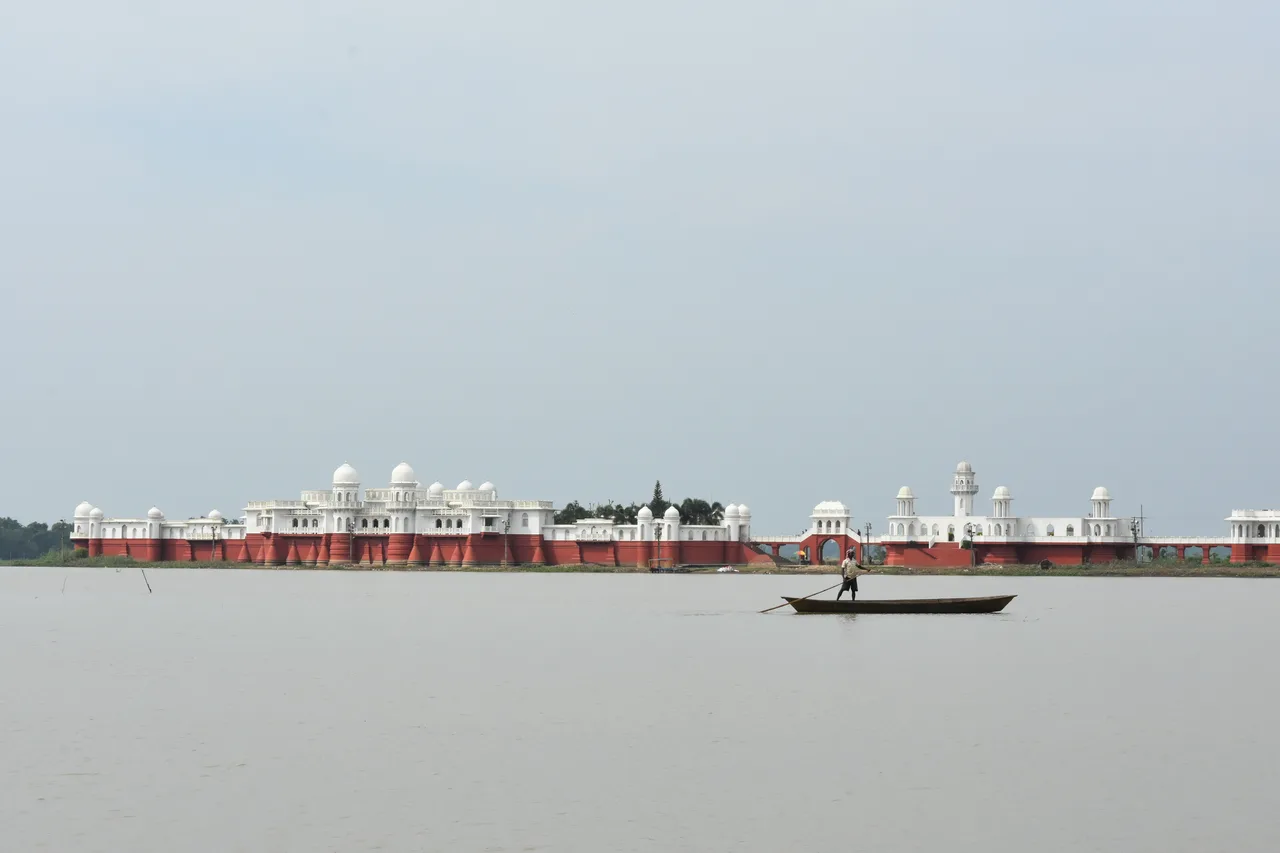
The lake is half the attraction. Rudrasagar covers about 5.3 sq km and is home to resident and migratory birds; facilities for boating and water sports are available, and a boat festival is held on Rudrasagar every year in July/August. The visit is therefore a boat ride with a palace at the end of it. The department's Neermahal page publishes no entry fee and no boating charge, so none is printed here — the Sagar Mahal Tourist Lodge at Melaghar is the department's listed stay if you want the lake at dawn rather than as a day trip.
SECTION 03Sepahijala: The Sanctuary, the Zoo and the Clouded Leopard National Park
On the same southern corridor, 28 km from Agartala at Bishalgarh, stands the state's biodiversity showcase. Tripura Tourism tells its history in one paragraph: with forest cover under pressure, the Sepahijala bio-complex came into existence in 1972; with a botanical garden, a deer park and a zoo added, it was given the status of Sepahijala Wildlife Sanctuary in early 1987. The sanctuary covers 18.53 sq km of moist deciduous forest holding no fewer than 456 plant species.
The animal list is the department's own: primates — rhesus macaque, pig-tailed macaque, capped langur, spectacled monkey and slow loris — and leopard, clouded leopard, jungle fowl, civets, barking deer and wild pig, with birds including stork, whistling teal and white ibis. Around the wildlife sit the visitor fixtures: views of coffee and rubber plantations, boating on the lake and a joy ride in the toy train, with tourist cottages inside. Inside the sanctuary sits its named enclave: the Clouded Leopard National Park, established in 2007, covering 5.08 sq km — a national park inside a wildlife sanctuary, devoted to its emblem animal. As with Neermahal, the department's page publishes no ticket prices or hours, and unofficial figures conflict, so none are printed; carry cash for the gates.
SECTION 04Kamalasagar and the Kasba Kali Temple: A Shrine on the Border
Half an hour beyond Sepahijala the road reaches the edge of India. The district administration's account is precise: the Kamalasagar Kali Temple was built on a hill-top by Maharaja Dhanya Manikya in the late 15th century, and it is situated just beside the Bangladesh border, with the lake in front enhancing its beauty. That lake — Kamala Sagar, dug by King Dhanya Manikya (1490–1520) — is the centrepiece: a large royal water body facing the shrine.
The tourism corporation's brochure fills in the story. Maharaja Kalyan Manikya started the work and Dhanya Manikya completed it; the place is Kasba — a Farsi word meaning town — and the lake was named Kamalasagar after the Maharaja's wife, Kamala Devi. The idol's identity is the temple's quiet surprise: the image installed is of the goddess Durga — the ten-handed Durga fighting the buffalo demon Mahisasura — but because the base platform carries an image of Shiva, she is worshipped as goddess Kali. The brochure also records what makes the visit unlike any other temple stop on this circuit: an Indo-Bangla Border Hut has been established here and is itself an attraction, and a big fair is held near the temple in April. For the practicalities, the district's directions are exact: Agartala airport is 32.2 km away, the railhead at Agartala 24 km, and buses run from Agartala bus stand toward Bishalgarh, with autos onward from Rastarmatha.
SECTION 05Udaipur and the Tripura Sundari Temple: One of the 51 Peethas
The old capital holds the state's holiest address. Tripura Tourism describes the ancient temple of Matabari, the Tripura Sundari Temple, on a hill-top 5 km from the main town at Udaipur — 57 km from Agartala. Maharaja Dhanya Manikya constructed the temple in 1501 AD. Its standing is stated without hedging: the temple occupies a place of distinction among Hindu shrines, being one of the 51 Peethas; the goddess Tripurasundari is an avatar of Parvati. The building itself is deliberately humble: a square-shaped sanctum designed on the model of a typical rural Bengal hut.
Behind the temple lies Kalyansagar, a placid lake that is home to tortoises deeply revered by devotees — the temple is also referred to as the Koorma (tortoise) Peeth. The department's festival page adds the year's peak: at Diwali, thousands of devotees, tribal and non-tribal, assemble at Matabari, bathe in the temple lake and pay homage, with a grand fair organised for two days in October/November. Udaipur repays the stop beyond the temple — the district calls it a lake-town, dotted with lakes dug by princely rulers along the Gomati — but Matabari is the reason the road south continues past Melaghar.
SECTION 06Unakoti: The Day Trip That Deserves a Night
North Tripura keeps the state's oldest wonder. Tripura Tourism dates the site plainly: Unakoti is a Shaivite pilgrimage place whose carvings date to the 7th–9th centuries, if not earlier. The name is the legend: Unakoti means one less than a crore — Shiva, halting here on the way to Kashi with a crore of gods, ordered all to wake before sunrise; only Shiva rose, and he cursed the rest to stone. The images are of two kinds, rock-carved figures and stone images, in a landscaped forest setting.
The centrepiece needs no legend to justify the journey. The central Shiva head, the Unakotiswara Kal Bhairava, is about 30 feet high, including an embroidered head-dress that is itself 10 feet high; on each side of the head-dress stand full-size female figures, one of them Durga standing on a lion; the gigantic Ganesha figures and three enormous images of Nandi, half buried in the ground, complete the famous group. The site's modern standing is official too: UNESCO's Tentative List carries "Rock-cut Sculptures and Reliefs of the Unakoti", entered for India on 13 December 2022 — a tentative listing, not yet a World Heritage inscription, and this guide states it as exactly that. Every year the Ashokastami Mela is held in April, visited by thousands of pilgrims.
Plan the logistics from the department's own numbers: Unakoti is 178 km from Agartala and 8 km from Kailashahar; the route is bus to Kailashahar, or train up to Kumarghat and then about half an hour onward. At that distance the department's own package tours do what this guide recommends — they sleep at the Unakoti Tourist Lodge in Kailashahar rather than attempting the round trip in a day. Go early either way: the carvings are open-air, and the forest light is best before the day's groups arrive.
SECTION 07Jampui Hills: The Extension into the Orange Hills
If the trip has a fourth day, spend it in the far north. Tripura Tourism calls the Jampui Hills the highest hill range in the state, bordering Mizoram, about 220 km from Agartala, at an altitude of about 3,000 feet — "this permanent seat of eternal spring". The range holds 11 villages inhabited by Mizo (Lushai) and Reang communities, whose main occupation is orange cultivation. Its calendar is written in fruit and flowers: from October to December the orange trees are laden and the whole range turns orange; from March to May orchids and wild trees flower; in the rains the hills fill with cloud. Within the range stands Betlingchhip, the highest peak of Tripura at 3,600 feet, with views over Mizoram and the Chittagong hill tracts, and there are trekking routes besides. The department's base is the Eden Tourist Lodge at Vanghmun, with paying-guest accommodation in the villages.
Jampui also carries this guide's neatest official footnote on formalities: the department notes that after the withdrawal of the Restricted Area Permit for foreign nationals, the hill range now attracts a large number of foreign tourists — a sentence worth having read before Section 08.
SECTION 08Permits, Getting There, and When to Come
The formalities first, because they are the reason many travellers wrongly skip Tripura. The state's neighbours run permit regimes; Tripura, on its own tourism corporation's printed word, does not: "There is no need of entry formalities like Restricted Area Permit (RAP) or Inner Line Permit (ILP) to visit Tripura." That sentence covers the question at the level of entry formalities, and the Jampui page's note on the RAP's withdrawal for foreign nationals points the same way. What this guide does not do is extend it into visa advice: foreign nationals should confirm their own visa conditions through official channels, as anywhere in India. The border, meanwhile, is a presence throughout the trip — at the Akhaura Integrated Check Post beside Agartala, at the Border Hut at Kamalasagar — but a thing to look at, not a procedure to clear, for a visitor touring Tripura itself.
Getting there is easier than the map suggests. By air, the corporation's brochure states that Agartala is well connected by air with Delhi, Kolkata, Guwahati and Chennai, through the M.B.B. (Maharaja Bir Bikram) Airport. By rail, the Press Information Bureau records that Tripura is connected to the country's broad-gauge network, and Agartala station is the state's railhead — the same network that carries the train up to Kumarghat for Unakoti. Agartala also holds a genuine first: the Agartala–Akhaura cross-border rail link with Bangladesh — 12.24 km in all, 5.46 km in India and 6.78 km in Bangladesh — was inaugurated by the Prime Ministers of India and Bangladesh on 1 November 2023, the first railway project between the northeastern states and Bangladesh; PIB records its inaugural freight run from Gangasagar in Bangladesh to Nischintapur in India, and presents the link as a trade and connectivity corridor rather than a visitor service. By road, the sights string along two corridors: south through Bishalgarh to Sepahijala (28 km), Melaghar and Neermahal (53 km), Kamalasagar and Udaipur (57 km); north to Kailashahar and Unakoti (178 km), with Jampui beyond.
When to come is a choice among the state's own festivals and seasons rather than a single official answer. October to December layers the year's best coincidences: the Diwali fair at Matabari and Jampui's orange season. April brings both the Ashokastami Mela at Unakoti and the fair at Kamalasagar. July/August is the boat festival on Rudrasagar, in the heart of the monsoon — dramatic, wet, and not for travellers who need predictable roads. No official page read for this guide promises weather, and none is promised here.
FAQFrequently Asked Questions
Do I need an Inner Line Permit or any entry permit to visit Tripura?
No. The Tripura Tourism Development Corporation — the state government undertaking that runs tourism in Tripura — states in its own published brochure: "There is no need of entry formalities like Restricted Area Permit (RAP) or Inner Line Permit (ILP) to visit Tripura." Tripura Tourism's Jampui Hills page likewise notes that after the withdrawal of the Restricted Area Permit for foreign nationals, the hills now attract many foreign tourists. Foreign nationals should still confirm their visa conditions through official channels, as this guide is not visa advice.
What does it cost to enter the Ujjayanta Palace museum, Sepahijala and Neermahal?
This guide prints no entry fees for any of the three, deliberately. Tripura Tourism's official pages for the palace and museum, the sanctuary and the water palace publish no ticket prices or opening hours that could be read and checked on 5 November 2026, and unofficial listings disagree — museum entry for Indian visitors is quoted anywhere from ₹10 to ₹50 across aggregator pages. Carry cash, read the board at the counter, or confirm through Tripura Tourism on 0381 232 5930 before you set out.
Can Neermahal and Sepahijala be done in one day from Agartala?
Yes — the state's own itineraries do exactly that. Sepahijala is 28 km from Agartala at Bishalgarh and Neermahal 53 km south at Melaghar, on the same southern corridor; TTDCL's published "Explore Tripura" package pairs the two on a single day, returning to Agartala for the night. Kamalasagar's Kasba Kali Temple and Udaipur's Tripura Sundari Temple, at 57 km, extend the same corridor if the day allows.
Is Unakoti a day trip from Agartala, or should I stay overnight?
Stay overnight if you can. Tripura Tourism puts Unakoti 178 km from Agartala and 8 km from Kailashahar, reached by bus to Kailashahar or by train up to Kumarghat and about half an hour onward; the department's own package tours sleep at the Unakoti Tourist Lodge in Kailashahar rather than returning the same day. The site — the 30-foot Kal Bhairava head, the gigantic Ganeshas, the half-buried Nandis — is open-air forest hillside, best seen in the morning.
When is the best time to visit Tripura?
There is no single official answer, so this guide gives the calendar instead. October to December combines the Diwali fair at Matabari with the Jampui Hills' orange season, when the department says the whole range turns orange. April brings the Ashokastami Mela at Unakoti and the fair at Kamalasagar. July/August holds the boat festival on Rudrasagar at Neermahal — in the monsoon. March to May is Jampui's flowering season. No official source guarantees weather; choose by which of those you most want to see.
Official references and checking status
Checked on 5 November 2026 against the official sources listed below; the accompanying sources file maps each claim to its page. Three limits are flagged honestly. First, the official pages for the Ujjayanta Palace and State Museum, Sepahijala and Neermahal publish no entry fees or opening hours that could be read at passage level, and unofficial listings conflict, so no fee or timing is printed for any of them. Second, Heritage Park is covered only as a fixture of the official Agartala tour circuits, because its dedicated page could not be read in this pass. Third, the no-permit position is printed exactly as TTDCL states it — a statement about entry formalities, not visa advice — and Unakoti's UNESCO Tentative List entry (13 December 2022) is not upgraded into a World Heritage claim anywhere in this guide. Confirm current prices and timings on the official sites before you travel.
- Tripura Tourism (official) — Ujjayanta Palace: the building, Tagore's name, the Assembly's departure and the State Museum
- Tripura Tourism (official) — Tripura Sundari Temple: the 1501 temple, the 51 Peethas, Kalyansagar and its tortoises
- Tripura Tourism (official) — Unakoti: the legend, the 30-foot Kal Bhairava, the distances and the route
- Tripura Tourism (official) — Neermahal Water Palace: the 1930 summer palace, Rudrasagar, boating and the boat festival
- Tripura Tourism (official) — Sepahijala Wildlife Sanctuary & Clouded Leopard National Park: history, species and areas
- Tripura Tourism (official) — Jampui Hill: the orange hills, Betlingchhip, and the note on the withdrawn Restricted Area Permit
- Sepahijala District Administration (official) — Kasba Kali Temple: the hill-top temple beside the border, Kamala Sagar, and how to reach it
- Tripura Tourism Development Corporation (official brochure) — Kamalasagar Kali Temple: the Durga worshipped as Kali, the Border Hut, and the entry-formalities statement
- UNESCO World Heritage Centre — Tentative Lists, India: Rock-cut Sculptures and Reliefs of the Unakoti, entered 13/12/2022
- Press Information Bureau — the Agartala–Akhaura rail link: length, implementing agencies and the 1 November 2023 inauguration
- Press Information Bureau — the link's inaugural freight run and Tripura's broad-gauge connection
Photos: Ujjayanta Palace, Agartala, by Kingshuk Mondal, via Wikimedia Commons, licensed under CC BY 4.0; Neermahal across Rudrasagar Lake, by Aghosh24, via Wikimedia Commons, licensed under CC BY-SA 4.0. Photographers keep their copyright; the licences require this credit.
General information only. This guide is based on official sources publicly available and checked on the date shown on this page. Visa rules change, and consular and USCIS officers decide every case on its own facts — nothing here is a confirmation or a guarantee for your individual case, and this is not legal advice. Always confirm the current requirement on the official page linked in this guide before you act, and consider a qualified immigration attorney for your specific situation.