
Researched & checked — 3 Nov 2026
Rishikesh and Haridwar: Ganga Aarti, Laxman Jhula and Rafting Rules, Planned on Official Facts
NEW Published 3 November 2026
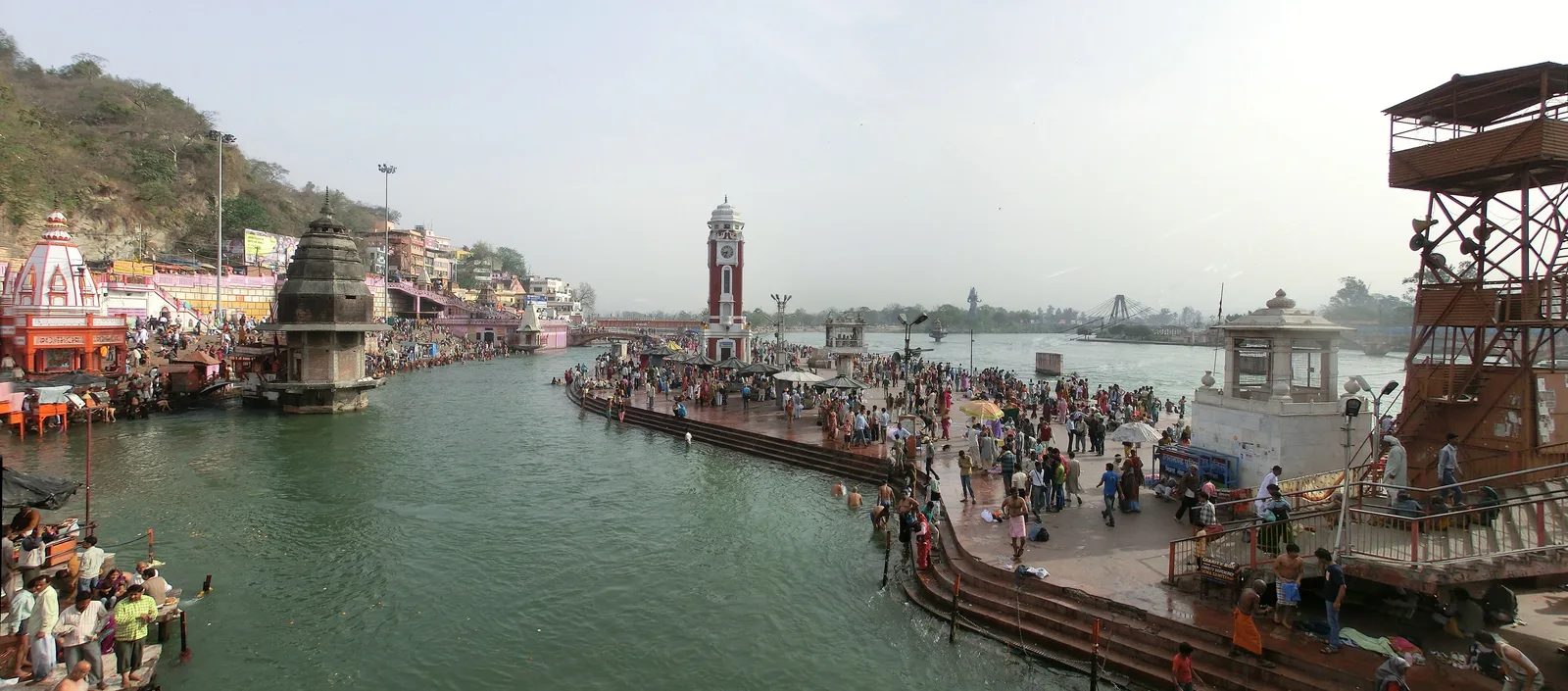
Two towns share one river and one trip: Haridwar, where the Ganga reaches the plains and the evening aarti fills Har Ki Pauri, and Rishikesh, a short climb upstream, where the same river runs green between ashram banks, suspension bridges and licensed rafting stretches. This guide keeps to what official sources actually publish — the district administration, the tourism board's rafting rules, GMVN, the ropeway and airport operators.
Plan the two towns as one trip: 24 km of road separate them, the distance on GMVN's published itineraries. In Haridwar, the district administration calls Har Ki Pauri the town's major and popular ghat, and its Ganga aarti is a daily ritual performed at sunset — no official timetable could be read, so arrive well before dusk rather than trusting a blog's clock time. Above the town stand Mansa Devi and Chandi Devi, the famous goddess temples on the district's own list, reached by Usha Breco's Udan Khatola ropeways or on foot. In Rishikesh, cross on Ram Jhula: the 1930 Laxman Jhula is out of service on safety grounds while its replacement is finished beside it. Rafting runs only with licensed operators under the Uttarakhand River Rafting/Kayaking (Amendment) Rules, 2015, on a river GMVN describes as pool-drop below Devprayag, with Grade III rapids and two Grade IVs — the Wall at Byasi and Golf Course below Shivpuri. And if your dates fall between 14 January and 20 April 2027, you are travelling into the Ardh Kumbh: plan around the mela administration, not ordinary-day advice.
SECTION 01Two Towns, One River: How the Pair Fits Together
Uttarakhand's own tourism policy writes the itinerary for you. Among the tourist circuits it identifies is "Haridwar–Rishikesh–Muni-Ki-Reti", and the same document sorts the pair by temperament: Rishikesh under Adventure & Watersports, both towns under Pilgrimage & Festivals, Rajaji National Park under Nature & Wildlife. That is the trip in one line — a pilgrimage town where the Ganga leaves the hills, an adventure town where it is still a mountain river, and a great forest between them.
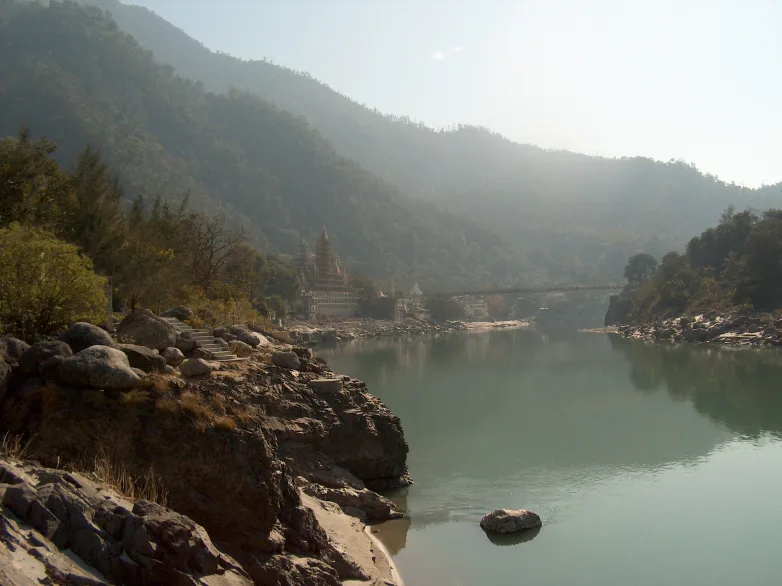
Haridwar stands where the Ganga comes down off the Shivalik hills onto the northern plains, which is why its ghats carry the weight they do: this is the first place the river can be met on open, level ground. Rishikesh, 24 km upstream by road, sits inside the hills, the river still green and fast-moving, its banks given over to ashrams, bathing ghats and the rafting trade's put-in points.
SECTION 02Har Ki Pauri and the Ganga Aarti
The Haridwar district administration's own tourist-places page gives Har Ki Pauri first place in the town: it is, in the administration's words, the "major and popular ghat on the banks of Ganges in Haridwar". The ghat is the town's centre of gravity — a broad flight of bathing steps facing the Ganga channel, backed by temples and the lanes of the old town, fullest at dusk. A first evening in Haridwar should end on its steps.
Every evening the ghat performs the ceremony Haridwar is known by: the Ganga aarti, in which priests raise great tiered stands of fire to the river in unison as the light fails, bells ring from the ghat temples, and the crowd sets small leaf-boats of flowers and flame adrift on the current. One honesty note: the aarti is conducted by Shri Ganga Sabha, but no timetable published by the Sabha could be read for this guide, so no clock time is printed here. The ceremony follows the sun — it begins at sunset, earlier in winter, later in summer. Arrive well before dusk, hold your place on the steps, and guard your belongings in the press of people.
Har Ki Pauri is also the centre of the Kumbh. Haridwar is one of the four cities that host the Kumbh Mela in rotation, and the state government has announced an Ardh Kumbh here in early 2027, to be held on the scale of a full Kumbh: after meeting the akharas, the chief minister announced the principal bathing dates — Makar Sankranti, 14 January 2027, to Chaitra Purnima, 20 April 2027, with eleven Amrit Snans announced by the mela administration. Those dates rest on the government's announcements as reported by PTI; the official Kumbh website launched in October 2026 could not be read directly for this guide, so confirm dates and arrangements there or with the district administration before travelling then.
SECTION 03Mansa Devi and Chandi Devi: The Ropeway Temples
Two goddess temples look down on Haridwar, and the district administration lists both among the town's famous sights: Mansa Devi Temple, "dedicated to goddess Mansa devi", on the hill above the old town, and Chandi Devi Temple, "dedicated to goddess Chandi devi", across the river on its own hill. Together they are the pair of hilltop darshans most pilgrims combine into a single morning.
Both temples are climbed on foot by pilgrims — the stepped paths are part of the pilgrimage — and ridden to by most visitors. The ropeways are run by Usha Breco under its Udan Khatola brand, and the company records that its ropeway story began here: the journey of Udan Khatola started with the construction of the ropeway at Maa Mansa Devi Temple at Haridwar. Its Haridwar operations today cover both ropeways. On fares and hours: the operator sells tickets through its own website and stations, but its current tariff could not be read at passage level, and third-party listings disagree with each other — so no price is printed. Check the fare, hours and any combined ticket on udankhatola.com or at the station; expect queues on festival days.
SECTION 04Rishikesh: Triveni Ghat and the Ashram Bank
Rishikesh's own ritual centre is Triveni Ghat, the town's principal bathing ghat, named for the meeting of three rivers — the Ganga, the Yamuna and the unseen Saraswati, in the belief held here. It works as Har Ki Pauri in miniature: bathers on the steps through the day, market lanes behind, and its own Ganga aarti at dusk, a smaller, more intimate ceremony than Haridwar's. A candid flag: Uttarakhand Tourism's Rishikesh pages would not render for this guide, so the ghat is described from general published accounts rather than an official page — and no official timetable exists for its aarti either; the same sunset rule applies.
Across Ram Jhula stretches the town's second identity: the east bank — Swarg Ashram and its neighbours — is a near-continuous ribbon of ashrams, temples, yoga schools and guesthouses. Rishikesh runs at two speeds, the pilgrims' ghat-and-temple rhythm and the slower residency of yoga students who stay for weeks; walk the riverfront in the cool of the morning or the hour before the aarti.
SECTION 05The Bridges: Laxman Jhula, Ram Jhula and the New Bajrang Setu
The iron suspension bridge that made Rishikesh's postcard carries its history on its own plaques. The plaques at its western foot record that Laxman Jhula was constructed by the Public Works Department during 1927–1929 and opened to traffic on 11 April 1930, replacing an earlier bridge of 284 feet span that was washed away by the great flood of October 1924 — and that no toll or tax would ever be imposed for crossing it. For ninety years it was the town's emblem, named for Lakshman, who in the Ramayana tradition crossed the river at this spot.
That bridge is no longer the crossing, and this is where travellers are most often misled by old photographs and older guidebooks. On its engineers' advice, the state closed Laxman Jhula on safety grounds — the structure had reached the end of its safe life — and a replacement has been built beside it: Bajrang Setu, a modern suspension bridge with glass walkways, built by the Public Works Department. Its announced opening dates have moved more than once, and no official page confirming its opening could be read for this guide. So: treat the old bridge as closed, confirm the new one's status locally, and cross on Ram Jhula, the larger suspension bridge downstream between Muni Ki Reti and the Swarg Ashram bank. This account rests on the plaques' text and consistent reporting of the PWD's statements rather than an official page; it is flagged in the checking note below.
SECTION 06The Beatles Ashram and Rajaji: The Forest Edge
At the forest edge of the Swarg Ashram bank stands Chaurasi Kutia — the "84 huts" — the meditation academy built for Maharishi Mahesh Yogi in the 1960s, where the Beatles stayed in 1968 to study Transcendental Meditation. The ashram was later abandoned, and in 2015 the Uttarakhand forest department opened the site to visitors: it is now walked as a beautiful ruin — meditation domes like stone beehives, lecture halls and bungalows under the trees, painted walls over the decay. Entry is ticketed by the forest department at the gate. This guide prints no price and no opening hours: the department's own current tariff could not be read, and figures published elsewhere in recent years disagree with each other several-fold. Carry cash and an identity document, and read the board at the gate.
The ashram stands inside a much larger fact. The Haridwar district administration gives Rajaji National Park's extent as about 820 sq. km — Shivalik forest and riverine plain between and beyond the two towns, tiger and elephant country. Safari entry runs through the reserve's own gates and booking arrangements, and here the guide's rule bites in an unusual way: the reserve's official site could not be reached when this guide was checked, and several lookalike booking sites in search results are private operators, not the forest department. So no safari fee, season date or zone list is printed. Book only through the forest department's own channels or at the gate.
SECTION 07Rafting on the Ganga: A Licensed River
Rafting here is a licensed trade, and the licence has a name and a number. Uttarakhand's tourism policy records that the Uttarakhand River Rafting/Kayaking (Amendment) Rules, 2015 were notified on 7 September 2015, vide notification no. 1889/VI/2015-01(03)/2013, laying down the conditions on which licences are granted for rafting on the state's river stretches — the Ganga among them. A Technical Committee of the Uttarakhand Tourism Development Board examines all rafting and rescue equipment, and the guides, every year; permissions run for a maximum of five years, and the Board's procedure has operators applying to its Chief Executive each April. For a visitor: your operator should hold a current UTDB permission — ask to see it before you pay.
The river itself is described best by the state corporation that runs it. GMVN, which operates its own rafting from its camp at Kaudiyala, explains the water like this: the Alaknanda and the Bhagirathi meet at Devprayag to form the Ganga, and above that confluence the young rivers run at Grade IV to V. Below Devprayag the Ganga changes into a pool-drop river — rapids separated by calm pools — and the stretch of almost 70 km is, in GMVN's words, perfect for amateurs, offering some fine Grade III rapids and two Grade IV rapids: the "Wall" at Byasi and the "Golf Course", 4 km below Shivpuri village, each followed by deep and placid pools. The runs sold in Rishikesh are slices of this one stretch — put-ins on the road above town, at places like Shivpuri and Kaudiyala, and a take-out in Rishikesh itself. GMVN's own short product is a single 10–12 km stretch; longer runs stack stretches together.
Two things this guide will not give you are a tariff and a minimum age, because the official record read for it does not contain them. The 2015 Rules' operative schedules — the stretch-by-stretch conditions — sit in documents on the tourism board's site that would not render, the ages quoted by different operators for the same stretch disagree by years, and GMVN's published tariffs are dated 2022–23, too old to print as current. What is on the record: the season is bounded by the monsoon, when the river runs high and rafting pauses; equipment and guides face an annual technical examination; and GMVN's own course terms require participants to be physically fit. Book only with a licensed operator, and ask in writing which stretch, which rapids, what minimum age and what swimming rule will apply to your group — an operator who cannot answer has answered.
SECTION 08Getting There, and a Two-Town Plan
Haridwar is the pair's railhead: trains from Delhi and across north India arrive at Haridwar station in the middle of town, and the Rishikesh road climbs from there — GMVN's published itineraries put the Haridwar–Rishikesh leg at 24 km, with buses, shared jeeps and taxis all day. By air, the Airports Authority of India lists Dehradun's Jolly Grant as a domestic airport — its own page heads it "Dehradun / Domestic" — on the Rishikesh side of Dehradun, the closest runway to both towns. Book trains through IRCTC; this guide prints no train times or fares, as Indian Railways publishes no fare table that could be read and checked.
A three-day shape fits most first trips. Day one, Haridwar: the two ropeway temples in the morning, the old town's bazaars in the afternoon, and a place on the steps at Har Ki Pauri well before sunset. Day two, Rishikesh: the bridges and ashram bank in the morning, the Beatles Ashram in the afternoon, Triveni Ghat's aarti at dusk. Day three, the river or the forest: a rafting stretch with a licensed operator, or a Rajaji safari booked through the forest department's own channels. Sleep in Haridwar if the pilgrimage rhythm and early trains matter most; in Rishikesh for yoga and the river. Warning: in the Ardh Kumbh window of January to April 2027, bathing days rule everything — rooms, trains and road space go to the mela first — so book far ahead and follow the mela administration's arrangements.
FAQFrequently Asked Questions
What time is the Ganga aarti at Har Ki Pauri?
At sunset — and that is the most precise honest answer available. The aarti is a daily ritual conducted by Shri Ganga Sabha at Har Ki Pauri, but the Sabha publishes no timetable that could be read when this guide was checked (3 November 2026). Because the ceremony follows the sun, it starts earlier in winter and later in summer. Arrive well before dusk and take your place on the steps. Triveni Ghat in Rishikesh holds its own, smaller aarti at dusk on the same principle.
Can I still walk across Laxman Jhula?
No — do not plan on it. The 1930 iron bridge (built by the Public Works Department in 1927–29, opened 11 April 1930, according to the plaques at its foot) was closed on safety grounds on its engineers' advice. Its replacement, the glass-walkway Bajrang Setu built by the PWD beside it, has had its announced opening dates moved more than once, and no official confirmation of its opening could be read for this guide. Cross on Ram Jhula, downstream, and check the new bridge's status locally.
How much does rafting cost, and what is the minimum age?
This guide prints neither figure, deliberately. Rafting here is licensed under the Uttarakhand River Rafting/Kayaking (Amendment) Rules, 2015: operators hold Uttarakhand Tourism Development Board permissions (maximum five years), and a UTDB Technical Committee examines equipment and guides annually. But the Rules' stretch schedules could not be read, operators quote conflicting minimum ages for the same stretch, and GMVN's tariffs are dated 2022–23. What is official: GMVN describes the river below Devprayag as pool-drop with Grade III rapids and two Grade IVs (the Wall at Byasi, Golf Course below Shivpuri), and its terms require participants to be physically fit. Book a licensed operator and get the stretch, rapids, minimum age and price in writing before you pay.
Can I see both towns from one base?
Yes — that is how the pair is designed to be visited. Uttarakhand's tourism policy lists "Haridwar–Rishikesh–Muni-Ki-Reti" as a single tourist circuit, and the road leg is 24 km on GMVN's published itineraries, with buses, shared jeeps and taxis running between the towns. Base in Haridwar for the temples, the aarti and the station; base in Rishikesh for yoga, rafting and the ashram bank — and day-trip to the other either way.
Why are there no ropeway fares or Beatles Ashram entry prices in this guide?
Because no official figure could be verified for either. The Mansa Devi and Chandi Devi ropeways are run by Usha Breco (Udan Khatola), but the operator's current tariff could not be read at passage level and third-party listings disagree; check udankhatola.com or the station board. The Beatles Ashram (Chaurasi Kutia) is ticketed by the Uttarakhand forest department, which opened it to visitors in 2015, but the department's own tariff could not be read and published figures conflict several-fold. So this guide prints none: carry cash and an identity document, and read the board at the gate.
Official references and checking status
Checked on 3 November 2026 against the official sources listed below; the accompanying sources file maps each claim to its page. Five limits are flagged honestly. First, Shri Ganga Sabha publishes no Har Ki Pauri aarti timetable that could be read, so the aarti is given as a daily ritual at sunset and no clock time is printed; Triveni Ghat's aarti likewise rests on general published accounts, as Uttarakhand Tourism's Rishikesh pages would not render. Second, Laxman Jhula's closure and replacement rest on the bridge's own plaques and consistent reporting of Public Works Department statements; no official page confirming Bajrang Setu's opening could be read, so its opening is not asserted. Third, the 2027 Ardh Kumbh dates (14 January to 20 April 2027, eleven Amrit Snans) rest on the state government's announcements as reported by PTI, the official Kumbh website launched in October 2026 not having been read directly. Fourth, the rafting Rules' stretch-by-stretch schedules and all current tariffs (rafting, ropeway) could not be read at passage level, so no rafting price or minimum age and no ropeway fare is printed. Fifth, Rajaji's official site could not be reached, so its safari tariff, seasons and zones are not printed; the Beatles Ashram's entry fee and hours are likewise unprinted, the forest department's own figures being unread and published figures in conflict. Confirm current prices and timings on the official sites before you travel.
- District Haridwar, Government of Uttarakhand (official) — Tourist Places: Har Ki Pauri, Mansa Devi, Chandi Devi, Rajaji National Park
- Government of Uttarakhand (official) — Uttarakhand Tourism Policy 2017: circuits, and the River Rafting/Kayaking (Amendment) Rules, 2015 notification
- Uttarakhand Tourism Development Board (official) — procedure for registration under the Rafting/Kayaking (Amendment) Rules, 2015
- GMVN — Garhwal Mandal Vikas Nigam (official state corporation) — Rafting: the river below Devprayag, its rapids and course terms
- Airports Authority of India (official) — Dehradun Airport (Jolly Grant): airport information
- Udan Khatola — Usha Breco (operator) — About: the brand's history, beginning with the Mansa Devi ropeway at Haridwar
- Uttarakhand Forest Department (official) — the department that administers Rajaji Tiger Reserve and the Chaurasi Kutia (Beatles Ashram) site
Photos: Har Ki Pauri and the Ganga channel at Haridwar, by D P Rangan, via Wikimedia Commons, released into the public domain; the Ganga at Rishikesh, by Roger roger, via Wikimedia Commons, licensed under CC BY-SA 3.0. The Creative Commons licence requires this credit.
General information only. This guide is based on official sources publicly available and checked on the date shown on this page. Visa rules change, and consular and USCIS officers decide every case on its own facts — nothing here is a confirmation or a guarantee for your individual case, and this is not legal advice. Always confirm the current requirement on the official page linked in this guide before you act, and consider a qualified immigration attorney for your specific situation.