
Researched & checked — 30 Oct 2026
San Diego in 2 Days: Balboa Park, the Coast and the Zoo Decision, Mostly Without a Car
NEW Published 30 October 2026
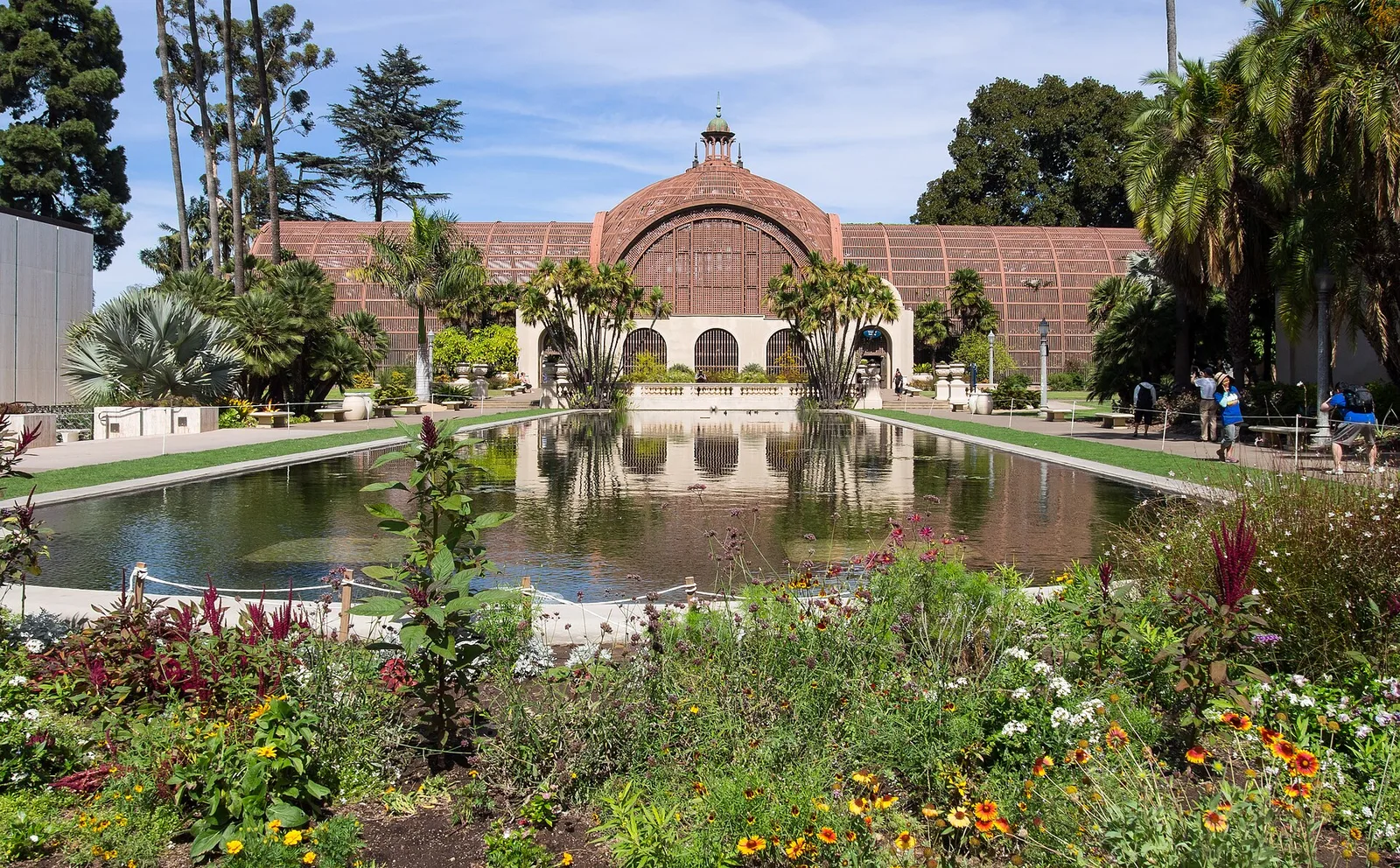
A first-timer's two days in San Diego — Balboa Park's free grounds and paid museums untangled, the Zoo decision made with real prices, the bay crossed by ferry to Coronado, and La Jolla for the coast — almost all of it on a $3 transit fare.
Base yourself downtown or in Old Town, on the trolley. MTS transit costs $3 per one-way fare — each fare is valid two hours with unlimited transfers, and on a PRONTO account your taps simply stop adding up at $7 a day. Day one is Balboa Park: entering the park and riding its tram are free; the spend is its museums, where the Explorer Parkwide Pass ($78 adult) covers 16 museums over seven days. The Zoo is a separate $78 decision — it is not in the pass. Day two crosses the bay: the USS Midway ($39 adult) in the morning, the $9 ferry to Coronado, and La Jolla's cove — a free public beach inside a protected ecological reserve — for the afternoon.
SECTION 01The Shape of the City: Bay, Mesa, Coast
San Diego's visitor geography fits on one hand. Downtown — the Gaslamp Quarter and the waterfront — sits on the bay, minutes from the airport. Balboa Park spreads over the mesa immediately northeast of downtown, close enough to walk up to and big enough to swallow a day. Coronado lies across the bay, reached by bridge or ferry. La Jolla perches on the coast to the north. And Old Town, the original settlement, sits at a major transit junction a few stops up the line — which is what makes this itinerary work without a car.
The transit spine is the MTS Trolley, whose lines converge on downtown and the Old Town Transit Center, backed by MTS buses for the legs the trolley does not reach — La Jolla among them. The fare system is called PRONTO, and its current numbers matter, because older guides quote older prices: a standard adult one-way fare is $3, and a one-way fare on PRONTO is valid for two hours with unlimited transfers — treat it as a two-hour pass, not a single ride. Ride with a PRONTO app account or card and you earn the day pass as you go: once your taps reach $7 in a day, the rest of that day's rides are covered. Contactless bank cards are also accepted for one-way fares. In practice, nobody on this itinerary pays more than $7 a day to move around.
Where to sleep follows from the map. Downtown puts the bay, the Midway and the ferry at your feet and every trolley line at your door. Old Town trades the waterfront for the transit center and a quieter, older-San-Diego feel — the smartest base if you are arriving or leaving by train. Mission Valley's hotels along the trolley line are the budget compromise. Pick any of the three and the car stays unnecessary.
SECTION 02Day One: Balboa Park — Free to Enter, Priced by the Museum
Start on the mesa. Balboa Park covers more than 1,000 acres of gardens, canyons and cultural buildings, its centrepiece the El Prado — a promenade of Spanish Colonial Revival palaces built for the 1915–16 Panama-California Exposition. Here is the fact the whole day hangs on: walking into Balboa Park costs nothing. It is a public city park. The grounds, the gardens, the architecture and the canyon trails are open to everyone, and getting around inside is free too — the Balboa Park Tram runs daily from 8 a.m. to 8 p.m., stopping at Tram Central every 10 to 15 minutes and looping the park's main sights, Plaza de Panama among them.
What costs money is the museums — sixteen of them participate in the park's pass programme alone, from the Fleet Science Center and the Museum of Us to the Natural History Museum, the Air & Space Museum and the San Diego Museum of Art — and each sells its own admission at its own price. The park's answer is the Balboa Park Explorer Pass, and its three shapes are worth understanding precisely:
- Parkwide Pass — $78 per adult (12+), $52 per youth (3–11): general admission to all 16 participating museums, over seven consecutive days.
- Limited Pass — $66 per adult, $43 per youth: any four museums in one day.
- Annual Pass — from $109: a year of the same museums, priced by type; a residents' and repeat visitors' product, not a two-day one.
Two exclusions to hold firmly, because they surprise people at the gate: the Explorer Pass does not include the San Diego Zoo — which sits inside the park but is run and ticketed separately — nor the Comic-Con Museum. And the pass arithmetic only works if you use it. Two museums in a day is a comfortable pace; three is a determined one; the Limited Pass's four-in-a-day is a sprint almost nobody enjoys. On a two-day trip, Parkwide earns its $78 if you would otherwise buy three or more museum admissions across the trip — plausible for museum people, waste for everyone else. If you want one museum, buy one museum. Between admissions, the park keeps giving: the Botanical Building and its lily pond are the park's postcard, and the gardens and the Prado itself are a walk, not a ticket. (The rotating free-admission Tuesdays you may read about are a programme for city and county residents with ID — a locals' perk, not a visitor strategy.)
SECTION 03The Zoo Decision: A Full Day at a Full Price
The San Diego Zoo needs no introduction, but it does need a decision, because in a two-day trip it is the single biggest claim on your time. The prices first, from the Zoo's own ticket page. The 1-Day Pass — Any Day costs $78 per adult (ages 12+) and $68 per child (ages 3–11). It includes the Guided Bus Tour and the Skyfari aerial tram, it is valid on any day within a year of purchase, and no reservation is required. Cheaper dates exist: the 1-Day Pass — Value Days, sold online only, in advance, for select days, is $73 adult / $63 child. Visiting twice, or adding the Safari Park, the 2-Visit Pass is $130 adult / $120 child. And if you come in October, the citywide Kids Free October promotion takes children in free — the one month the family arithmetic transforms.
So: is it worth it? Honestly framed, the Zoo is not a morning. It is large, hilly and absorbing, and visitors who rush it in three hours leave feeling they paid $78 for a glimpse. Given the whole day — in at opening, the bus tour early to learn the layout before the crowds, the Skyfari as a rest rather than a queue — it justifies itself against almost any zoo on earth. What it competes with here is not Balboa Park's museums, which pair with it naturally on day one, but the coast: a Zoo day plus a park day leaves La Jolla and Coronado fighting over the remaining hours. Our call: families and animal people — yes, give it day two's core and take the coast in the afternoon. Everyone else on a first two-day trip — walk the park, ride the ferry, swim at the Cove, and let the Zoo be the reason you come back. Either way, decide before you buy the Explorer Pass, remembering the Zoo was never in it.
SECTION 04Day Two: The Working Bay — the Midway, the Ferry and Coronado
Day two starts on the downtown waterfront, where San Diego keeps its naval heart. The USS Midway Museum is a retired aircraft carrier moored as a museum — flight deck, hangar bays and island tours. From the museum's own ticket store: general admission is $39 for adults (ages 13+), $29 for youth (ages 4–12) and $26 for veterans (with proof of service at the entrance). Tickets are date-based, so pick your day when you buy. The Midway rewards time — two unhurried hours at minimum, a half-day if the flight deck gets you — and pairs naturally with a morning start, leaving the afternoon for the water.
Then cross the bay the way the views deserve. The Flagship Coronado Ferry costs $9 one-way for the 15-minute crossing — from Broadway Pier roughly every hour, and from the Convention Center every 30 minutes — a walk-on boat whose ticket is valid on any scheduled departure on the route you bought, subject to capacity. It is less a transport purchase than a short harbour cruise that happens to land somewhere useful. On the Coronado side: the Ferry Landing's lawns and shops, Orange Avenue's small-town main street running across the island, and at its end the broad public beach, with the red roofs and white turrets of the Hotel del Coronado — the Victorian grand hotel that has fronted this sand since the nineteenth century — as the backdrop. Swim, walk the strand, and ride the ferry back into the downtown lights; in two days of sightseeing, this $18 round trip is the easiest money in the guide.
SECTION 05La Jolla: The Coast at Its Best
Keep one afternoon for the coast, and spend it at La Jolla. From downtown or Old Town, MTS buses make the run north — allow roughly an hour each way; a rideshare halves the time and multiplies the cost, and on a two-day trip that trade is sometimes right. What you arrive at is a village wrapped around a curve of cliffs, coves and impossibly clear water.
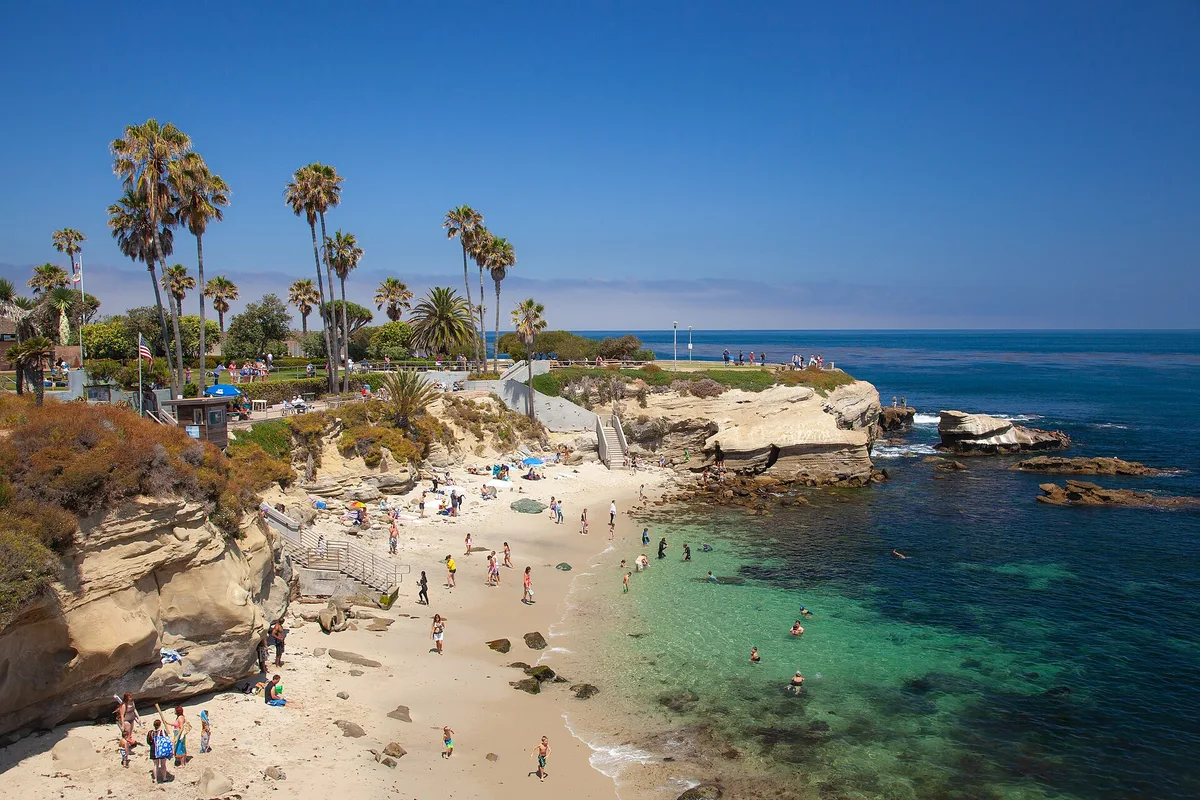
The centre of it is La Jolla Cove: in the city's own words, "a very small beach, tucked between sandstone cliffs" — and one of the most photographed beaches in Southern California. The Cove lies within the San Diego–La Jolla Underwater Park Ecological Reserve, which is why the water is full of life: fishing and removing anything from the reserve are prohibited, and the payoff is snorkelling over garibaldi and kelp in water whose visibility, the city notes, can sometimes exceed 30 feet. It is a proper swimming beach with a permanent lifeguard station — small surf in summer makes it the coast's natural pool. It charges nothing: bring a mask, or simply swim. Above the Cove, the Coast Walk traces the cliff tops north; a short stroll south, Point La Jolla is where California sea lions haul out on the rocks — watch them from the railed viewing areas, photograph them all you like, and give them their space. The village behind you does the rest: coffee, galleries and an early dinner before the bus or the car back downtown.
SECTION 06Old Town, Point Loma and the Practical Wrap
Two pieces complete the map. Old Town San Diego State Historic Park sits directly at the Old Town Transit Center, which makes it the easiest history in the city to reach without a car: a preserved plaza of the 1820s-to-1870s settlement — adobe and timber buildings, museums, courtyards and restaurants — best used as an arrival-afternoon or evening stroll rather than a headline day. And out on Point Loma, the bay's protective arm, stands Cabrillo National Monument, marking the 1542 landing and holding the city's finest viewpoint — the bay, the ocean and the skyline in one turn of the head, with tidepools below at low tide. Its federal prices are small: $20 per private vehicle, $15 per motorcycle, $10 per person on foot or bicycle, each valid seven days, cards preferred (the monument is moving toward cashless but has set no date). The line international readers will want underlined: Cabrillo is not one of the eleven national parks where the 2026 non-resident fee applies — there is no $100 surcharge here; a $20 car is a $20 car. The honest catch is access: Point Loma genuinely argues for a car or rideshare — treat it as the swap-in for travellers with wheels, or for a third day.
Practical notes to close. Layers: San Diego's warmth is real but the bay breeze is too — evenings on the ferry or the Cove ask for a jacket most of the year. Timing: the Zoo and the Midway both reward opening time; Balboa Park's museums mostly keep daytime hours, so give the park the middle of day one rather than its edges. Money: a couple following this itinerary without the Zoo spends, per person, roughly $14 of transit across two days, $39 of Midway and $18 of ferry, plus the museums of their choice — the city leaves the budget's centre of gravity where it should be, on food and the one big ticket you actually chose.
FAQQuick Questions
Can I really do San Diego without a car?
Yes — this itinerary is built for it. The trolley covers downtown, Old Town and Mission Valley; buses cover La Jolla in roughly an hour; the ferry covers Coronado. With PRONTO, transit costs $3 per two-hour fare window and never more than $7 in a day. Only Cabrillo National Monument, on Point Loma, argues for wheels.
Is Balboa Park free?
Entering the park is free — it is a public park of more than 1,000 acres, its gardens and grounds open to all, with a free tram inside (daily, 8 a.m. to 8 p.m.). Its museums charge admission individually. The Balboa Park Explorer Pass bundles 16 of them: Parkwide $78 adult / $52 youth for seven days, or Limited $66 / $43 for any four museums in one day. The Zoo is not included in any Explorer pass.
How much does the San Diego Zoo cost — and is it worth one of only two days?
The 1-Day Pass costs $78 per adult (12+) and $68 per child (3–11), including the guided bus tour and Skyfari tram, with no reservation needed; select Value Days, booked online in advance, are $73 / $63. It is worth the day if animals are a trip priority and you give it the hours — arrive at opening and stay. If the coast matters more, the Zoo is the best reason to return; in October, Kids Free October changes the family maths entirely.
Explorer Pass or pay museum by museum?
Pay as you go if you will visit one or two museums — at typical single admissions, the Parkwide Pass ($78) only pulls ahead once you would otherwise buy about three admissions, and its seven-day window suits this trip better than the Limited Pass ($66), whose four museums must all fit in a single day. Buy Parkwide if museums are the point of your Balboa day and you plan three or more.
What is the cheapest way to reach Coronado?
The Flagship ferry: $9 one-way, 15 minutes, from Broadway Pier (about hourly) or the Convention Center (every 30 minutes), walk-on, with tickets usable on any scheduled sailing on the route. It doubles as the best-value harbour cruise in the city. The alternative is driving over the Coronado Bridge — choose the ferry on a short trip.
Official references and checking status
Checking status: every fare, pass price, admission and crossing detail here was checked in full on the official MTS, City of San Diego, Balboa Park Explorer, San Diego Zoo, USS Midway, Flagship and National Park Service pages on 30 October 2026. The honest limits: the Explorer Annual Pass is priced by type and is quoted only as its official "starting at $109"; museum single admissions vary and are deliberately not priced one by one; the downtown–La Jolla bus time is an approximate road time; and Kids Free October is a seasonal promotion that applies to October visits.
- San Diego MTS — Fares and PRONTO
- City of San Diego — Balboa Park
- Balboa Park Explorer — Pass options and prices
- San Diego Zoo — Tickets
- USS Midway Museum — Buy tickets
- Flagship Cruises & Events — Coronado Ferry
- City of San Diego Lifeguards — La Jolla Cove
- Cabrillo National Monument — Fees and passes
- National Park Service — Non-resident fees
Photos in this guide: the Botanical Building and Lily Pond in Balboa Park by Rhododendrites / Wikimedia Commons (CC BY-SA 4.0); La Jolla Cove by Stephen Bay / Wikimedia Commons (CC BY 4.0). Both resized and converted for this page.
General information only. This guide is based on official sources publicly available and checked on the date shown on this page. Visa rules change, and consular and USCIS officers decide every case on its own facts — nothing here is a confirmation or a guarantee for your individual case, and this is not legal advice. Always confirm the current requirement on the official page linked in this guide before you act, and consider a qualified immigration attorney for your specific situation.