
Researched & checked — 30 Oct 2026
Las Vegas in 3 Days: The Strip, Downtown and One Desert Day, With the Real Costs Shown
NEW Published 30 October 2026
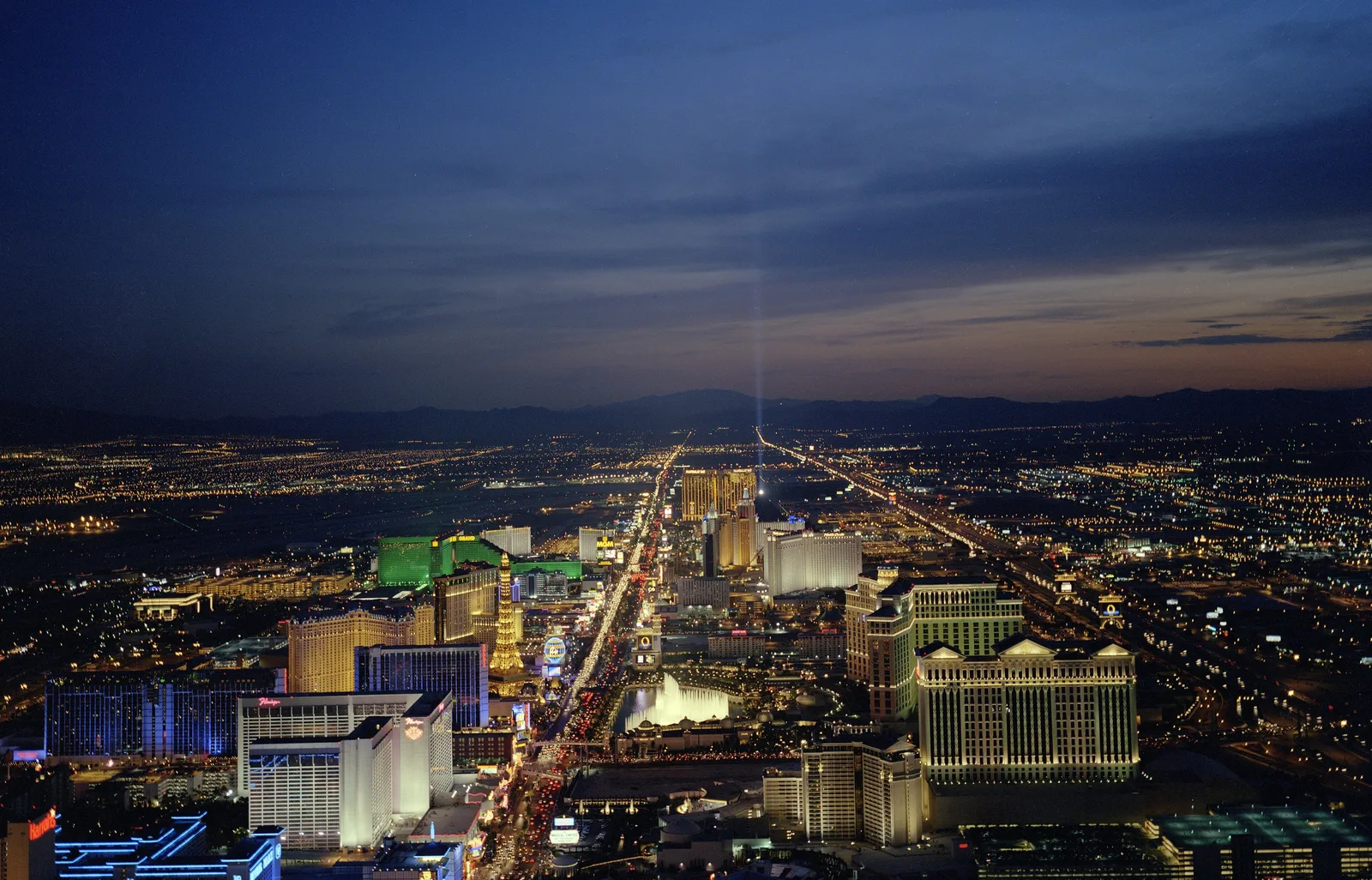
Three days split the way the city actually divides — one on the Strip, one downtown under the Fremont Street canopy, and one out in the desert at Hoover Dam and the Valley of Fire — with fares and tour prices checked against the operators' own pages.
Las Vegas looks like one long street of lights, but a first visit works better as three separate trips. The Strip is a four-mile boulevard of themed resorts in the suburb of Paradise, downtown is the older casino district around Fremont Street, and the desert beyond the city holds two of the best day trips in the American Southwest — Hoover Dam and the Valley of Fire. This plan gives each its own day, walks the Strip in one direction, and prices the paid parts from the operators' own fare pages.
Most of what people photograph in Las Vegas is free: the Bellagio fountains, the Fremont Street light shows and the walk past the resorts cost nothing. What you pay for is movement — buses, the monorail, parking — plus the desert day. Those prices are small but specific, and all are laid out in the costs section below, including the two charges visitors get surprised by: nightly resort fees and hotel parking, quoted here honestly as a cost category rather than as an invented figure.
Spend Day 1 walking the Strip from the Bellagio fountains (free; every 30 minutes on weekday afternoons, every 15 minutes after 8 p.m.) north past Caesars Palace and The Venetian, riding the Monorail back (one ride $5.75 as an eTicket; one-day eTicket $13.95). Spend Day 2 downtown: ride the Deuce (24-hour pass $8) to the Fremont Street Experience, where entry and the hourly Viva Vision shows from 6 p.m. are free. Spend Day 3 in the desert: Hoover Dam's Dam Tour is $40 per person, sold only on site, first come first served, and the Valley of Fire charges $15 per vehicle for non-Nevada vehicles. Gambling is 21+ under Nevada law — and so is standing around in the gaming areas.
SECTION 01What does the 3-day plan look like at a glance?
Day 1 — the Strip. One long walk, roughly south to north: start at the Bellagio lake for the first fountain show of the afternoon, cross to Caesars Palace and the Forum Shops, continue past The Venetian's canals and the LINQ Promenade, and finish near SAHARA. Ride back rather than re-walking it — the Strip is about four miles end to end, and distances between resorts are much longer than they look.
Day 2 — downtown. The Deuce runs the full length of the Strip and continues into downtown, so the same pass covers the trip. Fremont Street is the original casino street, now a five-block pedestrian mall roofed by the Viva Vision canopy. The street, the light shows and the live stages are free; you pay only for food, drinks, gaming and the optional zipline. Downtown hotels also tend to be cheaper than Strip resorts.
Day 3 — the desert. Hoover Dam sits about 45 minutes southeast of the city and the Valley of Fire about an hour northeast, so combining them means an early start and a fair amount of driving — but it is the standard pairing, and organised tours run both in a day. There is no public bus to either place, so this is the one day a rental car or a booked tour is genuinely necessary.
Getting around on Days 1 and 2 needs no car. The Deuce, RTC's Strip bus, runs the boulevard and continues into downtown roughly every 15 minutes; visitors pay Strip & All Access fares — $4 single ride, $6 for 2 hours, $8 for 24 hours, $20 for 3 days — valid on every other RTC bus too. The Monorail runs the east side between MGM Grand and SAHARA, seven stations, trains every 4 to 8 minutes. Choose the monorail for speed on the east side, the Deuce for the west side and downtown.
One legal point shapes the whole trip: under Nevada law (NRS 463.350), a person under 21 may not gamble or even loiter where gambling games are operated. Under-21s can walk the marked thoroughfares through casinos to reach restaurants, shows and hotel towers, but cannot stop at the tables or slots.
SECTION 02Day 1: how do you walk the Strip in the right order?
Start mid-afternoon at the Bellagio. The Fountains of Bellagio perform over the resort's lake — more than 1,200 fountains on a lake of more than 8.5 acres, per MGM Resorts — and the show is free from the sidewalk. MGM's schedule runs every 30 minutes from 3 p.m. to 7:30 p.m. Monday to Friday, from noon to 7:30 p.m. on Saturdays, Sundays and holidays, and every 15 minutes after 8 p.m. until midnight. Catch a late-afternoon show and another after dark and you get both versions of the Strip in one stop.
From the Bellagio, cross Las Vegas Boulevard to Caesars Palace and the Forum Shops, then walk north past the Flamingo to the LINQ Promenade, the open-air lane running toward the High Roller wheel. Cross back east for The Venetian, whose indoor canals and St Mark's Square replica are free to walk through, and finish around Treasure Island. The honest rule of the Strip: each "next door" resort is a five-to-fifteen-minute walk, casino interiors are deliberately disorienting, and four miles of boulevard with diversions becomes an eight-mile day. Wear the shoes for it.
When you are done walking, ride back. The monorail's seven stations sit behind the east-side resorts from MGM Grand to SAHARA, and it is the fastest way back: one ride is $6.25 at full fare or $5.75 as an eTicket, and the one-day pass is $15.50 or $13.95 as an eTicket — the eTicket is consistently the cheaper way to buy. The Deuce is better for the west side or downtown, stopping at street level; its 24-hour pass is $8.
Evening on Day 1 belongs to the Strip after dark, when the fountains switch to every 15 minutes and the resort exteriors are lit — none of it needs a ticket. Save paid shows and restaurants for whichever night you have the energy; the gaming floors are 21+ territory, strictly ID-checked.
SECTION 03Day 2: what is downtown like, and what is free there?
Downtown is where Las Vegas started, and it feels different: the casinos are older and closer together, the ceilings lower, and the centrepiece is a street rather than a single resort. The Fremont Street Experience covers five blocks of Fremont Street with a barrel-vault canopy — the Viva Vision screen — above a pedestrian mall lined with the classic downtown casinos: the Golden Nugget, Binion's, the Golden Gate and the newer Circa.
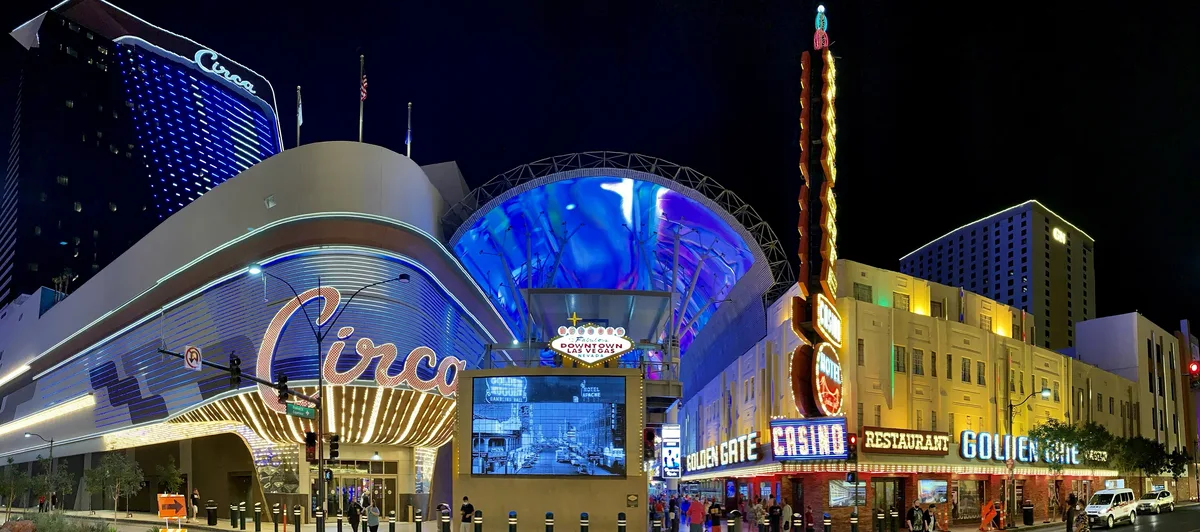
Everything on the street itself is free. Entry costs nothing, the Viva Vision light shows run hourly from 6 p.m., and the three stages host free live concerts — the Fremont Street Experience organisation describes its nightly light shows as free and open to the public. The one famous paid extra is SlotZilla, the zipline under the canopy; it is entirely optional, and its prices change often enough that this guide does not print them.
Use the daytime hours around downtown rather than arriving only for the evening: Fremont East has the bars and murals that make downtown feel like a neighbourhood, and the Mob Museum and the Neon Museum are the two paid museums most visitors pair with the day (check their own sites for prices). Then stay into the evening — light shows on the hour, free concerts, vintage neon, a crowd that skews local. The Deuce runs back down the Strip through the night, and your morning's 24-hour pass is still valid.
SECTION 04Day 3: Hoover Dam and the Valley of Fire in one desert day?
The desert day starts early, and Hoover Dam is the reason. The dam sits in the Black Canyon of the Colorado River on the Nevada–Arizona line, and the Bureau of Reclamation — the agency that runs it — is direct about the ticketing reality: the full Guided Dam Tour costs $40 per person, is sold only on site, in person, first come first served, with your whole group present, and the tours "routinely sell out", so arriving early is recommended. There is no online booking for the Dam Tour.
Two cheaper options run alongside it. The Guided Power Plant Tour ($25 adults, $15 ages 4–16) covers the construction tunnels, the penstock viewing platform and the eight generators of the Nevada Powerhouse, and can be booked online — the Bureau notes the least busy windows are 9 to 11 a.m. and 2:30 to 3:45 p.m. The Self-Guided Visitor Center Tour ($15) covers the narrated exhibits and the 360-degree observation deck. Children 3 and under are free on all three. The visitor center and tours run daily 9 a.m.–5 p.m. except Thanksgiving Day and Christmas Day (doors close 4:15 p.m., last tour 4:10 p.m.); the dam itself is open 5 a.m.–9 p.m. Parking in the Nevada-side garage is $10 per vehicle, and interagency passes are not accepted — the dam is self-funded.
The Valley of Fire is the second half of the day, roughly an hour northeast off Interstate 15: Nevada's oldest state park, a landscape of red Aztec sandstone and petroglyph panels along a scenic drive, open for day use from sunrise to sunset. Nevada State Parks charges $10 per vehicle for Nevada-registered vehicles and $15 for non-resident vehicles, so a rental car pays the $15. As a state park it sits outside the federal pass system.
Sequencing matters. Hoover Dam first, at opening, secures the tour that sells out; the Valley of Fire in the afternoon gives you the scenic drive and short trails — Mouse's Tank and the Fire Wave viewpoint are the usual picks — with light improving toward sunset, when the park closes anyway. Carry far more water than feels reasonable, download maps before you leave the city (signal fades in the park), and in summer treat midday hiking as a genuine hazard: the honest version of this day in July is a scenic drive with very short walks.
SECTION 05What do the paid parts of 3 days in Las Vegas cost?
Transport. RTC Strip & All Access fares, from RTC's own fares page: single ride $4, 2-hour pass $6, 24-hour pass $8, 3-day pass $20; children 5 and under ride free, exact fare required on board. The monorail is $5.75 for a one-ride eTicket or $13.95 for a one-day eTicket pass. From the airport, RTC buses are the budget route in at the $2 residential single fare (routes and the new RED LINE are covered in the FAQ below); taxis and rideshares vary by destination, traffic and surge, so their fares are not printed here.
The desert day. Hoover Dam: $40 per person for the full Dam Tour, $25 per adult for the Power Plant Tour, or $15 for the visitor center exhibits, plus $10 parking — a couple doing the full tour pays $90 all-in. Valley of Fire: $15 per non-Nevada vehicle. A rental car adds rental and fuel; an organised tour bundles the driving and usually the entrance fees — compare what is included, not headline prices.
What is genuinely free. The Bellagio fountains, entry to Fremont Street and its hourly light shows and concerts, walking the Strip and downtown, the Venetian's canal level, and the views from the bridge walkway at Hoover Dam. Days 1 and 2 can be filled almost entirely with free sights.
The two costs this guide will not put a number on. Almost every major hotel adds a nightly resort fee on top of the room rate, and Strip hotels charge for parking; both vary by property and change too often for a printed figure to stay honest. Judge any room on the total — rate plus resort fee plus parking — using the property's own page.
SECTION 06What mistakes do first-time visitors to Las Vegas make?
Underestimating the Strip's scale. Resorts that look adjacent are separated by wide plots, pedestrian bridges and long interior walks. Plan one direction per outing and ride back.
Assuming Hoover Dam's main tour can be booked. It cannot — the $40 Dam Tour is sold only at the dam, first come first served, and it sells out. Arrive near the 9 a.m. opening, or book the Power Plant Tour online instead.
Getting the age rules wrong. Nevada law sets 21 for gambling and for being in gaming areas, enforced at tables, slots and bars. Under-21s are welcome in restaurants, shows and shops — just not lingering on the casino floor.
Ignoring the desert. The Valley of Fire has no shade worth the name, no fuel, and patchy phone signal. Bring water, a full tank, sunscreen and a turnaround time tied to sunset.
Judging a hotel by its headline rate. Resort fees and parking can change the real nightly cost substantially — and downtown properties often undercut the Strip on both.
How do I get from Harry Reid International Airport to the Strip cheaply?
By RTC bus. Route 108 (Paradise) and the Centennial Express serve the airport, and the RED LINE — the bus rapid transit service that replaced Route 109 in August 2026 — stops at Terminal 1. Residential fares apply: $2 for a single ride. From the South Strip Transit Terminal, the Deuce continues up the Strip.
What does the Deuce bus cost, and which pass should I buy?
RTC's Strip & All Access fares are $4 single ride, $6 for 2 hours, $8 for 24 hours and $20 for 3 days, and the passes work on all other RTC routes too. The 3-day pass at $20 covers this whole itinerary.
Are the Bellagio fountains and Fremont Street really free?
Yes. MGM Resorts lists the Fountains of Bellagio as complimentary — every 30 minutes on weekday afternoons, every 15 minutes after 8 p.m. Fremont Street is a public pedestrian mall: entry, the hourly Viva Vision shows from 6 p.m. and the concerts are free. You pay only for food, drink, gaming and extras like the zipline.
Can I visit Hoover Dam and the Valley of Fire without a car?
Not by public transport — no bus serves either place. The practical route is an organised day tour, which typically combines both sights; check whether dam tour admission and the Valley of Fire fee are included before comparing operators.
What is the gambling age in Las Vegas, and can under-21s walk through casinos?
Twenty-one. Nevada law (NRS 463.350) prohibits anyone under 21 from gambling or loitering in gaming areas. Under-21s may pass through on the marked walkways to reach restaurants, shows and rooms, but cannot stop at tables or machines; ID checks are routine.
Official references and checking status
Every price, fare, schedule and rule in this guide was checked against the operator's or agency's own page on 30 October 2026 — RTC for bus fares, the Las Vegas Monorail for its fares, the Bureau of Reclamation for Hoover Dam, Nevada State Parks for the Valley of Fire fee, MGM Resorts for the fountain schedule, the Fremont Street Experience for its free shows, and the Nevada Revised Statutes for the gambling age. Two things are deliberately not priced: hotel resort fees and parking charges, which vary by property and change too often for a printed figure to stay honest — check the total on the property's own page before booking. SlotZilla's prices are likewise left to its ticket office.
- RTC — fares and passes: rtcsnv.com/ways-to-travel/fares-passes
- Las Vegas Monorail — ticket information: lvmonorail.com/ticket-information
- U.S. Bureau of Reclamation — Hoover Dam tours and parking: usbr.gov/lc/hooverdam/service
- Nevada State Parks — Valley of Fire fee ($10/$15 per vehicle): parks.nv.gov
- Bellagio (MGM Resorts) — Fountains of Bellagio: bellagio.mgmresorts.com
- Fremont Street Experience: vegasexperience.com
- Nevada Revised Statutes, Chapter 463 (NRS 463.350): leg.state.nv.us
Photos in this guide: the Las Vegas Strip at dusk from the air by Carol M. Highsmith / Wikimedia Commons (public domain); Fremont Street by APK / Wikimedia Commons (CC BY-SA 4.0). Both resized and converted for this page.
General information only. This guide is based on official sources publicly available and checked on the date shown on this page. Visa rules change, and consular and USCIS officers decide every case on its own facts — nothing here is a confirmation or a guarantee for your individual case, and this is not legal advice. Always confirm the current requirement on the official page linked in this guide before you act, and consider a qualified immigration attorney for your specific situation.