
Researched & checked — 30 Oct 2026
Zion National Park: The Shuttle, Angels Landing Permits and What Entry Really Costs in 2026
NEW Published 30 October 2026
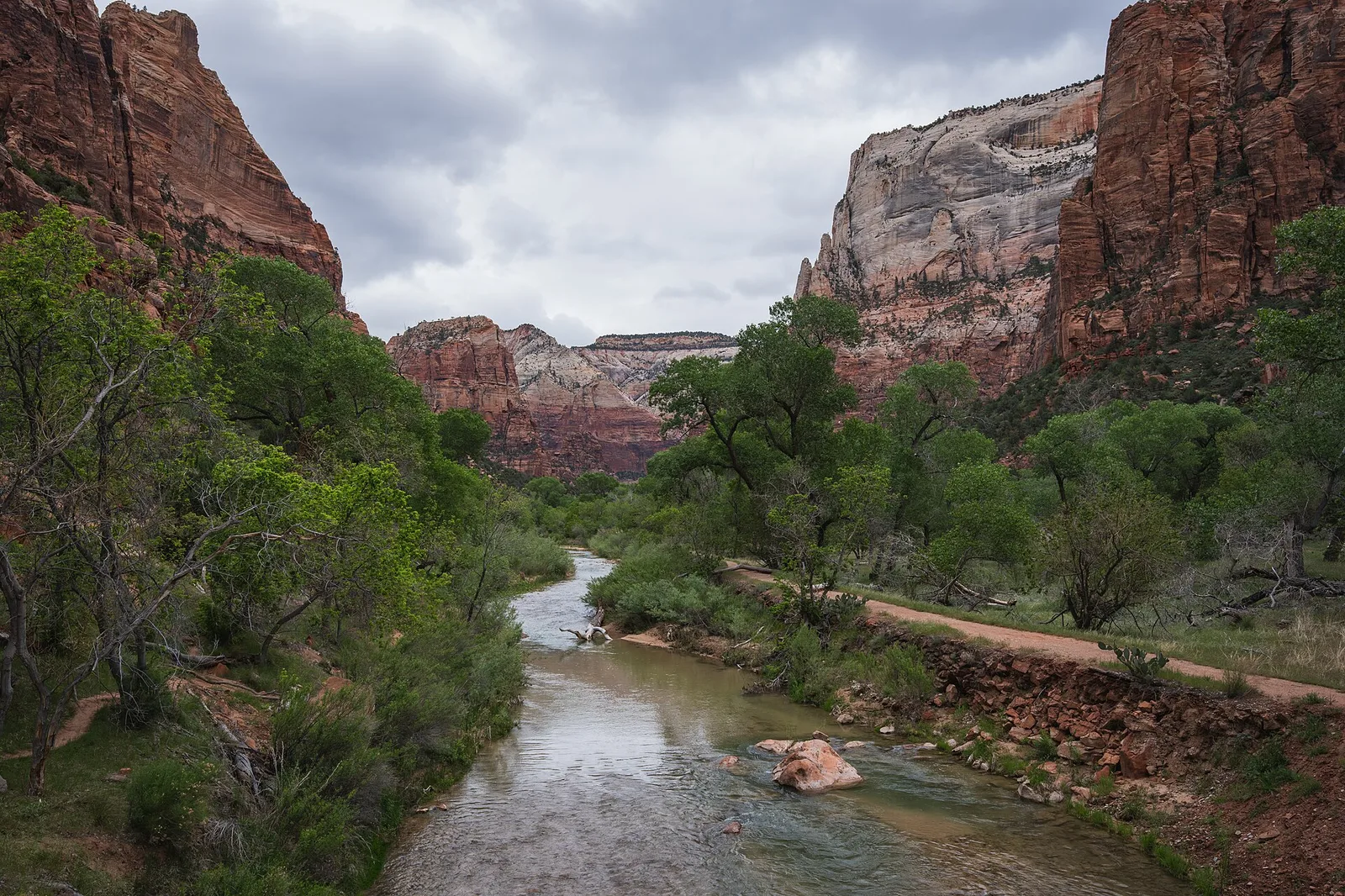
A first-timer's guide to Zion — the free shuttle that replaces your car in the canyon, the Angels Landing lottery explained, The Narrows walked safely, and the 2026 entry maths in real numbers, including the $100 non-resident fee.
Zion costs $35 per private vehicle for up to seven days ($30 motorcycle, $20 per person on foot or bicycle, under-16s free); the park is open 24 hours a day, year-round. Non-US residents aged 16+ pay an extra $100 per person at Zion unless admitted on the annual pass — so two non-resident adults arriving by car pay $235, against $35 for residents. From early March to late November the Zion Canyon Scenic Drive is closed to private cars: ride the free shuttle (every 5–10 minutes in the canyon; a free Springdale town line feeds it). Angels Landing's chained section requires a lottery permit — $6 to apply, $3 per person if you win — while Scout Lookout needs none. The Narrows needs no permit from the bottom, but closes during flash-flood warnings — check the forecast first.
SECTION 01One Canyon, One River, One Road
Approach Zion through its south entrance and the geography explains itself. The gateway town of Springdale runs along the highway to the park boundary, and just inside it the Zion Canyon Visitor Center marks the start of the only road most visitors use: the Zion Canyon Scenic Drive, following the Virgin River into a deepening corridor of red and cream sandstone to its end at the Temple of Sinawava. Everything famous is a stop along that road — the Court of the Patriarchs, Zion Lodge, The Grotto for Angels Landing, Weeping Rock, and the riverside walk that becomes The Narrows. The park is bigger than its canyon — a highway climbs east out of it, and the Kolob Canyons district sits separately in the northwest — but for a first visit the canyon is the park.
Two baseline facts shape any plan. The park itself is open 24 hours a day, 7 days a week, year-round — the rhythms that matter are the shuttle's season and hours, not the park's. And Zion runs no advance reservation for entering the park: entrance passes are bought at the entrance stations on arrival. The advance battles are two: a bed in or near Springdale, and — if your heart is set on it — the Angels Landing permit.
SECTION 02What Does Entry Cost in 2026 — Including the Non-Resident Fee?
Zion's standard entrance pass covers a vehicle and all its occupants and stays valid for up to seven days: $35 for a private, non-commercial vehicle; $30 for a motorcycle; $20 per person entering by foot, bicycle or shuttle from Springdale. Children 15 and under enter free. The Zion Annual Pass costs $70 — available to US citizens and residents, bought in person at the entrance stations. Cards are preferred, but unlike several famous parks Zion still accepts cash. Keep the pass — if you park in Springdale and ride the shuttle in, you will show it to re-enter the park on foot. There is no timed-entry ticket to fight for.
Now the 2026 change: at a list of eleven high-demand national parks — Zion is on that list — each non-US resident aged 16 or older pays the standard entrance fee plus a $100 per-person non-resident fee, unless admitted with an annual pass. The passes split by residency: the America the Beautiful annual pass costs $80 for US residents and $250 for non-residents, and the $250 pass carries a carload — or, where a park charges per person, the passholder plus up to three additional adults. Worked out for Zion the way this guide does for every park affected:
- Two non-resident adults arriving by car: $35 (vehicle) + $100 + $100 = $235. The $250 non-resident annual pass costs just $15 more and then covers every park in the country for a year.
- Two non-resident adults with children 15 or under: still $235 — children owe neither fee.
- Four non-resident adults in one car: $35 + $400 = $435 against the $250 pass.
- Two non-resident adults arriving on foot via the Springdale shuttle: 2 × $20 entry + 2 × $100 = $240; the $250 pass admits the holder plus up to three additional adults at per-person entrances, so it covers both of you.
- US residents: $35 per vehicle, or $70 for the Zion annual pass, or $80 for the America the Beautiful pass on multi-park trips.
The mechanical advice is simple: do the arithmetic at home, not at the booth. Non-resident couples and groups should default to the $250 pass and buy it at the first park on the route — it is valid a full year from purchase.
SECTION 03The Shuttle Is the Road: How the Canyon Moves
For most of the year, your car stops at the canyon's mouth. During shuttle season — daily from early March through late November, plus a late-December holiday window — the Zion Canyon Scenic Drive is closed to private vehicles. The only exceptions are guests with reservations at Zion Lodge or with the park's authorised horseback operator, who get passes to drive to their booking. Outside the season — usually December through February — private vehicles may use the Scenic Drive again. Everyone else, all season: the shuttle.
The system has two halves, and both are free. The Zion Canyon Line runs from the visitor center to the Temple of Sinawava — eight stops — in about 40 minutes, with buses roughly every 5 to 10 minutes. The Springdale Line runs through the town itself — nine stops along its main street, roughly every 10 to 15 minutes — delivering you to the park's pedestrian and bicycle entrance at Zion Canyon Village, where you show your pass and transfer to the canyon line. No ticket, no booking: you queue, you board, you ride. The strategy follows: staying in Springdale, stay on the town line and never move your car. Driving in for the day, the visitor center car parks fill early in season — when they do, park in Springdale (paid parking is available in town) and take the town shuttle in, exactly as the park itself advises.
Three disciplines keep the system pleasant. Start early: mid-morning queues build at the visitor center. Mind the last bus — the park is blunt about this: miss the day's last shuttle from the far end and you face up to a nine-mile walk back down the canyon. Check the return times posted at the stops when you arrive. And know the small rules: pets are not allowed on the shuttles.
SECTION 04Angels Landing: The Permit Is the Gate
Angels Landing is Zion's signature hike and its most managed: 5.4 miles round trip with 1,488 feet of climbing, from The Grotto (shuttle stop 6) up the West Rim Trail — through Refrigerator Canyon and the 21 tight switchbacks of Walter's Wiggles — to Scout Lookout, and then, for those holding a permit, along a half-mile of exposed ridge where bolted chains are the handrail and the canyon drops away on both sides. The trail is even listed on the National Register of Historic Places. Under the park's pilot permit programme, the rule is absolute: a permit is required for the chained section beyond Scout Lookout, every day, at all hours, for every hiker. Scout Lookout itself — a superb viewpoint after most of the climbing — requires no permit at all, which makes it the right consolation, and for many people the right destination, permit or not.
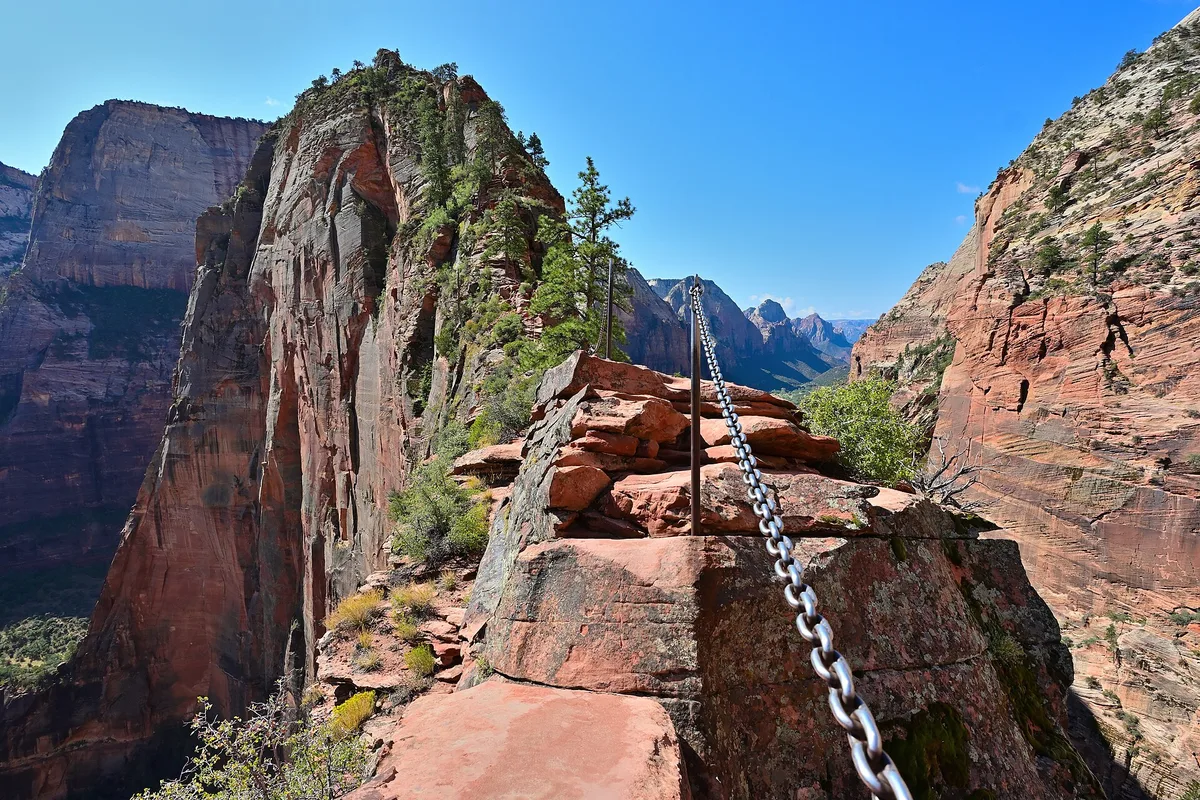
Permits are issued by Recreation.gov through two lotteries, and only two — there are no day-of permits, anywhere, from anyone. The Seasonal Lottery opens in quarterly windows, months ahead of each hiking season: rank up to seven days and timeslots, for a group of up to six people including yourself. The Day-before Lottery runs daily: opens at 12:01 a.m., closes at 3 p.m. Mountain Time, for hikes the following day, with permits issued at 4 p.m. The fees are small but specific: a $6 non-refundable application fee per application (the whole group's application, not per person), and if a permit is issued, $3 per person, charged automatically to the card you applied with. Seasonal permits can be cancelled up to two days before the hike for a refund of that $3-per-person fee — cancelled places roll into the day-before pool — but permits are not transferable: the named applicant hikes, or the permit dies.
On the day, three details from the park: your permit's start time is at The Grotto trailhead, not at the shuttle queue — arrive at the visitor center earlier than feels necessary; the trailhead is shuttle-only for most of the year. Download or print your confirmation before you enter the canyon; there is no reliable signal to fetch it later, and rangers may check permits and ID at The Grotto, at Scout Lookout, or anywhere on the trail. And if the lotteries say no, take the hint gracefully: hike to Scout Lookout anyway, watch the permitted lines move along the fin above you, and give your day to The Narrows or the Emerald Pools.
SECTION 05The Narrows: Walking in the River, Watching the Sky
At the end of the Scenic Drive, the shuttle stops at the Temple of Sinawava; the paved Riverside Walk carries you along the Virgin River — and then the trail becomes the river. This is The Narrows, where in places the canyon squeezes to 20 to 30 feet wide beneath walls up to 2,000 feet tall, and the hike is a wade — over boulders, through current, in water that stays cold whatever the rim above is doing. The bottom-up day hike needs no permit — walk in as far as you like, with Big Spring as the far limit: ten miles round trip, strenuous, a full day for strong walkers. Most people go an hour or two up, find their pool and their light, and come back changed anyway. (The full 16-mile top-down route from Chamberlain's Ranch is a different creature — a permitted wilderness trip, not a day out.)
The safety framing is not decoration here, because a slot canyon has one way out and the river is it. The park's disciplines: wear closed-toe shoes that can grip wet rock, carry a walking stick, and wear layers that are not cotton — the canyon stays noticeably cooler than the rim, and wet cotton makes it colder. Above all, respect the flash-flood rules. Before entering, check the current conditions and the National Weather Service's flash-flood forecast — ask at the visitor center — and know the closures: The Narrows closes whenever a Flash Flood Warning is issued and stays closed for at least two hours after the warning is lifted, and in spring it closes for snowmelt whenever the river runs above 150 cubic feet per second. Learn the warning signs the rangers teach — a sudden rise or muddying of the water, a roar from upstream, debris appearing in the current — and act on them immediately. Let it fix one habit rather than frighten you off a great walk: in Zion, the forecast is part of the trail.
SECTION 06Springdale, Seasons and Sleeping
Where you sleep decides how Zion feels. Springdale is the base the shuttle was designed around: its hotels and rentals line the town line's nine stops, so your commute to the canyon is a free bus and a walk across the footbridge. Inside the park, Zion Lodge sits midway up the canyon under the cliffs; its guests are the one group who drive the Scenic Drive in shuttle season, on passes issued with their reservation. Book any of it as early as your dates allow: at Zion, the bed is the booking that matters, the entrance pass is not.
Season shapes the rest. Summer brings the full shuttle timetable and the full crowds, canyon-floor heat that can pass 100°F, and the year's most consequential weather-watching for The Narrows — go early, hike early. Autumn brings more stable weather, in the park's own assessment — the connoisseurs' season, with the shuttle running into late November. Winter quiets everything: the shuttle rests (apart from the late-December holiday window), private cars return to the Scenic Drive, and the canyon goes cold, bright and nearly empty — with The Narrows a serious, high-water undertaking rather than a stroll. Spring is waterfall season on the canyon walls and closure season in The Narrows, when snowmelt swells the river past its limits for weeks. However you time it, leave one unscripted margin: a last shuttle ride to sit at the Temple of Sinawava as the light leaves the walls costs nothing.
FAQQuick Questions
How much does Zion cost for international visitors in 2026?
Zion is one of the eleven parks applying the non-resident fee: every non-US resident aged 16+ pays $100 on top of the standard pass. Two non-resident adults by car pay $35 + $100 + $100 = $235 for up to seven days; children 15 and under pay neither fee. The non-resident America the Beautiful pass costs $250 — covering the car, or the holder plus three adults at per-person entrances, for a year — and beats the gate price for almost any couple or group.
Do I need to book Zion entry in advance?
No — passes are sold at the entrance stations on arrival ($35 per vehicle; cards preferred, cash accepted), with no timed-entry system. Book ahead only accommodation and an Angels Landing permit, if wanted: the Seasonal Lottery months ahead, or the Day-before Lottery the day before.
Can I drive my own car into Zion Canyon?
Not while the shuttles run — which is daily from early March through late November, plus a late-December holiday window. Then the Scenic Drive is closed to private vehicles (only Zion Lodge and authorised horseback guests with reservations receive drive-in passes) and the free shuttle is the transport. Off-season, usually December–February, private vehicles may drive it again.
What if I don't win an Angels Landing permit?
Hike to Scout Lookout — the same 1,488 feet of climbing and a superb viewpoint, no permit needed; the permit gates only the chained half-mile beyond it. Apply in the Day-before Lottery (12:01 a.m.–3 p.m. MT the day before your hike) for another chance, and give the day to The Narrows or the Emerald Pools. No day-of permits exist, and permits cannot be bought or transferred.
When does The Narrows close, and how do I check?
It closes whenever the National Weather Service issues a Flash Flood Warning, and remains closed at least two hours after it lifts; in spring it also closes when snowmelt pushes the Virgin River above 150 cubic feet per second. Before hiking, check current conditions and the forecast, or ask at the visitor center — and inside the canyon, treat a rising, muddying river or a roar upstream as your signal to move to high ground at once.
Official references and checking status
Checking status: every fee, pass rule, shuttle rule, permit fee and closure threshold here was checked on the park's own National Park Service pages and the Recreation.gov listing on 30 October 2026. The honest limits: shuttle frequencies are published as approximations ("every 5–10 minutes") and seasonal dates are given by the park as windows (early March, late November), not fixed calendar days; the non-resident fee framework is a 2026 policy that could change, so the figures here are the policy as published on the check date; and no Angels Landing success-rate statistics are quoted, because the park publishes none on the pages checked.
- Zion National Park — Fees and passes
- National Park Service — Non-resident fees
- Zion National Park — Zion Canyon shuttle system
- Zion National Park — Operating hours and seasons
- Zion National Park — Angels Landing hiking permits
- Recreation.gov — Angels Landing permit listing
- Zion National Park — The Narrows
Photos in this guide: the Virgin River from the Zion Lodge bridge by Christian David / Wikimedia Commons (CC BY-SA 4.0); hikers on the Angels Landing chains by Andrew Heneen / Wikimedia Commons (CC BY 4.0). Both resized and converted for this page.
General information only. This guide is based on official sources publicly available and checked on the date shown on this page. Visa rules change, and consular and USCIS officers decide every case on its own facts — nothing here is a confirmation or a guarantee for your individual case, and this is not legal advice. Always confirm the current requirement on the official page linked in this guide before you act, and consider a qualified immigration attorney for your specific situation.